[?] Nly Money Makes Money
pp. 55-57 · Read in the full issue


For The Cocoa Planter
By Pat Robertson, in New Guinea.
- Wouldn’t it be nice to slip down to Australia every now and igain in the role of "Planter” from New Guinea? To enjoy the ound-eyed wonder of the females as they listen to the fairylike tales tf life in the tropics, wallowing in luxury and surrounded by servants?
r OULDN’T it be nice to lavish champagne on your friends; to sit into that poker game where sky’s the limit, to be the idol [ the envy of the males in the v Guinea bar? Wouldn’t it be ; to have acres of cocoa produc their lush pods at £4BO a ton? fho wants to be a millionaire? fell if you are prepared to recog ; and contend with “mealie bugs”, g moth”, “panthorytes”, “cater ers”, “capsids”, and “ambly a”; if you are prepared to sweat work in sweltering jungle; to d your house, and to exist for 29iths before you see a cacao pod, t you are on the way to your : million.
Trek into the Forest
r ith axe over shoulder, or with natives with axes, you trek into rain forest. This is the land have leased for your plantation which costs approximately £lOO acre to clear. ou are anxious to get those ns in and see those trees grow- But believe it or not, you won’t i plant a cacao bean for six iths. You plant lines of shade s (Lucaena Glauca) 13 ft apart maintain them for six months )re planting. i the meatime you are still clear building your house, digging any rosewood there is around Jause these roots carry fungi to cacao), feeding and housing r labour line, and managing to >t yourself. This is costing you
about £4O an acre for the first nine months —and no returns.
At the end of the first year— you’ve planted the beans (you should have 222 cacao trees to the acre, or unit, each one of which has cost you 12/6).
Rising two years the trees have cost another 5/- each, and from there on good maintenance is going to cost about £55 an acre a year.
This includes native labour, super vision, housing and insurance.
You are starting to gloat now— -29 months from germination the tree is supposed to bear —you’ve possibly seen the first tiny blossoms covering the wood, and had a cele bration when the first pods were picked. But don’t be too jubilant, you’re a long way from that first million.
The third and fourth years, when the fruit is coming, is very im portant and a strict watch on hygiene is a full-time job. Care lessness with refuse can spread disease and fungus through the whole plantation of young plants and bearing trees. The crop, although not rotated, when fully planted finishes up with perhaps seme areas 12 months behind the oihers.
In areas where there are “wet” and “dry” seasons, shade trees are cut out at the beginning of the wet to allow the foliage to grow again for the dry. And, of course,
These photographs, taken at Mr. N. C. Osborn's Tamiloa Plantation, about 10 miles from Lae, New Guinea, show cacao pods being taken the fermenters, and the wooden fermenters in operation. Banana leaves are placed on top of the fermenters, and bags on top of those.
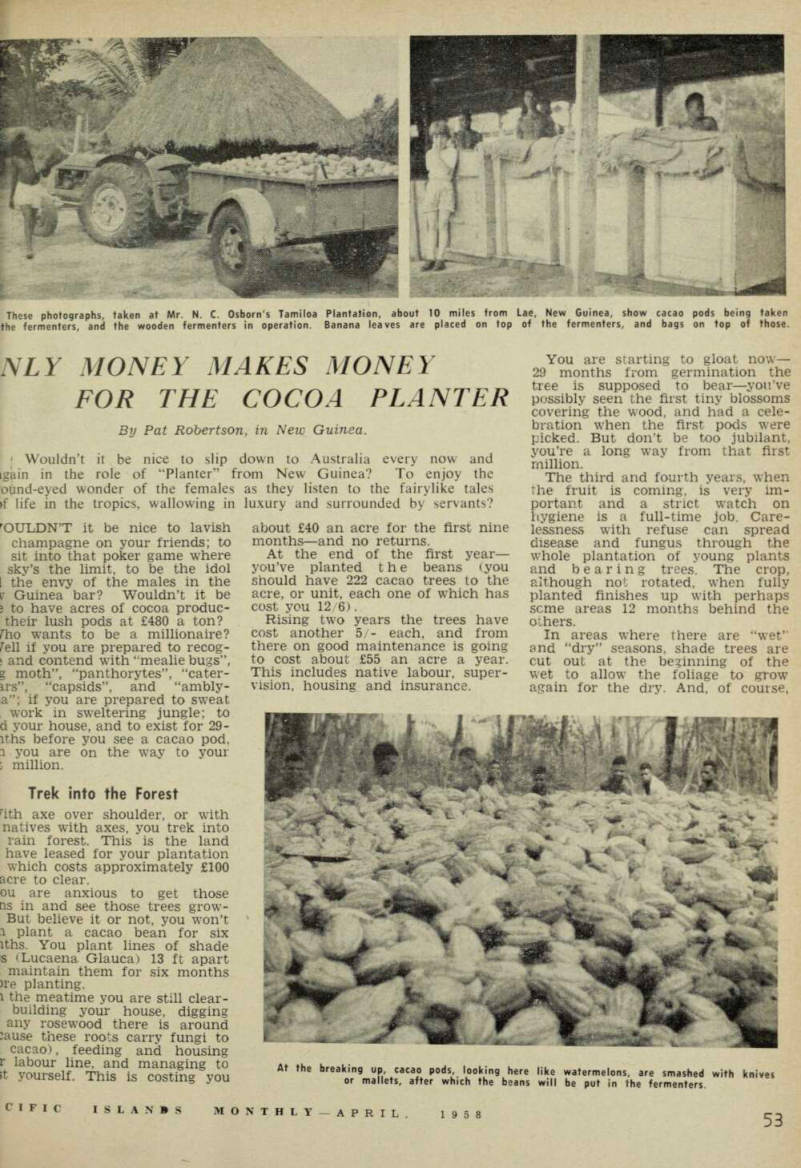
At the breaking up cacao pods, looking here like watermelons, are smashed with knives or mallets, after which the beans will be put in the fermenters.
ie constant watch for pests is laintained.
Never Ending
The process of clearing, planting lade trees and maintaining them ) the stage where the new cacao in be planted continues all the me.
In some countries the cacao is anted out from nurseries, but most ew Guinea growers prefer to put ie beans (two or three in holes 15 apart) into the prepared ground.
The best specimen—chosen for its tape and roots—is later left, and ie others destroyed.
Nature usually endows young ,cao trees with an intuition and means to control their bearing, lis enables them to throw off the rplus pods and keep enough to >urish. But some take no notice, i haywire and overbear. These ieducated ones have to be watched id relieved of their burdens and e breaks sealed off.
The older trees, too, have to be itched for the growth of chupons, suckers, which grow from the se and branches of the tree, lese chupons have to be cut off refully and the scar sealed with wax to prevent fungi entering the eak. you’ve been working hard all this ne; you’ve managed to eat, to ild some sort of a house, and to >d and clothe the children. That tall friend of the cacao grower— small fly called “Forcipymia” has ne his work and pollinated the wers; the pods are growing fat d its time to get the fermenters *dy.
There are big wooden boxes. Even oden dowels are used instead of ils as the metal would cause idisation and blacken the bean, ie boxes are lined with banana ,ves and are known as banana if ferments.
Your First Cheque
Mter picking, the pods are carted the fermenters, where they are )ken up. The beans are put in J fermenters for six to seven days, ned and aerated at 24-hour in vals. Then they are taken out d spread on galvanised iron, lere they are turned and moved ■ three to four days to dry. gging and marketing follows— d you’ve got your first cheque, ifou need it, too, because by this i are nearly broke, or badly bent, d you may have to form a com ny, and others will help you reap s ultimate harvest.
But if you can hang on for another *ee years, working, clearing, plant ; and supervising; if you can sp the place free of pests; if the ttom does not drop out of the irket, and if you are still alive, u can sit back and watch the >ney roll in—although not exactly million.