French Expedition Recovers
p. 30 · Read in the full issue
An Old Chart Gave a Lead
French Expedition Recovers New La Perouse Relies
By a Special Correspondent in the New Hebrides
Relics recovered by a French party from the New Hebrides in mid-March confirm Captain Dumont d’Urville's siting of the wreck of La Perouse's vessel, “Astrolabe” on a reef off Vanikoro about 1788.
Local legend had it that the site was to the north-east, but this is thought now to be the place where the second of La Perouse’s ships
(“Boussole”) may have foundered.
IN March, the French Resident Commissioner of the Hebrides, Monsieur P. Anthonioz, and a party left Vila in the Condominium ship Don Quixote to explore the Vanikoro reefs. In the party were Reece Discombe, a diver of Vila, and M. Charles, an amateur diver of Santo.
In Paris last year while on leave, M. Anthonioz saw the original chart of d’Urville and noted where he had marked, in 1828, the site of the wreck of La Perouse’s ship. M.
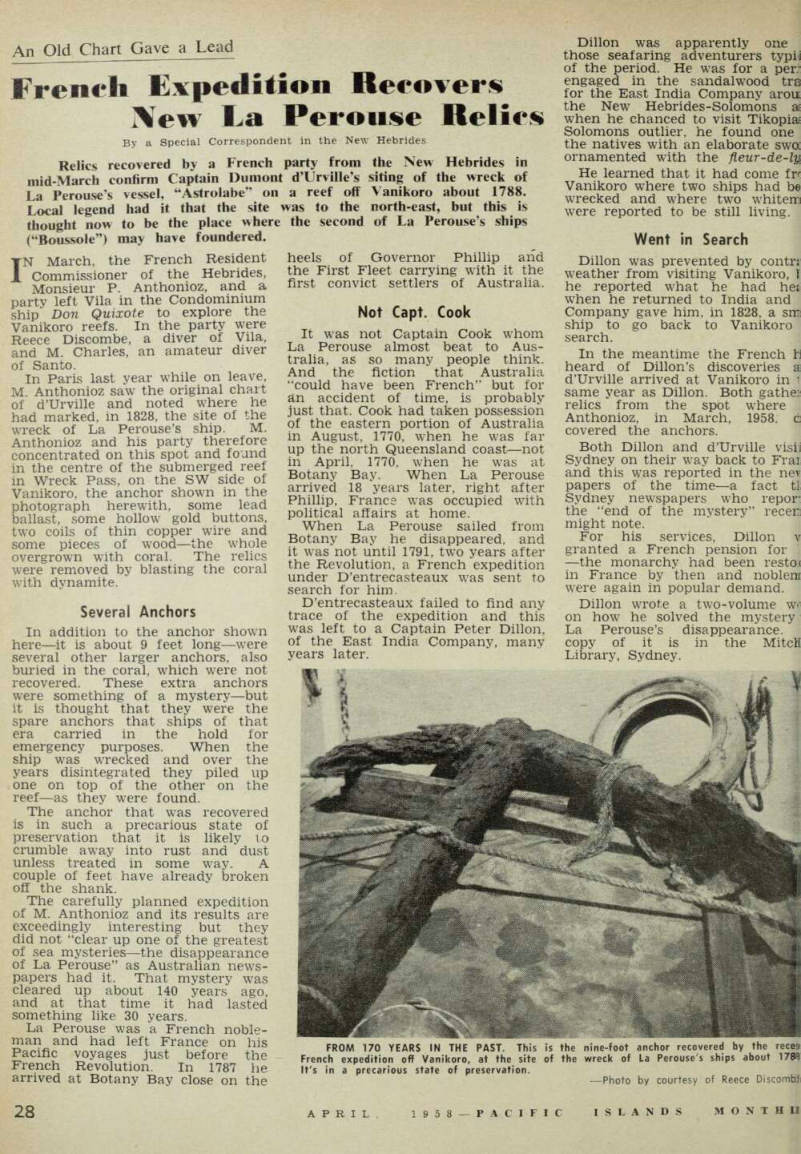
Anthonioz and his party therefore concentrated on this spot and found in the centre of the submerged reef in Wreck Pass, on the SW side of Vanikoro, the anchor shown in the photograph herewith, some lead ballast, some hollow gold buttons, two coils of thin copper wire and some pieces of wood—the whole overgrown with coral. The relics were removed by blasting the coral with dynamite.
Several Anchors
In addition to the anchor shown here—it is about 9 feet long—were several other larger anchors, also buried in the coral, which were not recovered. These extra anchors were something of a mystery—but it is thought that they were the spare anchors that ships of that era carried in the hold for emergency purposes. When the ship was wrecked and over the years disintegrated they piled up one on top of the other on the reef—as they were found.
The anchor that was recovered is in such a precarious state of preservation that it is likely to crumble away into rust and dust unless treated in some way. A couple of feet have already broken off the shank.
The carefully planned expedition of M. Anthonioz and its results are exceedingly interesting but they did not “clear up one of the greatest of sea mysteries—the disappearance of La Perouse” as Australian news papers had it. That mystery was cleared up about 140 years ago, and at that time it had lasted something like 30 years.
La Perouse was a French noble man and had left France on his Pacific voyages just before the French Revolution. In 1787 he arrived at Botany Bay close on the
heels of Governor Phillip and the First Fleet carrying with it the first convict settlers of Australia.
Not Capt. Cook It was not Captain Cook whom La Perouse almost beat to Aus tralia, as so many people think.
And the fiction that Australia “could have been French” but for an accident of time, is probably just that. Cook had taken possession of the eastern portion of Australia in August, 1770, when he was far up the north Queensland coast —not in April, 1770, when he was at Botany Bay. When La Perouse arrived 18 years later, right after Phillip, France was occupied with political affairs at home.
When La Perouse sailed from Botany Bay he disappeared, and it was not until 1791, two years after the Revolution, a French expedition under D’entrecasteaux was sent to search for him.
D’entrecasteaux failed to find any trace of the expedition and this was left to a Captain Peter Dillon, of the East India Company, many years later.
Dillon was apparently one those seafaring adventurers typii of the period. He was for a per;' engaged in the sandalwood trs for the East India Company arou. the New Hebrides-Solomons as when he chanced to visit Tikopiaf Solomons outlier, he found one the natives with an elaborate swoc ornamented with the fleur-de-ty He learned that it had come frr Vanikoro where two ships had be wrecked and where two whitem were reported to be still living.
Went in Search Dillon was prevented by contrr weather from visiting Vanikoro, 1 he reported what he had he* when he returned to India and Company gave him, in 1828, a sm ship to go back to Vanikoro search.
In the meantime the French H heard of Dillon’s discoveries as d’Urville arrived at Vanikoro in i same year as Dillon. Both gather relics from the spot where Anthonioz, in March, 1958. d covered the anchors.
Both Dillon and d’Urville visii Sydney on their way back to Frai and this was reported in the nev papers of the time —a fact tL Sydney newspapers who repor the “end of the mystery” recen might note.
For his services, Dillon v granted a French pension for ; —the monarchy had been restox in France by then and noblera were again in popular demand.
Dillon wrote a two-volume wn on how he solved the mystery ■ La Perouse’s disappearance, copy of it is in the MitcH Library, Sydney.
FROM 170 YEARS IN THE PAST. This is the nine-foot anchor recovered by the rec[?] French expedition off Vanikoro, at the site of the wreck of La Perouse's ships about 178[?] It's in a precarious state of preservation. —Photo by courtesy of Reece Discomb[?]