P-NG Discovers
pp. 23-24 · Read in the full issue
Lesson From Nng
P-NG Discovers New Building Materials From PIM’s NG Correspondent
Papua-New Guinea has lagged
behind most other Pacific terri
tories in employing cement and
coral bricks and blocks but there has been a sudden interest in this
building medium in recent
months.
MAYBE this can be regarded as the first of the benefits of closer co-operation with Neth erlands New Guinea where houses, native and European, are built of coral and cement blocks.
The experiments now being carried out, could if successful revo lutionise the building trade in the Territory where the traditional mat erials are timber, fibrolite and native materials.
Mr. Charles Hyland is starting a cement brick factory in Lae shortly, and recently in Rabaul a local firm Vulcan Concrete Products Ltd., went into production with bricks, cement pipes etc.
The P-NG Department of Works has been experimenting with various solid building materials in a number of places in the Territory for some time. As well as brick-making, it has experimented with pise, adobe and stabilised earth.
Different types of soil and gravel have been tried out, and propor tions of mixtures tested. At Kavieng, experiments with bricks made of cement and coronous (coral), of which there is a plentiful supply, are well ahead, and an immediate
start is being made on a number of buildings there.
At Rabaul a start has been made with experimental blocks, and these, too, are to be used in constructing buildings.
At the Regional Depot of the Works Department at Konedobu, Port Moresby, 10,000 bricks are ready for use in an experimental building which has already been started.
At Lae, experiments in mud and soil combinations have been going on for some time, and an experi mental building is to be started shortly. The next step will be to build native quarters and stores, and later go on to a better class of house for Europeans, after of ficers are satisfied that they have obtained the best possible combina tion for a lasting and economic brick.
NG Highlands Stages Modern
Home Exhibition
From AAP-Reuter Correspondent In an effort to get the natives to provide themselves with better accommodation in their traditional style, a “model homes exhibition”—
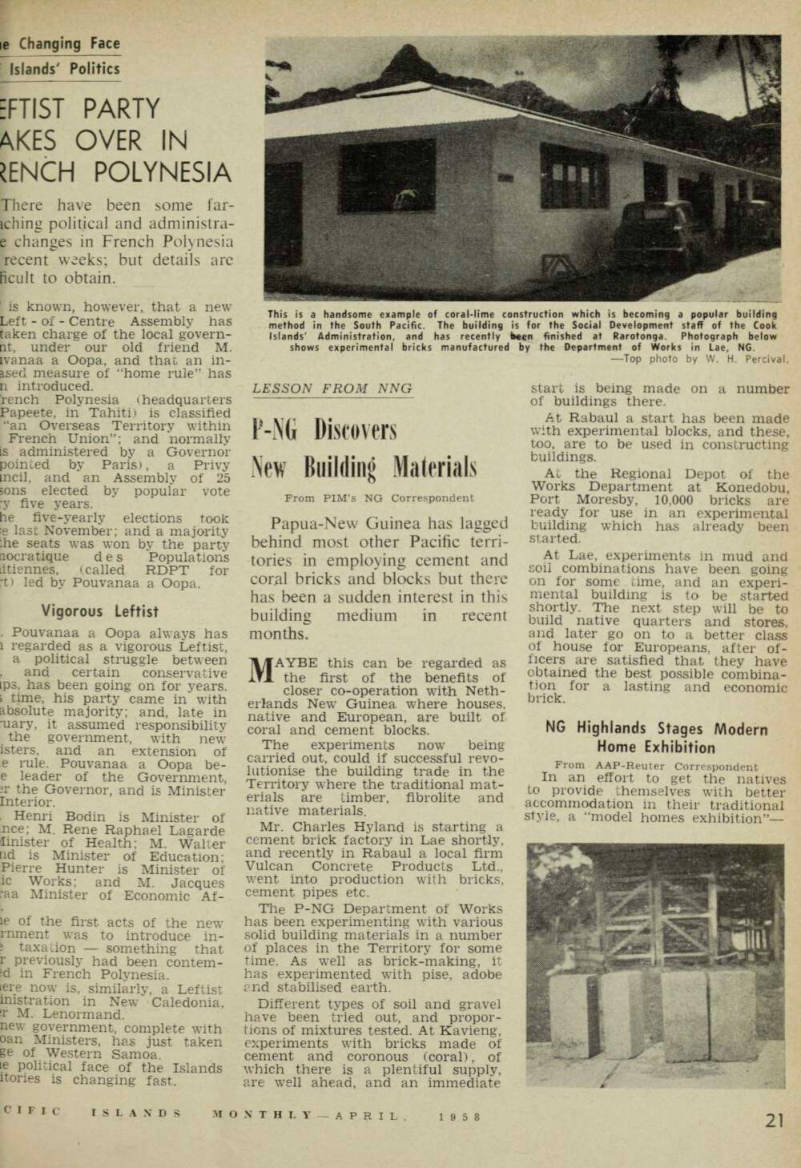
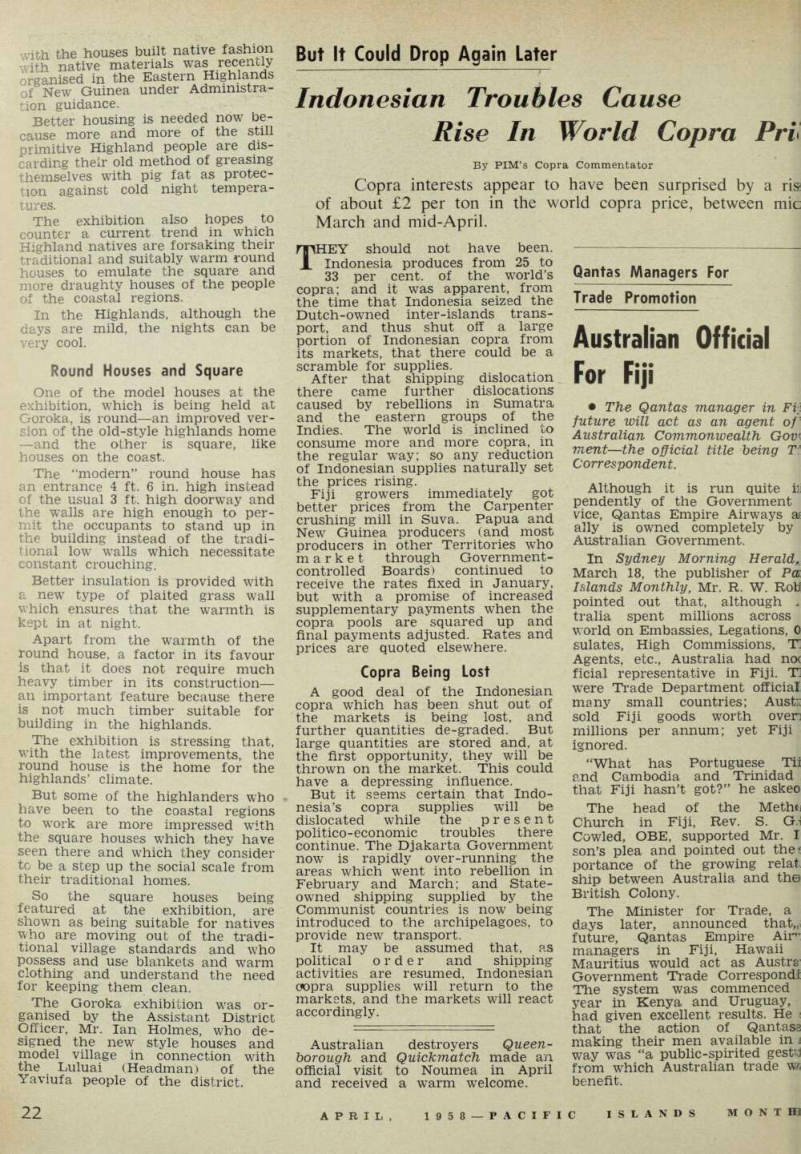
This is a handsome example of coral-lime construction which is becoming a popular building method in the South Pacific. The building is for the Social Development staff of the Cook Islands' Administration, and has recently been finished at Rarotonga. Photograph below shows experimental bricks manufactured by the Department of Works in Lae, NG. —Top photo by W. H. Percival.
rith the houses built native fashion v ith native materials was recently organised in the Eastern Highlands of New Guinea under Administra tion guidance.
Better housing is needed now be cause more and more of the still primitive Highland people are dis carding their old method of greasing themselves with pig fat as protec tion against cold night tempera tures.
The exhibition also hopes to counter a current trend in which Highland natives are forsaking their traditional and suitably warm round houses to emulate the square and more draughty houses of the people of the coastal regions.
In the Highlands, although the days are mild, the nights can be very cool.
Round Houses and Square
One of the model houses at the exhibition, which is being held at Goroka, is round—an improved ver sion of the old-style highlands home —and the other is square, like houses on the coast.
The “modern” round house has an entrance 4 ft. 6 in. high instead of the usual 3 ft. high doorway and the walls are high enough to per mit the occupants to stand up in the building instead of the tradi tional low walls which necessitate constant crouching.
Better insulation is provided with a new type of plaited grass wall which ensures that the warmth is kept in at night.
Apart from the warmth of the round house, a factor in its favour is that it does not require much heavy timber in its construction — an important feature because there is not much timber suitable for building in the highlands.
The exhibition is stressing that, with the latest improvements, the round house is the home for the highlands’ climate.
But some of the highlanders who have been to the coastal regions to work are more impressed with the square houses which they have seen there and which they consider to be a step up the social scale from their traditional homes.
So the square houses being featured at the exhibition, are shown as being suitable for natives who are moving out of the tradi tional village standards and who possess and use blankets and warm clothing and understand the need for keeping them clean.
The Goroka exhibition was or ganised by the Assistant District Officer, Mr. lan Holmes, who de signed the new style houses and model village in connection with the Luluai (Headman) of the Yaviufa people of the district.