Pacific Report
pp. 115-140 · Read in the full issue



Is a Hot Question
New Caledonia
lestions of the repatriation of Indo-Chinese is fast becoming ilitical issue in New Caledonia, he Committee for the Defence New Caledonian Interests”, h had been lying low during elections, has now come into m, declaring that members will ill in their power to get the 5 out of the country. The nittee is making a wide appeal lew members. iking a radio broadcast in r , the vice-president of the As ily Territorial, Mr. Lenormand, North and South Viet Nam been invited to send delegates ew Caledonia to discuss the re ation question. But only South had done anything about it, most New Caledonia Viets from the north.
Lenormand said President l, of South Viet Nam, had made ;ar to him and Senator Ohlen ligon recently that his govern could only give asylum for e willing to remain in his ter 7, and no guarantee could be . for any passage to the north. . Lenormand said there were
to send a New Caledonian ation to Northern Indo China attempt to break the impasse, added that the local govern would not tolerate “any ap to public disorder by rabble rs who were only using the situation as a political eon.” ning back to the attack, the littee denied that it had any cal aims and said it was aston the government was doing ng “to rid the country of the menacing it.” - committee accused the Viets sfusing to pay the recently Foreigners’ Tax, of sending sums of money to Ho Chi s Communist government, of
irately increasing their popu-
lation to insure the complete sub mergence of the white population in 20 years, and of planning the destruction of the native by illicit liquor sales.
Royal Occasion, With
Cheers For Mr. Cleland
The best view by far—on the verandah of Parliament House— of the arriving diplomats, politi-
cians and their beautifully gowned wives at the Royal Ball in Can berra on February 26, was had by the youngsters from the Territories who were brought down to see the Queen Mother.
There were about 40 of them from P-NG, Nauru, Norfolk and the Northern Territory.
Right opposite a battery of TV cameras and Press photographers, they were seen by thousands of Australians w r ho were viewing the
spectacular occasion from the com fort of their living rooms 180 miles away in Sydney.
Overawed a little, they stood quietly watching the hundreds of guests enter the King’s Hall. But when the familiar face of P-NG Administrator Cleland hove into view, many let themselves go and he received a specially loud clap.
The Prime Minister, Mr. Menzies, and Dame Pattie Menzies, walked over and talked to them while awaiting the arrival of the Queen Mother. One Island boy stood rigidly to attention when Australia’s number one stopped to talk to him.
And when the Queen Mother, es corted by the Governor-General, Sir William Slim, arrived she turned and gave the Territory kids a wave and smile all to themselves.
Captain de Bisschop
Rafts Again
Captain Eric de Bisschop, that notable navigator and wanderer of the Eastern Pacific, now aged 65, is in the news again.
This time, aided by three com panions, he is attempting to sail a two-masted raft 6,850 miles, from Constitucion (Chile) to Tahiti.
They departed in February, and said they planned to follow the route of the Kon-Tiki raft (which carried a jolly party of Scandinavi ans) and of the less buoyant raft which carried William Willis, and the much-headlined black cat that ate the Willis parrot.
De Bisschop has been around Hawaii and French Oceania for a long time. It was he who fought with Botanist Degener over the
Some of the children from the Australian Territories, in Canberra to see the Queen Mother in February.
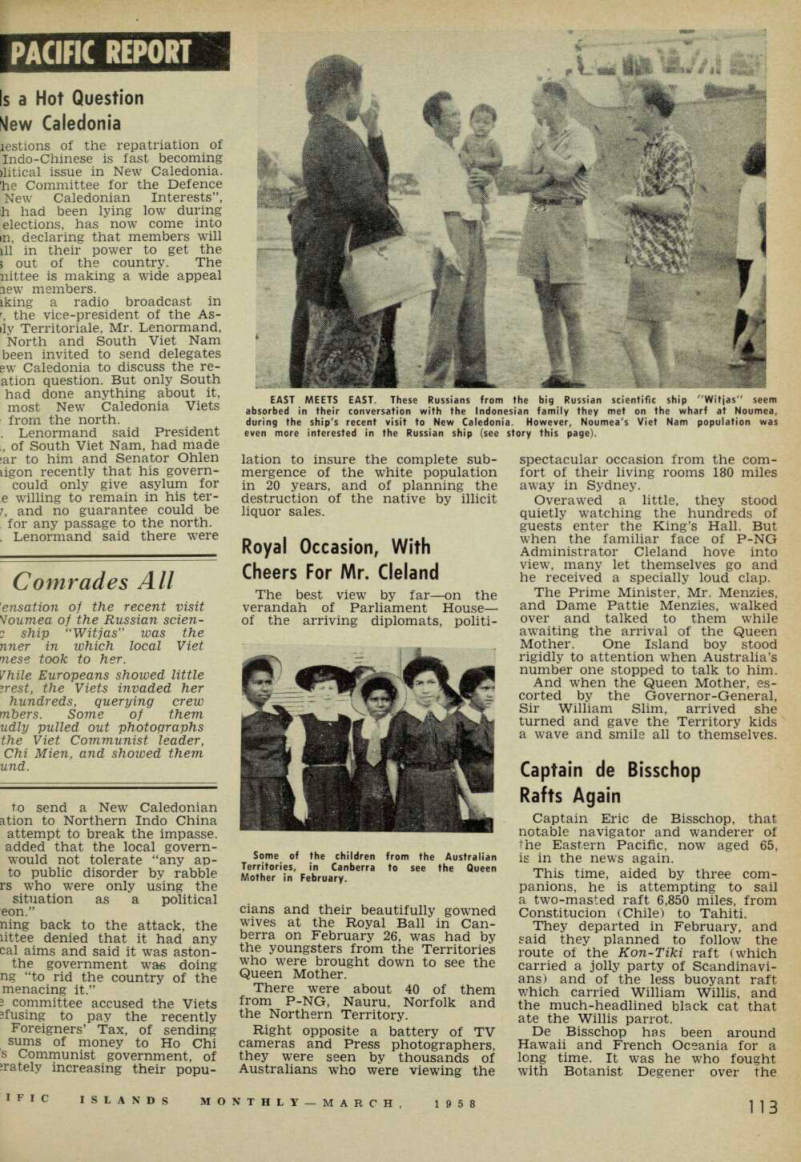
EAST MEETS EAST. These Russians from the big Russian scientific ship "Witjas" seem absorbed in their conversation with the Indonesian family they met on the wharf at Noumea, during the ship's recent visit to New Caledonia. However, Noumea's Viet Nam population was even more interested in the Russian ship (see story this page).
ershlp of the famous junk-tyne it Cheng Ho, and finally left htr ;ing drearily at anchor in ;ete Harbour. 1957, De Bisschop set off to ; on a raft of bamboo logs from iti to Chile, but ended up in •eck on Juan Fernandez Island, far from the Chile coast. He been 200 days at sea.
uel to N. Caledonia
jedy
Ilowing the recent death of a who was hit and killed by a iboat driven by a youth, New ionia has brought in new regu as to control speed boats and planes. e regulations lay down that mum speed near beaches is five 3. To get in to the beach the ; must follow specially marked nels which will be forbidden ithers. No speed boat may be n by any one under the age son terms may be imposed on ders.
' Tongan Palace
s Shelved
ns to build a modern new royal e some miles inland from alofa, to replace the present vo-storied palace at the water have been abandoned, was first announced late in that the New Zealand Works 'tment had designed the new 3 along lines suggested by i Salote. is understood that Queen ; has now decided that any palace should best remain on traditional present site and rebuilding plans have been ;d for the present, was also announced in 1954 vork would soon commence on )vernment-owned hotel, and for this were completed. The is still not completed. The ’s only public boarding house down early last year. There o other hotels at present.
ble Comes in
iS forecast that 200 school jrs were likely to be dismissed •t of West Samoa’s severe pub rvice pruning, proved correct Pruary. cation Minister Tuatagaloa ie Te’o, announcing the dis s - said all other educational ses had been cut down and was nothing else for it but to 5 staff. :e Samoa has only 800 village teachers, the big cut has severely criticised as tending
isorganise the whole of the )an education service, ne critics have said an all -3 salary cut would have been r, because the system wouldn’t been disturbed, cumber of schools will have to malgamated as result of the ic new cuts. e retrenchments, brought out L Samoa’s financial difficulties elsewhere this issue) have also )ther branches of the public ;e, including the police, health igricultural departments. About amoan policemen have been ssed. anwhile, the public service has having troubles of a different e—accusations of dishonesty been made against some of large number of electricity • readers in the Public Works rtment have been accused of ig illegal electricity connec in their homes, designed to tss the meters. sre are also allegations of mis >priation, and forgery of its, against other workers. An official has been charged with following the alleged disap -nce of about £250 of banana t payments meant for growers.
H’s Apia correspondent says system of control and super i by senior Government offi is apparently unsatisfactory.
fal Fatigue' Grounds
Planes
i’s internal communications thrown into confusion on Feb
ruary 11 when Fiji Airways grounded their Drover aircraft.
Marks found on one of the three aircraft indicated serious metal fatigue so the company played safe and grounded the entire fleet.
An expert was flown from Sydney to make a detailed examination of all aircraft. Fiji Airways tried to charter suitable replacements, but without success.
Much equipment and many re placements were flown in from Aus tralia and New Zealand.
February 20 saw one aircraft back in action, operating from Nausori to Labasa, Savusavu and Taveuni; and all were serviceable by February 26, and the service was soon resumed.
Agitation in Labasa before the limited service was resumed gave the impression that there was a backlog of passenger and cargo traffic. But the first four flights carried only 23 passengers, and there were seats for 32.
The complaints of those who were suddenly deprived of their air ser vice can be understood. For several years they had enjoyed an air ser vice which brought them within two hours of the captal at Suva.
Mails arrived promptly and so did urgent cargo.
They became “air-minded”; and they showed it when they had to go back to coastal shipping, with irreg ular schedules and high fares for one-way passages.
The development came at an awk ward time for Fiji Airways, which was being carried on under tempor ary conditions pending probate be ing granted in the estate of the late
Mr. Harold Gatty. As stated else where, the service will soon be taken over, on formal purchase, by Qantas, the big Australian, Gov ernment-owned corporation.
PIR Riots: More Service
For Officers
“I wish to die!” a member of the Pacific Islands Regiment called out in the P-NG Supreme Court in Port Moresby in February, after being convicted of having taken part in last December’s FIR riots.
But he didn’t get his wish. He and three fellow native soldiers were each sentenced to 18 months’ hard labour by Mr. Justice Gore.
This was no surprise. The sur prise came when 54 other soldiers who had been charged with the four were found not guilty and dis charged.
The reason was, as Mr. Justice Gore pointed out, that there was no evidence to say that this par ticular 54 had been among those who had taken part in the riot, “although there was a riot beyond any doubt at all”.
And it was, said the judge, “an outrageous, alarming event —outrageous because the riot was in a court of law, aimed at stopping the proceedings: alarming because the rioters were soldiers on whom the
ABAUL INTEREST IN SYDNEY WEDDING: Mr. and Mrs. Henry Chow, of Rabaul, are seen with attendants Peter Chow, John Seeto, Rosie Jung and Lucy Chow outside St. Brigid's Catholic Church, Coogee, on February 1. Henry Chow, educated in Australia, is the son briel Chow Sing Yip, whose father, alive and well at 77, arrived in New Guinea 67 ago. Henry's wife is the daughter of Thomas Ah Ying. The couple will return to Rabaul, Mr. Chow will open a boat-building yard.
While she was in Lautoka on February 1, the Queen Mother received one of Fiji's oldest residents, Mrs. Peggy Eaves, who is 85. Mrs.
Eaves arrived in Suva in 1912, and this was the first time she had left the capital city.
She is a Scotswoman, and she was born in Ayrshire, not far from the Queen Mother's childhood home. They chatted informally for some time about Ayrshire, and at one stage Mrs. Eaves asked, "Would you please speak up a bit, your Majesty, as I am rather deaf".
Her Majesty smilingly did.
Photo: Rob Wright.
:e have a right to depend in shing lawlessness. ’here was arrogance displayed :h showed that these unbridled ps had abrogated to themselves isition above the civil authority, were going to assert this dis rd for the authority of the law its administration. ’his has never happened before should not be allowed to Den again,” he added, r. Justice Gore said a PIR ain and a lieutenant could not gnise any of the troops who part in the disturbance. And ;ould not be satisfied with the r identifications, le four men found guilty will iishonourably discharged from
Pir.
1 58 men before the court had ded not guilty. iring the hearing, witnesses ribed how PIR soldiers had ded a court being held at their acks on December 16, screamed, d, beat the walls with their , overturned furniture, men some of those present and e up the proceedings. ;anwhile, retiring Chief of the ralian General Staff, Lt.-Gen- Sir Henry Wells, said in Bris in February that Australian ;rs of the PIR would be given i tours of duty with the unit, spersed with periods of service Australia, “to keep them in i”. gave few other details.
Port Moresby, CO of the PIR, Jolonel L. McGuinn, welcomed announcement and said he d the day “would not be far nt” when the PIR would be i a parent unit for junior :rs. ter a term in the Territory would be able to return south, ‘ back to the regiment with aps the rank of captain, until tually one of them commanded mit, he hoped. is scheme is one that has been
widely advocated by the PlR’s critics since the riots.
He's the Motor-bike King
of Kainantu
It was red-letter day for native miners in the Kainantu area, NG Eastern Highlands, on February 13, when something like £4,000 was paid out.
It was an even redder-letter day for trade stores in the area.
The money represented refund of gold royalty (when this was reduced last year natives became exempt retrospectively) plus the native share of the Commonwealth gold bonus.
This Government largess does its bit towards enriching the whole community. Just after the war, when Australia opened its heart and paid war damage compensation to natives, the Mt. Hagen indigenes got £1,400.
They were paid in £1 notes, which they had never before seen. The matter was easily adjusted, however.
Local trade stores marked everything at £1 and everyone was happy.
The Kainantu native miners are not likely to be so naive. Wealthiest native in the area is Kabaki, who is reputed to have made £2,000 from goldmining last year. He is now the proud owner of a motor-bike.
Fifteen Dead in
Catalina Crash
Fifteen people lost their lives when an MAI (formerly RAI) Catalina flying boat crashed into the Raiatea lagoon, Tahiti, late February—in what was French Polynesia’s first serious air crash.
The dead included the Adminis trator of Raiatea, M. Lecas, the head of the Public Works Depart ment of French Polynesia, M. Pas sand, and three of the Catalina’s crew—Captain R. C. Allais, chief pilot for TAI in the Pacific area, his
WELL-KNOWN FIJI FAMILY. Mr. and Mrs. Felix Emberson, of Suva, photographed in Sydney itly with Felicia, who is on the nursing staff of St. Vincent's Hospital, Dr. Felix Emberson, tly graduated from Sydney University, and his brother Oscar, who is also studying medicine. —Tele-Photos.
lilot, Captain R. Seitre and the f engineer, Maurice Diard. iptain Allais was also acting as f pilot for MAI in the absence laptain A. Frame, a New Zea ler who was on leave in New and. He had joined MAI only !w months ago. iptain Allais and Captain •e, with Captain Frame, had ght MAl’s only other aircraft, a ilina, south to Auckland for in January and had returned apeete by TEAL, is understood that passengers he tragic flight were all local lents. wing of the aircraft apparently the water as it was landing,
a flight from Papeete, and the Lina quickly sank in deep r.
H’s NZ correspondent reported larch 3 that it was probable MAI operations would cease the return of the other Cata and work on that is not ex d to be finished before late Collet, representative of TAl at Auckland was unable to lent on what effect the crash t have on the planned TAI- Noumea - Horabora - Papeete ;e, which calls for MAI main ig the water link between Dora and Papeete with Cata- He indicated, however, that with the New Zealand Gov ent on certain phases of this :e, which would compete to extent with TEAL, were still nuing, and that the loss of the ina would therefore not be a oiling factor at present.
Deports a
ician
„ Arthur de la Perelle, aged 62, ined £lO in Suva in February laving remained in Fiji after srmit to enter had expired and s ordered that he be deported ntain at the end of three h s. appears that after World War
II Mr. de la Perelle, then residing in Queensland, divorced his wife, and went wandering in a yacht in the South Pacific Islands. He lived in New Hebrides, Tahiti (for two years), Tonga (for nine months), Samoa and Cook Islands. He returned from New Zealand to Samoa and married a Samoan girl and remalned there for three years.
He divorced his Samoan wife, and his permit to live there was not renewed, and he went to Fiji at the end of 1954, entered on a visitor’s permit, and then was given a permit to remain three years on his representation that he was a magician and proposed to tour Fiji, giving performances. Some time in 1956 he acquired a launch and had lived on board practically ever
since. He then apparently wished to remain indefinitely in the Colony but the Immigration authorities re fused the necessary permit.
Another Plague of
Politicians Looming
There are all the signs that the Cook Islanders, their pig and poultry runs and their gardens already struggling to meet the all too frequent needs of the traditional inter-island tere party, are to be inflicted with yet another plague of parliamentary visitors from New Zealand some time this winter.
The opening moves in the raid were made by Mr. G. A. Walsh, Opposition MP for Tauranga—who
resented the then government at 1956 annual Legislative Council eting at Rarotonga—when he put ward the suggestion in parlia nt in January that “a five-man liamentary deputation make the t in recognition of the new Cook mds Constitution and as an ression of interest”. hough there are unlikely to be ■ seconders in the Cook Islands, proposal will doubtless have ity of support in the house on part of likely candidates. fficially, visiting journalists are d somewhat less than visiting ticians by the Cook Islands ainistration, but it is to be ed, for the sake of the Cook nders, that if this completely ecessary holiday trip is made, ill be financed in the same way ; journalistic visits are financed, without causing havoc to the stock and gardens. jwever, as the Auckland Star kly pointed out in an editorial ing thumbs down on the visit, culd be a far greater “expression nterest” if, instead of making visit, five politicians made a ful study of the Belshaw-Stace art on the Cooks which was
;d in October, 1955, and has r yet been properly debated. e Auckland Star's concluding graph is pertinent: “Until some iamentarians have read what is y available to them in Welling -and above all the Report—no ■man deputations’ should go to itonga, to be feasted and feted the misguided and endlessly itable islanders—who do not se what a false impression of ’ true situation is conveyed to visitors by trestle tables laden the pork and fish and chicken can hardly spare”.
No Rest for the
Vanquished
Human bones gathered in the vicinity of a wrecked aircraft 25 miles out of Lae, NG, in February, are something of an embarrassment to the Administration.
The aircraft was a wartime Jap anese bomber and the bones are presumably Japanese. The machine had plowed into the ground, scat tering wreckage over a wide area.
However, there has been no Jap anese cemetery in Lae since a Jap war graves’ ship removed the re mains of Japanese war dead in 1955.
Drop in Income
For Milne Bay
The Samarai area of Papua looks like having a depressing year financially, says a NG correspondent.
The copra prices dropping was bad enough but the dry years have taken their toll of copra production.
Many plantations dropped over one third in production last year.
The Copra Marketing Board in Samarai received into its shed 24,000 bags less than 1956, which year pro duced less than 1955. With rains now becoming general the future looks brighter, but it will not improve very much until towards the end of the year. The copra shortage means that approximately £lOO,OOO less was received by the district last year.
A lot of this would have been paid to native growers, some of whose production practically ceased, but it was not only caused by dry weather. The high rejection rate
earlier in the piece had the result of causing many to give up mak ing copra at all (most natives take the line of least resistance) and the activities of the Agricultural Depart ment in pushing the coffee and rice programme had an adverse effect on copra.
One area in Milne Bay allowed all its small drum-type copra driers to fall into disrepair while they con centrated on coffee and rice.
Whether the programme will pay off is problematical.
The rice growing can be left to several small areas where the country lends itself to such crops but the coffee is growing well. It will be years before any quantity is marketed. It appears to be a pity the natives did not take advantage last year of the MOF contract (the correspondent adds).
A bit more of a commercial out look by the Agricultural Depart ment in this area would have been advantageous. The native co operatives are feeling the strain badly.
16-inch Telescope
For Rarotonga
A 16-inch reflector telescope will soon be probing the heavens from Rarotonga, Cook Islands.
The instrument is being made available to Mr. F. M. Bateson, probably the only amateur astronomer doing serious work from a South Pacific tropical location, by a United States astronomical observatory.
Mr. Bateson, who is manager of a Cook Islands business firm, has had the use of a 9-inch American telescope for a number of years.
The new telescope is one of the
John Mathison, New Zealand's new er of Island Territories. He is aged 56.
FOUR GENERATIONS OF KAI VITI. "RlM" in February reported that with the birth of a great-grandchild of Sir Hugh Ragg in Suva on January 25, there were now four generations of Raggs born in Fiji—for Sir Hugh himself was born there in 1882. Here they are: Sir Hugh; his son, Mr. David Petrie Ragg, of Sydney; Mr. Ragg's son, David Hugh, who is holding his own new-born son, Hugh Nicholas Petrie Ragg.
of his recent visit to the 1 States to lecture on his of recent years, and to brief sted astronomers on certain s of their plans to observe Jclipse of the sun from >uka and/or Nassau in the ern Cooks in October.
Liquor Policy
r Review
BSIP might revise its liquor
policy for natives. A committee ap pointed by the High Commissioner to examine and report on the situa tion, has already had two meetings, and received the views of members of the public.
Chairman of the committee is Mr. C. H. Allan, and members are Archdeacon Reynolds, Fr. J. M.
Wall, Mr. A. C. Blair, Headman Vouza, Mr. A. Daga, and Mr. W.
Bennett. Secretary is Mr. A. J.
Hunter.
Under present BSIP laws, Solo mon Islanders aren’t allowed to drink spirits, but there is a re stricted permit system enabling some to drink beer.
Night Classes
In Tonga
Night classes in higher education have been commenced at Nukualofa by the Tonga Overseas Students Association. This organisation is an p&sociation of Tongan and European students and ex-students with the benefit of advanced overseas educa tion. Their plan is to provide an educational opportunity for students unable to go overseas for more ad vanced education than is at present available in Tonga.
For a start, lectures are being given in English, book-keeping, commercial practice, teaching
New Hebrides Wedding
daughter of an old New Hebrides family Ginette Ratard, daughter of Mr. Jack of Santo—was married in Sydney on [?] y 8 to Mr. Frederick Clark, a Sydney [?] r. Friends of the bride—including mem the well-known Harris family, on Santo [?] d to the ceremony; and there were [?] 00 guests at the reception at the Hotel [?] a, later in the day. bride's grandfather settled in the Con [?]m some 50 years ago. The bride was ing sister at the Concord Repatriation
bridesmaids were Miss Margaret Pavey, [?] es, and young Cynthia Ratard, 11, a of the bride and now a student at the Pymble, Sydney. Mrs. C. M. Ratard, ide's stepmother, directed the happy [?] ings. Photographs show the bride and [?] om (above) and the bride with her Mr. J. Ratard.
methods, and electricity. Only a small number of students will be handled at first, but it is hoped that the scheme will develop gradually.
A small fee will be charged.
New Plans for Avele
Agricultural College
The proposed scheme to convert the Avele Agricultural College, W.
Samoa, into an institution to be used for other South Pacific Terri tories cannot be put into effect.
American Samoa and Tonga have declined to join in the venture.
It is now intended to operate the college as a Samoan-New Zealand partnership and make the training available to boys from New Zealand island territories —the Cooks, Niue and the Tokelau Islands. The college is to be opened in February.
They've Heard It In
Papua, Too
Papua-New Guinea’s ham radio enthusiasts, who are always chasing something new, managed to receive a signal from the United States’ new satellite in February, shortly after it had been put into space.
Frank Nolan, president of the P-NG Division of the Wireless In stitute of Australia, heard a weak signal for about a minute. It was surging badly.
P-NG to Get 12 Vacuum Co.
Scholarships
Suzanne Wood and Malcolm Stevenson, both of Port Moresby, have been awarded Vacuum Oil scholarships to study at Australian secondary schools.
This means that in 1958, four children will be studying at main land schools under Vacuum scholar ships for Papua-New Guinea, estab lished last year. The scholarships are tenable for six years and two more winners will be added annually, until each year 12 students will be studying in Australia under Vacuum Scholarships.
Suzanne, 12, is the eldest child of Mrs. Truda Wood, of Port Moresby, and the late Charles Wood, of the Department of Agri culture. Malcolm, also 12, is the eldest son of Mr. and Mrs. H. R.
Stevenson, of Port Moresby.
A First For
The Cook Islands
History was made for the Catholic Church in the Cook Islands when the first Cook Island girl took her final vows as a member of the congregation of the Sisters of St. Joseph of Cluny, at Tutakimoa church on January 26.
The special ceremony was con
duced by Hs Lordship Bishop Übald Lehman. Sister Juliana had earlier completed her studies in New Zealand.
The Sisters of St. Joseph of Cluny, a teaching Order, have communities throughout the Islands.
Fiji Cuts its
Unfavourable Balance
Fiji did quite a lot in 1957 to straighten out its unfavourable trade balance, which had been causing some uneasiness.
At the end of 1956, the Colony had an unfavourable balance of £F5,000,000; at the end of last year it was only £F200,000. During the period, exports increased by £3,700,000 —and sugar, coconut oil, gold, and bananas, in that order, helped.
Imports decreased by £F1,200,000.
The improvement in the situation was caused by a good season for export crops, plus a credit squeeze that limited bank accommodation.
Some Notes From
Norfolk Is.
Norfolk Island is regretfully to lose shortly the services of the Rev.
Silas Horton, who will be returning to Sydney with his baby daughter, following the tragic loss of his wife last year.
Mr. Horton has done remarkable work among the young people of the island, and has been instrumental in building up attendances at All Saints’ Church and St. Barnabas Chapel to a degree not thought pos sible. (Over)
[?] S WEDDINGS. Top: Mr. and Mrs. [?] ee, are showered with confetti while he Holy Trinity Cathedral, Suva, after rriage. (Photo C. L. Cheng). Centre: [?] oole and the former Miss A. Schultz, urama Chapel, Port Moresby. Below: damson and his bride, formerly Miss after their marriage at Port Moresby [?] F England. (Papuan Prints).
The former Miss Winnie Mon, taken after her marriage to Mr. T. E. Roga, at the Roman Catholic Church, Port Moresby, on January 15.
There were several attendants.
Photo: Papuan Prints.
■spite stories of a falling school ilation on Norfolk, latest cn ee ts bring the total to more i 150 children —one of the high ;otals ever. irfolk got a visit from a Lan ;r from New Caledonia in Feb y. The French crew did a con able amount of shopping, des the language difficulties. The aft was checking on landing ities. t long afterwards, the strip visited by half a dozen RAF RAAF aircraft. ere was a spate of farewell es for the departing Adminis r, Brigadier Norman, before he in February, including one the Advisory Council on be of the Island’s residents. Its ight was a wonderful “Thank speech from Mrs. Norman for she described as the “friend > shown me in the five years”, is understood that the Minister territories has again asked the cil when the ordinance grant 1, measure of local government De implemented, seems that without revenue to tain essential services, the cil is not in a hurry to intro it and will no doubt stall to f the new Administrator can the problem.
ew Council And
ew Budget
is to be hoped that the coun cil be instrumental in the ition of a New Hebridean 3n,” said the French and h Resident Commissioners in nt address, opening the first n of the New Hebrides Ad r Council on January 29. vas a good start. ; Commissioners announced they intended to consult the council each year on the 3t, and “from time to time on tant issues of policy”, ly said the number of New dean members would be in id to eight as soon as possible, iew of the need to associate js with the activities of the nment”. aking of the need to free the my of the New Hebrides from dence on a single crop i), the Commissioners referred /elopments in mining and the y at Santo, but said that agri e nevertheless remained pre lant in the economy. The Ag iral Department would there )e strengthened.
Budget, discussed at the ng, calls for the establish ed a new experimental station piritu Santo, and recruitment •ee new extension officers with )b of improving the quality of ce and developing new cash er Budget points: or new works project is the
installation of a water supply for Santo town, first phase to begin this year at a cost of £5tg.16,060.
Vila and Santo manual tele phones will be replaced with an automatic exchange.
A better town sanitation service wili be instituted.
A Museum and Cultural Centre will be built at Vila to commemorate the 50th anniversary of the Joint Administration, and the Tagabe airfield on Efate will be put into repair.
No new general taxation is pro posed for 1958, but an urban pro perty tax for people in Vila and Santo is being considered.
Qantas and
Fiji Airways
The gross estate of Mr. Harold Gatty, of Fiji, who died last August, was officially valued at £40,500, and probate was granted at the end of February. He left the whole of his estate to his widow. He and Mrs. Gatty were the owners of Katafanga Estates Ltd. and the latter owned, among other things Fiji Airways.
It is expected that, since pro bate now has been granted, no time will be lost in completing tne sale of Fiji Airways to the Australian International company, Qantas.
Owing to the late Mr. Gatty’s long association with Pan Ameri can Airways, the inclination of his executors is beleived to have been in favour of a sale to PAA.
British officialdom, however, let it be known that such a development would be badly received by Brit ish-Australian interests.
As has been frequently pointed oui by PIM, almost 100 per cent, of the corporations carrying on the trade, commerce and indus tries of Fiji now are Australian owned.
Enquiries made by PIM in Syd ney indicate that, as soon as a sale becomes effective, Qantas will take over the management and operation of Fiji Airways within 30 days.
It is expected that Qantas will register Fiji Airways in Fiji as a company, and that the conrolling interest —if not the whole of the shares —will be held by Qantas.
Planning for a
Big Trek
Investigations into the possi bility of moving New Guinea natives en masse from overcrowded areas into less settled ones are going ahead in the Territory.
Minister for Territories, Mr.
Hasluck, first announced at a political science conference in Canberra in January that the plan was afoot.
Acting director of Native Af
i, Mr. J. K. McCarthy, said in Moresby in late February in at least two places, the ibu valley and the Gazelle nsula, there were land prob , and the people would suffer use of it within a few years, said the department was [ng a survey of the Chimbu y position, and had already d. using one clan as an av ; unit, that there was a short of land there caused by the sasing population, traditional usage and the people’s de fer cash crops, remedy would be to change [and usage (whereby land was mused for 10 to 20 years) but could be done only after years xperience of proper crop ro i, and Mr. McCarthy said he Dted very much if we have for that”. e of the resettlement sites : looked at by the Adminis m is the Wahgi valley, but l of it is swamp land which i have to be drained, d another problem, which the nistration is aware of, is that Chimbus, among others, are to be reluctant to move, t “unbearable” population ure might eventually change viewpoint, according to the nistration.
of Fiji's Freakish
ight
3 monsoonal rains arrived in ate in February, instead of in nber-December, after the gest weather Fiji had ex iced in many long years. 3 south-east trade-wind blew steadily through December January, and by early Febru he usually lush Fiji was cry drought”. It appeared that the production of cane would be ly affected, and water short were reported from all direc -3 city of Suva was in dire
straits —there was just not enough water coming into the catchment area to take care of normal needs.
Various rationing plans were operated.
Old residents said it was between 30 and 40 years since the south-east persisted in this fashion. Meteoro logical reaction was shown in freakish weather, from New Zea land to the Solomons.
Then the rains came, in a series of heavy deluges—and, as usual, road communications were dis rupted.
But the change in the appear ance of the country was magical.
All green growth seems to be making up for lost time.
By March 1, the sugar industry people were drastically revising their cane estimates. There will be a reduction in the 1958 sugar crop —but it will not be nearly as serious as at first reported.
Suva got water —but mostly in the form of yellow mud. New roads and dams are in course of construction to improve catchment in the water supply area; and the deluge washed the clay into the supply system.
The city still was suffering great inconvenience in early March —and every kind of known home-made filtering system was being tried out.
Broadcasting Station
For Tonga
The Tonga Government has de cided to proceed with the establish ment of a broadcasting station, ac cording to a February Nukualofa announcement.
The decision follows a visit last year by Mr. W. L. Harrison, chief engineer of the New Zealand Broad casting Service.
The station will operate in the broadcast band—not on short wave.
This will offer some advantages from the listener point of view, as not all receiving sets have a short wave band, and some short-wave sets do not cover all the frequencies used by tropical broadcasting
stations. The precise frequency of the transmitter is not yet settled.
The station will have a power of not less than two kilowatts and the transmitter site will be at Popua, Tongatabu. The studio will be on the present site of the Copra Board headquarters near Nukualofa, The Copra Board is to shift its> stores to Havelu.
It is understood that the station will be in operation some time in 1959.
The government announcement says that a broadcasting service will permit early and accurate report ing of local and overseas news f school broadcasts, and entertain ment of many kinds, and should make a real contribution to the educational and cultural life of the Tongan people.
With the establishment of this station, the New Hebrides will be the only administrative area in the South Pacific of any size which has not got some sort of broadcasting service.
An End to the
Goilala Trouble
P-NG, which in the last 12 months has had more than a normal quota of noteworthy court cases, closed the case history on yet another one on February 21 when the Chief Justice, Mr. Justice Mann, found a former mission teacher, John Huon De Havran court, not guilty of having unlaw fully assaulted a native.
Evidence was that Navrancourt had tied the hands of the native and led him behind a horse for about three miles, from his village to a neighbouring one, in the mountainous Goilala area of Papua.
The native, Kutoi, was a pupil teacher under Navrancourt, and Navrancourt had taken him to the neighbouring village to straighten out some trouble the native had got into.
Mr. Justice Mann said the acts of the accused were carried out by him in carrying out a part of a de liberate plan, and there was noth ing to show that he was in any way enraged.
The evidence did not show that the native or the horse were hard pressed during the ride to Jake
Village.
Mr. Justice Mann said, “I think the real case is to be found in the relationship between the accused and the native.
“The accused was the head of a local mission school, and in that capacity represented, in an Ill defined way, a new concept of civil isation being established in this remote region.
“Apart from getting his schools going, he had to establish some common understanding amongst the inhabitants of the little scat tered hamlets and villages served by his schools. (Over)
[?] ographed at a recent Polynesian Asso [?]meeting in Sydney are Messrs. E. J. and G. Dennis, from the British Solo with Mary Young, of Suva. —Tele-Photos.
[any of these local communi had histories of mutual lity. he accused had made much ress when Kutoi was suspected aking improper advances to the of a native in another, and to extent, hostile village. Both jes were in the care of the ac l and both Kutoi and the com ing husband were student ters being trained by the ac , Justice Mann added: ridence does not warrant any ig that he acted otherwise with kindness and with a real rstanding of the people and ems involved. think that what he did was by
cans an unreasonable action le part of a person charged the duty and responsibility of ng education and enlighten to these people. ie of the matters which im ;d me most strongly, was the ilified approval of the native, , of the work of the accused 3 area which was devoted to the well-being of the natives d come to serve, think it would be an un iate result if because of some icality, I were to find that he ommitted a technical assault native.”
Navrancourt case was of 1 interest in New Guinea be- Navrancourt -was stationed in oilala as a mission teacher at ime time as Assistant District r Frederic Anderson, who last vas given gaol sentences total -21 months, by Mr. Justice , on several charges connected assaults on Goilala natives, ippeal to the High Court, An il was released after serving two months.) lerson’s conviction was un ar in the Territory, and it was is stage that the first public ;s began about “the man who
ran a native behind a horse —what are they going to do about him?
Nobody at that time had been charged.
Now, at last, from the legal view point anyway, the long Anderson- Navrancourt story has been ended.
In Quest of a Place
In the Sun
Former Tasmanian advertising man Leonard Staples, his wife and three young children (the youngest only a few weeks old) were in Honolulu in February, awaiting a decision by the US Immigration Department on whether the family could enter the US as permanent citizens.
They arrived in Honolulu last November rather dramatically—in their 38-ft ketch, Solquest, which hit a local reef after the family (with no previous experience) had sailed her the 8,000 miles from Sydney.
Mr. Staples sold his home in Hobart so he could build the vessel and head for the US, in the hope that the compassionate nation would open its doors once it found him knocking. The family has only visitors’ visas, allowing them six months in the US.
Mr. Staples told Honolulu re porters that he had a liking for Americans after meeting them in Australia during the war, but his attempts to get an immigrant visa had been hopeless. Only 100 a year were available to Australians, and there was a waiting list of about 5,000.
Honolulu Immigration officers have sent details of the case to Washington for a decision, and Mr.
Staples has also made an appeal to President Eisenhower. The Staples have no cash and Mr.
Staples is not allowed to take a job.
Meanwhile, the new baby, born in Honolulu, is an American citizen under US laws, which also provide that the parents could be admitted to the US legally when the son becomes 21.
Fiji-lndian Nurses: More
Basic Education
It appeared at first that the ac tion of the Immigration Depart ment of Australia, in ordering twin Indian trainee nurses from Fiji to return from Brisbane to Fiji, would blow up into a first-class row.
Newspaper reports, as first pub lished, suggested racial discrimin ation.
However, it soon became clear that the official action was directed not against the two 19-years-old girls because they are Indians, but because of embarrassment caused to the training authorities in the Brisbane General Hospital by the girls’ low scholastic standard. They
had not had a sufficient basic edu cation before leaving Fiji for hospi tal training.
The twins are Khairun and Tajun Nisha. They are attractive young sters and they have been popular among the trainee nurses since, in February of 1957, they came from Fiji for training under the Brisbane and South Coast Hospital Board.
However, before the year ended the Hospital authority said the girls did not have the necessary educa tional qualifications to continue; and the Immigration Department thereupon requested them to return to Fiji.
The fellow-nurses of the Fiji- Indian girls urgently requested that they be given another chance. The Hospital Board said it would let them to stay on as assistant nurses for six months if they would un dertake special study to lift then educational standards. Finally, the Immigration Department said the girls could stay in Australia if they became student nurses instead of trainee nurses.
It was not a matter of race— it was a matter of basic education.
The increasing number of Fiji- Indians who are looking towards Australia for opportunities of training in various crafts should bear this incident in mind.
Leprosy Clean-up
At Aitutaki
One of the darker skeletons in the Cook Islands cupboard has been the high incidence of leprosy on certain islands, especially Aitutaki which is one of the more acces sible to the health services.
The governments of the past have never shown any great concern about this situation—as evidenced by the fact that the number of cases has actually increased and no really drastic action has been taken to root out this disease which is associated with poor hygiene.
New Zealand newspaper publicity on recent health surveys of the Cooks now seems to be having its
happy family group was aboard the when it left Auckland in January. prises Mr. and Mrs. K. H. Hemus, with Daryl and Brent. Mr. Hemus was on his take up his appointment as Principal, College. He has recently been at Aka [?] hool, near Waiuku. —J. P. Shortall.
»t. Last year a survey revealed lositive leprosy cases on Aitutaki ie _an island of only 2,600 in itants —nine of these cases being »ol children. n February 26, the new Minister [sland Territories, Mr. Mathi announced that orders had i given for the immediate demo n of 36 Aitutaki houses with a sry of the disease. A property aiso been purchased by the riiment as a treatment centre . its own school, le announcement will he par arly welcomed by Cook iders as it is an indication that new government in New Zea is going to proceed vigorously work commenced In a small by the previous government rds the removal of slum hous and replacement with some g more worthy of New Zea ' administration of the Group, le Minister also announced that nior CIMP will be sent to New and for an intensive course in ic health and will return home public health officer for the :s.
Lite clearly it will not be much building better houses in these ds if they are going to be al j to again deteriorate into s. The programme of public th education is intended to this situation and the pre unnecessarily high incidence isease associated with it.
lei Plantation
Sale
cording to a February report Rarotonga, the best equipped most efficiently managed itely operated coconut planta in the Cook Islands is about sold. Mr. Karlo Andersen, who managed the property for aas Plantation Company of ourne, is reported to have ten -1 his resignation, e Belshaw-Stace economic sur of the Cook Islands, made in
1955, found Manuae to be the sole bright spot in the Cook Islands copra industry. The plantation con sists of 528 acres on Manaue and 996 acres on Te Ao-o-tu, the two islets of the atoll. The lease expires in 1997 and the annual rent is £6l/10/-.
Since the war, following the ap pointment of Mr. Andersen as man ager, there has been a considerable programme of development. The native groves were thinned out to 30-ft spacings, rat-guards were fitted to palms, a modern mechani cal dryer was installed, and a re planting scheme put in hand, using selected nuts. South Pacific Com mission copra experts have used Manuae as an example. Production over the past four years has averaged 165 tons, according to official export figures.
More Gilbertese for
The Solomons
The Resident Commissioner of the Gilbert and Ellice Islands, Mr.
M. L. Bernacchi, reached Honiara from Tarawa on February 14 for talks with the Western Pacific High Commissioner, Sir John Gutch.
Mr. Bernacchi travelled in the Nareau, accompanied by his wife, and also 25 Gilbertese settlers for Titiara. The new arrivals are mainly family groups from the overcrowded Phoenix Islands.
Titiana village is five miles from Gizo in the western Solomons—and literally carved from the tropical
undergrowth. PlM’s Honiara corres pondent says it’s a credit to the Gilbertese, who with the latest ar rivals will number about 100.
The Problem of
The Misplaced Capital
The unawareness of a certain Medium Important Person (a pub lic Servant) of an Asian population in New Guinea, was a pretty good indication of the disadvantage the Other Side suffers in having the P-NG capital in Port Moresby, ac cording to Mr. Dudley Jones, elected member for the New Guinea Islands.
Speaking at the March meeting of the Legco, he described Port Moresby as being on the geo graphical and business perimeter of the Territory, and Rabaul and other parts of the Trusteeship territory suffered from “double re moteness” —remoteness from Port Moresby, and remoteness from Canberra. Because of this, New Guinea did not get proper con sideration.
Of the non-indigenous population of the combined territory, 7,600 were in Papua and 14,400 in New Guinea. There were 461,000 natives in Papua and 1,289,000 in New Guinea. Yet when money was allo cated for public building, 52.4 per cent, went to Papua (45 per cent, to Port Moresby) and NG got the remaining 47.6 per cent.
Of the last allocation for new works, out of £1,305,700, Bougainville
her Ronald (left), of the Marist Brothers s, Apia, returned there aboard the " from Auckland in January, after visit [?]is people at Whangarei. He is probably aly NZ Maori Marist Brother stationed in slands. He was accompanied on the [?] a" by Brother Nicholas, who was bound pia for the first time. —J. P. Shortall.
"Witjas”, the big Russian scientific ship which has been cruising the Pacific —and making news of a sort in one or two places—is now on its way back to Vladivostok. The hammer and sickle insignia, photographed here when the ship called at Noumea, created wide interest during the ship’s Pacific tour.
;he extraordinary sum of £1,500, d Mr. Jones. [r Jones did not ask for the ival of the capital elsewhere— ontented himself with “draw the attention of the Adminis jn to the remoter districts”. one who has sighted that iding labryinth called Kone could imagine that anything than a cataclysm could re i it. •eading like a rash upon the tre more and more office build all filled with perspiring public nts burrowing amongst moun of files. The miracle of the is that, when the traveller at last charted a blundering e to the particular department squires, the individual public nt comes up with unfailing esy and goes to endless trouble oduce the information that is *ed.]
ing Palms for
0 Beetle
ieriments in dusting the palm is of coconuts for the eradica >f rhinoceros beetles have had sing results in Fiji.
' experiments have been in sss for four months and ly palms in Viti Levu are free signs of beetle damage—if not the beetle itself, omologists who are in charge 1 treatment say that it is too yet to tell whether palm-dust one will be sufficient. ogical control of the pest is egarded as the best prospect— -3 far no really effective pre has been found. Dusting the crowns of coconut trees would laborious process in a large ition.
assionfruit and
Bananas
organisation called the il Passionfruit Growers’ As on of NSW has been howling in a NSW country newspaper >e someone called a “a proces eems likely to get permission the Commonwealth Govern to import 25,000 gallons of nfruit juice from New Guinea :h is scathingly described as tive labour country”, se people never get accus to the idea that if Australia lation is going to sell its pro abroad—which it is ex gly eager to do—it must be ed to purchase a correspond lantity of goods from abroad, is the basis of international and if that system of ex s does not work out, trade ears and corresponding 3 is suffered by the persons in the manufacture of the which have to be exported, some years ago, provided a
very good example. Australia for years sold millions of pounds’ worth of flour each year to Fiji, but bought practically nothing from Fiji in return.
Finally, Fiji took action. Unless Australia could buy a certain quan tity of Fiji bananas, Fiji would buy the greater part of its flour else where. Australia promptly came into line and agreed to purchase a quantity of Fiji bananas each year.
Thereupon the North Coast banana-growers of NSW went cry ing to their parliamentary represen tatives. The latter were quite ready to kill the Fiji banana trade; but learned that if that happened a flour market would be lost and cer tain wheatgrowers would suffer cor respondingly.
The harried politicians had to choose between wheatgrowers and
bananagrowers.
A policy of masterly inactivity was followed: and certain under ground organisation succeeded in killing the Fiji banana trade with Australia.
As far as is known it still is per missible to import a limited quan tity of Fiji bananas to Australia — but no one seems game to do it.
The matter could be brought into the limelight again—and perhaps with good effect—if Fiji as a mat ter of policy decided to buy most of its flour needs elsewhere than in Australia.
Australia sells millions of pounds worth of goods every year to New Guinea. Australia, in fairness, should buy whatever it can.
If NSW passionfruit growers can net compete against juice that has to be brought from the middle of New Guinea —part of the way by air—they should try some other means of making a livelihood.
New Hotel Company
For Fiji
Mr. Fletcher C. Kettle and Mr.
Rodolphe de Seife, president and vice-president respectively of South Seas Enterprises Ltd., a Canadian foreign business corporation, an nounced in Suva on March 5, the formation of its new Fiji subsidiary, “Hotels of the Crown Colony of Fiji, Limited”.
Mr. Kettle stated that the crea tion of this company marked the first step in the implementation of their programme for hotel and tourist development in Fiji.
The new company was registered in Suva on March 5 with a capital
of £500,000. The company’s direc torate is; Mr. Carl F. Rehnborg, industralist, of California; Mr. Fletcher C. Kettle, business executive, of California; Mr. Luther G. Hester, business executive, of California; Mr. de Seife, attorney and coun sellor-at-law, Washington, DC; Mr. R. L. Munro, solicitor, of Suva; Mr. Barry Philp, of the Mocambo Hotel, Nadi: Mr. Harvey Hunt, of Hunts’ Travel Service, Fiji.
Mr. Hunt has been very active in interesting the Canadian corpora tion in Fiji and other areas of the South Seas.
Hotels of the Crown Colony of
Fiji Limited, plans to acquire and construct hotels in Suva and Nadi, and to develop other allied tourist enterprises in Fiji.
On that date, the company still was negotiating for the purchase of the Grand Pacific Hotel, Suva, built by the Union Steamship Co.
Ltd., 40 years ago, and owned and operated by that company ever since.
Young Fiji And
Beer-Drinking
There has been no noticeable change in the behaviour of the Fijian men, as the result of the re moval of the beer-drinking-permit system. But licensees report that
the purchase of bottled liquor— often for friends waiting outside, without permits—has markedly de creased.
Mr. J. H. H. Millett, veteran pro prietor of Melbourne Hotel, tells an illustrative story, Two young Fijians breasted the bar and ordered beer. They drank; ro iied their eyes at each other in astonishment; and then tried again.
After that, they abandoned their drinks, and went outside, and spat vigorously.
They had been happy to test their new-found freedom; but learned that the Fijians’ taste for European liquor, like the Euro peans’ taste for Polynesian kava, must be cultivated and acquired.
Liquor offences in Suva dui February—the first month duu which there were no restriction!! the drinking of beer by Fijians < Indians —totalled 44. There wan in January.
But 10 of the February arr occurred on February 1, two i before unrestricted beer drinr became legal; so that the iotas the unrestricted period really 34.
Most of those arrested ’
Fijians—24 for drunk and orderly behaviour, two for td under the influence, five for td drunk and incapable, and twoc unlawful possession of liquor.
Eight Indians were arrestedE drunk and disorderly behavv and two for being drunk andE capable.
Police officers in Suva say there has been little, if any,, crease in rowdy behaviour at S hotels. The hotels employ “be cers”, who go into action at; first sign of trouble. In addii the police make regular patrol!
But there seems to be r rowdiness in the streets. Fiji v/ho have found their natural spirits curbed in the hotels, themselves go” when they get 8 from surveillance.
New Caledonia's Food
Troubles
New Caledonia has been gee trial shipments of meat fromr New Hebrides in an effort tco heve its serious meat shon brought on by the recent proloc drought.
First shipment of more than! tons arrived on January 30 atf the Polynesie —and it was sold) the next morning. It was “enti satisfactory”.
Meanwhile, two extra ships been put on the Marseille-Nox< run (via Suez) to help relieve : Caledonia’s food shortage genes They are carrying frozen canned meat and a large quas of rice.
PlM’s Noumea correspondents it’s regrettable that New Caleo? and Australia can’t get togethr solve their exchange prolf< through some form of trade ae ment. He says France appear forget Noumea’s peculiar graphical position in the S Pacific and its inability to sufficient food for its population
Lae Airstrip To Be
Repaired
The airstrip at Lae, New Gir will be closed for at least six * from late March for repairs tf run-way.
Nadzab, about 26 miles out o town, will be used while the i is being done. Temporary t« facilities were being erectee Nadzab in early March.