Pacific Shipping And Cruising Yachts
pp. 99-113 · Read in the full issue
An important international conference on the law of the :a opened at Geneva on February 24, and will continue until pril 25.
will attempt to hammer out national agreement on at least of a variety of subjects, li include breadth of the terri -1 sea, right of innocent ige through territorial waters, •nality of ships, penal jurisdic in cases of maritime collision, tion of the seas, and piracy, ne 73 draft articles covering subjects were prepared by the national Law Commission in Breadth of the territorial sea :ely to be the most contenti issue, with some nations, like in and Japan, holding firmly le traditional three-mile limit, others claiming rull rights to uch as 200 miles off-shore, my decision is reached on this it will probably influence a which Japan and Australia will to the International Court of ;e later this year, concerning lese pearling rights off the coast of Australia, cussions on this subject broke in 1953, but an interim agree was reached whereby Japanese s have operated under Aus n license and in Australian lated areas only, the annual being fixed by agreement. Dis ms on the basis of conserva ff the resources of this pearl y took place in Canberra be the Japanese and Australian i Ministers some months ago.
Iampling Continues
about the time that the m oceanographic vessel Wit
jaz arrives back at Vladivostock via the meridian of 173 degrees east — her next run will be across the North Pacific to the US the New Zealand oceanographic vessel lui will be moving off from Auckland on the next project of her IGY undertakings, some time in March.
The main purpose of this cruise will be to study the South Equatorial Current in the Western Pacific, with soundings and samplings all the way from Auckland northward. Plans call for an approximately five-day run to Suva, for ten days on a Suva- Niue-Tonga-Suva loop, another ten days on a Suva-Samoa-Suva circuit, and a final five-day run from Suva to Auckland.
Suva may be the only Island port actually visited. At regular points along the circuit water samples will be taken at various depths. Temperature readings, chemical analysis, and Carbon-14 “dating” of these samples will all contribute towards a knowledge of surface and deep-sea currents in this region.
The carbon dating will reveal something of the history of bodies of water now deep down, but perhaps on the surface centuries ago m the course of a slow but littleknown pattern of vertical and horizontal circulation. Climatologists, perhaps more than navigators, will benefit from this knowledge. Tui is
scheduled to make another cruise to tropical waters in September - October.
Sold By Receiver Of Wreck
On October 13, 1955, a Japanese tuna vessel went on a reef at Ongea Driki, Southern Lau, and despite subsequent efforts to haul her off, made first by other tuna vessels, and later by the fishery training vessel Jinyi Maru from Japan, the vessel remained fast, and eventually, abandoned by the owners and under writers, became the property of the Receiver of Wreck.
In earlier reports from Fiji, the vessel’s name appeared as Miye Maru, Mie Maru, and Mei Maru.
The Receiver settled for the latter version when he advertised the vessel, as is, where is, in Fiji Times of January 24, as well as three sep arate lots of equipment which had been removed from the vessel and brought to Suva, including radar, direction-finding, and radio equip ment. Tenders closed January 31.
Our information is that the Jap anese effectively wrecked the main engine after abandoning salvage efforts. Met Maru is a wooden vessel 187 tons gross. The tender price was to include Customs duty,
Watery Talky
“Watery Talky” could well be the name assigned to an interesting piece of World War II submarine hunting equipment which the RNZAF is now using for search-and rescue operations. Known to the Americans as a sono-buoy, the de vice is simply a radio telephone transmitter sealed in a buoy, with a whip aerial on top and a micro phone dangling on a 25-ft cable below. (Over)
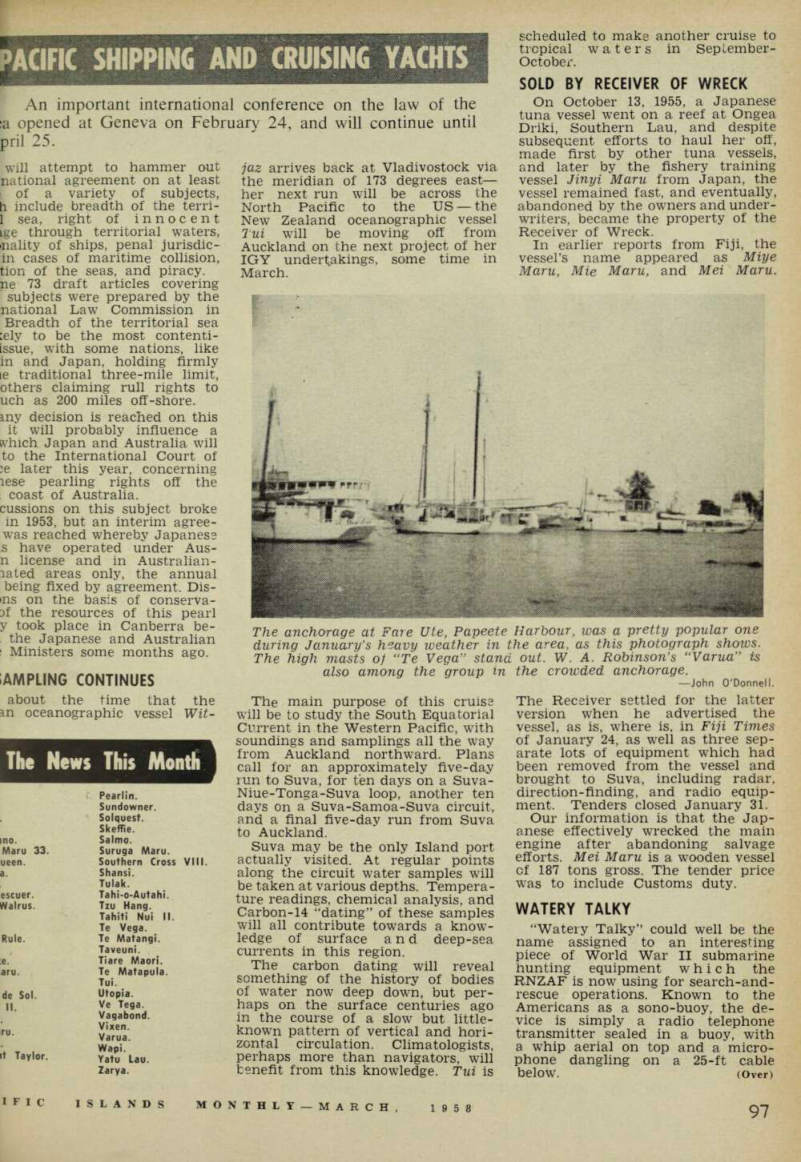
The anchorage at Fare Ute, Papeete Harbour, was a pretty popular one during January’s heavy weather in the area, as this photograph shows.
The high masts of “Te Vega” stand out. W. A. Robinson’s “Varua” is also among the group in the crowded anchorage. —John O'Donnell.
to a dozen of these were >ed by a submarine-hunting ift in a large circle enclosing area where a sub was last ed. Each sono-buoy operated slightly different radio fre ;y. Aboard the aircraft was a fl twelve-channel radio re tire sub moved out through the of sono-buoys its engine Is were picked up by those st. In the aircraft overhead the on of each sono-buoy was n, so the position of the sub be quickly fixed, he peace-time RNZAF applica tive sono-buoy will be dropped side a vessel in trouble and ut radio transmitter. With the will be instructions to haul up Aerophone and speak into it. 1 be one-way contact with the ft, but will allow the distressed er to explain his troubles and i be highly effective and a useful aid under some circum is. ilar equipment was moored in n channels during the ons campaign to pick up the of Japanese destroyers or sub es passing through by night, watch was kept on the sono transmitter from a distant and post.
H That Ballast
days out from Rarotonga, Dick Brown’s 128-ton ketch ni reached Auckland for re- February 12. Nearing Auck serious engine damage was
i by quick work by the engineer when the big-end 3roke in one cylinder of the 'Under 125 hp Crossley motor, dinder liner was fractured but ible by the Metalock system, iston was drawn at sea and few hours the voyage was ?d under four cylinders. 3ed by Chas. Bailey & Son, hull-planking was found to )een worn thin by improperly
secured permanent stone ballast, necessitating a few plank replace ments. In one place, near the keel, lii-inch planking was worn to half an inch, accounting for a hull leak which had developed in recent months.
There seemed to be a lesson here for all vessels with stone ballast.
On completion of repairs, Taveuni was to load stores for Mr. Brown’s new Rarotonga store, recently acquired by buying out Jagger and Harvey Ltd.
Japanese Fleet Out Again
Though no Japanese destroyers have cruised the Solomons channels
since World War 11, they have cruised Pearl Harbour waters. Early February, a four-ship destroyer flotilla, headed by the Harukaze flying the flag of Admiral Nakayama, paid an official goodwill visit to Hawaii. These are vessels of the American-organised Japanese home defence force. Hula girls were on the wharf to meet them in the traditional Hawaiian fashion. Like the hula girls, most of the Jap anese seamen of this force were in fants or unborn on December 7, 1941.
Going South
According to reports in Auckland, the attractive 128-ton, 28-year-old
C. Brown's "Taveuni" arriving in —J. P. Shortall.
ich Polynesia Mormon Mission jl Paraita is likely to head for port from Papeete in March ,pril. She would bring mission i to attend the planned open >f the huge new Mormon college temple near Hamilton late I. rmerly the yacht Fandango, by le American owner she was ,ted to the mission some years Paraita is a schooner-rigged, finished craft of pleasing lines a pair of tall sticks. She is red by an Atlas 120 hp motor registered in the name of :te Tahitienne de Navigation, insions unknown.
)Tonga Harbour
Lopment
isp i t e fan-fares concerning Dur development for Rarotonga, progress has been made to Last year a drag-line was im d and put to work at Avarua passage, mainly in deepening ipproaches to the Union Co.’s ?r hauling-out ramp and on sast side of the jetty, tv the harbour improvement littee has recommended to the nistration that operations for opment of Avarua be abandoned esent and work instead be con-
ated on Avatiu, a mile to the rard, used in recent years only is vessels of A. B. Donald & ltd. ? committee has decided that u is more sheltered and less ct to silting and that the ■ n side of that “harbour” could lore easily developed into a -ship haven with less main ice-dredging involved.
The Union Co. lease of the Avarua jetty and the land on which their cargo sheds are located at the water front, has been renewed for a further ten years, but is now sub ject to termination on six months’ notice, on payment of compensation of up to £50,000, depending on date of such termination.
Lady With A Story
Survivor of a mere handful of trading craft still to sail Pacific waters under schooner rig, Tiare Maori, based in the Cook Islands but Bahama-registered and Ameri can-owned, is a lady with a tale to tell —though few details have yet come our way. This wooden stay
sail schooner was built at Nunes Boatyard, Sausulito, Cal., year un known to us, and launched as Soreno.
Next she became E. W. Scripps and made her contribution to the scientific knowledge of the Pacific as a maid of all work for the famous Scripps Institution of Oceanography of La Jolla, Cal. Next name on our list is Henrietta, under which she became a film star in, we believe, Eighty Days Around the World.
After that, Walter S. Johnson, of California, took her in hand, re fitted her, and brought her south to the Cooks, where she has just returned after lengthy engine over haul in Papeete. (Over)
DRESSING WELL: Mr. Bob Grant, of USA, seriously burnt aboard his trading "Ve Tega" in the New Hebrides last [?] ter, is progressing well at Middlemore [?] l, Auckland, where he has undergone [?] ve skin grafting. Story February RIM. —J. P. Shortall.
e Register shows dimensions t overall by 21-ft by 16-ft depth deck-line; 168 tons gross and >ns nett, single screw. In profile closely resembles Tahitienne, srly owned by Maxwell & Co., apeete, and lost at Rarotonga years ago under the owner of Mr. D. C. Brown.
Onia" —Case-Book
ED ;k in September, 1954, PIM ;d an interesting story by Mrs. le Booth Johnson, concerning 96-ton salvage “yacht” Caronia which she was purser-radio tor at the time—and of work in hand carving up the war wreck of the 10,495-ton Pre t Taylor in the entrance to m Island lagoon. Subsequently, is column, we gave occasional ess reports until word came in Tarawa that Caronia had been i by fire on July 11, 1956. ters to several sources at Can ailed to raise so much as an iwledgement and no details forthcoming. Now at last the look can be closed, thanks to iteresting letter from Jeanne l Johnson, now of Honolulu, i. Johnson says that had she een roused from sleep by the ig of her pet dogs, all aboard lave been lost. The fire, which ently originated in a cargo irtment, had a firm hold and smoke and fumes were being ated through the ventilation n when she roused the others, ersonal belongings were lost, y the engine-room with its two p Atlas diesels, each worth 3, was little damaged. The steel remained afloat but was so twisted by heat that she was lered incapable of towing to yerseas junk-yard. Insurance mies, marine law, and “the s that be” at Canton then took id.
A move was made for the vessel to be towed to Tarawa by the GEIC government ketch Te Matapula, where the motors —then for sale from the insurance underwriters at a mere $7,500 —could have been used, together with the big generators aboard, as a valuable electric power source.
This offer fell through, and a plan by the original owners, North Coast Corporation, to beach the derelict and dismantle all salvageable equip ment, was prevented. The end came last April, 1957, when a US Coast guard cutter was diverted 750 miles off-course to Canton, to tow Caronia off-shore and sink her, complete with Atlas motors. No one seems to know quite why, but marine law was involved. Technically, the vessel was already “abandoned” and was littering up Canton “harbour”.
Five gun-shots at a point three miles SSW of Canton spelt the end of Caronia ex Andradite-PCY-11 ex Comoco.
The vessel was built between the wars as a yacht at a cost of $750,000.
She served as a weather station in the North Atlantic during World War II and had been re-equipped by her post-war owners, at consider able expense, specially for the type of salvage work in which she was engaged at Canton.
Still Demonstrating
Dana Rescuer, that 22:7-ft Danish designed ship’s lifeboat, commanded by master mariner Walther West borg, is on the move again after nine months in Panama canal zone.
The steel decked-in craft, with automatic pilot and diesel motor with fuel tankage for 3,500 miles of cruising, cleared Balboa December 17 for Los Angeles, Honolulu, Guam, Wake, Yap, the Philippines, Singa pore and westward ports. Westborg and designer Claus Sorensen, too old to make the voyage, are hopeful that shipowners will appreciate the lifeboat’s virtues and that com mercial production will commence in Germany. Westborg took aboard a monkey as companion before clearing Balboa.
Where Goes "Zarya"?
Though Professor Ivanov and his fellow scientists are now almost certainly engaged in their IGY re search aboard the Russian 480-ton non-magnetic schooner Zarya some where in the Pacific, no one this side of the Iron Curtain seems to have any idea of the vessel’s approximate itinerary.
Inquiries to a number of overseas magnetic laboratories likely to be informed of her movements have all drawn blanks. It would appear
[?] in Archie Pickering (left) and chief [?] r Emori Waka, both well known on the [?] aterfront, brought "Taveuni" south from [?] ga for refit in Auckland. Story page 99. —J. P. Shoctall.
UP SHE GOES! Loading and unloading ships at Mangaia, the southernmost of the Cook Islands, has always been difficult and dangerous.
The Passage off the main settlement, from which all produce is shipped, is narrow and frequently impassable, so that canoes have to go over the reef. There have been several attempts to blast a bigger passage—mostly unsuccessful. Photo shows an operation during the last attempt in November-December. Navy depth charges of 250 lbs were used —and this is what it is like when 15 of them are fired simultaneously. Work has now been halted for the hurricane season.
Photo: W. H. Percival.
ble that her course will be the magnetic equator and it from main Island ports, un tie diverts. Technically Zarya i be a unique vessel to examine ise quarters.
: 0R The Bookshelf
ure Is Your Guide, said to be lel to, and in some respects a i edition of the well-known Book, in the hands of English hers at the time of Harold ’s death in Fiji last year, has ieen published, price 16 - Stg. the Raft Book, this one em a great deal of research and ation of natural phenomena to aid the traveller afloat or ?. (See review elsewhere.)
Whalers Did Well
mese and Russian whaling in the Antarctic have reported alarly good catches in the pre season, which opened early ry, and the indications are he total catch of 14,500 Blue units (one Blue equals two wo and a half humpback, or i whales) for the season, will iched early March. of those busy maids of all Suruga Maru and Banshu No. 33, which run supplies to acific tuna fleets part of the 'arry meat from New Zealand pan for part, and serve the ig fleets in season, were back pan from South early Feb with a total of 1,430 tons of whale-meat, and word that lx Japanese fleets had then
taken 40 per cent, to 54 per cent, of their expected totals.
One had taken 314 Blue Whale units (440 actual whales) to Feb ruary 1, the highest of all 20 in-
ternational fleets operating. (Nor way sent nine, Japan six, Britain three, the Netherlands one, and
[?] ese heavy anchors, photographed at the rear of the Papeete Customs [?]ice, look as if they are capable of doing the job that has been [?]gned them—that of anchoring the new off-shore mooring system at Taiohae Bay, Marquesas. —John O'Donnell.
Anare Vuli Vuibureta, captain of the 84-ton "Yatu Lau", which he successfully brought through the recent hurricane that caused havoc in Fiji. The ship was located by the RNZAF after it had drifted in the teeth of the gale. —Fiji PRO.
Russia one.) In Russian fleet reported taking as many Blue Whales in a night as in the whole of last se one 93-ft Blue weighing 140 t The numerous Japanese v\ may be sighted in the W© Pacific as they head back hon April, on the lookout for a few 1 Sperm whales en route—ass latter do not come under the ges annual limitation. Next to Noc Japan produces most of the wv Sperm oil.
New Mission Ship
The Melanesian Missions’ Som Cross VIII, for which a tender let to S. G. White & Co. Pf October, 1956, for building atd Company’s Ballina, NSW, yard,!
be launched on March 8 Caulton, wife of the Rt. Rev.
Caulton, Assistant Bishop of a and former Bishop of Melae The £65,000 vessel will be read) service in May, when she will tf livered to the Solomons by Cas G. E. Langley. There the comr will be taken over by the pu( Bishop, the Rt. Rev. A. T. Hill, , himself a master mariner.
When Southern Cross VII\ laid up for sale in Sydney s©e years ago (since sold to New GI and renamed Kilinailau) the ML intended to build a somor smaller vessel than SC VII. plans were changed and two c siderably smaller craft were dei upon. The first of these, Badfe
"La Cle de Sol" of Cannes now cruise Pacific. (See story Yachting Notes). —Max
x 16i ft, powered by a single ) Gardner diesel, was launched illina on July 11, 1956. Southern t VIII measures 711 ft x 20 ft, is a twin-screw vessel with nger accommodation. Both are en vessels. Baddeley has no nger accommodation.
Al Queen" Delayed
npletion of Coral Queen, new ig vessel for the WPHC, has i delayed in Hongkong, ■ently because of “problems in ruction”. Delivery to Honiara )een expected in January, but efinite delivery date is now ible. BSI Marine Superinten- J. Morris flew to Hongkong at nd of January to advise on ruction.
Posh
ew 56-ft scow now under con ion at Bjarne Halvorsen’s Syd ards for the P-NG Adminis n, will be finished before April.
iw will be sent from Port by to take her up. scow, as yet unnamed, is tv draft, similar in hull design ? K-boats, and will be used )ply the outstations. She will erent from the K-boats in lay- Dwever, with special provisions >oth European and native igers. Among the amenities, mtly, are improved, separate . Power is from a 6 LW ter.
P-NG Administration’s trawl e reported to be developing a deal of rot, and might not a much longer life.
Copra Fire
The Shansi, Sydney-bound, had some trouble in Port Moresby in February when a cargo of copra meal in the forward hold caught fire —apparently through spontane ous combustion. Local firemen got quickly on the job, removed the hatches and top bags of meal to get at the seat of the fire. About 20 bags were affected by the fire.
"A'oniu" For Men Only!
Holland may be far from Tonga, but Tongan custom is to be rigidly enforced in respect of Tonga Copra Board’s smart new A’oniu, which was launched in Holland last December 19, according
to a report of the event recently received in Tonga from Holland.
The report said no woman will be allowed aboard the vessel “until the official boarding ceremony has been performed by a lady of rank”, and the shipyard authorities will see that this instruction from Tonga is en forced. Though launched, it will be some time before the vessel is com pleted.
The launching, strangely enough, was performed by a woman—Mrs.
K. Kamp, wife of the ship-broker through whom the order for the vessel was placed—but there was no call for Mrs. Kamp, of Gronigen, to board the vessel for this event.
Just whether the “lady of rank” must be a Tongan is not made
has begun on extensions to the main Papeete. The scaffolding is up to drive s for the new foundations. —John O'Donnell.
If a Tongan is called for, one ave to be shipped to Holland the job—or the tapu will re in force until A’oniu reaches ilofa. can imagine the popular press 5 a glorious time with this ; custom before it’s all over.
Can Catch Fish
Tonga Department of Agri 3 and Fisheries’ research ves laimoana—the fishing vessel ised in Auckland several ago and then named Pearlin, it in over 4,000 lbs of ocean rom a short cruise late in :y. The catch included a big swordfish. The vessel is red by a Japanese fishing ex brought from Japan some tf ago to “show them how”.
vs of Cruising Yachts
Xhina-11, Ex Manu-O-Aitutaki, Ex
EAS, ex SCALDIS, 19 days out from a via Raoul, reached Auckland 16 on delivery voyage to her new t Nadi. Dave Beard and Gordon nie, handling the job for the love lame, reported fair winds but equip ubles en route. Two pleasant days ent ashore on Raoul, Kermadecs, lying comfortably at anchor in Boat le the crew relished the fresh-food dairy produce and fruit which that igical station had to offer. A good maintenance work will be involved e yacht continues to Fiji about April, i readers will recall that Messrs, d Auchterlonie were first reported in imn when heading for the Pacific land in SKAFFIE, which they sold at coming on to NZ by ship. Since then is cruised to Australia and Norfolk -member in the Wellington yacht A. His ambition is to acquire a iss yacht of his own for entry in a trans-Atlantic race. TAHI-O-AUTAHI, to be shortest ever (about 19 ft.) the Pacific, which sailed from Raro the same day as MAHINA-11, had not ited en route.
MO, first Vertue-class to come to the lavigated by the Hamilton couple of
England, was reported out from Borabora for Apia early January. This yacht has no auxiliary motor. • AGNES, 136-year-old English trading ketch cum-yacht, with her unlikely crew of both sexes, urged on by professional mariner Alistair Barr, was reported at Papeete early February. The crew, it will be recalled, had each contributed £l6O for the privilege of working their way to Tahiti, and an additional £3O on to Auckland, in the 100-ton craft.
The voyage began May 4, 1957, from Apple dore. Barr was then said to have plans to put the ketch to work somewhere in the Islands after delivering his human cargo. • LA CLE DE SOL of Cannes, 45-ft ketch owned by Jean de L'Espee and with Christion Regaud and Mar Roche as sailing companions, cleared Balboa for Polynesia January 26, west bound round the world. Our information indi cates an unusual route—from Papeete to Japan thence Indonesia, etc. The three men are keen musicians and before the yacht was decked a grand piano was installed. Our Balboa corres pondent's impression: An able ship and an
able crew. The yacht left France September last. c PHOENIX, American owned, which cruised the Islands 1956-57 from Japan, bound round the world, again entered the Pacific via Panama January 18 bound for Galapagos, Marquesas, and Honolulu, with a target date for arrival back at Japan July, 1958. Two of the Japanese university student crewmen left the yacht at Panama to hurry home by faster means. Owners are the Reynolds family. • FLYING WALRUS which caused all the rumpus last year, now at Whangarei, NZ, will be signing on a new crew member in March when the Wells' expect the arrival of a son and heir —or, anyway, an heir. Meanwhile John is working on the waterfront. • GEMINI, 44-ft. Honolulu ketch, currently based at Palmyra Island where Jack Wheeler has an IGY job, has signed a new crew-member —a daughter recently born. Wife Leah travelled to Fanning in November for the big event as a passenger aboard Martin and Bea Vitousek's 72-ft. schooner FIESTA. FIESTA has the IGY
seized and sold by court order at while en route to Sydney. (See story [?] ng Notes).
:t to supply Palmyra regularly from lu. 10LDEN RULE, on a somewhat late "pro ission" to Eniwetok to halt the nuclear ests, cleared Los Angeles February 11. the 30-ft. ketch was owner A. S. i and a crew of three.
ZU HANG, believe it or not, has again Dth masts and dog-house, according to circulating in Auckland. Dismasted en from Australia to the Horn last year, cht spent months at Talcahuano, Chile, g Away again, the yacht received beating-up—apparently in January— iin made port, this time Valparaiso, from the Smeetons reported that they will lip the yacht home and renounce the I delights of sailing round the Horn.
AHITI NUI-11, successor to TAHITI NUI, raft in which Frenchman Eric de i and companions failed to complete a -Chile voyage last year, is on the way jm Constitucion, Chile, to French Poly- The 40-ft. x 16-ft. raft was towed to miles and set free on February 15, ; to contact land at Callao, Peru, before larance via the KON-TIKI route. TAHITI stbound, foundered near Juan Fernandez May 26 last while in tow, with her >oard the Chilean frigate BAQUEDANO. ichop was later reported down with iia. It is not known whether the crew are the same four men who were Bisschop before.
PEDA of Canada, which ended a trans cruise to New Zealand on a Rarotonga st June 15, may soon start a new as a towing launch. Mr. Dick Brown
onga, trader, who purchased the vessel reef at auction, salvaged her, and is )ut to fit a Lister diesel. The 34-ft. !-type craft will be used for the towage lighters at Rarotonga for Mr. Brown. iPI of England, details of which were n January PIM, has been traced. Our correspondent gives the interesting VAPl— we called her WAPY—a husky 18-ft. double-ender ketch, was being from Southampton to Sydney by Sarel and his wife Margerie. Having no pay, the Sarels held the vessel at iy "attachment" last October 18 and Marshall put the vessel up for public fhere on December 16 after advertising he US. The Sarels claimed $2,600 in ages. The sale, to a San Francisco brought $3,650. Total liens against el by then were $5,000. Debts were »ly settled, as the vessel, with the nd two other persons hired by the ner, cleared Balboa for San Francisco iry. WAPI was built of oak on steel m Germany in 1920. She has a 54
bhp Lister diesel. She draws 8£ ft. She is gaff-rigged with topsails. e Jean and Jim Stark, on VIXEN, are in Brisbane from Miami. Departing Tahiti in May, 1957, they visited Pago Pago and Fiji, and are currently preparing to leave for a five-months' Barrier Reef cruise in April, thence from Thursday Island to South Africa. • NONA, 41- ft. x 11-ft. x 6-ft. of London, owned by Charles Candler and John Grout, arrived Papeete January 19, departed February 2, en route direct to NZ. Vessel was built in 1900 and modelled on lines of a Moreton Bay prawner. With Mr. Chandler are Bill Hodgson (engineer) and Joe and Elsa Channing- Pearce. Mr. Candler's partner returned home from the Channel Islands because of family illness. • George L. Karl, who with James G.
Robinson, was previous owner of MARINER (Pacific cruise, 1953, 1954), of Seattle, has temporarily forsaken the sea and is currently owner of the Coronation milk bar, Ponsonby, Auckland. • According to a Papeete report, Fred J.
Petersen, owner of UTOPIA, planned to rejoin the yacht late February, with his wife. No news on whether he had recruited a new crew. • TE MATANGI, owned by Jack, Jacque and Lon Ferguson, THE GENII, a cutter, 40-ft. x 12£-ft. x 6J-ft., owned and crewed by Bill Schallenberg from Coronado, California, with Jean (and new born son, little Bill!), and ANNETTE, cutter, 32-ft. x 11-ft. x 6-ft., owned and crewed by Byron (Doc) and Dot Tanner, all plan to clear Honolulu together for Polynesian ports in May. It will be the second trip to Tahiti and points west for the Tanners.
TE MATANGI ("The wind", in Tuamotuan) was —rather like Noah's Ark, built on the shores of a lake—this one 8,300-ft. high in Nevada, with snow and sleet abounding and only hand tools for the job. She was towed to the Sacramento River near San Francisco, finished and launched. Jack Ferguson single-handed her across to Hilo, where he was joined by his wife and son. • The 60-ft. yacht VAGABOND of Okinawa has just been bought by the Wright Essers, of Honolulu, is being sailed by Horace Pope and crew to Honolulu, expected to arrive mid-March.
The Essers will then move aboard, check, refit and prepare for a cruise south. • Yacht ADOIS, 32-ft. ketch from Newport, California, owned and crewed by Tom and Janet Steele, will be leaving from Acapulco, Mexico, in mid-March for the Marquesas, Tahiti and points west. • The yacht SUNDOWNER, 37-ft. ketch, owned and crewed by Ed and Betty Wall and their two children from Newport, California, left for Tahiti last month, but due to a calm and later high seas and gales, turned back to the coast of Mexico. Will be leaving for Tahiti about March. • TULAK of Hamburg, whose where-abouts we were querying in January, arrived safely at Brisbane last June 21 from Papeete via Suva. Our last report had been from Papeete.
This was believed to be the first German-flag vessel to cross the Pacific from Europe in post war years. Joroslav Novy and wife Bozena were the navigators of the 31£-ft. craft, and both are now working in Brisbane. TULAK is anchored off the Botanic Gardens. • Details are in of the grounding of yacht SOLQUEST (January PIM). It occurred off Wailupe Circle, southeast of Diamond Head, Oahu, Hawaii. Len Staples, the owner, with wife Joyce and the two boys Len, Jr., and Wayne were asleep in the cabin when in early hours the wind shifted and the yacht was driven on to the reef. Local residents made the rescue, and a US Coast Guard boat, with members of the Hawaii Yacht Club, salvaged SOLQUEST and took her to dry dock. She is now at the slip while the Staples, from Tas mania, await Immigration Department decision on whether they can enter the US, where they want to stay. However, they had only a visitors' permit. Meantime, Mrs. Staples got her name in the paper after giving birth, January 24, to her third son at Queen's Hospital—and wihout doubt HE is an American citizen. (See story elsewhere this issue).