He's A Pilot Without A Plane
p. 79 · Read in the full issue
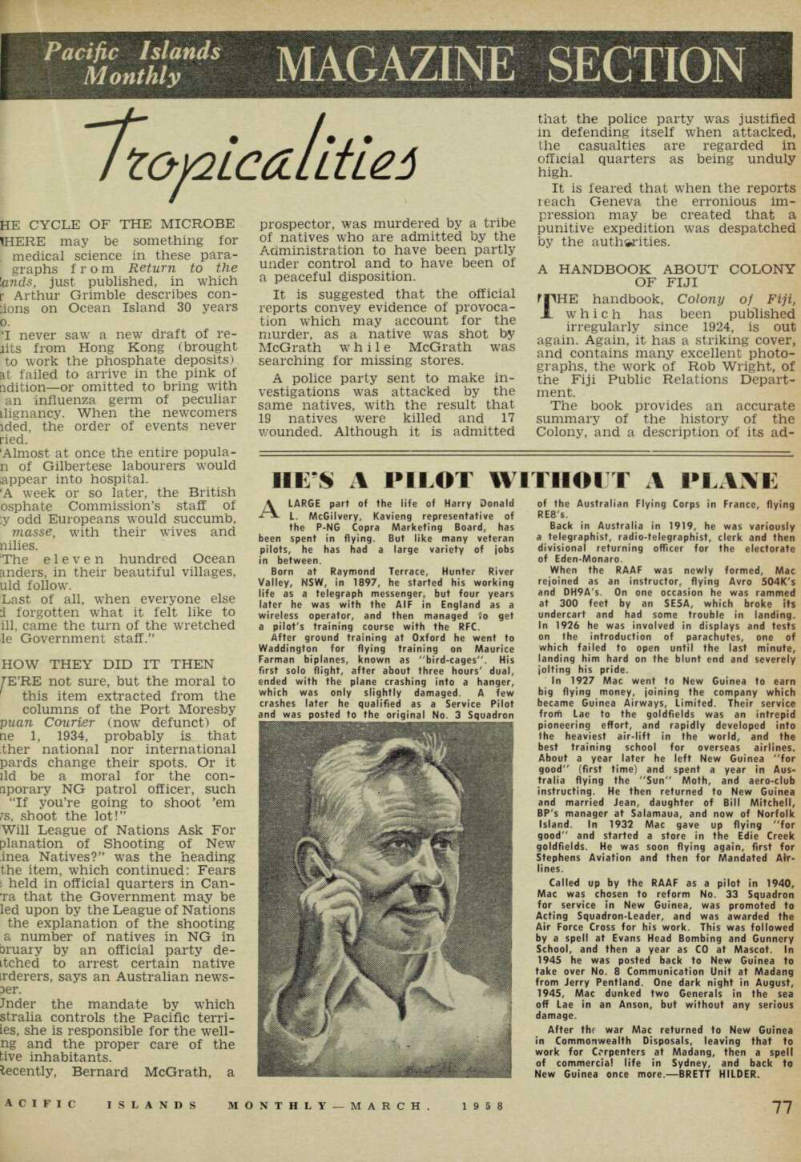
A LARGE part of the life of Harry Donald L. McGilvery, Kavieng representative of the P-NG Copra Marketing Board, has been spent in flying. But like many veteran pilots, he has had a large variety of jobs in between.
Born at Raymond Terrace, Hunter River Valley, NSW, in 1897, he started his working life as a telegraph messenger, but four years later he was with the AIF in England as a wireless operator, and then managed to get a pilot's training course with the RFC.
After ground training at Oxford he went to Waddington for flying training on Maurice Farman biplanes, known as "bird-cages". His first solo flight, after about three hours' dual, ended with the plane crashing into a hanger, which was only slightly damaged. A few crashes later he qualified as a Service Pilot and was posted to the original No. 3 Squadron
of the Australian Flying Corps in France, flying
Reb's.
Back in Australia in 1919, he was variously a telegraphist, radio-telegraphist, clerk and then divisional returning officer for the electorate of Eden-Monaro.
When the RAAF was newly formed, Mac rejoined as an instructor, flying Avro 504K's and DH9A's. On one occasion he was rammed at 300 feet by an SESA, which broke Its undercart and had some trouble in landing.
In 1926 he was involved in displays and tests on the introduction of parachutes, one of which failed to open until the last minute, landing him hard on the blunt end and severely jolting his pride.
In 1927 Mac went to New Guinea to earn big flying money, joining the company which became Guinea Airways, Limited. Their service from Lae to the goldfields was an intrepid pioneering effort, and rapidly developed into the heaviest air-lift in the world, and the best training school for overseas airlines.
About a year later he left New Guinea "for good" (first time) and spent a year in Aus tralia flying the "Sun" Moth, and aero-club instructing. He then returned to New Guinea and married Jean, daughter of Bill Mitchell, BP's manager at Salamaua, and now of Norfolk Island. In 1932 Mac gave up flying "for good" and started a store in the Edie Creek goldfields. He was soon flying again, first for Stephens Aviation and then for Mandated Air lines.
Called up by the RAAF as a pilot in 1940, Mac was chosen to reform No. 33 Squadron for service in New Guinea, was promoted to Acting Squadron-Leader, and was awarded the Air Force Cross for his work. This was followed by a spell at Evans Head Bombing and Gunnery School, and then a year as CO at Mascot. In 1945 he was posted back to New Guinea to take over No. 8 Communication Unit at Madang from Jerry Pentland. One dark night in August, 1945, Mac dunked two Generals in the sea off Lae in an Anson, but without any serious damage.
After thf war Mac returned to New Guinea in Commonwealth Disposals, leaving that to work for Carpenters at Madang, then a spell of commercial life in Sydney, and back to New Guinea once more.—BRETT HILDER.