pra Prices Under Scrutiny
pp. 47-49 · Read in the full issue

trolled versus Free Marketing
pra Prices Under Scrutiny The South Pacific
By The Pim's Copra Market Commentator
I find that, among copra growers and merchants generally, iere is lively interest in the prices being paid now for copra in le different South Pacific Territories. The rates vary consider
bly. (See produce section.)
E markets in most of the Ter tories are more or less under he control of Government umentalities. But the market in is completely free. The ten y is to compare prices else e with those paid in Fiji, e comparison is difficult to ;, and in some ways, unfair, e P-NG price, for example, was tentatively in January at £47 , in Copra Marketing Board , New Guinea port. “Tenta /” means that, at intervals, i will be a general clean-up in accounts department: and, if
there is a surplus, there will be a pro rata distribution to all suppliers.
Present indications are that there will be a fairly substantial distribu tion; but it remains very much on the knees of the high market gods.
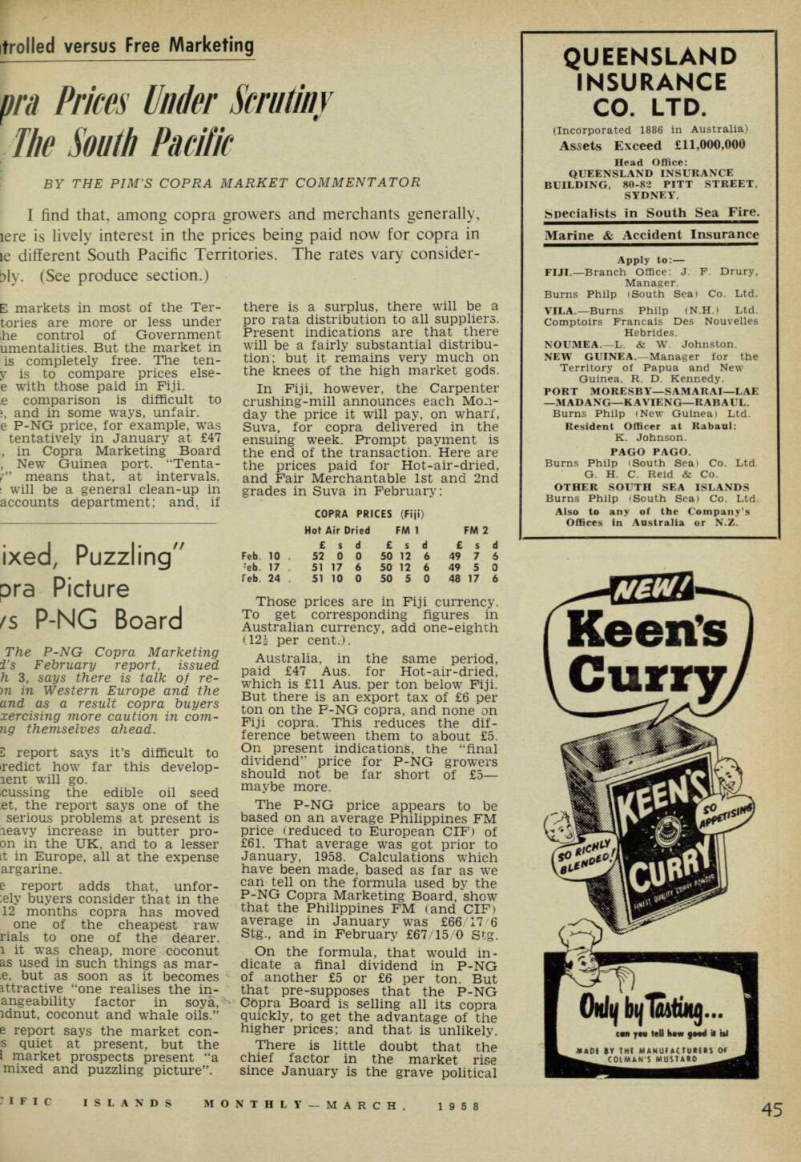
In Fiji, however, the Carpenter crushing-mill announces each Mon day the price it will pay, on wharf, Suva, for copra delivered in the ensuing week. Prompt payment is the end of the transaction. Here are the prices paid for Hot-air-dried, and Fair Merchantable Ist and 2nd grades in Suva in February:
Those prices are in Fiji currency.
To get corresponding figures in Australian currency, add one-eighth (12s per cent.), Australia, in the same period, paid £47 Aus. for Hot-air-dried, which is £ll Aus. per ton below Fiji.
But there is an export tax of £6 per ton on the F-NG copra, and none on Fiji copra. This reduces the dif ference between them to about £5.
On present indications, the “final dividend’’ price for P-NG growers should not be far short of £s— more.
The P-NG price appears to be based on an average Philippines FM price (reduced to European CIF» of £6l. That average was got prior to January. 1958. Calculations which have been made, based as far as we can tell on the formula used by the P-NG Copra Marketing Board, show that the Philippines FM (and GIF) average in January was £66 17 6 Stg., and in February £67 15/0 Stg.
On the formula, that would in dicate a final dividend in P-NG of another £5 or £6 per ton. But that pre-supposes that the P-NG Copra Board is selling all its copra quickly, to get the advantage of the higher prices; and that is unlikely.
There is little doubt that the chief factor in the market rise since January is the grave political
Copra Prices
(Fiji) Hot Air Dried FM 1 FM 2 £ s d £ s d £ s d Feb. 10 . 52 0 0 50 12 6 49 7 6 : eb. 17 . 51 17 6 50 12 6 49 5 0 feb. 24 . 51 10 0 50 5 0 48 17 6
d economic confusion in Indo sia. which supplies from 20 to 30 r cent, of the world’s copra. Pre nably. Indonesian copra is still ng made: but it cannot get out to ‘ markets.
Jooner or later, it will get out; i the world market will react icrdingly, ’he P-NG Copra Marketing ird is in the position of a huge, i-profit-making trader —doing the y best that it can for its nerous clients, but taking no ponsibility. The final dividends its clients depend on (a) the ird’s success in handling and ing the copra placed in its ids; (b) the ups and downs of world market. he set-up in Fiji is entirely erent. he growers there are more or in the hands of the Carpenter shing-mill. The mill buys the ra as it is brought in to Suva, pays prompt cash—and takes usual trader’s risk on the world •ket. The growers have got their i, and know precisely where / stand. The mill has the copra, cannot know its profit until copra is milled, sold and iped.
Carpenter Mill Prices to calculations I have i in Sydney, based on the Feb •y figures, the Carpenter mill suva is doing quite well on the es it is paying for copra in a— always providing it is selling shipping promptly, to catch world market. would be interesting to know t the Carpenter mill in Rabaul aying for its supplies, think it is probable that the center Fiji interests—shrewd ers always—are keeping their ulated profits low so as to give Fiji growers the biggest possible le eyes of all the Pacific growers irally are on the Government rolled prices in P-NG, Solo s, Samoa, etc., and on the pri enterprise price being paid in i. If 1958 shows a consistent ad ;age in favour of sale to the pri ly-owned copra-mill, there irally will arise a demand for ider application of the system, merally, this moral competition • good thing. It will tend to keep Government-controlled instru talities on their toes, onversely, a monopoly—by 3r privately-owned mills or by
overnment controlled-marketing
jm—would be a bad thing. Let i bite at each other. Australia t had better air services than n Australian National Airways Government-owned Trans Aus an Airways were in full com uon.
Prices in Solomons A friend of ours has had a look lately at the Annual Trading Ac counts of the British Solomon Islands Government, and especially at the figures which show the result of the marketing of BSI copra by the Government, Some compari sons; The average export duty paid by BSI was well over £lO per ton; in F-NG it was slightly over £7 per ton.
The BSI handling costs were just on £3/15/- per ton; while the P-NG Board got its handling costs down to approximately 42/6 per ton.
The BSI people reported a shrinkage rate of 2.4 per cent., while the P-NG rate was just under 2 per cent.
The BSI price, which is final, is running from £5 to £6 Aus. above the P-NG price (tentative). As already stated, we shall need the figures for a large part of 1958 before we can be sure whether this is a good or bad thing.
One market student, looking at that day’s whale oil quote (£77/10/-) and the Groundnuts quote (£6O) said: “It can be taken as certain that the copra quote will fall”,