Territories Talk-Talk
pp. 43-45 · Read in the full issue
By Tolala
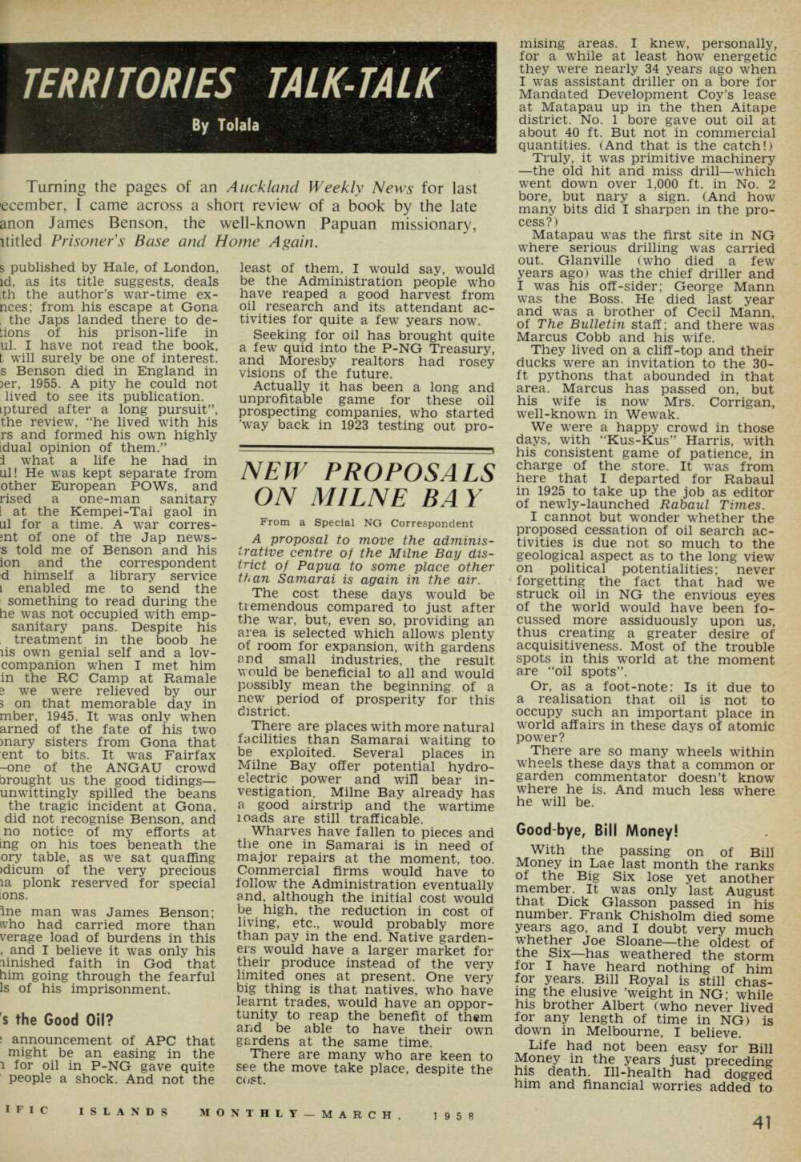
Tuming the pages of an Auckland Weekly News for last ecember, I came across a short review of a book by the late anon James Benson, the well-known Papuan missionary, ititled Prisoner's Base and Home Again.
s published by Hale, of London, id, as its title suggests, deals th the author’s war-time ex nces; from his escape at Gona , the Japs landed there to de mons of his prison-life in ul. I have not read the book, t will surely be one of interest, s Benson died in England in ier, 1955. A pity he could not lived to see its publication, iptured after a long pursuit”, the review, “he lived with his rs and formed his own highly [dual opinion of them.” i what a life he had in ul! He was kept separate from other European POWs, and rised a one-man sanitary 1 at the Kempei-Tai gaol in ul for a time. A war corres ;nt of one of the Jap news s told me of Benson and his ion and the correspondent d himself a library service i enabled me to send the something to read during the he was not occupied with emp sanitary pans. Despite his treatment in the boob he lis own genial self and a lov companion when I met him in the RC Camp at Ramale 3 we were relieved by our s on that memorable day in mber, 1945. It was only when arned of the fate of his two mary sisters from Gona that ent to bits. It was Fairfax -one of the ANGAU crowd brought us the good tidings— unwittingly spilled the beans the tragic incident at Gona, did not recognise Benson, and no notice of my efforts at ing on his toes beneath the ory table, as we sat quaffing )dicum of the very precious la plonk reserved for special ions. ine man was James Benson; who had carried more than verage load of burdens in this , and I believe it was only his linished faith in God that him going through the fearful Is of his imprisonment. s the Good Oil? : announcement of APC that might be an easing in the i for oil in P-NG gave quite people a shock. And not the
least of them, I would say, would be the Administration people who have reaped a good harvest from oil research and its attendant ac tivities for quite a few years now.
Seeking for oil has brought quite a few quid into the P-NG Treasury, and Moresby realtors had rosey visions of the future.
Actually it has been a long and unprofitable game for these oil prospecting companies, who started ’way back in 1923 testing out pro
mising areas. I knew, personally, for a while at least how energetic they were nearly 34 years ago when I was assistant driller on a bore for Mandated Development Coy’s lease at Matapau up in the then Aitape district. No. 1 bore gave out oil at about 40 ft. But not in commercial quantities. (And that is the catch!) Truly, it was primitive machinery —the old hit and miss drill —which went down over 1,000 ft. in No. 2 bore, but nary a sign. (And how many bits did I sharpen in the pro cess?) Matapau was the first site in NG where serious drilling was carried out. Glanville (who died a few years ago) was the chief driller and I was his off-sider; George Mann was the Boss. He died last year and was a brother of Cecil Mann, of The Bulletin staff; and there was Marcus Cobb and his wife.
They lived on a cliff-top and their ducks were an invitation to the 30ft pythons that abounded in that area. Marcus has passed on, but his wife is now Mrs. Corrigan, well-known in Wewak.
We were a happy crowd in those days, with “Kus-Kus” Harris, with his consistent game of patience, in charge of the store. It was from here that I departed for Rabaul in 1925 to take up the job as editor of newly-launched Rabaul Times.
I cannot but wonder whether the proposed cessation of oil search ac tivities is due not so much to the geological aspect as to the long view on political potentialities: never forgetting the fact that had we struck oil in NG the envious eyes of the world would have been fo cussed more assiduously upon us, thus creating a greater desire of acquisitiveness. Most of the trouble spots in this world at the moment are “oil spots”.
Or, as a foot-note: Is it due to a realisation that oil is not to occupy such an important place in world affairs in these days of atomic power?
There are so many wheels within wheels these days that a common or garden commentator doesn’t know where he is. And much less where he will be.
Good-bye, Bill Money!
With the passing on of Bill Money in Lae last month the ranks of the Big Six lose yet another member. It was only last August that Dick Glasson passed in his number. Frank Chisholm died some years ago, and I doubt very much whether Joe Sloane—the oldest of the Six—has weathered the storm for I have heard nothing of him for years. Bill Royal is still chas ing the elusive ’weight in NG; while his brother Albert (who never lived for any length of time in NG) is down in Melbourne, I believe.
Life had not been easy for Bill Money in the years just preceding his death. 111-health had dogged him and financial worries added to
burden; but he always re led the same lovable character, y to share his last bean with a y one. Had he been less gen s in his more affluent days he d have been in more comfort circumstances in the autumn is life. Good-bye, Bill. You’ve a well-earned rest.
fries and Such-Like
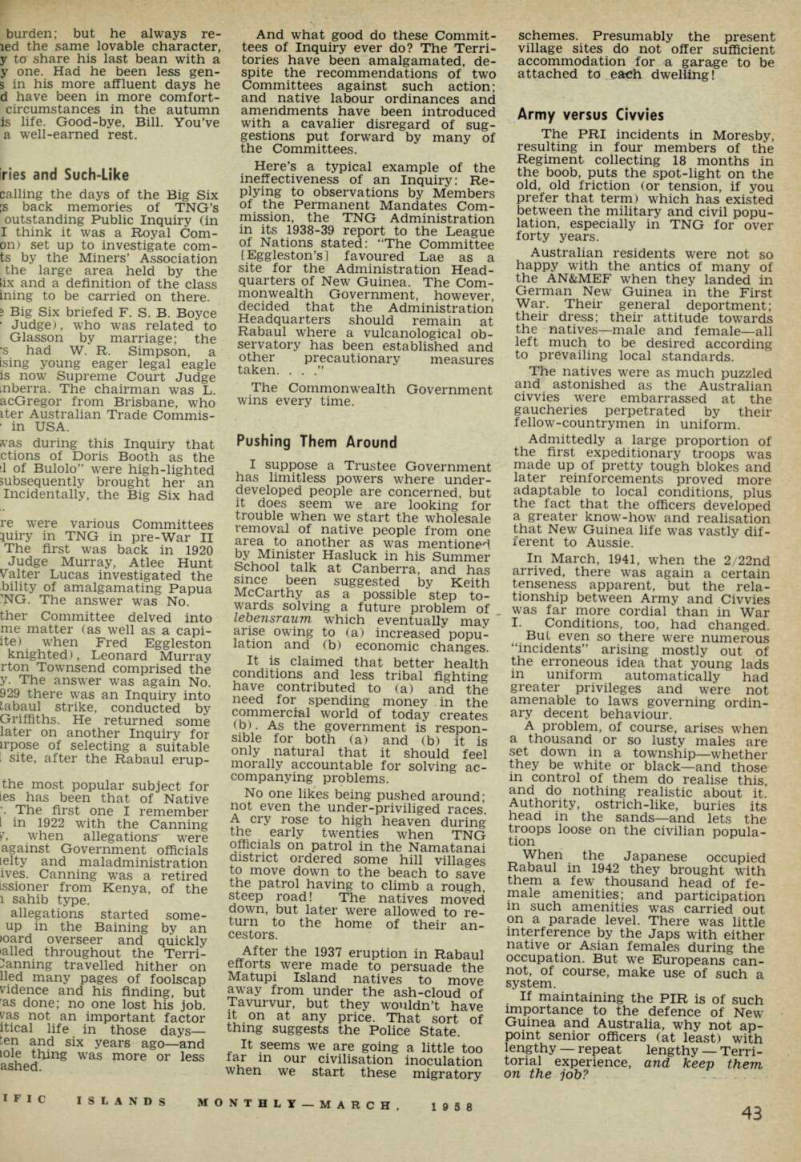
calling the days of the Big Six ;s back memories of TNG’s outstanding Public Inquiry (in I think it was a Royal Com on) set up to investigate com ts by the Miners’ Association the large area held by the iix and a definition of the class ming to be carried on there. 3 Big Six briefed F. S. B. Boyce ■ Judge), who was related to Glasson by marriage; the •s had W. R. Simpson, a [sing young eager legal eagle is now Supreme Court Judge mberra. The chairman was L. acGregor from Brisbane, who iter Australian Trade Commis • in USA. vas during this Inquiry that ctions of Doris Booth as the •1 of Bulolo” were high-lighted subsequently brought her an Incidentally, the Big Six had re were various Committees luiry in TNG in pre-War II The first was back in 1920 Judge Murray, Atlee Hunt Valter Lucas investigated the bility of amalgamating Papua 'NG. The answer was No. ther Committee delved into me matter (as well as a capi ite) when Fred Eggleston knighted), Leonard Murray rton Townsend comprised the y. The answer was again No. 929 there was an Inquiry into tabaul strike, conducted by Griffiths. He returned some later on another Inquiry for irpose of selecting a suitable 1 site, after the Rabaul erup the most popular subject for ies has been that of Native •. The first one I remember 1 in 1922 with the Canning 7, when allegations' were against Government officials :elty and maladministration ives. Canning was a retired issioner from Kenya, of the i sahib type, allegations started some up in the Baining by an >oard overseer and quickly 'ailed throughout the Terri tanning travelled hither on lied many pages of foolscap vidence and his finding, but as done; no one lost his job. vas not an important factor itical life in those days— ten and six years ago—and tole thing was more or less ashed.
And what good do these Commit tees of Inquiry ever do? The Terri tories have been amalgamated, de spite the recommendations of two Committees against such action: and native labour ordinances and amendments have been introduced with a cavalier disregard of sug gestions put forward by many of the Committees.
Here’s a typical example of the ineffectiveness of an Inquiry: Re plying to observations by Members of the Permanent Mandates Com mission, the TNG Administration in its 1938-39 report to the League of Nations stated: “The Committee [Eggleston’s] favoured Lae as a site for the Administration Head quarters of New Guinea. The Com monwealth Government, however, decided that the Administration Headquarters should remain at Rabaul where a vulcanological ob servatory has been established and other precautionary measures taken. . . .”
The Commonwealth Government wins every time.
Pushing Them Around I suppose a Trustee Government has limitless powers where under developed people are concerned, but it does seem we are looking for trouble when we start the wholesale removal of native people from one area to another as was mentioned by Minister Hasluck in his Summer School talk at Canberra, and has since been suggested by Keith McCarthy as a possible step to wards solving a future problem of lebensraum which eventually may arise owing to (a) increased popu lation and (b) economic changes.
It is claimed that better health conditions and less tribal fighting have contributed to (a) and the need for spending money in the commercial world of today creates (b). As the government is respon sible for both (a) and (b) it is only natural that it should feel morally accountable for solving ac companying problems.
No one likes being pushed around; not even the under-priviliged races.
A cry rose to high heaven during the early twenties when TNG officials on patrol in the Namatanai district ordered some hill villages to move down to the beach to save the patrol having to climb a rough, steep road! The natives moved down, but later were allowed to re turn to the home of their an cestors.
After the 1937 eruption in Rabaul efforts were made to persuade the Matupi Island natives to move away from under the ash-cloud of Tavurvur, but they wouldn’t have it on at any price. That sort of thing suggests the Police State, It seems we are going a little too far in our civilisation inoculation when we start these migratory
schemes. Presumably the present village sites do not offer sufficient accommodation for a garage to be attached to earch dwelling!
Army versus Civvies
The PRI incidents in Moresby, resulting in four members of the Regiment collecting 18 months in the boob, puts the spot-light on the old, old friction (or tension, if you prefer that term) which has existed between the military and civil popu lation, especially in TNG for over forty years.
Australian residents were not so happy with the antics of many of the AN&MEF when they landed In German New Guinea in the First War. Their general deportment: their dress; their attitude towards the natives—male and female—all left much to be desired according to prevailing local standards.
The natives were as much puzzled and astonished as the Australian civvies were embarrassed at the gaucheries perpetrated by their fellow-countrymen in uniform.
Admittedly a large proportion of the first expeditionary troops was made up of pretty tough blokes and later reinforcements proved more adaptable to local conditions, plus the fact that the officers developed a greater know-how and realisation that New Guinea life was vastly dif ferent to Aussie.
In March, 1941, when the 2/22nd arrived, there was again a certain tenseness apparent, but the rela tionship between Army and Civvies was far more cordial than in War I. Conditions, too, had changed.
But even so there were numerous “incidents” arising mostly out of the erroneous idea that young lads in uniform automatically had greater privileges and were not amenable to laws governing ordin ary decent behaviour.
A problem, of course, arises when a thousand or so lusty males are set down in a township—whether they be white or black—and those in control of them do realise this, and do nothing realistic about it.
Authority, ostrich-like, buries its head in the sands—and lets the troops loose on the civilian popula tion When the Japanese occupied Rabaul in 1942 they brought with them a few thousand head of fe male amenities: and participation in such amenities was carried out on a parade level. There was little interference by the Japs with either native or Asian females during the occupation. But we Europeans can not, of course, make use of such a system.
If maintaining the PIR is of such importance to the defence of New' Guinea and Australia, why not ap point senior officers (at least) with lengthy repeat lengthy Terri torial experience, and keen them on the job?