The Editors' Mailbag
pp. 148-149 · Read in the full issue
The Award Went
to Darkest Africa
One disconcerting thing about residents of the South Pacific is that they never seem to be in one place for any length of time.
We found this out last year when we made some photographic awards, Mr, Eric C. Adams, who took a photograph of a lifeboat being lowered away from Matua when that vessel went on a reef about a year ago, has never been located.
Apparently he was a passenger on Matua, who deposited his roll of film with a Suva processor and was then lest to sight.
The cover award, which went to Mrs. R. C. Short, then of Gizo, BSIP, we felt was to suffer the same fate, but in December we received a cheery letter from Mr. Short, from Natal, South Africa, to say that the cheque had finally caught up with them.
He writes: “We have not given up photo graphy and have, in fact, had some success with local magazines—but my wife is temporarily out of the pic ture business as she has just given birth to a 71 lb son—both doing well. He looks like being photogenic, but it is a bit early to be sure. This is one of the reasons for our return to Darkest Africa, but once this and some other business has been settled we hope to renew our acquaintance with the Pacific.”
We hope so, too. Marjorie Short has supplied us with some excellent cover material—including the one on this month’s issue, Ata’s mother.
Happy Days
Recalled
“I wonder how many remember these old-timers of the Solomons,” writes Mr. Frank M. Street, now of Springfield Avenue, Potts Point, Sydney , and lists the following names: Norman Wheatley; Joe Buskin; Sam and Willie Atkinson; Captain Voy; “Bunny” Hug (“who had one blue eye, one grey”); “Billy Boy”
Bennett; Dick Laycock and his brother; Jock Cromer and his Maggie; Captain Robinson; and Symington, of Lever Bros.
Mr. Street says that he went to the Solomons in 1912, for Burns Philp and Co., and was stationed at the Gizo branch. Later he was for many years supercargo on the old Mindini. “In those days,” he writes, “the traders’ boat-day dress
was a pair of immaculate pyja: which they donned to go as: from their schooners to do t business at the stores and to li on the Sydney steamer. ..In many friends amongst BSI reside and spent the happiest days of life there”.
The Pine Forests
of Buin
Well-known Methodist Mission the Rev. A. H. Voyce, of B TNG, has something exceedingly teresting to say about Klinkii % which, as reported in Bepten “PIM” (p. 71), is exceedingly ficult to establish as seedling pU in its natural habitat, the W Bulolo area of New Guinea.
He writes: I thought it might interest to know that at the time of Coronation of Queen Elizabeth, made application to the Fore Department in Lae, New Guinea, suitable trees for ceremonial ph ing on that day, and, amoi others, they sent us a quantltj Klinkii Pine seedlings. These 1; made amazing growth in the si period since, and are 20 feet hi some have trunks eight inches diameter already.
About 18 months ago, an off of the Department of Forests round this way, and he was ams at their growth, and carefully nc and measured each one, and recor them, stating that they would checked again whenever anot officer came this way.
He then pointed out the gi difficulty that was being experien in growing them at 2,000 to 3 feet, which is their natural envir ment, but here at sea level and ri on the coast they were flourishir Could it be that the vast B Flats might be a suitable area grow Klinkii Pine Forests?
The Breathless
Army of BSIP
A correspondent at Mandolia BSIP, gives us some amus additions to the account of Malaita expedition of 1927 (P.
October, p. 86), whose intention s to capture the native murderers: two European government offic; and their native police.
Our correspondent says that would have been more fitting if ' heading read, “Commercials Do When Officialdom Fails.” He s: the punitive expedition was inspir
led and corn led entirely n o n-govern
l t personnel.
Government he says—fear i mass native ing, had dis :d the native Lee, thinking would join nd then sent de for help. :e the MAS Adelaide
the Marines, but by the time arrived, the Commercial Cou nt had infused some sense of Ity into Tulagi by “parading iselves into shape around the yy r friend continues: las, the expedition to Malaita wed very little, Basiana and his v assassins simply stayed put
in their mountain hide-outs till finally brought down to the coast for surrender by their own tribes men. After a lengthy trial, at which they had the best of legal defence, Basiana and others were hanged at Tulagi whilst others received long term gaol sentences.
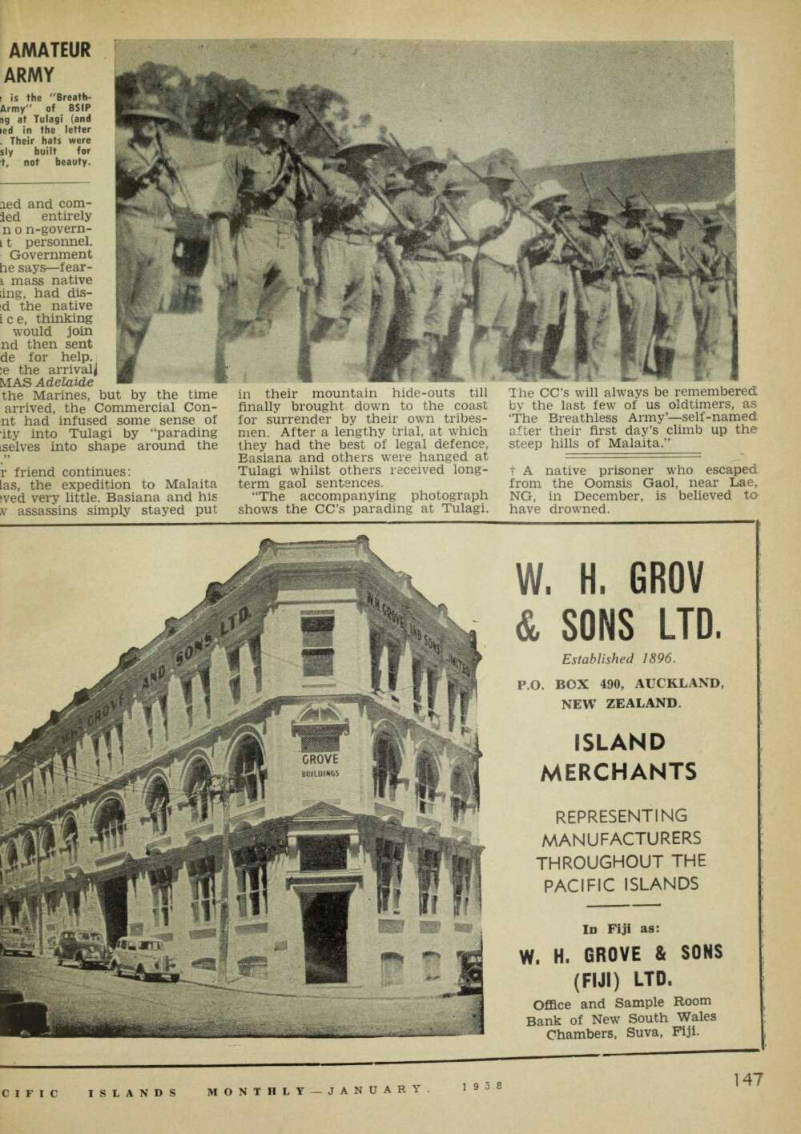
“The accompanying photograph shows the CC’s parading at Tulagi.
The CC’s will always be remembered by the last few of us oldtimers, as ‘The Breathless Army’—self-named after their first day’s climb up the steep hills of Malaita.” t A native prisoner who escaped from the Oomsis Gaol, near Lae, NG, in December, is believed to have drowned.
Amateur
Army
! is the "Breath- Army" of BSIP ng at Tulagi (and [?]ed in the letter Their hats were sly built for t, not beauty.