Heaths Of Islands People
pp. 133-136 · Read in the full issue
Mr. Les Lawlor
Dne of Fiji’s most popular and pected merchants, Mr. Ledwedge thur Lawlor (known always as 3S” Lawlor), died in Suva on De nber 14, aged 66. He had suffered ich illness in recent years. 3e was a Melbournite, and in his ms he entered the service of the JSN Company, and became an ustant purser, and later a purser, some of the well known liners the Australian coast. His service the ships introduced him to Fiji; d, in 1914. when only 23, he settled Suva as secretary of the Fiji tipping Co. Ltd.
Within a year, however, Mr. wlor had gone to World War I as member of the Second Fiji Con sent; and he was gassed once id wounded twice in the fighting . the Western Front.
He returned to the Fiji Shipping j.’s secretaryship, and remained ere until the Co. was absorbed by orris Hedstrom Ltd. in 1924, when ; became the big firm’s shipping anager. He joined Mr. A. E. Pearce forming Pearce & Co. Ltd., in 30; and in 1949 he bought out r. Pearce’s interests, and carried i the company as managing irector. He semi-retired, and avelled extensively, in the early ifties.
Mr. Lawlor was keenly interested
i sports—especially football —and
»ok an active part in the com .ittees controlling various organisa ons and clubs, and in the Service ten’s Associations.
“Les” was a famous host, and ived convivial company. He had lends and well-wishers all around re world. , In 1919, Mr. Lawlor married Miss iieen Nicholson, a member of a ell known Fiji pioneer family, and ley had two children —Mrs. W. J. [alley and Mr. B. D. G. Lawlor, now ssidents of Suva.
Mr. Ray Galloway
The death occurred in Rabaul, lew Guinea, on December 21 of Mr. lay Galloway, one of the town’s icst-known and hardest working itizens.
Mr. Galloway was manager of lobert Gillespie (NG) Ltd., joining he firm when the parent Sydney ;ompany opened its New Guinea übsidiary company in Rabaul in .048, but he had had a long career n the Territory before that.
He went to New Guinea in the nid-twenties for the Ex-Propriation Soard and after some years went to ;he British Solomons. He was in Slorth Queensland when war broke 3ut. He enlisted from there, later transferring to the YMCA Field Unit and seeing service in the Solomons Campaign and in Bougain ville. In Port Moresby, in early
1946, he joined the then Production Control Board.
After he settled in Rabaul he be gan to take a prominent part in the community life of the district. He was the first post-war secretary of the New Guinea Club, and a mem ber of the New Britain Advisory Council until his death. He was a trustee of the P-NG Museum and of the Queen Elizabeth Park, but probably the work to which he de voted most of his free time and enthusiasm was that done on behalf of the Boy Scouts’ Association. He was Commissioner of Scouts in the NB District and the strength of the present membership is a tribute to his work.
Scouts and Sea Scouts of all races formed a guard of honour at his funeral—at which there were three services. Two ministers of the Methodist Church conducted a re ligious service; Major Don Barrett conducted an Ex-Serviceman’s ser vice; and Mr. T. M. Wilson con ducted a service on behalf of the local Masonic Lodge.
Galloway by leading citizens.
At the time of his death be was believed to be in his early 50’s. He was unmar ried.
Capt Joseph Coste
A shocking accident on November 30 caused the death of Captain Joseph Coste, 30, Army doctor of the Noumea hospital. Dr. Coste was swimming 100 yards from the shore when he was struck by a speed boat which inflicted terrible wounds from which he died, The speed boat was driven by a boy of 13 and was towing a youthful aquaplaner.
The doctor was very popular, and had arrived from France in Sep tember; he was not married.
The accident has shocked Noumea snc j n i s hoped that overdue action vvil i be taken to prevent people from using the public beaches for their Gyrations.
M . Rene Petre
and R resoect«l' ‘New*’ 6 Caledonian family, died in Noumea in December.
n 1940, M. Petre was quick to ;wer the call of General de Gaulle i throughout the war he was in . thick of the fighting. He won i Legion D’Honneur, the Medaille litaire and the Resistance Medal i ended his military service as a utenant of Reserve. it the time of his death he was lirector of a large Noumea estab iment, Societe Havraise Cale lienne.
Mr. C. D. Barford
During his seven years’ residence Fiji as manager of the Bank New Zealand, Mr. C. D. Barford ik a keen interest in public affairs, d made many friends; and they re shocked when he died suddenly December 21, from a coronary dusion. ie had been under hospital treat ing but apparently was making a 3d recovery.
SAv. Barford was aged 58, and was se to retirement. He had had 43 ars’ service with the Bank —all of except for one year in London d seven years in Suva —in New aland.
Vlrs. Barford, well known and pular in Suva, survives him.
Ir. W. P. (Willie) Browne
Mr. William Parau Browne, a ill known Rarotonga resident, died ere on November 14, aged 73 years.
Mr. Browne is best remembered visitors to the island as the unified figure sitting in the open mt seat of an ancient truck, whose ay bore a typical Cook Islands ind dispensing rousing hula music, the truck swept round the island i “picture days” shedding hand 11s en route.
Mr. Browne’s Royal Hall was for a ng period, until recent years, the ily public hall and picture theatre
on the island. He was also associ ated with the retail trade and was probably at one time the leading figure in the Cook Islands business world if the New Zealand-owned firms are excepted.
His Nikao home was the centre of much of the island’s gay life and hospitality, and many a stranger from overseas has attended some island feast there.
Mr. Browne was a member of the Island Council from the First World War until 1947, and was again elected in 1950, when he was also elected to the Cook Islands Legis lative Council.
He represented the Cook Islands at the Second South Pacific Confer ence in 1953.
On the death of his first wife several years ago, Mr. Browne again married and is survived by his second wife and by many children.
M. Paul Berton
The death occurred in Noumea, New Caledonia, in early December, of M. Paul Berton.
M. Berton had just recently re tired from the Nickel Co., where he was an engineer for 32 years.
During his service with the company he was responsible for many of the improvements at the smelters in Noumea and also at the mining centre at Thio.
Mr. Joseph Michael
Mr. Joseph Michael, who served v/ith distinction in the Fijian First Battalion in the Solomons in World War 11, with rank as Company Sergeant Major, was killed in an accident at Penang, in Fiji, on De cember 27. He was employed by the CSR Company, and fell off a bridge, and died from severe head Injuries.
He was well known and esteemed.
He was 48, and unmarried.
Rev. Father Benjamin
Briand. Sm
The Rev. Father Briand, veteran Marist missionary of Western Samoa, died suddenly in Auckland, where he had been receiving medical treatment, on December 6, aged 70 years.
Father Briand went to the Samoan Mission from France in 1911 and had worked there ever since. At the time of his death he was in charge of the training college for Samoan catechists, and editor of a Samoan Catholic monthly magazine.
The Requiem Mass in St. Patrick’s Cathedral, Auckland, was attended by large numbers of Samoans re sident in Auckland.
Fr. Briand’s body was sent back to Samoa for burial.
Mrs. G. H. Massy-Baker
We have received advice that Mrs.
G. H. Massy-Baker, aged about 70, died in Nuriootpa, South Australia, last August.
She was the widow of a one-time Resident Magistrate of the Gulf Division of Papua and she herself kept a trade store for many years on the beach not far from the Kerema Government Station.
Mrs. Massy-Baker left Papua in the evacuation at the end of 1941
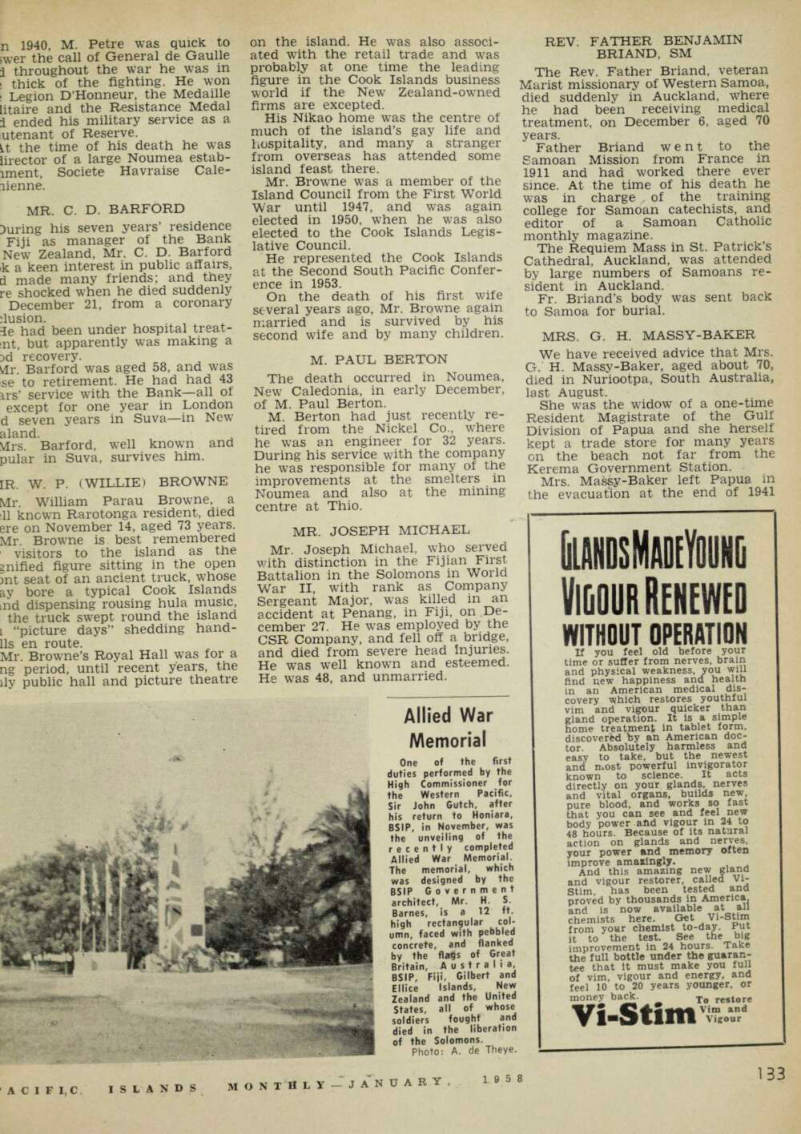
Allied War
Memorial
One of the first duties performed by the High Commissioner for the Western Pacific, Sir John Gutch, after his return to Honiara, BSIP, in November, was the unveiling of the recently completed Allied War Memorial.
The memorial, which was designed by the BSIP Government architect, Mr. H. S.
Barnes, is a 12 ft. high rectangular col umn, faced with pebbled concrete, and flanked by the fags of Great Britain, Australia, BSIP, Fiji, Gilbert and Ellice Islands, New Zealand and the United States, all of whose soldiers fought and died in the liberation of the Solomons.
Photo: A. de Theye.
and has sines been living with relative in South Australia. She we to Papua about 1925.
Mr. A. R. Pechotsch
The death occurred in Lae, Ne Guinea, on December 18, of m Albert Raimund Pechotsch, who lesidence in Papua-New Guim dates back to 1912. He was 80.
After he first arrived in Po Moresby he was employed on tl technical staff of the Departmei of Public Works. Later he resign* and joined the BNG Companv manufacture trade tobacco fro’ l9cal leaf grown at Katea, just ou side the town. The venture failei the factory closed down and he wei to Oro Bay to manage a plantatio for the company until recalled t Moresby to be BNG shipping mar ager.
His next venture was gol prospecting around Milne Bay, an after this a radio repair shop i Port Moresby, where he remaine until the outbreak of the Pacifi War.
He joined the Allied Works Coun cil and travelled all over Australi analysing soil for emergency land mg strips. After the war he remaine 9 n m Queensland doing a simila job, this time for the Main Road Commission.
He retired three years ago an* for the last year has been livin, with a son-in-law and daughter ii Lae.
He is survived by three marriet daughters (Claire, who lives in Aus tralia; Norris, wife of Mr. Denni Cahell, Lae, NG; and Eileen, wif of Mr. Clarence Healy, Westen Papua), 12 grandchildren and si; great-grandchildren.
Dr. G. Kroening
The death occurred in Decembe cl Dr. G. Kroening, of Tobero: Bougainville, who had been in poo health for some time.
Dr. Kroening was Governmen Medical Officer at Kieta during thi German regime and married Mis Frances Highley in 1914. He ha been resident at Toberoi for over 4 years. (Details of Dr. Kroening’s caree: will appear in the February issui of PIM). t Madame Ingeborg de Beausacq, j famous New York photographer am traveller, returned to USA, via Sydi ney, in December. In the course ot a leisurely tour in the South Pacific she spent some time in Fiji, the Nev Hebrides and New Guinea. She waj in the Sepik area of New Guinea between July and December, am she spent a fortnight on Mananr Island, leaving just before th* volcano’s last big eruption.