Pacific Shipping And Cruising Yachts
pp. 107-121 · Read in the full issue
his Month's News of—
Tonga’S Weather: To Our
wember summary of Pacific voice ;ather broadcasts, compiled from st information to hand, we must iw add that Nukualofa Radio ould be included amongst those ations making regular weather oadcasts —at 0740 and 1940 GMT lily on 2080 or 2095 kc/s. The oadcasts normally consist of de ils of actual prevailing weather roughout the Group, with no fore st of future weather unless a storm arning has been issued by Nadi eather Centre for the Tonga area.
There are slight discrepancies in r summary of timfes of weather oadcasts from Fiji Broadcasting )mmission stations, but these will readily revised by interested teners.
Ussr’S Interesting Ships;
terest in the Soviet Union’s assive IGY research programme ust inevitably be dimmed by the rtain knowledge that all this is signed first to serve world Com unism rather than the cause - of ire science for the general good.
But there is no denying that in e field of oceanography alone their >rk and the equipment employed
is of great interest to seafarers.
Vityaz, claimed to be the largest research ship in the world, which was in Rabaul in July-August and in Suva in mid-December, has—as mentioned before in PlM —the capacity to anchor in very deep water. From scientific journals it is noted that Vityaz (also spelled Vitiaz) did in fact establish a record by anchoring in a depth of nearly 6 miles some time after calling at Rabaul, though the exact position was not given in the reports sighted.
The operation of dropping anchor and heaving up again a while later took almost seven hours. The ship’s cable is almost eight miles long.
Previous deep anchoring record was established by a German vessel 35 years ago, the depth being only about three miles. Vityaz ’ record is likely to again be broken by another Russian vessel lately com missioned, Mikhail Lomonosov, which has a cable 9i miles long.
She, too, will probably be seen in Islands ports during 1958.
In a way more interesting than these vessels will be Zarya, a schooner of 580 tons, which will also be showing up soon. Since Carnegie
was destroyed by explosion and fire in Apia, on November 29, 1929, Zarya is the first and only non magnetic vessel to sail the seas.
A wooden vessel with entirely non-ferrous fastenings, she has a 300 hp diesel motor made of bronze and gunmetal. The motor will be used only when essential. Zarya cleared Gravesend, England, about September, for Nova Scotia, Cape Horn and the Pacific and Indian Oceans. Her cruise will end at Vladivostok and her job will, of course, be to make magnetic read ings which, combined with other magnetic research in the polar regions and along the magnetic equator, will provide information of
use to mariners, aviators and guided missiles.
The above vessels are three of the twelve Soviet ships engaged in IGY work. The others will probably not be seen in the South Pacific, though some are attached to the Russian Antarctic project.
NAMING NAMES: The precise name of a ship may not greatly in terest the man in the street, but it i s . ,° . interest to mariners and historians. The latter gentlemen of a century hence may well be side tracked by some recent press reports.
There was, for example, the report from Rarotonga of the stranding of the Japanese tuna-vessel Taiko maru 16. Overlooking the fact that Maru is a separate word, there are very good grounds for believing that the vessel was actually Taiyo Maru i ;i. i 67^ h i ch is a ver y different kettle of fish when we study Llovds Register. 9 Next came an amusing conference aboard a small Japanese vessel at Gisborne, NZ, where acute language problems arose. Perhaps the name was not painted on the vessel—she was reported as a fishing vessel but proved later to have been a whale chaser, one of a fleet heading for the Antarctic but whatever the cause, while the Gisborne newspaper reported that she was Koyo Maru No. 5, the Auckland and Welling
ton dailies stuck firmly to Ahihiro Tsushime —no Maru, no appendages.
It is a fairly safe guess that this was the Master’s name, as it appears to be a firm rule that (a) Jap anese ship-namers never use two words preceding the Maru, and (b) the Maru invariably is attached to
merchant Vessels A *SSt Tc
iru No. 5 but Kyo Maru No. 5, :ed in Lloyds Register as a whale aser
Still pondering these conflicting
les, PlM’s researcher was not ight off-guard when Suva news irces cabled to the world that tiaz was in port—for whatever jiggles may appear on her bows, 3 scientific world is firmly agreed at this vessel’s name is spelt \yaz when recorded in our Western jhabet.
UNUSUAL CARGO: Customs thorities are used to unusual rgoes, but San Francisco Customs »n probably looked twice at an try in the manifest of the Matson er Monterey, in December, when at vessel arrived there with a nsignment of 16 drums of bre aking stones from Suva. The >nes were for use by a film com ny arranging a “mock-up” of a ji fire-walking ceremony. (See M, December).
Why US-brand rocks could not be ed for the job was far from clear, no real fire-walking was to be ne which would call for the special rous rocks. This was not the first oe that such cargoes have been ported from Suva —fire-walking rties have on at least two occa >ns taken their own stones to New aland.
Something Wrong Some
HERE: Though some of the >rld’s meteorologists have utterly jected the idea that nuclear bomb plosions could affect the weather yond the immediate area of the plosion, others are less certain. So i may be certain that the iristmas Island bomb testers are ing to be blamed by some for the ocking events of November when hurricane, virtually unknown in ie area, rampaged through the awaiian Islands.
One of the strong points of
awaiian tourist publicity has
ways been the perfection of its imate —and even if hurricanes did rike occasionally, they would cer inly not be anticipated in No mber, which is equivalent to the >uth Pacific’s May.
Local vessels made for cover but e 5,401-ton, 37-year-old Greek amp Margarita Chandris, south of ie group, w r as heard sending dis £ss signals and was badly battered, tough she survived.
Not Wanted On Voyage: As
aui Pomare, two days out of Auck nd, headed for the Cooks late No :mber, Chief Officer Thomson, off ity and reclining on his bunk, adually became aware of a highly
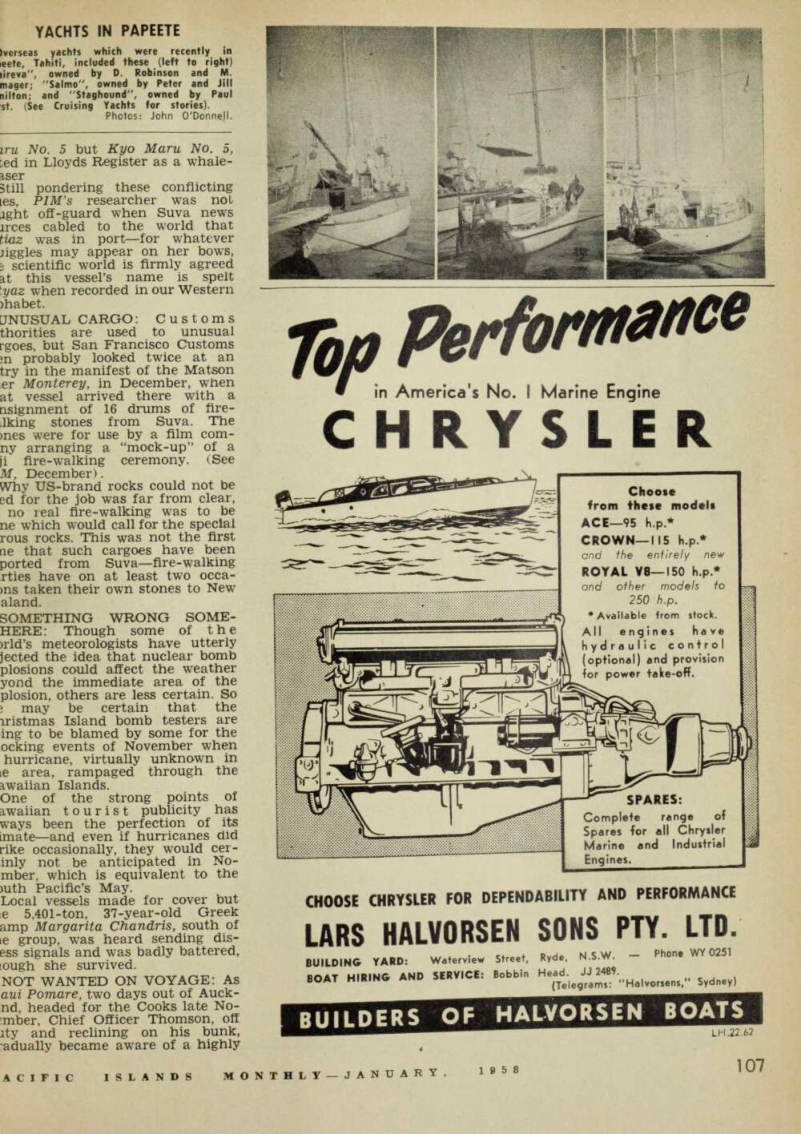
Yachts In Papeete
Overseas yachts which were recently in eete, Tahiti, included these (left to right) ireva", owned by D. Robinson and M. mager; "Salmo", owned by Peter and Jill nilton; and "Staghound", owned by Paul st. (See Cruising Yachts for stories).
Photos: John O'Donnell.
Bctionable odour seeping in ough the port-hole. A moment ;r there was the rumble of the ;ring gear as the ship changed rse. tepping out on deck the cause the trouble was quickly fixed ship was about to pass a large I very dead whale, floating with eavy list, its body well encrusted h barnacles —which infest even whales. ’erhaps Jap whalers, lately head
ing south through this general area, had lost this one—but there were no votes for a close investigation.
Mate Thomson speculated on what a horrible situation it would be for a yacht which happened to strand itself on such an odiforous “shoal” on some dark night, as could very well happen.
It would be a marine disaster of more than routine interest!
For Immediate Delivery:
French Oceania readers would cer
tainly identify the attractive brigantine whose photo appeared in an advertisement in PIM of last September, as Ernest K. Gann’s Albatros, which visited Papeete just a year earlier.
Under command of Captain George Atcheson, the Panamanian registered yacht arrived at San Francisco on November 30 under contract to a film company shooting Gann’s best-seller, Twilight for the Gods, most of which has been shot in Hawaii in recent months.
Film contract ended, this attrac tive nveted-steel former Dutch pilot vessel will be available to any purchaser, through the PIM ad vertiser. She would make an ideal sail-training craft for a well endowed Sea Scout organisation or similar body. She measures 96 ft x 75h ft x 206 ft x 101 ft and has a U-boat engine and a considerable spread of canvas.
TUG FOR TONGA: The second of four vessels to reinforce the
loyita" shortly after she was refloated by Mr. Jack Morris at his shipyard in Levuka, lovember. The vessel is now in Suva —see story, page lll.
Photo; H. Franklin.
Tongan merchant fleet arrived at Nukualofa in December. First came the 60-ft landing-craft type barge Kao, which was off-loaded from a ship at Suva some months ago. The second unit, a 60-ft x 13i ft x 9 ft, |teel, diesel-powered tugboat named Fonualei, was off-loaded from the FiZS Co. 10,000-ton Papanui at Suva on December 2, for delivery there— onwards under her own power to the Tonga Copra Board.
The Board’s ketch A’oniu, with a crew for the new tug, stood by at Suva to take delivery. Still to come, from a Dutch shipyard, are the much lai ger steel vessels A’oniu and Hijojua, under their own power.
ORDERED OFF: Because she was classed as “a disfigurement to the view and a “nuisance”, the ageing 35-ton, 60 ft x 17 ft hold-scow Scot, only vessel of her type in Fiji waters, was ordered by the author ities to be removed from her laying up anchorage near Mosquito Island, Bay of Islands, Suva, in November.
Built at Omaha, north of Auck land, by the famous scow builder, David Darroch, for years she worked th e North Island’s East Coast beaches with a two-man crew. Dur ing or after the Second War, Scot became club-boat for the Auckland Coastguard Service, a sort of Sea Scout organisation, until purchased by Mr. Lew Graham, one of the present owners of the trans-Tasman freighter Babinda.
Scot sailed for Suva in July, 1952 under command of Captain J.
McKenzie Arnot, now Master of another Fiji vessel but then only recently arrived by yacht Kimbala from England. At Suva, Mr. Graham sold the scow to Mr. J. B. Turner and since that time she has suf fered various minor mishaps.
She has also persistently had her correct, registered name, mis spelt Scott.
For a scow she has rather pleas ing lines and it would not be re alised at first sight that this vessel, when down to her marks, draws onl? 05 it.
LATER: Scot changed hands twice m recent weeks and left Suva under tow for Savusavu on January 4 for newest owner Mr Ross Denney.
Another For Davy Jones:
Following the loss of the American owned Ve Tega, by explosion, fire, and sinking last month, yet another New r Hebrides vessel went to the bottom in November. This was the locally built, 15-ton cutter Helvetia, owned by a local Swiss trader, Mr.
Jean Urben. This vessel apparently struck some floating object off Aesi Island, near Undine Passage, south east coast of Santo.
There was just time for the crew to take to a dinghy before Helvetia went down. The vessel was insured and represented the fourth recent loss in these waters by the same insurance company.
Ve Tega now lies in about four thorns at Hog Harbour. Extent of »r damage and whether she is Drth salvaging were matters under vestigation late November. Owner 3b Grant was progressing satis ctorily from his burns.
A Thorn In The Thorn: One
che causes of the sale of the Cook lands trader Melva was excessive impetition since American Walter Johnson brought his Bahama gistered schooner Tiare Maori to lose waters. Just as prospects emed brighter for that vessel she iffered a gear-box breakdown hich has temporarily removed her om the trade. The mishap occurred uthbound from Penrhyn to Raro nga in November.
The schooner has substantial sail •ea, however, so had no trouble in aking port. On discharge she died the 620 miles to windward > the nearest dockyard at Papeete >r repairs.
Tiare Maori has an ample re igerator and owner Johnson knows 3W to make it pay. Fish caught ; sea have been on sale in recent eeks on arrival at port at 2/3 per Dund—which is a fair indication : the absence of consumer supplies l the Cooks, though there un mbtedly are plenty of fish in those (as.
Radar May Not Find You:
s time goes by the evidence mounts lat radar is far from being the all ying eye that some would have us slieve. One of the clearest demon ;rations of radar’s limitations was ?en in the air search for Joyita vo years ago. Radar equipment the RNZAF Sunderlands was said, rior to that event, to be capable I detecting even tiny objects on le sea’s surface.
Later, with Joyita under tow, tests lowed that a wooden vessel as large 5 Joyita could not be satisfactorily etected at quite short range. Con dence in radar as an infallible in ;rument of detection was further laken and its limitations again tnphasised in November when a ja-and-air search, said to be the irgest ever organised, and employ ig the best of America’s airborne nd ship-based radar and submarine etection gear, failed to locate reckage of a PAA airliner down i the sea north-east of Hawaii. The reckage, which covered an area 11 hies by three, was eventually ’Gated visually by a carrier plane.
The wreckage, which included nine odies, some strapped in seats, had ndoubtedly been overflown by adar-equipped aircraft many times efore visual location. As in the ase of Joyita, the wreckage was 3und just where the known in armation on point of breakdown nd speed of drift would have stimated it to be.
For radar to give satisfactory re ults the sought object must have small expanse of metal a few
feet above sea-level—and even then results are dependent upon the shape of the metal parts. These are details worth remembering.
JOY IT A BACK IN SUVA; The Joyita, in December, was in Suva after an absence of 11 months, but there is no knowing when she will go to sea again. She went on to Horseshoe Reef in the Koro Sea on January 8, 1957, and after she floated off she was taken to Levuka for repairs to enable her to get back to the Government slip in Suva.
She was at Levuka much longer than expected, mainly because of labour troubles and private disputes among the owners.
Her future plans are uncertain, She has not yet gone on to the slip (December 24), again because of disputes among the owners. All thal L is required to make her sea worthy again are repairs to one of engines.
It will be remembered that after the Joyita was discovered, mysteri ously crew-less, northwest of Fiji, in 1955, she was taken to Suva, and later sold to Mr. D. Simpson, of Suva. She then was taken over by the Hurley Shipping Agency, and put into commission in the inter-island copra trade. On her second voyage, the luckless ship ran onto Horseshoe Reef, and was badly
amaged. Repairs probably will cost ot less than £6,000 by the time ley are completed.
Meanwhile, Mr. T. Hurley has urchased from Captain Cliffe the jrmer mission ship Melanesia (re orted price, £6,000). The Melanesia as quite a history. She was used >r years by the Seventh Day dventist people in their Islands [ission Work; and then she was >ld to Captain Hugh Frewen, of iji. She was operated as an ex jrsion vessel by Captain Frewen. !e sold her a couple of years ago, > Captain Cliffe; and he used her i trading and for pleasure. He now as sold her to the Hurley Agency, >r use in the development of the anana industry.
Melva Changes Crew: In
ydney, just before Christmas, were Upper Hugh Williams, his engineer, es Livingstone and eight Cook danders, aboard 243-ton Melva fter a 9-days crossing of the Tas tan from Auckland. Business: to and the vessel over to her new wner, a Hongkong shipping firm hich will use the vessel to trade atween Darwin and Timor, where ii prospecting it currently proceed ig- It is understood that the price aid for Melva was £NZI4,OOO.
There was considerable general iterest in the new ownership in ustralia, due to the fact that a 'ew of Bathurst Islanders took over
in Sydney from the Cook Island ers. This is the first time that Australian ab o riginies have come so far south to crew a vessel.
The Cook
Islands crew (with Williams and Livingstone) flew back to New Zealand just before Christmas. Most of the Cook Island ers will stay there in new jobs.
Skipper Williams, however, will re turn to Rarotonga, where he will indulge in a little citrus and tomato growing. He has finished with the sea; or so he says.
Items From Tahiti: Mv
Benecia seems to be dogged by bad fortune. Following her reconstruc tion after the burning of a year ago the vessel has been operating on the
Tuamoti run, and on November 27, while in this group, she broke her rudder post. Temporary repairs have been effected and she is, at present, returning to Papeete. This is the third occasion this mishap has occurred. * * * Auxiliary schooner Te Vega is ex pected to clear Papeete bound for Rarotonga on January 18 with a charter party of twelve aboard. * * * Oiseau de lies I has (reportedly) been sold to Mexican interests and
End Of A
Landmark
This old Japanese transport which has been a landmark on the beach not far from Honiara, BSIP, for about 14 years was recently being cut up for scrap. A team of Chinese workers was doing the job—but the scrap will go to Japan Photo: F. Drilhon.
was expected to leave Papeete on delivery early December. * * *
Triumph For Japanese
SALVAGE: The Japanese freighter Erifuku Maru, which went up on Wreck Reef off the North Queens land coast on October 11, was re floated on December 28 —due to the vigorous efforts of Captain M.
Hatono, Japanese salvage expert. A tug left Brisbane on December 29 took the vessel in tow on New Year’s Eve for the return trip to Brisbane. The tow was completed successfully early January.
Eifuku Maru, a new vessel, was carrying a cargo of wool when she hit the reef. Cargo salvaged and taken to Brisbane is already esti mated at £500,000.
It was believed at first that the vessel and her cargo would be a total write-off. The Japanese salvage experts thought differently, and after flying over the wreck, Captain Hatono was smartly on the job with Wakashio Maru, which vessel has unloaded and transported to Bris bane the cargo that has been salvaged.
The salvage effort has been assisted by the fact that an almost unbroken spell of good weather has been experienced in the wreck areas since the vessel went up. But with the wet season and its attendant
cyclones imminent, the salvage team had not a moment to lose.
Japs Were Broke: After A
four-day period in Port Moresby Harbour, made difficult by the language barrier, the Japanese tuna fishing boat Daikoku Maru 18 left on December 30 without the extra
fuel she wanted, only to be recallec to port.
When the Daikoku Maru arrivec in PM on December 27 to pick up a sick crew member who had been put ashore about a fortnight earlier her captain indicated he needed 4,400 gallons of fuel oil and extra
K)d to get him back to Japan, but ad no money to pay for it.
Negotiations were difficult, because one of the Japanese spoke English.
Interpreting was done by an em loyee of an oil company, who had een a Japanese prisoner-of-war nd who was able to make himself nderstood with the aid of an Eng sh-Japanese phrase book.
The Japanese apparently held a tarpaulin muster”, and on De ember 30 had enough yen to buy bout £ASO worth of food and pay arbour dues.
After a bank had agreed to change ie money, the captain said he had nough fuel to rejoin his mother hip, and the Daikoku Maru left arbour.
Shortly after she left her moor ags, Burns Philp (NG) Ltd. re eived a cable from its head office i Sydney announcing the Japanese ionsul had given authority for an xtension of credit so the ship could e fuelled for the homeward journey.
A launch chased the Daikoku Jam and she was brought in to J ort Moresby wharf to take oil board.
Sandbank Unfound: There
;as no great comfort for navigators esulting from a recent search made iy HMS Cook for a supposed navi gational hazard in Fiji waters. The lazard, of unknown nature, was breakers” reported by a French essel in 1924, about 20 miles off he Great Sea Reef in Bligh Water, lorth of Viti Levu. Another vessel lad reported discoloured water in he same area in 1927.
HMS Cook, survey vessel, has bund 1,000 fathoms in the immedi ite vicinity, proving that the sup losed position was free of dangers, rhe early navigation may well have >een inaccurate and the reef or ihoal may exist at some other point ,n the general area —or, like so nany other supposed reefs and ihoals, this may simply have been i shoal of fish.
First Visit Under New
ST AME: Now wearing her new iame of Tiare, the vessel which vas formerly named Petunia, was Tiaking her first patrol to Fiji, Wallis, and the Loyalties in No vember.
As Petunia, this 320-ton vessel, Larger than her now de-com tnissioned predecessor, called at Suva last August en route to her station from France. The old Tiare, which came to Suva for refit each year, now lies idle at Noumea. As a new slipway has recently been commissioned at Noumea it is probable that the new vessel will be able to refit at her base port.
Japanese Igy Survey: As
part of Japan’s IGY effort, four oceanographic research vessels have now commenced soundings and sea water samplings in a triangular area between Wake, Midway, and Kam
chatka. The survey will be similar to that being undertaken by the Russian Vityaz and by American vessels.
News of Cruising Yachts
• Auckland-Suva Yacht Race: The Second
Aockland-Suva Yacht Race, which yachtsmen hope will become a biennial event, is scheduled to take place next winter according to plan. Royal Akarana Yacht Club, sponsors of the event, announced in Auckland early De cember that the race will commence on May 3, 1958. Interested yachtsmen should contact the club. Entries will close February 1, except in certain circumstances. • NEWS WANTED: News is sought of the 31£-ft steel yacht TULAK, German flag, in which Joroslav Novy and his wife Bozena cleared Papeete last April 27, for Suva and Brisbane.
Reports from any en-route islands, with ap proximate dates, would be appreciated. The V acht ma V well be at Brisbane. Advice is also sought from England of the yacht WAPY, un known to PIM, but last heard of at Panama Canal Zone last July. We have had no mention of this craft ' owned and manned by Mr C. r. Sarel, from our regular Balboa correspondent, Max Hart - who would normally only report
a-as, ssjs ssot W4prs
destmat,on was originally Australia • DIANA of England, now making Auckland her home base, was back there November 30 after a six months loop north to Fiji. With owner N. E. Young on his latest cruise were Michael Henderson of England, David Morgan of Australia, Brian Ferraz of South Africa, and Fred Undsted of England. The yacht will cruise coastwise through the summer. • KIWI, 28-ft ketch of MARCO POLO type— the latter yacht recently completed a world cruise—cleared Auckland for Lord Howe Island
Sydney on commencement of a no-plan Id cruise on December 4—an unusual time the year for departure. With owners Tom and Tom Sharpies are Graeme Hooper and Jenkins. The latter crew member has e Island cruises in other craft. The yacht built by the owners, and has a 10 hp Mary. . TREKKA's John Guzzwell, last reported as tember of the crew of TZU HANG, arrived c in New Zealand in November from South «rica, where TZU HANG is still refitting after dismasting and damage in the Roaring ies bound from Australia to the Horn. Guzz- I's TREKKA has meanwhile been hauled out i northern NZ port. i SWALLOW, 48-ft sloop, left Vancouver on rorld cruise August 31 and will probably itually be seen in the Islands. Aboard were srs. Richardson and Quail, and two brothers ens. • MERIDIAN, and the Staffords, have not i reported to PIM since the 44-ft cutter sd from Borabora for Suwarrow and Pago 0 in mid-September. Friends are inquiring. , NOENA of unknown dimensions, with re du Montet lone-handing, was reported from Naples in October on a round-the- Id cruise.
TRES DAMAS, Chilean-flag motor-sailer of tvely lines, which Arturo Prieto Urioste ight to Papeete in November, 1955, with n companions, and later sold there as a k-boat, was renamed POPOUA—just to keep record straight. She now maintains con between Papeete and the lonely atolls of iline and Flint for lessee Tony Bambridge. 1 TARASS BOULBA, 31-ft gaff ketch, with ie Zavialoff lone-handing, cleared Ostend April 20 for Panama and round the world might be the first yacht to bring the lian flag to Pacific, at least in post-War II s. The owner, Ukrainian-born, is evidently laturalised Belgian. The yacht is a con ed lifeboat. 1 FLYING WALRUS and NOVIA are, for the ; being, holed-up at Whangarei, northern though the crews have quietly slipped in Auckland by land transport, we hear. • SOLQUEST of Tasmania, which cleared eete September 24 bound for the US was irted in November to have been wrecked the Hawaiian Islands —no details. . RAIREVA (ex RENEGADE), 36' x 10' x owned by Doug Robinson (Canadian) and tie! Fromager (Channel Islander) arrived eete November 24 after 42 days out from kland. Accompanying them were Karl Teppo nish) and Robert Van Duyne (Dutch) —all in a veritable cruising United Nations. The wners bought the boat in Port Moresby sailed her to Sydney where they fitted out.
REVA is a staysail schooner equipped with 2 hp Petters diesel as auxiliary and has ity of "adapted" equipment aboard —exiles being aircraft blister tanks as auxiliary er tanks and a petrol station filling pump j bilge pump.
AIREVA was built in New Zealand to an teur design and, at the time, caused criti i owing to her unusual construction. Com its by the yachting magazine "Seacraft" e, "Three craft of similar size could be t with the materials used if normal con ction methods were followed", and "OK for as a light ship—guaranteed to bob and down in the same place", wners planned to stay in Papeete for weeks and then proceed to Honolulu via Societies and Marquesas. i SALMO, 24' 6", 21' 6" x 7' x 5' 10", er of Poole, England, owned by Peter and Hamilton, arrived Papeete November 24. >r Hamilton (ex Royal Navy) sailed SALMO lie-handed to Canada, returned home and ried Jill, then both of them returned to ada by normal means to continue a world se aboard SALMO. After leaving Panama Hamilton's called at the Galapagos, Pit n, Mangareva, Rapa and Tubuai. Present ntion is. to remain ittrPapeete until Feb-
From Tonga
And The Soviet
The Tonga Copra Board's new 52 ft tug, "Fonualei", photo graphed in Suva after it had been unloaded from the "Papanui", in December. It weighs 18 tons, has a beam of 13 ft 3 in. and a draught of 9 ft. She later sailed from Suva for Tonga under her own power.
She will engage in copra and general trading round that group.
Right: The Soviet survey ship "Vityaz" or "Vitiaz", which visited Suva in De cember. Stories else where this issue.
Photos: Fiji PRO.
ruary when, after visiting the rest of the Society Group, they will sail for Suva in continuation of world cruise. • STAGHOUND, 39' 8" x 10' 10" x 6' 1", of Santa Barbara, California, arrived Papeete November 25. The vessel is ketch rigged with a 25 hp Mercedes Benz diesel as auxiliary STAGHOUND is owned by Paul Hurst who will be remembered as the owner of PRIMAVERA which arrived in Papeete from Honolulu in June, 1954, and stayed there until late last year when she was sold to a Californian buyer Mr. Hurst is at present in Japan and hopes to (om the boat in Papeete within a month or so. Skipper for the trip down was Bill Weir of Maui and with him as crew are Phil Schroder (ex TAHITI) and Kerry Teeble (ex CELEBES). Skipper Bill Weir is well known having been on QUEEN MAB, PRIMAVERA, and navigator of JADA, winner of last year's Los Angeles-Tahiti race. STAGHOUND is quite a notable craft among ocean racers. Under the ownership of Brent Fulmor she has been in the trans-Pacific race on three occasions for two firsts ('53 and '55) and a second ('5l).
She also won the Honolulu-Kauai race in '55.
Present intention is to remain in Tahiti until the end of the hurricane season and then cruise via the Societies, Cook's, Samoa, Tonga and Fiji to New Zealand. • TAK-O-AUTAHI, of Poole, England, with owner Bill Morgan and Rick Mohun aboard cleared Papeete December 11 bound for Moorea.
On the agenda were plans to visit the rest of the Society group during the hurricane season before heading west through the islands to New Zealand. Owner Morgan hopes to build a larger boat (a 38' double ender) in New Zealand. • TAHOE, 36' x 10' 6" x 5' 6 ", staysail schooner of Vancouver, BC, arrived Papeete De cember 19. The co-owners Reg Blake (Aust.) and Fred Shepherd (Canadian) are accompanied by John Lewis (Canadian), Bob Drude (US) and Her bert Knopf (German). The vessel (amateur built) is designed after the style of a Rio de Janiero coastal sand-barge. Auxiliary is a 100 hp Kermath gasoline engine. TAHOE sailed direct
from San Francisco to Taiohae Bay, Marquesas in 48 days and then called at Ua Pou and Rangiroa on the way to Papeete. The owners intend to weather out the hurricane season in Papeete doing necessary repairs to the boat and then proceed through the Societies to the Cooks, Samoa, Tonga, New Zealand and on to Sydney which is the proposed terminus of the cruise. • UTOPIA owner Fred Petersen departed Papeete by TEAL aircraft on December 22. He is returning home to Sturgeon Bay, Wisconsin tor business reasons and while in the States
hopes to recruit some more crew to assist hi continue his world cruise. • HAVFRUEN 111 of England, Group Captai J IT . Car . r J s 7T ' ton ketch, arrived at Russe NZ, m mid-December from Nukualofa and w expected at Auckland later in the month. • . TE , RAPUNGA, which cleared Hobart f Auckland December 1, finished her tran Tasman passage on a beach near Greymout west coast of the South Island of NZ, c December 21 and a local resident lost his lii in rescue operations.
wner George Dibbern, known for 20 years [he S. Pacific, reported that the 32-ft ketch dismasted when knocked on her beam s by a freak sea when 750 miles out from
art The voyage proceeded under jury rig when the South Island was sighted on ember 12 the diesel auxMiary was started end the passage on the limited fuel avail- B. lowever a shaft bearing burnt out some e later. A fresh southerly sprang up but yacht was unable to make to windward or louvre under jury rig so it was impossible
make Greymouth.
nstead, the anchor was dropped in the lee a shingle bank eight miles north of that t Local residents could see that the yacht i in distress and in a precarious position in deteriorating weather so efforts were made take the five men off. In this operation ocal man was drowned, hen TE RAPUNGA parted her cable and le ashore on a shingle beach, undamaged with all aboard safe. With Dibbern were ssrs. R. Vincent, D. Haley, W. Pearton and Jones. Jones had suffered a broken cheek e when the vessel was dismasted. He was en hospital treatment. It is expected that yacht will be refloated and brought to hour, but Dibbern and his crew are out ot ds and will take local employment until y can afford to refit and continue the age to the Islands via Auckland. Dibbern, o sailed the yacht from Germany in pre r 11 days, is 69.
As a result of the retirement of r. R. M. Gladney, the position of
jsident Agent, Aitutaki, Cook
iands, was advertised in New aland in December. The salary
“up to £NZI,IIS, according to
erit”. The job is one of the most sponsible in the Cook Islands
;der the present programme of
icial Development. The Coral
Dute air service also involves a iod deal of work not called for on e other islands at present.