A Bumper Holiday Selection
pp. 86-97 · Read in the full issue
This Month's New Reading
Conducted by J.T.
Take a Bow,
Mr. Porteous
IT is a matter of opinion whether better books have been written since someone discovered that Australian culture does not consist entirely of blue-gums and large, open spaces. As about 60 per cent, of Australians live in large cities, it was not a surprising discovery, anyhow.
But as it is the remaining 40 per cent, who set Australians apart from other people, these are the ones still worth writing about. Who expects a tale of South Africa to be about city life in Johannesburg?
R. S. Porteous, in his recently published Brigalow, confines his at tention to some of the 40 per-centers and produces a truly Australian novel as refreshing as a brew of billy-tea after a hot day on the road.
Probably to ensure the necessary serenity, the period is the early be tween-wars. The location, a Queens land cattle station. The story is
told in the first person by Bob Anders, who gets the job of pulling the place together—not from the owner, Joe Carson, but from Car son’s Brisbane bank-manager, who seems more worried about the over draft than Joe.
Bob has problems including Carson’s ulcer, Carson’s schoolgirl daughter, prickly-pear, drought and incompetent station-h and s. But what he has to say makes the thing look like good wholesome fun and it was probably the kind of way Bob looked at it that made our fathers go West—even if the pre sent generation prefers something a little more secure and less sweaty.
Porteous’ characters are real, breathing individuals; they are de lightfully Australian and they don’t speak like Wooloomooloo comedians.
The station men live hard on the job and drink too much beer in town. The boss grouses like a lunatic, swears like a bullockey, and always turns up trumps in the end. There is a simple love story running through' the narrative that—after the strong diet of Bangkok and Hongkong brothels we have been having lately—brings us back with a jerk to the realisation that most people manage to have a com paratively uncomplicated love life.
Good characterisation, good writ ing combine to make this the most pleasant book that has come this way for a long time . . . the sort of story that leaves a warm glow of satisfaction long after it is read and tucked away on the bookshelf. (Published by Angus and Robertson. Aus tralian price, 17/-.)
Nursing Natives
Marjorie gartrell spent a year at a government station in the Mac Donnell Ranges, north of Alice Springs. She has now written a book about it called Dear Primitive, which is an interesting enough account of nursing aborigines —although it is unlikely to break any records in the best-seller class.
In the last decade, Australians have become aware of the interior of their continent and the books on this subject now emerge at the rate of about one per week. There are few new angles that can be presented—the so-called dead heart having been ridden over, walked over, gone over in broken down jalopies, and flown over—by air borne doctors and others with something written from every aspect.
Miss Gartrell’s book presents the nursing angle, and from that point
can be said to cover less trodde] ground. (Published by Angus and Robertson, Ltt Australian price, 16/-.)
Bony in the
Dead Heart
Arthur upfield’s 25th nove —Bony Buys a Woman —wa a Christmas offering.
This is up to the high standarc set by Death Of a Lake, the 195model; and makes up for No. 24 which appeared earlier this yea; (Man Of Two Tribes) and stretchec credulity to the limit.
Number 25 is also about a lake- Lake Eyre—at a time when flood! in the island rivers were beginning to reach and fill it. (over)
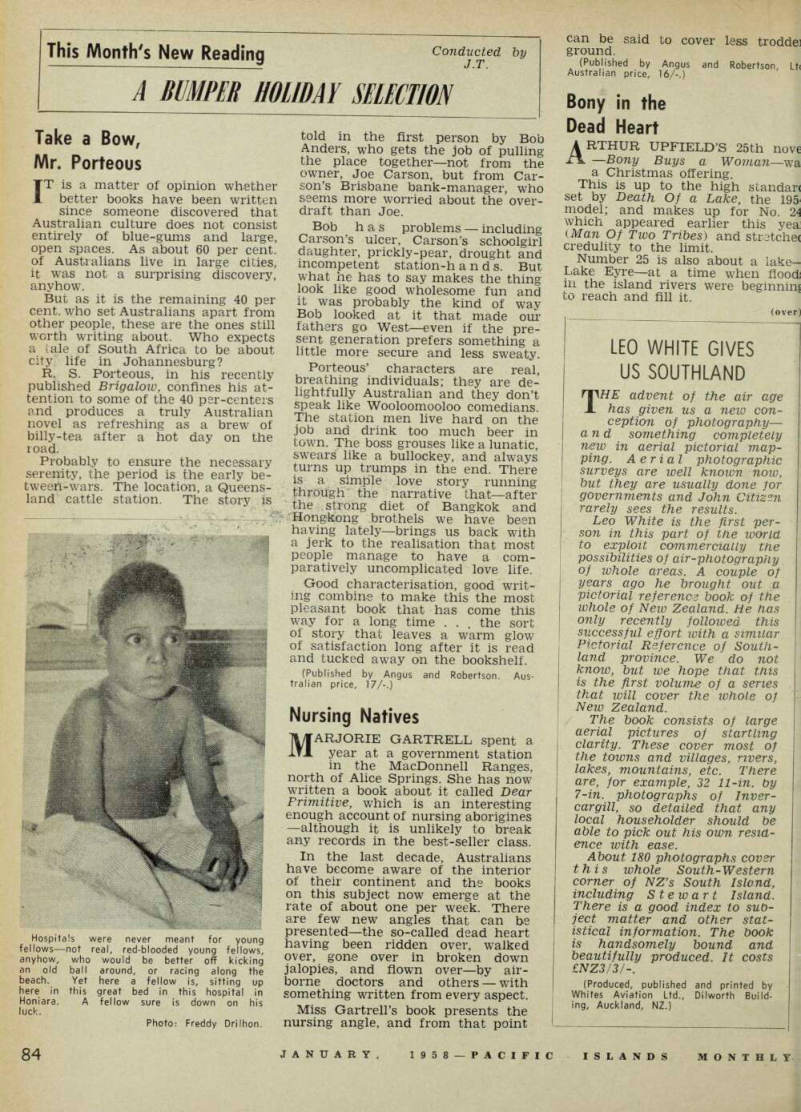
Hospitals were never meant for young fellows —not real, red-blooded young fellows, anyhow, who would be better off kicking an old ball around, or racing along the beach. Yet here a fellow is, sitting up here in this great bed in this hospital in Honiara. A fellow sure is down on his luck.
Photo: Freddy Drilhon.
The respectable female cook on a station near the shore of the lake is murdered in mysterious circum stances and her 10-year-old daughter Linda disappears without a trace. Detective-I nspector Napoleon Bonaparte is called in and there are doings with the station aborigines and the slightly wilder variety camped near by. Although what Upheld has to write about aborigines does not seem to jell with everything that Sydney professors of anthropology taught yours truly, there is no doubt about it that Upheld makes them sound far more entertaining.
The part that Australia’s mysteri ous Lake Eyre is made to play in the story is ingenious and provides all the suspense necessary for the climax of the thriller.
Upheld has the rare gift of being able to produce Australiana accept able equally to the home market and foreign consumption.
A few weeks after this latest Bony epic got into circulation, a real murder mystery developed in the Centre. The wife of a station owner, their 14-years-old daughter and a young man, driving south to Ade laide, disappeared. A week later their murdered bodies were dis covered hidden under sleeping-bags covered with scrub. Soon black trackers, Territory police, CIB men from Adelaide were converging on the spot. But it looked like a clear job for Bony.
Some of Upheld’s earlier books were founded on actual fact; this seems like a ready-made plot for his particular talents. (Published by Heinemann. Australian pricer 13/6.)
Founders of
the AIF
MA J O R-G ENE R A L William Bridges and General Cyril White are not names well known to the public, but in the annals of Australian military history they deserve more than a short chapter.
And in Two Men I Knew they get more than a chapter—a book on their lives, written by the man most qualified to tell their story, C. E. W.
Bean, Australia’s historian of World War I. He knew them personally, and in this book he brings them to life—quietly, without fanfare (as they had lived)—but in a fascinat ing form.
Bridges was the man responsible for establishing Australia’s miliary college, and raised, trained and led the Australian division on Gallipoli, where he was killed by a sniper’s bullet within three weeks.
White’s influence, happily, lasted longer. After being able to develop the First AIF he continued to in fluence it between the wars and to the beginning of the second, when he was appointed Chief of the
General Staff. He was killed in an lir crash in 1940.
Both were the founders of the AIF md this tribute by Dr. Bean is in important one, giving, as it does, ilimpses into the actions of many ither World War I personalities, ;ome of whom are still on the world itage.
Dr. Bean writes with a quiet en husiasm that makes his book far rom stuffy—as it might have been n less experienced hands, (Published by Angus and Robertson, Ltd.
Australian price, 25/-.)
Colourful Story of Early
Australian Aviation
A FEW years ago this reviewer cV found himself among a relaxed group of flying identities enjoy ng a good dinner at a pub near ;he Pillaga scrub country of NSW.
Included were Arthur Butler, head >f Australia’s Butler Airways, and STorman Ellison, a public relations nan specialising on aircraft matters, vho has been mixed up with the lying industry for so long, that he ong ago became a part of it. When ;he cigars came out, Ellison began jgging Butler on to tell some stories )f his early barnstorming days.
Butler soon obliged, and within 10 ninutes the group were rolling about n their chairs, tears streaming from
their eyes—for Arthur Butler can tell some very funny stories.
One story that day told of the first aircraft to visit Pillaga—a barnstorming Avro piloted by Butler, who first shot up the town to at tract attention, and then landed on a dirt road a mile away, to await the arrival of the citizens.
But they were a long time coming.
When, finally, Butler was about to give up hope he and his engineer saw a dust cloud in the distance. It could be, they thought, a mob of sheep, but after another long wait
it turned out to be a marching column of schoolchildren being led with precision by a military looking schoolteacher.
The flyers watched with fascinated interest. As the column came up to the aircraft, the schoolteacher snapped out orders to halt, gave a snappy right turn, and commanded, “Children, three cheers for the aeronauts!”
That story, and many more like it, can now be read in Norman Ellison’s Flying Matilda, a wonderfully enter taining, and in its way, important
ook, on the early days of Aus ralian aviation, a book which is .lied with the excitement and avour of a more lusty era of viation.
Ellison is personally acquainted dth the aviation greats—he knew Smithy” and Ulm and many others bat have gone, and he knows the arly histories of others still on the cene.
There are many anecdotes of the arly days of New Guinea flying, tories of “Jerry” Pentland and Ray *arer.
Half the book is devoted to “Smithy”, with many facts about him published for the first time.
Ellison collected them from many sources, some from several hundreds of his letters made available by “Smithy’s” mother before she died. (Published by Angus and Robertson. Aus tralian price, 27/6.)
Dukes Before
Income-tax
Georgette heyer comes in two varieties —Regency romances and detective fiction—with the romances far outnumbering the Whodunnits. Those who have en joyed the latter, feel that this is a pity.
Sylvester, the latest in a long line of books from the agile Heyer pen, is in the romantic mood —with high stepping aristocrats, Dukes, Lords, Ladies and so forth —pursuing their privileged way across 330 pages.
There probably is a moral in the fact that these stories of a way of life that now seems a great deal more remote than the moon, should be best sellers in an age dedicated to reducing society to just plain unromantic average.
It appears that a great many people enjoy reading about arrogant blue-bloods —particularly if one can cast oneself into the role of upper crust dandy. And there is no doubt
about it—the Regency period was a fine one in which to be a Duke, Sad to reflect that the heirs of these exalted beings are now reduced to showing tourists round ancestral homes at two bob a time.
Anyhow, it is not a bad idea to throw off the cares Of this Sputnik age once in a while and dally in a
make believe world where outer space was beyond comprehension.
Sylvester is by far the best of the Heyer romantic brew for a long time and should find a place in the hearts of the writer’s fans along w^J 1 A he first famous effort, These Old Shades. 15/6 ÜbliShed by Heinemann - Australian price,
Agatha and
the Xmas Spirit
THE Whodunnit reader who gets an Agatha Christie in his Christmas stocking counts him self well-served by friends and relatives.
Doubtless with the gift-giving season in view, 4.50 From Padding ton was produced simultaneously in Australia and the UK —and gives every indication that the author was pushed a little bit by Santa, towards the end.
With 250 of the 255 pages gone m inimitable Christie manner, the author evidently decides to have done with it and finished it up in a half-page denouement that is com pletely shattering, to say the least.
Well go further, Agatha, and say it was close to a complete ring-in. And almost unethical, old girl.
This is a Miss Marple mystery— Hercule Poirot apparently being on Christmas vacation.
Mrs. McGillicuddy, going for a
pre-Christmas visit to Miss Marple, takes the 4:50 from Paddington. She relaxes happily; then dozes. As she awakes she finds that her train has come abreast of another, going in the same direction. A blind in the second train flies up, and in a lighted carriage, Mrs. McGillicuddy sees a tall man strangling a woman.
. We leave you, dear reader, to tala U _, there ’ with Agatha C. 15/6) ' Shed by Co,lins * Australian price
Really One for All Ages
CONSIDERING the amount o; material available, Australia hat too few of the books which car
lonestly be said to be “suitable for jhildren of all ages”.
Piccaninny Walkabout, by Axel 3 oignant, a handsome volume on rood paper, is a book anyone would ike to own—not only the five to LO-year-olds for which the pub ishers say it is suitable.
The book is in the form of a ihotographic story of the daily lives >f two aboriginal children in Arn lem Land. They go goanna and :rab hunting, search for the tastier jrubs and generally enjoy them ;elves. The book would make an ittractive gift. (Published by Angus and Robertson. Aus ralian price, 16/.)
Pussies and Yanks
it Mille Miglia
rHERE is probably no reason why Jon Cleary, who hitherto has written about war in New Guinea and life in outback Aus ralia, should not go abroard and jroduce a story about professional ;ar racing. It is just that to a ■Jcotsbyterian mind, professional ■ace-car drivers are about as ssential as professional tennis play ;rs or jockeys.
This book —The Green Helmet— vill probably have considerable ippeal to those who have not passed f ar beyond the hot-rod stage; all ;he characters talk the jargon.
The psychological effects the nental suffering of the women who )elong to these death-darers — ilthough perhaps designed for more nature readers do not get beyond rery minor counterpoint to the main nelody.
This isn’t to say that the book Joes not improve vastly towards the md in the sequences that deal with ;he famous Italian road race, Mille Vliglia. This is when Mr. Cleary jets over his Colonial’s Dream of Some, and has finished dragging n every place-name in the London Some counties.
Ham Rafferty is an ace racing driver. He is also the son of a 'acing-driver who killed himself in :he Mille Miglia, and he himself has tracked up at Le Mans.
He is on the point of losing his tierve when an American millionaire tyre manufacturer offers to sponsor iim in two more international races; for these events they choose a car designed by an Australian.
Ham has a brother, Taz, who also wants to be a racing driver but has promised their mother he will not until Ham gets out of the business.
The tyre manufacturer has a beautiful daughter with whom Ham falls in love.
The Australian car designer speaks like a refugee from the Woolloomooloo waterfront; the American is not so easy to place
linguistically, but when these two get together and speak their separate lingos, the result really is something. This is a gimmick we have never seen tried out in a novel before.
Most of the characters in this story act like a lot of ageing childdelinquents and although they and their setting are probably authentic enough, readers of early Cleary novels will wonder why he had to
travel 15,000 miles to the other side of the world to produce a novel about a section of international society so completely unimportant, m _. .
There is sufficient competence m the novel, however, to suggest that one of these days he will burst through with something worthwhile, This, we might add, is the feeling left by the other Cleary novels, too.
He has never yet given the complete satisfaction that his contemporary
ustralian writer—T. A. G. Hunger ed —has managed so easily. Not i our very humble estimation, any ay. (Published by Collins. Australian price,
uth Park v.
I'Arcy Niland
T was inevitable that the oppor tunity would one day arise for a comparison of the writing bility of Ruth Park and her usband, D’Arcy Niland, Angus and Robertson have now üblished at the same time, One -Pecker, Two-a-Pecker, written by ,uth Park and dedicated to Mr.
Hand, and Call Me When the Cross urns Over, by Mr. Niland, dedicated ) Miss Park—so now the oppor mity is here.
Ruth Park’s excellent novel tells le story of New Zealand’s Otago old rush of 1863. She bases her :ory on fact —even, she says, to the ind or weather on certain days— ut there are none of the usual immicks one has, unfortunately, ome to expect with historical ovels.
Miss Park is a very smooth writer -smoother now than in her earliest ovels which were set in Sydney’s lums. In this story, whose central
character is Currency Mac Queen, a pretty unspoilt girl who finds her self, in tragic circumstances, alone on the fields at 18, Miss Park creates, and then overcomes, some technical problems of plot structure in a way which must make any would-be novelist envious.
But the reader who reads merely for his entertainment would not be conscious of this —but only of the fact that Miss Park writes a most entertaining and pleasing story.
The underlying vein of humour which runs through this novel con veys skilfully the character of the diggers themselves, but also gives the reader the impression that the novelist herself sees the humour of life, and is unable to prevent it shining through her work, enriching it.
Call Me When The Cross Turns Ovsr, will be a disappointing work
to some—to those especially who exnected something better from the author of The Shiralee, to which this new book seems to be some kind of sequel.
The girl is now grown up, and her life is, as one would expect, far more complicated.
But at times it is hardly worth following the complications, for there is no sense of realism in the book. You can never fully believe that these things are happening.
Mr. Niland seems to be writing to a formula, and the formula shows through tl\e story. Gum trees, opal fields, bush characters, are all in the mixture, as usual.
This, in fact, seems to be the real difference between Miss Park and Mr. Niland as novelists. Both once earned a living the hard way, as freelance contributors and hack writers. That is a tough school of
writing, and anyone who can make money at it —and move on to greater things without having shattered his soul on the way up deserves credit.
But both the Nilands having got there, through application and guts, Miss Park is revealed as a writer true— and Mr. Niland merely as a capable tradesman. (Bolh published by Angus and Robertson.
Australian price, 17/6.)
The Tanker that
Came Back
IN October, 1940, a convoy of 36 ships in charge of an armed merchant cruiser, Jervis Bay, moved out from Nova Scotia across the Atlantic. With half the voyage behind it, the convoy was attacked by the German battleship Admiral Scheer. The escort vessel and five other ships were sunk, and the tanker San Demeirio was set on fire.
The crew abandoned her, expect ing her to explode as she drifted •away into the gloom of a North Atlantic gale. Thirty-six hours later, a handful of her men in a lifeboat sighted her again. She was still burning but by now seemed a better refuge than the lifeboat at the mercy of the sea.
They reboarded her, put out the lire, got the engines and the electric generating plant functioning. The bridge gear, radio, compasses, steer
ing charts, cabins and signalling flags had all been destroyed in the fire. An ingenious system of signal lights was rigged to communicate between emergency aft steering gear and the engine room. The compass was soon found to be useless, having with its binnacle, dropped through two decks.
All navigation had to be by sun
or stars, when they were visible which was infrequent, and the sea farers were unsure whether the would make their landfall in occupie Europe or where they wished to g —which was anywhere in the Britis] Isles.
First land sighted, was southern Ireland, and fron there, with the Navy’s help, Swi
emetrio was able to carry on to te Clyde, where she was able to scharge her cargo of high octane ;trol almost intact.
The story of San Demetrio has ;en told before —we seem to re ember that there was a movie ade of it, also —but this par cular version (called simply, San emetrio ) is by Calum Macneil, le of the tanker’s crew at the me of the incident. Unfortunately, ;acneil is a better seaman than a riter and some of the most •amatic parts of the story are killed / understatement.
However, for those who prefer iat to dramatics, the story will do ;ry well indeed. (Published by Angus and Robertson. Aus alian price 13/6.)
/ritten in English
HHEY say you either like science L fiction or you don’t. But they’ve got it wrong. The average reader prepared to tackle any new volume : science fiction without prejudice, ut having read the first page, he len reserves the right to discrimin :e—and it is here that he differs ■om the SF addict, who believes iat all SF is just the most.
High Vacuum, by Charles Eric [aine, is not by any means a high ass story by either SF or ordinary andards, but the discriminating ;ader will probably allow himself ) read it right through, even if ily to find out how those people scape from the rocket that has lade the world’s first trip to the 100n—and crashed there.
The book’s main attribute is that makes no attempt to baffle the 3ader with science, and for this ne he needs no glossary of futur ;tic technical terms to be able to >llow what is going on. Australia’s /oomera rocket range gets frequent lention—it seems it will be a busy lace in another 10 years or so. (Published by Hodder and Stoughton. Aus alian price, 15/6.)
New Pocket Books
DOCKET books which became available in the last month included the following: THE SUN ALSO RISES, the Ernest Heming ay story about the girl who fell in love with Spanish bull-fighter. Lately it was filmed rith Ava Gardner and Tyrone Power in the jading roles. (Great Pan).
JUMP FOR IT: Gerald Bowman tells a series f stories about the people who belong to the aterpillar Club—those who have saved their ves by taking to a parachute—and incidentally ives a lot of information about parachutes i general. (Great Pan).
THE PERFECTIONIST: By Lane Kauffmann. A hriller of the perfect murder that wasn't quite. *an).
THE LONG HAUL: by Mervyn Mills. American ype crime but set in the United Kingdom, ilso recently made into a film with Diana iors and Victor Mature as the stars. (Great an).
A DRAGON APPARENT: by Norman Lewis, ravel-adventure, in a country little written bout since the French bowed out. Indo-China hen, it is now divided between Viet Nam nd Viet Minh Lewis visited there in 1950 /hen the confusion and the results of the onfusion can only be described as fabulous.
(Pan Giant).
BOY ON A DOLPHIN: by David Divine, the story of Greece that when filmed was supposed to do as much for that country as "Three Coins in the Fountain" had done for Rome.
The book is, however, far better than the picture (which starred Sophia Loren, Alan Ladd and Clifton Webb). It is an excellent piece of fiction entertainment. (Great Pan).
THE GOLDEN HORSESHOE in which Terence Robertson gives us a story from the other side —the story of one of Germany's most success ful U-boat captains, Otto Kretschmer, Captain of U-99. (Great Pan).
LIVE AND LET LIVE: By lan Fleming. A thriller in which Britain's key Secret Service agent James Bond gets entangled with a Russian counter-espionage organisation. Most of the action takes place in the US hemi sphere. (Great Pan).
GUIDE TO THE PLANETS: Patrick Moore, FRAS, has followed Guide to the Moon (also published in Comet Books) by an equally easily assimilated study on the planets. In these days of approaching space travel it is as well
to |< now where we are going, and ftrtr. Moore can tell you. (Comet Book), HELEN KELLER, an account of this famous woman's triumph over deafness and blindness by Van Wyck Brooks, who has known her well for 20 years (Comet Book), WESTWOOD THE WOMEN: Nancy Wilson Ross sets out to show that the genesis of the dominating role American women have in their own world was the fact that they accompanied the men west across the North American con tinent in the days when terrible hardships were the norm. (Comet Book).
THE STORY OF OUR CIVILISATION: By Philip Lee Ralph. This study of the history of the Western peoples starts about 10,000 BC and ends in the present looking into the future.
If you have done any thinking along the lines of Why and Whither, this will probably help sor t out your ideas. Highly recommended. (Comet Book). (Our copies of the above pocket books are from Wm. Collins (Overseas), Ltd. Australian prices. Pan Books, 3/-; Great Pan, 3/6; Giant Pan, 5/-; Comet Books, 3/6.)