The Day “The Courier"
pp. 82-84 · Read in the full issue
Died
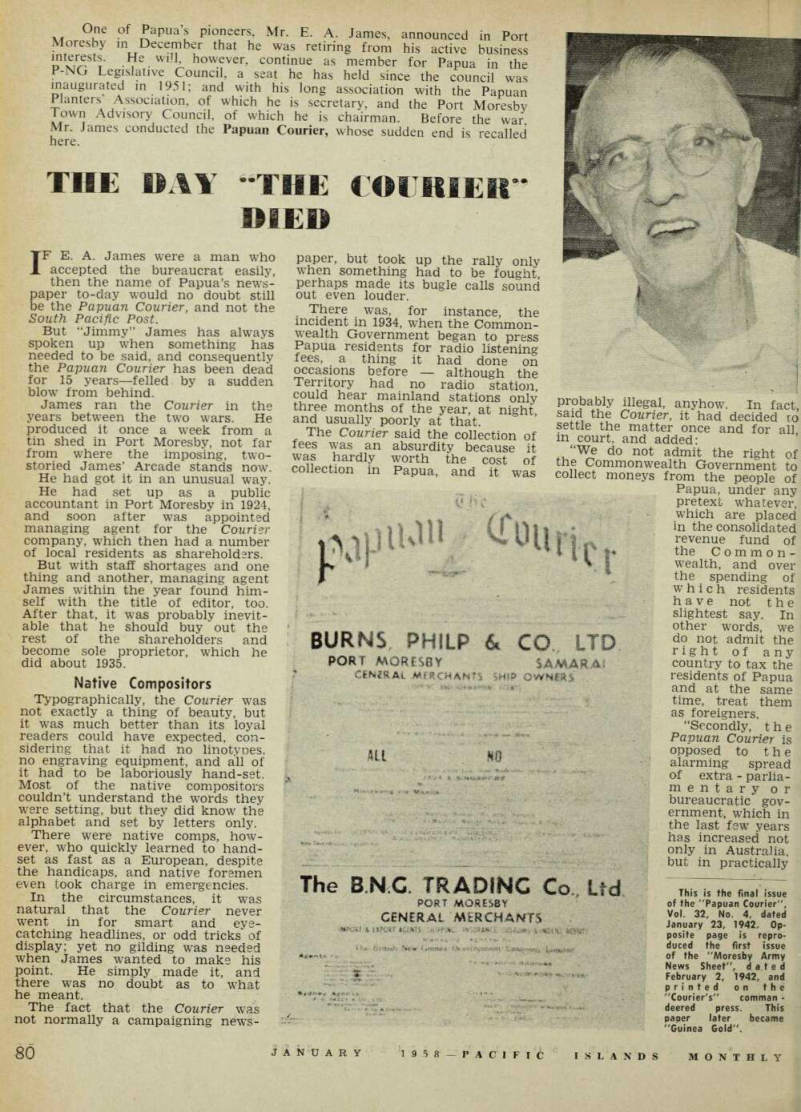
-° f £ apua ? P loneers ’ Mr - E - A. James, announced in Port Moresby in December that he was retiring from his active business ¥ e wi1 ’ how . ever > continue as member for Papua in the P-NG Legislative Council, a seat he has held since the council was inaugurated in 1951; and with his long association with the Papuan Planters Association, of which he is secretary, and the Port Moresby Town Advisory Council, of which he is chairman. Before the war Mr. James conducted the Papuan Courier, whose sudden end is recalled here.
IF E. A. James were a man who accepted the bureaucrat easily, then the name of Papua’s news paper to-day would no doubt still be the Papuan Courier, and not the South Pacific Post.
But “Jimmy” James has always spoken up when something has needed to be said, and consequently the Papuan Courier has been dead for 15 years—felled by a sudden blow from behind, James ran the Courier in the years between the two wars. He produced it once a week from a tin shed in Port Moresby, not far from where the imposing, two storied James’ Arcade stands now.
He had got it in an unusual way.
He had set up as a public accountant in Port Moresby in 1924, and soon after was appointed managing agent for the Courier company, which then had a number of local residents as shareholders.
But with staff shortages and one thing and another, managing agent James within the year found him self with the title of editor, too.
After that, it w r as probably inevit able that he should buy out the rest of the shareholders and become sole proprietor, which he did about 1935.
Native Compositors
Typographically, the Courier was not exactly a thing of beauty, but it was much better than its loyal readers could have expected, con sidering that it had no linotynes. no engraving equipment, and all of it had to be laboriously hand-set.
Most of the native compositors couldn’t understand the words they were setting, but they did know the alphabet and set by letters only.
There were native comps, how ever, who quickly learned to hand set as fast as a European, despite the handicaps, and native foremen even took charge in emergencies.
In the circumstances, it was natural that the Courier never went in for smart and eye catching headlines, or odd tricks of display; yet no gilding was needed when James wanted to make his point. He simply made it, and there was no doubt as to what he meant.
The fact that the Courier was not normally a campaigning news
paper, but took up the rally only when something had to be fought, perhaps made its bugle calls sound out even louder.
There was, for instance, the incident in 1934, when the Common wealth Government began to press Papua residents for radio listening fees, a thing it had done on occasions before although the Territory had no radio station, could hear mainland stations only three months of the year, at night, and usually poorly at that.
The Courier said the collection of fees was an absurdity because it was hardly worth the cost of collection in Papua, and it was
probably illegal, anyhow. In fact, said the Courier, it had decided ro settle the matter once and for all m court, and added: ‘‘We do not admit the right of the Commonwealth Government to collect moneys from the people of
Papua, under any pretext whatever, which are placed in the consolidated revenue fund of the Common wealth, and over the spending of which residents have not the slightest say. In other words, we do not admit the right of any country to tax the residents of Papua and at the same time, treat them as foreigners.
“Secondly, the Papuan Courier is opposed to the alarming spread of extra - parlia mentary or bureaucratic gov ernment, which in the last few years has increased not only in Australia, but in practically
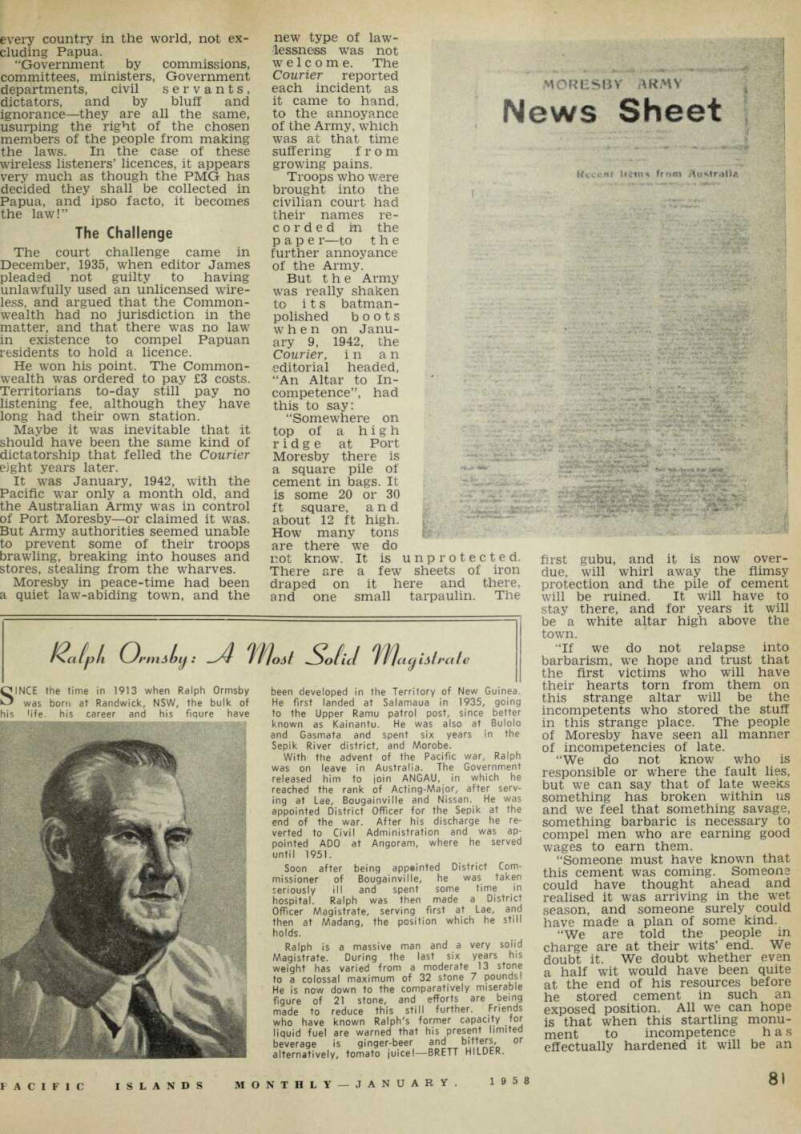
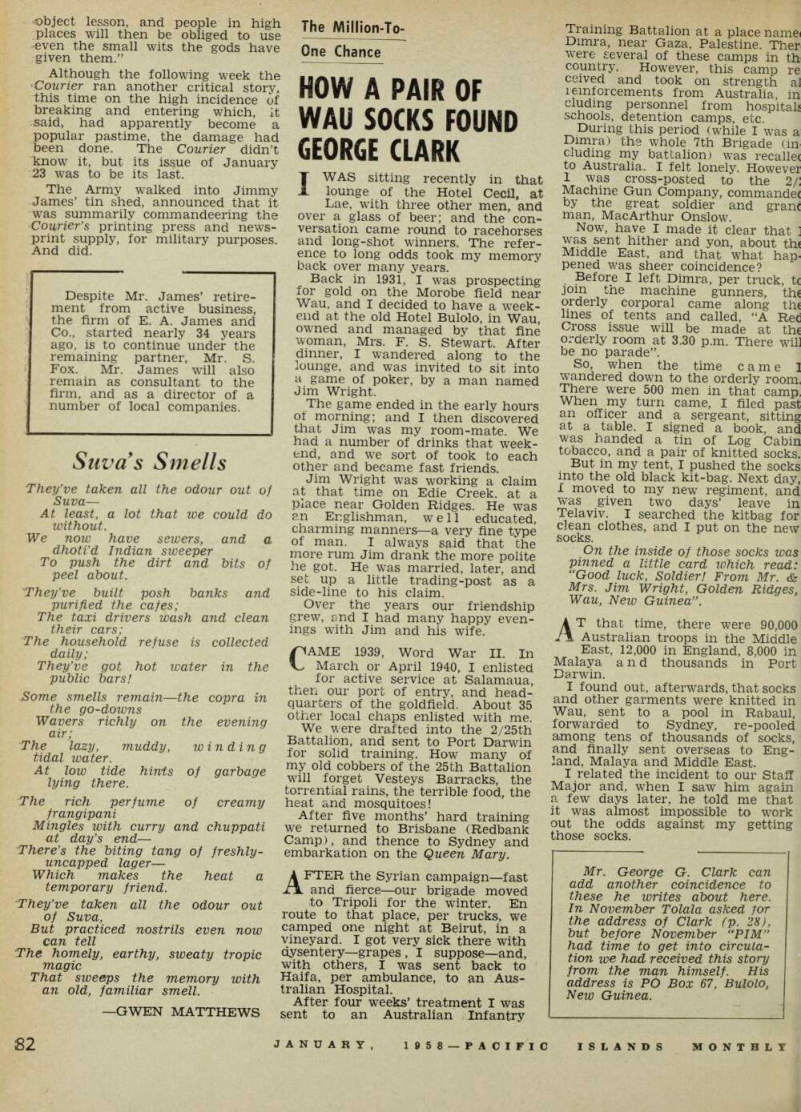
This is the final issue of the "Papuan Courier", Vol. 32, No. 4, dated January 23, 1942. Op posite page is repro duced the first issue of the "Moresby Army News Sheet", dated February 2, 1942, and printed on the "Courier's" comman deered press. This paoer later became "Guinea Gold".
every country in the world, not ex cluding Papua.
“Government by commissions, committees, ministers, Government departments, civil servants, dictators, and by bluff and ignorance—they are all the same, usurping the right of the chosen members of the people from making the laws. In the case of these wireless listeners’ licences, it appears very much as though the PMG has decided they shall be collected in Papua, and ipso facto, it becomes the law!”
The Challenge
The court challenge came in December, 1935, when editor James pleaded not guilty to having unlawfully used an unlicensed wire less, and argued that the Common wealth had no jurisdiction in the matter, and that there was no law in existence to compel Papuan residents to hold a licence.
He won his point. The Common wealth was ordered to pay £3 costs.
Territorians to-day still pay no listening fee, although they have long had their own station.
Maybe it was inevitable that it should have been the same kind of dictatorship that felled the Courier eight years later.
It was January, 1942, with the Pacific war only a month old, and the Australian Army was in control of Port Moresby—or claimed it was.
But Army authorities seemed unable to prevent some of their troops brawling, breaking into houses and stores, stealing from the wharves.
Moresby in peace-time had been a quiet law-abiding town, and the
new type of law lessness was not welcome. The Courier reported each incident as it came to hand, to the annoyance of the Army, which was at that time suffering from growing pains.
Troops who were brought into the civilian court had their names re corded m the p a p e r—to the further annoyance of the Army.
But the Army was really shaken to its batman polished boots when on Janu ary 9, 1942, the Courier, in an editorial headed, “An Altar to In competence”, had this to say: “Somewhere on top of a high ridge at Port Moresby there is a square pile of cement in bags. It is some 20 or 30 ft square, and about 12 ft high.
How many tons are there we do
not know. It is unprotected.
There are a few sheets of iron draped on it here and there, and one small tarpaulin. The
first gubu, and it is now over due, will whirl away the flimsy protection and the pile of cement will be ruined. It will have to stay there, and for years it will be a white altar high above the town.
“If we do not relapse into barbarism, we hope and trust that the first victims who will have their hearts torn from them on this strange altar will be the incompetents who stored the stuff in this strange place. The people of Moresby have seen all manner of incompetencies of late.
“We do not know who is responsible or where the fault lies, but we can say that of late weeks something has broken within us and we feel that something savage, something barbaric is necessary to compel men who are earning good wages to earn them.
“Someone must have known that this cement was coming. Someone could have thought ahead and realised it was arriving in the wet season, and someone surely could have made a plan of some kind.
“We are told the people in charge are at their wits’ end. We doubt it. We doubt whether even a half wit would have been quite at the end of his resources before he stored cement in such an exposed position. All we can hope is that when this startling monu ment to incompetence has effectually hardened it will be an
object lesson, and people in high places will then be obliged to use even the small wits the gods have given them.”
Although the following week the Courier ran another critical story, this time on the high incidence of breaking and entering which, it said, had apparently become a popular pastime, the damage had been done. The Courier didn’t know it, but its issue of January 23 was to be its last.
The Army walked into Jimmy James’ tin shed, announced that it was summarily commandeering the Courier’s printing press and news print supply, for military purposes.
And did.
Despite Mr. James’ retire ment from active business, the firm of E. A. James and Co., started nearly 34 years ago, is to continue under the remaining partner, Mr. S.
Fox. Mr. James will also remain as consultant to the firm, and as a director of a number of local companies.