[?]eportalion Queried in
pp. 49-50 · Read in the full issue
The “Why” Of
Ack Thornton
[?]eportalion Queried in ritish Parliament
i S was expected, the tireless Mr.
L Jack Thornton (who was de ported from Fiji in November, id transported by air from Nadi i London, at the Fiji Government’s tpense) caused a question to be ;ked in the House of Commons.
Why was Thornton’s visitor’s per it (to remain for four months in Lji) not renewed? What were the asons for his deportation?
A reply on behalf of the Colonial ffice said that Thornton entered Fiji i a visitor’s permit (four months) August, 1955; was allowed lother eight months “in order that 5 might complete a book”; was fused permission to remain another ;ar, but was allowed to remain bile he petitioned the Colonial Tice; in December, 1956, his petition as refused; was ordered to leave ie Colony in January, 1957. As he iled to depart, he was charged id convicted under the Immigra m Ordinance in March, 1957, and deportation order was made ainst him; and an appeal he made the Supreme Court was dismissed October, 1957. , CTUALLY, Thornton is a harm- L less and inconspicuous person, who probably would have been lowed to remain in Fiji, had he >t attracted unfavourable atten >n to himself through certain urnalistic activities, and through iwise friends.
The Fiji Government is not nearly strict in the application of its [migration laws as the details of lornton’s case suggest. Well haved persons, with visible means support, are not hounded out of e Colony unless the official eye is reed to observe them, and examine eir credentials.
Thornton, a wandering scribbler, is in and out of Fiji once or twice ior to 1955. When he returned in 55, he got a job with a small Suva ■ekly (now defunct), and he might ve been left alone had he not come involved with the “mystery the Joyita”. \HORNTON was living in Western Samoa, briefly, while the Joyita was at Apia, and he had a yage on her. When Joyita dis peared between Samoa and the •kelaus, Thornton (now back in ji) insisted that something of a rk and sinister nature had curred. As 1955 drew to a close, d the Joyita was discovered drift ? helplessly, all her company parently lost for ever, sensational
journalism built the incident up to a screeching climax.
There came one famous Saturday when a report, distributed from Suva, was blazoned across Australia’s newspapers, that the Joyita actually had been attacked, and her company removed or destroyed, by the Jap anese; and —horror of horrors!—it was suggested that this was the official view of the Government of Fiji.
A denial of the whole silly story —and especially of the Fiji Govern ment’s association with it—followed within a few hours; but it was too late —sensational journalism’s rabbit already was loose, and careering across half the world’s newspapers.
Rightly or wrongly, Thornton was blamed for much of that lunacy.
There is no doubt that he was ex tremely active in trying to solve the Joyita mystery, and in feeding lively reports on the subject to newspapers in New Fiji, New Zealand and Aus tralia. (Over)
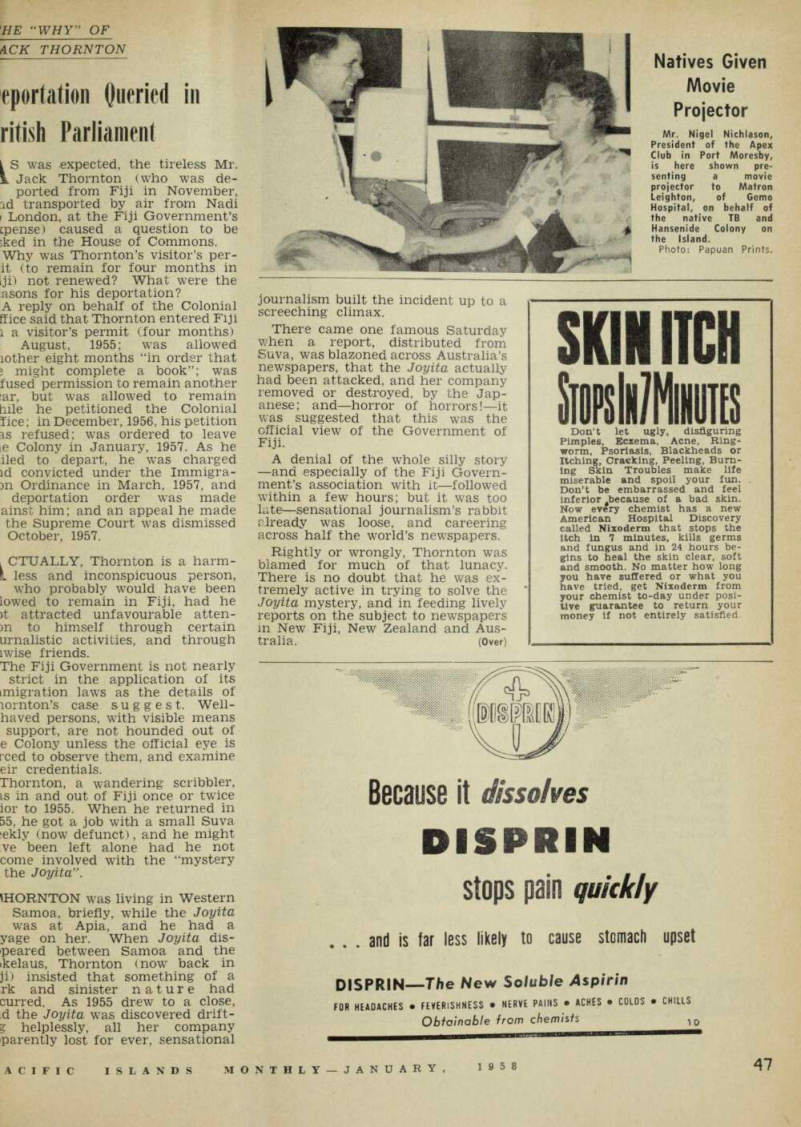
Natives Given
Movie
Projector
Mr. Nigel Nichlason, President of the Apex Club in Port Moresby, is here shown pre senting a movie projector to Matron Leighton, of Gemo Hospital, on behalf of the native IB and Hansenide Colony on the Island.
Photo: Papuan Prints.
IT is probable that it was at th stage that highest Fiji officia dom began examining tl Thornton credentials with a co and unfriendly eye.
If he had remained in his week newspaper job, he might have g by. But he returned to “free-lan and even free-lancers of his degree have difficulty sometimes providing assurances of an adequa income.
Thornton, legally, had no perm to remain beyond August, 1956; ar the guardians of Fiji law and ord set the machine working, accon mgly.
Thornton’s case was not helped I his friends. One of them wrote a article for a popular Sydney journa wnerein was presented a picture ( a lotus-eating Thornton at ease am: tropical pleasures, and amusing hin self at intervals by twisting tl beard of Fiji officialdom.
It was suggested that he had ir geniously defied every effort to d( port him. One almost could hea the resentful snort of high officia dom.
From that moment, Thornton fate was clear. The machine groun slowly and inexorably to his d( portation.
He made himself even more cor spicuous by engaging in litigatio over an alleged libel—a Sydne Bulletin reference to “irresponsih journalists” which, even if it ha been proven, was of so little cor sequence as scarcely to merit notio The case occupied Fiji’s Chie Justice and a jury of eight, in Fiji Supreme Court, for two weeks.
Small, inconspicuous and harm less, Thornton might have bee allowed to remain in Fiji, withor economic or social damage to th Colony. But, by criticising govern mental machinery, insisting on som odd angles in the Joyita story, defy ing the immigration machinery an engaging in unnecessary litigatior he attracted so much unfavourabl notice from the Immigration Offic that there was only one thing t be done with him.
But it cost the Fiji taxpayers man hundreds of pounds. A steam hammer to get rid of a mosquito! t The Governor of New Caledonia M. Aime Grimald, together with M Maurice Lenormand, New Caledonia] Deputy and leader of the majorit; party in the New Caledonian As ssmbly Territoriale, together witl M. Ohlen, New Caledonian Senator were called to Paris in Novembe to confer with the French Ministe: of Colonies. It is thought that thi summons is to smooth out certair difficulties that have arisen in th( application of the new “Loi Cadre”.