Territories Talk-Talk
pp. 30-34 · Read in the full issue

By Tolala
Queen Emma
FOLLOWING on Toaguba’s re marks in The Editor’s Mailbag (Oct. PIM, p. 14), on Memories of Queen Emma, I received a note from Mrs. Louisa Miller, of Vuvu, Rabaul, enclosing the Toaguba clip ping with which she enclosed a note: “When Queen Emma came back to Rabaul in 1912 she came to say ‘Good-bye’. Those two young girls came up with her for a trip, and returned with her; one was Miss Hyland, the other Miss W illiams. Queen Emma had a daughter, but she died at the age of ten years, in Samoa.”
The Jovial
Bishop Again
The yarn about Bishop Wade in December “Tropicalities” reminds me of another story this kindly, jovial missionary head tells against himself. It happened before he had been consecrated as the ecclesiastical RC governor of the Northern Solomons, and he was starting to unravel the mysteries of the written word to a crowd of small boys on the island of Pororan (Buka).
Writing his own name on a black board in the native school-house he explained the characters stood for “Thomas Capital J. Wade”.
Returning a few weeks later to the island, one bright-eyed youngster, instead of greeting him with the usual title of “Pater”, remarked:
“Good-day Thomas Capital J.
Wade.”
I have known a good many missionaries in NG, but Bishop Tom Wade heads the list of practical Christian do-gooders of my experi ence.
The Cloud On
The Horizon
The regrettable fracas, as it has been described, which occurred in Moresby on December 15, cannot be allowed to pass without some com ment; although anything that may be said of a constructive nature is at least ten years too late and I, for one, feel very much inclined to utter the cliche, “I told you so.”
Divested of all its complicities, the riot of the PIR is merely a manifestation of native reaction to lack of discipline being exercised by the government throughout the Territory in its administrative policy in dealing with the indigenes.
That such demonstration occurred amongst the ranks of a reputable section of the Army only emphasises how this lack of discipline has been followed, by more or less forceful measures, by every section of the community.
What surprises me more than anything else is that such a breach of the peace and flagrant disregard for law and order has not taken place before.
In some ways the incident is reminiscent of the Rabaul strike back in 1929, only that “first vague stirring of group consciousness” —as that incident was described by an eminent sociologist—was more adequately organised by the ring leaders, so much so that not an indication of such a movement was given to the Europeans until they awoke to find all native labour em ployees were absent from their duties.
It’s easy enough to close the stable door after the horse is stolen, but the Administration cannot deny that it has been warned that its
policy of bringing primitives into line with modern life must also be accompanied by certain disciplinary rules.
Through political influences —both Party and international —pressure has been brought to bear on giving the native his head. This same policy, naturally, has been a tion of enlistment for the members of the PIR and whether the appointment of officers to the Regiment, who know little of handH ling the natives, was a contributing factor to the mid-December fracai is best left to the public to decide, Personally speaking, I could noi imagine such a debacle occurring in the PIR ranks with such original members as “Bluey” Allan or Jack Mullaly. But then comparisons ars always odious. Save in this rei spect: The remarks of the GQC
Northern Command to me appea to be pomposity personified in a: endeavour to save military face o display a die-hard esprit de cori for troops of whom he shows a alarming amount of ignorance.
For a GOC to attempt to whit( wash an outstanding breach c military discipline indeed appears fl be not only alarming for the futui life of the Regiment, but a derelid tion of duty which calls for offici< explanation.
Be Prepared!
That is the old Boy Scouts’ motto and a very worthy one. It is a pit that our present army heads do nc signify their awareness of such] necessity with “Indonesia” ju s : across the border, threatening a kinds of things, with one eye on ttt Colombo Plan and the other on t|
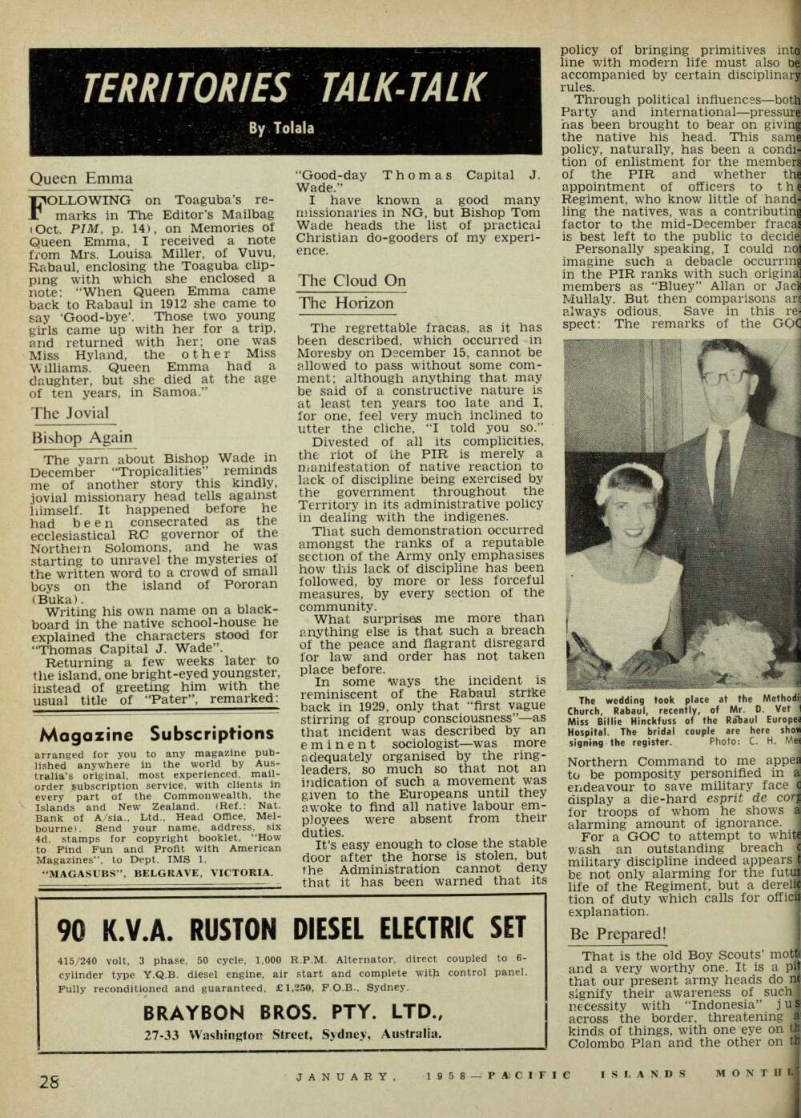
The wedding took place at the Methodn Church, Rabaul, recently, of Mr. D. Vet 1 Miss Billie Hinckfuss of the Rabaul Europea Hospital. The bridal couple are here show signing the register. Photo: C. H. Mee
ro-Asian conference, held in late cember.
Colombo Plan Casey, following in ? footsteps of Neville Chamber n with his umbrella, is doing his >t to lull Australia into a com icent frame of mind and Sydney ; least), with its jack-pot totes d an unlimited number of modern •s available on the HP system, ms quite prepared to be lulled. )ne aspect of this dolce far niente itude which passed my compu lsion was a paragraph in the uth Pacific Post, describing the FI riots: The Administrator, Mr. D. M. :ieland, going on leave had to [rive through the rioters to get 0 the air-strip.
Jo comment, save to say it seems ange for a Brigadier to be so red to lack of discipline amongst ops f that he could go blithely on way. I can hardly imagine Hubert Murray not delaying his itjay under such unusual condi is existing in the capital of the Titory, of which he was the re nsible head. .et’s hope there is some deep -1 security measure planned to be into operation when, and if, northern neighbours decide to ch out with their red talons, lerwise the sad events of 1942 y well be repeated.
e Perennial
liman rom old-timer Hans Mannsfeld les an interesting screed on the .iman derivation question. Says “After I had been in touch with 3ral old-timers I want to revise first explanation (as appearing PIM, Nov. 1956, p. 22), as fol s: As surmised by the first cor jondent who raised the question, word is perhaps derived from name of an old German and 7 likely from the name Rudolph: r Rudolph was once in charge he Botanical Gardens in Rabaail Master Gardener, and his pre sssor, Herr Zwanzger (later on —Kaiserlicher Stationsleiter —of engau, Manus) confirmed to that Rudolph was greeted in Rabaul Club during those days i the nick-name Radidiman. e usual abbreviation of Rudolph Rudi: Rudi- Radi- Radidiman).
Ay first explanation (Radi abbre ion for radish), may have in ed the club members to form nick-name. Zwanzger also re ed me to Herr Barschdorff, in >e days headmaster of the Ger i school at Namanula who, in jizger’s opinion, would be able /ouch for his explanation.” e then quotes at length, the l of Herr Barschdorff, who in ■War I days was a recognised lent of Pidgin and the Tolai ect, and who thinks the name iman was the native designation the Lloyd Quelle (Lloyd Spring)
i freshwater spring in the hills hind the Botanic Gardens-4-and gives recognised native jsffHixes d prefixes to account for “Radidi m.” But he is still at a loss to fiain the stem of the word idim” and suggests some of the i-time missionaries might be able help. fhe Lloyd Spring was well-known the old German days. Water from was piped by the Nord Deutcher Iyd shipping company to its Big larf at the end of Namanula eet (later burnt in 1923) for the rpose of supplying shipping. I /e an old town map of Rabaul, ;ed June, 1913, and it shows the yd Quelle located some 800 metres ■th of the intersection of Mango 1 Malaguna Road. [ans Mannsfeld, I discovered from letter, was managing Arawa ntation, down in Bougainville, in 0- where I met him, when the jroboard took over control, and man who relieved him was none er than Arthur Richards, the 1- plantation expert who still going strong in the Terri y.
Welcome
eeting
.t this time of year we all realise have had a surfeit of highly
decorative seasonal greeting cards embellished with snow, reindeers carol-singers and such-like; most of them wholly inappropriate to the southern hemisphere. Therefore I was particularly pleased to receive a greeting from Rabaul in the typical Douglas Pratt style, than whose sketchings of Australiana there is none better.
This year, after his visit to NG, he has caught the true island atmosphere and his “Rabaul from the Observatory” was a delight with Mount Mother towering above the Rabalanakaia crater, the South Daughter in the distance with Tavuvur in its foreground. A pleas ing memento of the town that is twined around my heart and I am grateful to Douglas Pratt for the creation of this thoughtful reminder —and the sender for remembering me.
A Popular
Reduction
Few people will disagree with the Full High Court’s decision to reduce the Anderson sentence, which Sir Owen Dixon described as being “extremely severe,” unless it be a few Canberra Jacks-in-Office who are always leaning over backwards in an effort to prove how extensive
the native welfare policy is being implemented, irrespective of the cost or who has to suffer.
To me the Anderson affair stank from start to finish, and was but yet another crucifixion of the P-NG Field Staff on the Canberra Calvary; another burnt offering to propitiate the political demi-gods.
Coming down to the personal level I should say that the most im portant matter for ex-ADO Ander son at the moment is rehabilitating himself, his wife and newly-arrived Prudence (a name every field officer should paste in his hat), and it is hoped that he will find no great dif ficulties in obtaining a suitable position.
CPL Shares
Choiseul Plantations Limited, which operates principally on Bougainville Island (and not to be confused with Copra Productions Limited, of Rabaul) has a scheme now to divide its £lOO shares into £1 units and to increase the capital from £150,000 to £500,000. At the be ginning of this month shares were quoted at £3lO.
The name of the company has been somewhat misleading insofar as its locality of activities is con cerned. Originally formed in 1912 to develop land on Choiseul Island
(BSD it centred its activities on the neighbouring island of Bougain ville, part of the German Solomons, receiving every assistance from the German government in selecting virgin country for extensive coconut planting.
This resulted in the establishment of Soraken, Baniu, Teopasino, Arigua and Kunua, all of which are amongst the most flourishing planta tions in the Territory. Walter Lucas (Island Inspector for BP) and Jim Campbell (manager of Berande, down in the Solomons) —both now passed on—selected the areas and set in motion the machinery that created these present-day very fine estates.
Profits last year amounted to £97,063 and a 30 per cent, dividend was declared. A good outfit, under good management.
Other Days
Other Ways
With Soerkano and his mob grab bing Dutch assets in “Indonesia” and banishing Dutch nationals from the country there comes to mind the days of 1921-22 in old Mandated New Guinea when German estates were being expropriated and their owners repatriated to Germany by the Australian government.
There is really no true analogy between the two cases: Soerkano is making his own laws; Australia was acting according to the Treaty of Versailles, but the same suffering was experienced, individual cases of hardship were the same and the same demonstration of man’s in humanity to man has been enacted.
The ultimate end has been the same, and it makes one wonder if there be such a document as the much-vaunted Bill of Human Rights.
The Governor of Fiji (Sir Ronald Garvey), Sir Hugh Ragg, Mr. Wilbur Donovan and Dr. Beckett (Superin-1 tendent at Makogai)—all represent-] ing Fiji—visited Christchurch, New Zealand, in December, to attend the annual conference on the adminisn tration of the Leper Hospitals in the South Pacific. The annual surH vey of conditions at Fiji’s famous institution at Mokagai Island was completely satisfactory.
New Guinea
Wedding
Shown here are Mr. and Mrs. P. Rodway after their marriage at the Methodist Church, Rabaul. With them are the Rev. W. Lutton who performed the ceremony; and Miss Merl Alexander, brides maid. The bride was formerly Miss Dorothy Hobran.
Photo: C. H. Meen.