Can't Lose Sight Of Individual ",
pp. 25-131 · Read in the full issue
[?]pua-New Guinea's Celebrated Court Case
[?]Ays High Court, Freeing Anderson
A series of criminal court proceedings which have caused great controversy in Papua-New Guinea, ended in late December when the High Court of Australia dealt with an appeal by Frederic Anderson, a former assistant district officer stationed at Tapini, in Papua.
HE High Court held that gaol sentences totalling 21 months, which had been imposed on Person by the Chief Justice of JG, Mr. Justice Mann, last Sep iber, were too severe, t ordered that Anderson be re >ed immediately—after having zed two months of his sentences hich, it said, was a term as great
as any of the convictions could justify.
The High Court was composed of the Chief Justice, Sir Owen Dixon, Mr. Justice McTiernan, Mr. Justice Webb, Mr. Justice Kitto and Mr.
Justice Taylor. Their decision was unanimous.
Counsel for Anderson, leading Sydney Queen’s Counsel, Mr. J. E.
Cassidy, assisted by Mr. A. H.
Conlon, had appealed against the severity of sentence and conviction on each of the five charges, and had also asked that the Court set aside Anderson’s plea of guilty on the fifth charge.
Hearing of the appeal, which was heard in Sydney, took two days.
Anderson was in court, released on bail from Bomana prison, Port Moresby, where he had been serving his sentences.
The following is a summary of the judgment, and of the main points made by counsel for Ander son and for the Crown, together with relevant comments made by the judges during progress of the appeal.
What Anderson Said:
Mr. J. E. Cassidy, QC, made these points: • Anderson had pleaded guilty to having unlawfully detained Avila be cause he had been shocked at the court’s decision on the other four charges against him. He had felt a plea of guilty was then the best course-open to him. • Mr. Justice Mann had thought Anderson had acted as a magistrate, and had thus abused his position as a magistrate, and he had taken this as an aggravating matter. But Mr.
Justice Mann had clearly been in error in adopting this view.
"Many Misconceptions"
• Avila had already been in con finement when Anderson returned from patrol, and Anderson had merely continued the confinement, failing to give a proper remand.
This was not criminal, as Mr.
Justice Mann apparently found it was. • Mr. Justice Mann had had
many misconceptions. He had had the idea that Avila would have been left in jail indefinitely by Ander son, but this wasn’t right. Anderson had made no effort to conceal Avila’s presence in gaol. His name had been in the gaol book. • The nature of Avila’s confine ment had not been as Mr. Justice Mann pictured it. Avila had worked about the area, and even been on patrol, and the inference that should have been drawn was that Avila was acquiescing in the confinement. • Avila had, in fact, gone into voluntary protective custody to avoid a payback from his fellow natives. Anderson was preventing a breach of the peace. • Both indictments of having de prived Avila of liberty by fastening him to a flagpole, and of having unlawfully detained him in gaol, could not stand, because the way the charges were made out, Ander son would be twice punished for the same offence.
Mr. Justice McTiernan asked at this stage whether a native would regard gaol as a punishment.
"Gaol is Nothing"
Mr. Cassidy: Not always, by any means.
Mr. Cassidy read an Administra tion report about a Goilala native who had returned home from a gaol sentence in Port Moresby and told his friends that he had been well fed and housed, and that “gaol is nothing. They did not kill us”
Sir Owen Dixon said he under stood about protective custody, but asked what was done legally when that course was to be adopted.
Mr. Cassidy replied that in Ander son's mind it would not have been illegal, because it had been' a practice long in operation in the Territory, and it was still in opera tion. • Mr. Justice Mann should have (over)
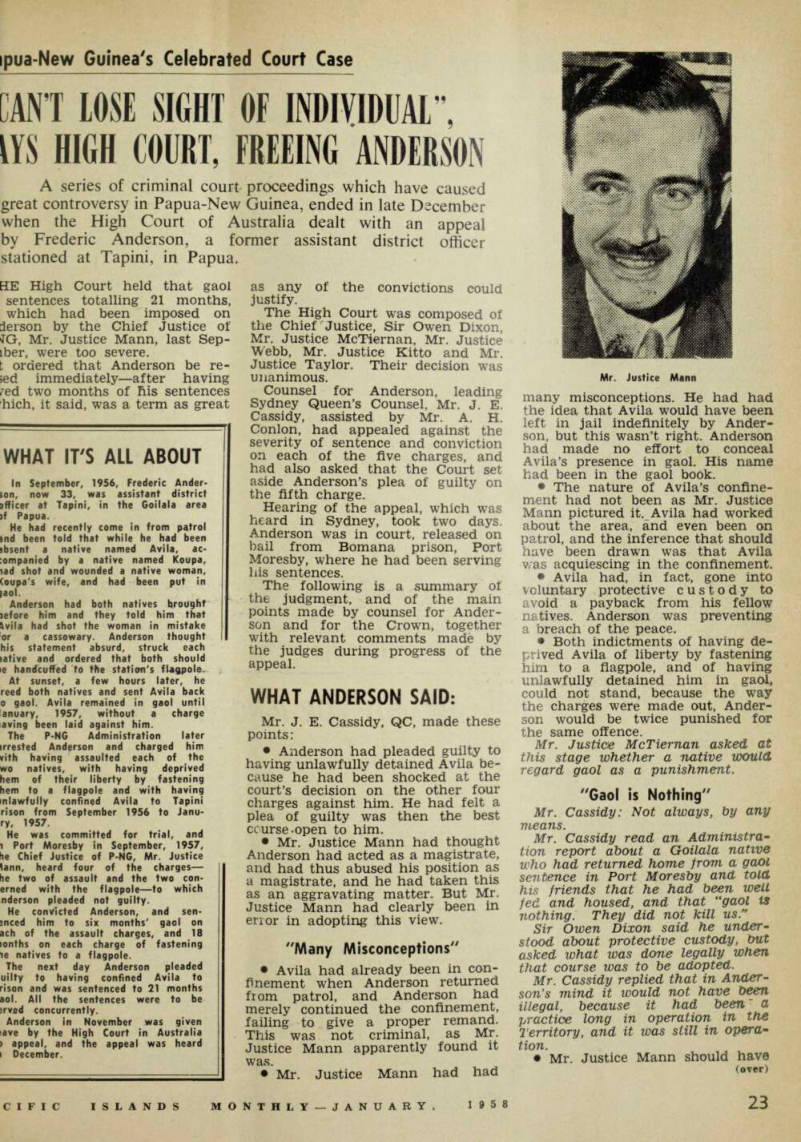
Mr. Justice Mann
given greater weight to the fact that it was customary in some cases to detain people for their protection, and he shouldn’t have given such a heavy penalty. • Mr. Justice Mann had not taken Anderson’s character fully into account when fixing the sentences.
Anderson; was respected by the natives (who had given him a big farewell) and the Administration had had a high opinion of his ad ministrative ability.
He had been 17 months in Tapini under cumulative pressure of work and domestic worry because of his wife’s health. The picture was really one of a who had lost his control and temper, which was in significant.
"Was No Malice" • After the first day, there had never been a repetition of the assault, or any malice or unfair dealings towards Avila, and these matters should have been taken Into account.
Mr. Justice Webb asked if it would be correct to say that Mr.
Justice Mann based punishment on the fact that he thought Anderson had shown too much zeal and ambition.
Mr. Cassidy said he based it on that, plus the fact that he thought Anderson had abused his magisterial powers. Mr. Justice Mann had been unfamiliar with the north. He had been in the Territory since June, 1957, and the Anderson case had occurred only three months later.
What The Crown Said:
These points were made by Mr. C.
Shannon, for the Crown, in his reply to the appellant’s case: • The prosecufion had not alleged that Anderson had been acting as a magistrate. It had said Anderson had been a police officer who had acted unlawfully. • Nor had it been the basis of Mr. Justice Mann’s judgment that Anderson was acting as a magis trate. The Chief Justice had not convicted because of that, but he had had in mind that Anderson had a threefold function and that the natives would not know what par ticular function he was performing.
Anderson was a police officer and magistrate, using his position as administrator to procure a confession that would be used in committal proceedings. • Anderson at no time had in dicated he was arresting the men handcuffed to the flagpole. He had chained them there as a way of securing a confession by improper means.
Mr. Justice Taylor: He already had a confession.
Mr. Shannon: No, he didn’t.
Anderson has already said he teas seeking to get one.
"Close Confinement"
Mr. Justice Taylor replied that there could be no dispute about the point. The two natives had said they shot the woman because they thought she was a cassowary, and “that wasn’t a bad sort of con fession.” • The whole picture had to be looked at. Anderson had been frus trated because he couldn’t get Avila to confess. • Avila had been kept in close confinement, “according to the Crown’s instructions.”
Mr. Justice Taylor: He seems to have been out of gaol more often than in it! Yet the charge says he was unlawfully confined to Tapini gaol against his will.
Mr. Shannon: In a legal sense he was confined.
Mr. Justice Taylor: But we don’t knew what he was doing.
Judge Experienced
Sir Owen Dixon commented that he still had difficulty in understand ing why Mr. Justice Mann thought Anderson’s detaining of Avila in gaol vms the more serious offence. Ander son may have acted in a way that could not be justified, but he had done irregularly something that he could have done lawfully anyhow, by remanding Avila. He did not
understand why the Chief Justice took such a serious view of it.
The Administration, naturally, ha\ to he firm in safeguarding th natives against miscontrol, hut th criminal law and the administrate\ of natives were different things. Th sentences imposed seemed to he vet severe when looked at from th point of view of administration.
The High Court seldom interfere vhth sentences and liked to giv effect to local knowledge hut, o course, the effect on the individm had to be taken into account, S\ Owen Dixon added. • There could be no question c the Chief Justice being exper: enoed. He had done more than or circuit of the Territory.
Sir Owen Dixon said he did m want to hear the Crown on th question of the withdrawal of th guilty plea. The plea had to stand
What The High Court Saie
In giving its, judgment, the Fu High Court made these points: • There were no circumstanci which would justify Anderson beir allowed to withdraw his plea.-i guilty on the fifth charge. • The real question was tl severity of the sentences, which we: considerably severe. The eight weel already served by Anderson was i great as any of the convictions cou! justify, and many -might think t( great a punishment. • Anderson’s assault on th Papuans, including his handcuffir of them to a flagpole, was ui lawful, but no great harm was dor to the natives. • In detaining Avila in gat
(Continued on page 129)
ierson acted irregularly, but that 5 all.
Mr. Justice Mann’s view that re had been insufficient evidence put Avila on his trial (so that would thus be kept in custody) ; not the view of the High Court, la could have been committed trial.
Anderson had kept Avila only a loose kind of arrest.
Dangerous Territory
' On a question of punishment, case of the individual had to be en into account. Anderson had n a trusted servant of the Crown, h a creditable record, working a dangerous territory with little and great responsibility. His ions had brought him to disaster, i his life must appear to him be in ruins. These were matters be considered. • Anderson’s total gaol sentences 21 months would therefore be )wed to expire on the date he i been allowed bail to attend the Deal.