Government’S Handling Of
p. 22 · Read in the full issue
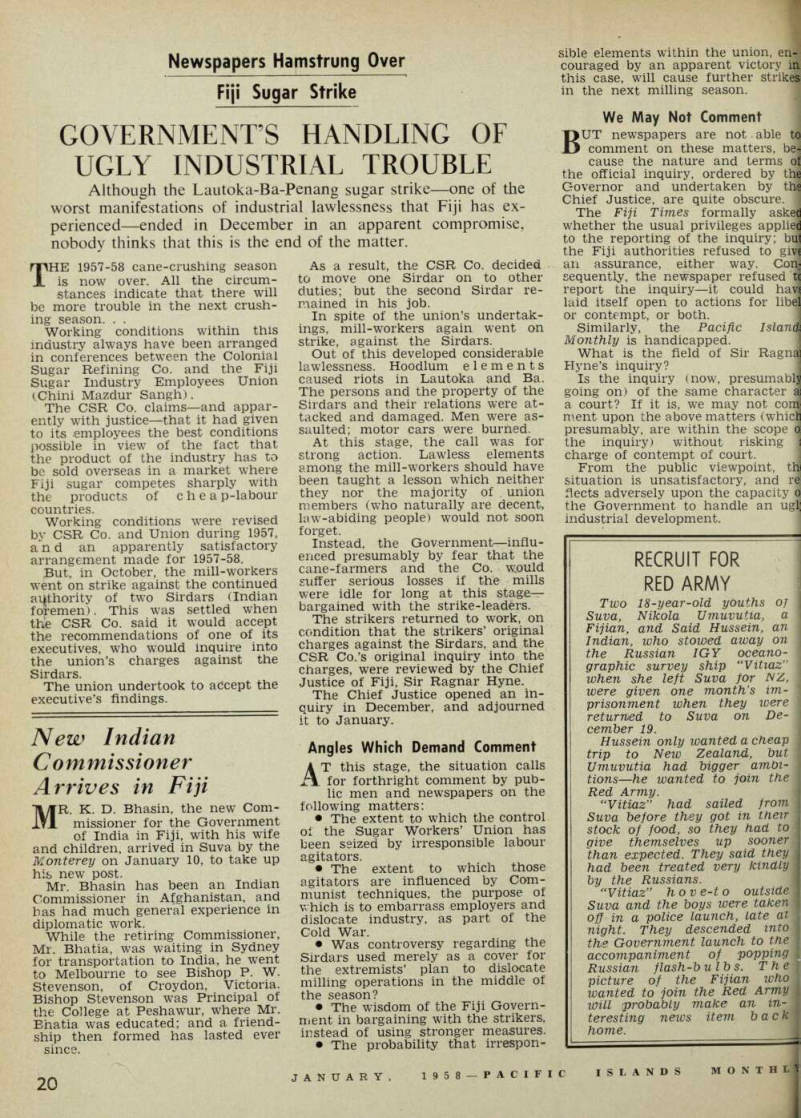
Newspapers Hamstrung Over Fiji Sugar Strike
Ugly Industrial Trouble
Although the Lautoka-Ba-Penang sugar strike—one of the worst manifestations of industrial lawlessness that Fiji has ex perienced—ended in December in an apparent compromise, nobody thinks that this is the end of the matter.
THE 1957-58 cane-crushing season is now over. All the circum stances indicate that there will be more trouble in the next crush ing season. . .
Working conditions within this industry always have been arranged in conferences between the Colonial Sugar Refining Co. and the Fiji Sugar Industry Employees Union (Chini Mazdur Sangh).
The CSR Co. claims —and appar ently with justice—that it had given to its employees the best conditions possible in view of the fact that the product of the industry has to be sold overseas in a market where Fiji sugar competes sharply with the products of ch e a p-labour countries.
Working conditions were revised by CSR Co. and Union during 1957, and an apparently satisfactory arrangement made for 1957-58.
But, in October, the mill-workers went on strike against the continued ai|thority of two Sirdars (Indian foremen). This was settled when the CSR Co. said it would accept the recommendations of one of its executives, who would inquire into the union’s charges against the Sirdars.
The union undertook to accept the executive’s findings.
As a result, the CSR Co. decided to move one Sirdar on to other duties; but the second Sirdar re mained in his job.
In spite of the union’s undertak ings, mill-workers again went on strike, against the Sirdars.
Out of this developed considerable lawlessness. Hoodlum elements caused riots in Lautoka and Ba.
The persons and the property of the Sirdars and their relations were at tacked and damaged. Men were as saulted; motor cars were burned.
At this stage, the call was for strong action. Lawless elements among the mill-workers should have been taught a lesson which neither they nor the majority of union members (who naturally are decent, law-abiding people) would not soon forget.
Instead, the Government —influenced presumably by fear that the cane-farmers and the Co. would suffer serious losses if the mills were idle for long at this stage bargained with the strike-leaders.
The strikers returned to work, on condition that the strikers’ original charges against the Sirdars, and the CSR Co.’s original inquiry into the charges, were reviewed by the Chief Justice of Fiji, Sir Ragnar Hyne.
The Chief Justice opened an in quiry in December, and adjourned it to January,
Angles Which Demand Comment
A T this stage, the situation calls for forthright comment by pub lic men and newspapers on the following matters: • The extent to which the control of the Sugar Workers’ Union has been seized by irresponsible labour agitators. • The extent to which those agitators are influenced by Com munist techniques, the purpose of which is to embarrass employers and dislocate industry, as part of the Cold War. • Was controversy regarding the Sirdars used merely as a cover for the extremists’ plan to dislocate milling operations in the middle of the season? • The wisdom of the Fiji Govern ment in bargaining with the strikers, instead of using stronger measures. • The probability that irrespon
sible elements within the union, en couraged by an apparent victory in this case, will cause further strikes in the next milling season.
We May Not Comment BUT newspapers are not. able to comment on these matters, be cause the nature and terms of the official inquiry, ordered by the Governor and undertaken by the Chief Justice, are quite obscure, j The Fiji Times formally asked whether the usual privileges applied to the reporting of the inquiry; but the Fiji authorities refused to give an assurance, either way. Con sequently, the newspaper refused tc report the inquiry—it could have laid itself open to actions for libel or contempt, or both.
Similarly, the Pacific Islandi Monthly is handicapped.
What is the field of Sir Ragna Hyne’s inquiry?
Is the inquiry (now, presumably going on) of the same character ai a court? If it is, we may not com! ment upon the above matters (whicM presumably, are within the scope o: the inquiry) without risking I charge of contempt of court.
From the public viewpoint, thj situation is unsatisfactory, and re fleets adversely upon the capacity o the Government to handle an ugl; industrial development.