Br. Planters Expect Lower Incomes
pp. 21-132 · Read in the full issue
Pacific Copra [?]ers New Phase
With End Of Mof Agreement
The year 1958 will be an important one for British copra producers in the South Pacific. Most of them face a considerable reduction in their incomes as copra reverts, for the first time since the war, to free marketing. But it is free marketing with a difference.
IE 9-years-old contract, under which the British Ministry of Food purchased the whole of the liable copra output of Papua, v Guinea, Solomons, Gilbert and ce, Fiji, Western Samoa and iga, expired on December 31. s from January 1, 1958, the in le of the British copra producers the South Pacific will be like 5e of the non-British people— dated by the world price, he world market price has been some time below the MOF tract price; but is tending to rise mse political disturbances are tting off the Indonesian supply >ut one quarter of the total world iuction). 11 the British Territories, except , have entered into an agree it in UK with Unilever Limited ; big international organisation) er which Unilever will take i e proportion of their output, at •ice fixed, from month to month, the ruling rate for Philippines •a. bis agreement is limited to 1958 early half of the Papua-Nev nea output, and a very large >ortion of the Fiji output, wil; sold to the Carpenter crushing s in Rabaul and Suva. On pre indications, the price offered the mills in both Suva and aul will be from £2 to £3 per better than the prices available vhere. rerefore, in 1958, the two factors y to dominate the South Pacific a market will be the averagt 3 offered in Manila for Philip s Fair Merchantable Grade, anc price offered by the Carpentei > in Suva and Rabaul. Arrange ts have been made to quote e prices—or a reliable approx ;ion of same—in each month’; 5 of Pacific Islands Monthly.
E following are the arrange ments operating from January 1958, in the various Territories:
Apua And New Guinea
1 copra produced must be de ed to the P-NG Copra Board, the assumption that the pro ion is about 100,000 tons per im, the Board proposes to dis of the output thus:
Tons, per annum To Unilever, European port 20,000 To Australia (local consump
tion) .. .. 35,000
To Crushing Mill, Rabaul .. 40,000 To Open Market 5,000 The price to be paid for deliveries to Unilever will be the current price of Philippines Fair Merchantable Grade at time of delivery at British or Continental ports, on delivered weight; less 2 per cent., and plus 50/- Stg. per ton for hot-air-dried, 25/- per ton for sun-dried, 10 per ton for smoke-dried, but no premium and a deduction of 10'if graded No. 2 smoke-dried or less.
Deliveries by the Board to Aus
(Continued on page 130)
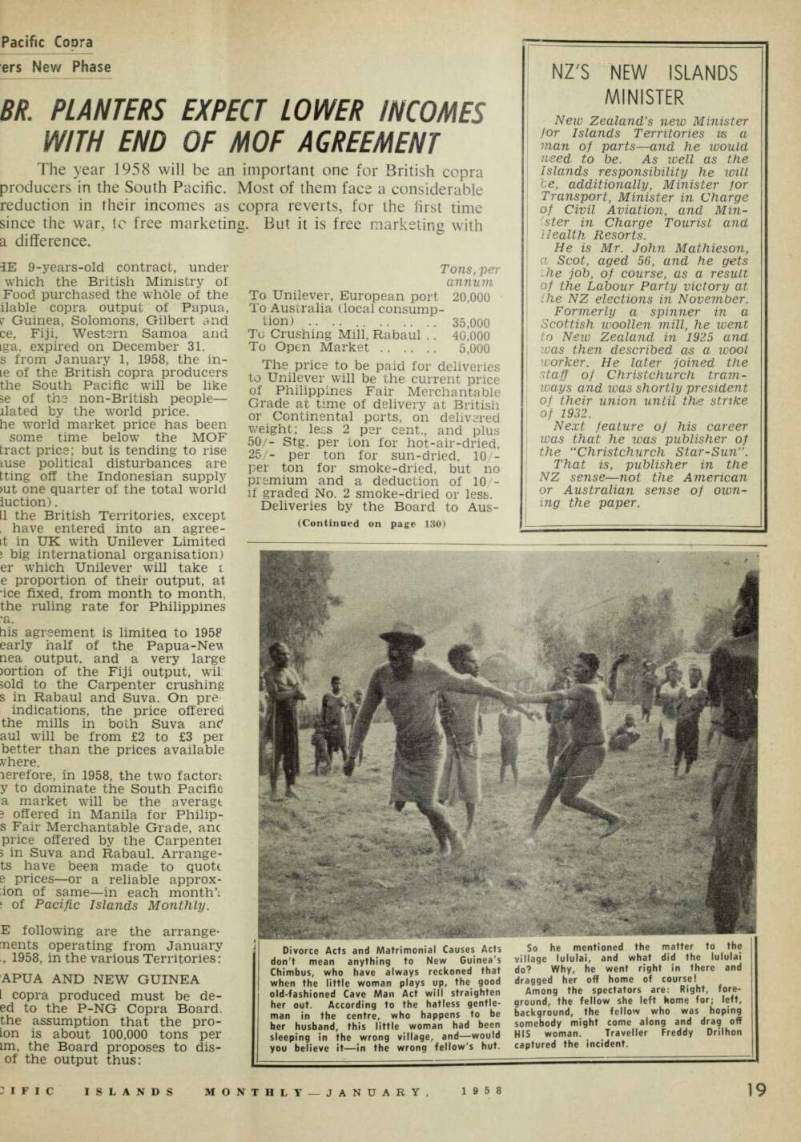
Divorce Acts and Matrimonial Causes Acts don't mean anything to New Guinea's Chimbus, who have always reckoned that when the little woman plays up, the good old-fashioned Cave Man Act will straighten her out. According to the hatless gentle man in the centre, who happens to be her husband, this little woman had been sleeping in the wrong village, and— would you believe it—in the wrong fellow's hut.
So he mentioned the matter to the village lululai, and what did the lululai do? Why, he went right in there and dragged her off home of course!
Among the spectators are: Right, fore ground, the fellow she left home for; left, background, the fellow who was hoping somebody might come along and drag off HIS woman. Traveller Freddy Drilhon captured the incident.
tralia and to the Rabaul mill w be on prices subject to negotiate —and such prices presumably w be regulated by the Unilever pri< which in turn is regulated by t free world market.
For provisional price, paid on wtu Rabaul, m January, see page 160.
Solomons And Gilbert An
Ellice
The copra output will be deliver! to a Copra Marketing Board whic in turn, has made arrangements dispose of the bulk of its copra, du ing 1958, to Unilever, on an arrangi ment similar to that made for Papi and New Guinea.
Fiji
There is no official marketing ir strumentality—producers now ms sell where they please.
The chief factor here regulatir the market is the price at whic copra will be purchased by tt Carpenter mill in Suva, whic henceforth is broadcast from Suv once a week. The first broadcast b the mill (Island Industries Ltd.; made on Wednesday, January offered the following prices in Fijia currency, on wharf in Suva:
(To convert to Australian currency add approximately one-eighth.) “ The Suva mill’s price in earll January appeared to be about £ less than the MOF contract pric: which ruled until December 31, bui about £2 better than the worl« market price, cif, European port Comparisons are difficult, however being complicated by currency ex: change differences, and by the cost of transportation (freight, insur ance, handling, shrinkage) between Fiji and Europe.
Tonga
The output of Vavau and Haapi goes to Unilevers, on a Philippines based price. The Tongatabu output is for the free market —it may go to USA, if the price is attractive The Government gathers anc markets the copra.
Western Samoa
All copra produced is delivered tc a Copra Board. During 1958, all copra will go (through C. and Co. Ltd., London, which acts also for Tonga) to Unilever, whiclr has undertaken to pay the Philip pines rate of the previous month, plus £3 per ton for hot-air-dried, 25/- for sun-dried No. 1; payment} on arrival of the shipping documents in London. * * * For latest Philippines’ prices, seeE page 160.
Per To Hot-air-dried X 51 5. t 17 \ Fair Merchantable, Grade 1 50 10 ( Fair Merchantable, Grade 2 49 2 i