Impressive Figures
p. 113 · Read in the full issue
G Changes In
[?]Pua-N. Guinea
[?]partment Quotes Impressive Figures
[TERESTING facts and figures, bearing upon to-day’s conditions in Australia’s Pacific Islands critories, appear in a compilation ently published by Australia’s partment of Territories, entitled ygress of Australian Territories, 0-56.
Vhen the Pacific War came in 1, there were approximately 6,200 ropeans and 1,800 Chinese m pua and New Guinea. Both com nities were scattered and partly imated by the war (1941-45). ey returned quickly after the war t was estimated that in 1947 there :e 8,700 Europeans and 2,000 inese there. thereafter, increase in non igenous population was rapid—it s estimated, at the end of 1956, to 16,500 Europeans, 2,500 Chinese i 2,000 of mixed races.
"he native population still is esti ted at about li million —1,453,000 nted, and 266,000 not enumerated, n 1947, there were 1,174 public vants in P-NG, 16 in Norfolk md and 261 in Nauru. In 1956, ;re were 2,206 in P-NG, 23 in [•folk Island and 336 in Nauru. )ne wonders what those teams of )lic servants find to do in Norfolk md (8,528 acres and 1,039 popula i) and Nauru (5,263 acres, and )3 people—l,976 Nauruans, 286 ropeans, 696 Chinese and 935 er Islanders).
Iources Of P-Ng Wealth
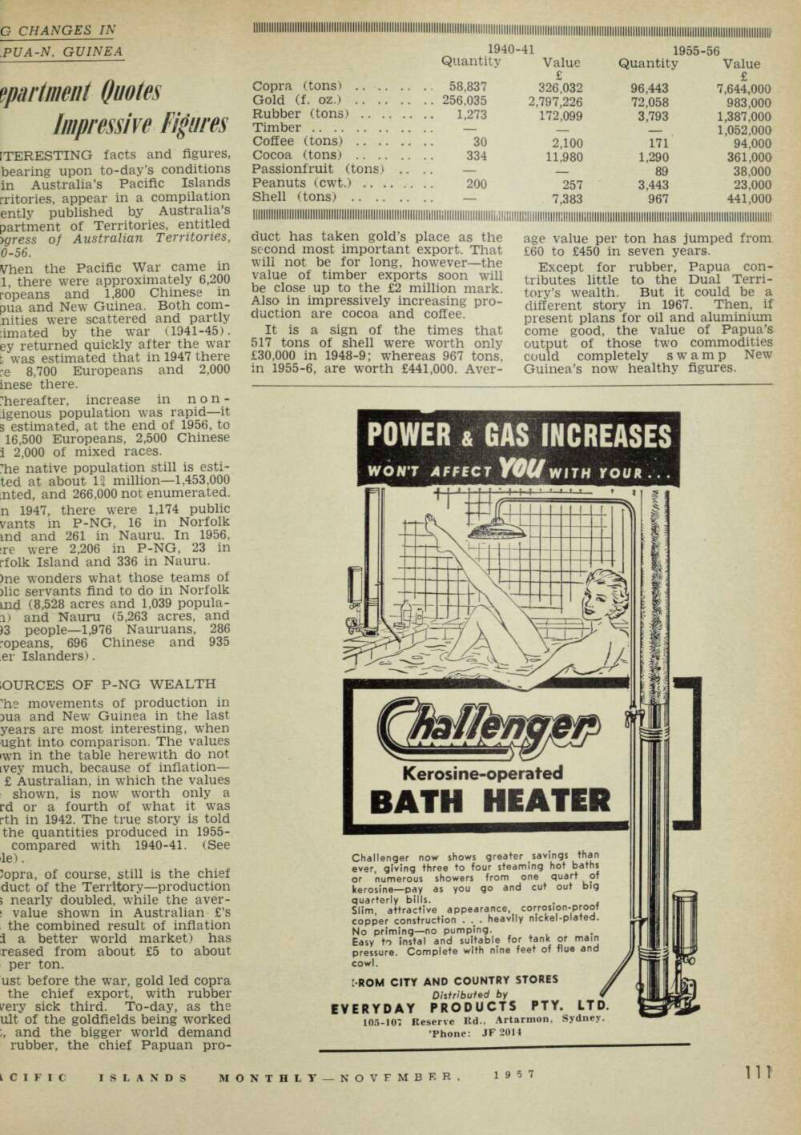
"he movements of production in Dua and New Guinea in the last years are most interesting, when ught into comparison. The values •wn in the table herewith do not ivey much, because of inflation — £ Australian, in which the values shown, is now worth only a rd or a fourth of what it was rth in 1942. The true story is told the quantities produced in 1955compared with 1940-41. (See le).
Jopra, of course, still is the chief duct of the Territory—production > nearly doubled, while the aver ; value shown in Australian £’s the combined result of inflation i a better world market) has reased from about £5 to about per ton. ust before the war, gold led copra the chief export, with rubber yery sick third. To-day, as the ult of the goldfields being worked ;, and the bigger world demand rubber, the chief Papuan pro-
duct has taken gold’s place as the second most important export. That will not be tor long, however—the value of timber exports soon will be close up to the £2 million mark.
Also in impressively increasing production are cocoa and coffee.
It is a sign of the times that 517 tons of shell were worth only £30,000 in 1948-9; whereas 967 tons, in 1955-6, are worth £441,000. Aver-
age value per ton has jumped from £6O to £450 in seven years, Exce pt tor rubber, Papua con tributes little to the Dual Terri torys wea ith. But it could be a different story in 1967. Then, if present plans for oil and aluminium come good, the value of Papua’s output of those two commodities could completely swamp New Guinea’s now healthy figures.
1940-41 1955- -56 Quantity Value Quantity Value Copra (tons) .. 58,837 £ 326,032 96,443 7,644,000 Gold (f. oz.) .. 256,035 2,797,226 72,058 983,000 Rubber (tons) .. 1,273 172,099 3,793 1,387,000 Timber — 1,052,000 Coffee (tons) 30 2,100 171 94,000 Cocoa (tons) 334 11,980 1,290 361,000 Passionfruit (tons) .. .. — 89 38,000 Peanuts (cwt.) 200 257 3,443 23,000 Shell (tons) 7,383 967 441,000