What Is Mr. Memizies Doing About “Staying"
pp. 69-73 · Read in the full issue


[?] Latitudes Or Positive Action?
In New Guinea?
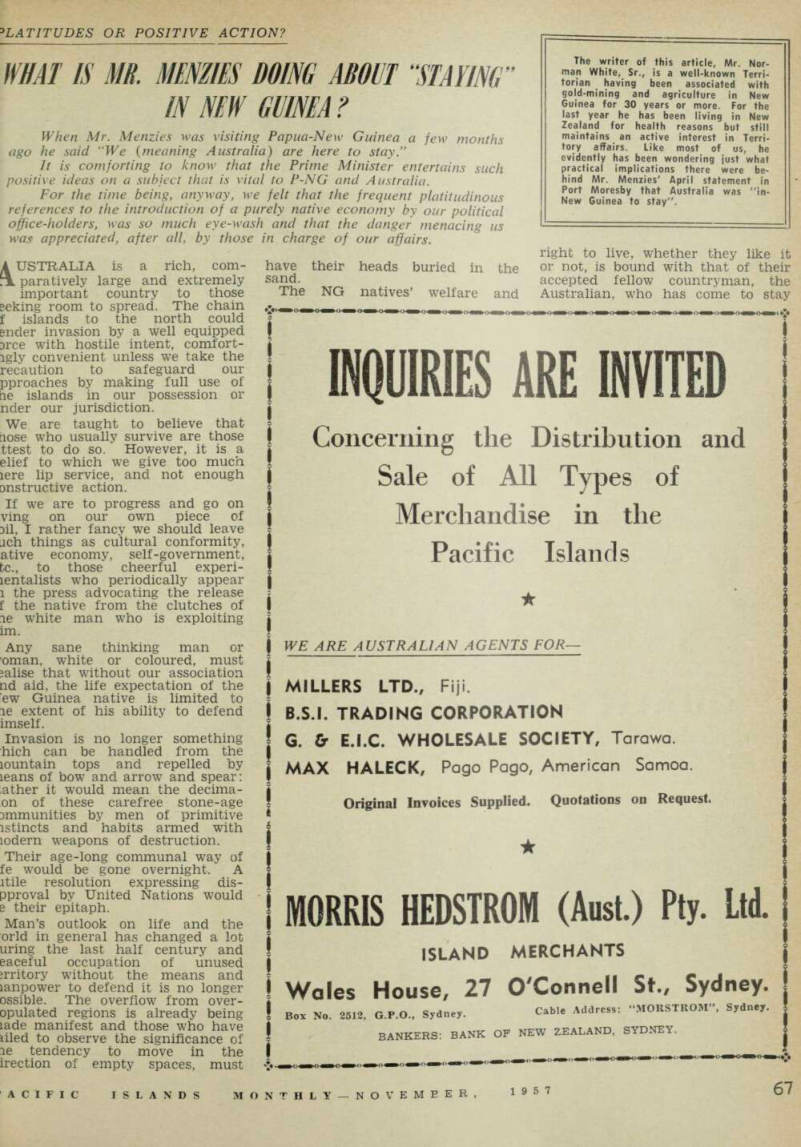
When Mr. Menzies was visiting Papua-New Guinea a few months ago he said “We (meaning Australia ) are here to stay.”
It is comforting to know that the Prime Minister entertains such positive ideas on a subject that is vital to P-NG and Australia.
For the time being, anyway, we felt that the frequent platitudinous references to the introduction of a purely native economy by our political office-holders, was so much eye-wash and that the danger menacing us was appreciated, after all, by those in charge of our affairs.
A USTRALIA is a rich, com nL paratively large and extremely important country to those geking room to spread. The chain f islands to the north could ender invasion by a well equipped grce with hostile intent, comfort igly convenient unless we take the recaution to safeguard our pproaches by making full use of tie islands in our possession or nder our jurisdiction.
We are taught to believe that tiose who usually survive are those ttest to do so. However, it is a elief to which we give too much lere lip service, and not enough Dnstructive action.
If we are to progress and go on ving on our own piece of Dil, I rather fancy we should leave ach things as cultural conformity, ative economy, self-government, tc., to those cheerful experi lentalists who periodically appear i the press advocating the release f the native from the clutches of le white man who is exploiting im.
Any sane thinking man or oman, white or coloured, must salise that without our association nd aid, the life expectation of the ew Guinea native is limited to le extent of his ability to defend imself.
Invasion is no longer something hich can be handled from the lountain tops and repelled by leans of bow and arrow and spear: ,ather it would mean the decima on of these carefree stone-age immunities by men of primitive istincts and habits armed with lodern weapons of destruction.
Their age-long communal way of fe would be gone overnight, A itile resolution expressing dis pproval by United Nations would e their epitaph.
Man’s outlook on life and the orld in general has changed a lot uring the last half century and eaceful occupation of unused jrritory without the means and lanpower to defend it is no longer ossible. The overflow from over opulated regions is already being lade manifest and those who have uled to observe the significance of le tendency to move in the irection of empty spaces, must
have their heads buried in the sand.
The NG natives’ welfare and
The writer of this article, Mr. Nor man White, Sr., is a well-known Terri torial! having been associated with gold-mining and agriculture in New Guinea for 30 years or more. For the last year he has been living in New Zealand for health reasons but still maintains an active interest in Terri tory affairs. Like most of us, he evidently has been wondering just what practical implications there were be hind Mr. Menzies' April statement in Port Moresby that Australia was "in- New Guinea to stay".
right to live, whether they like it or not, is bound with that of their accepted fellow countryman, the Australian, who has come to stay
ind is prepared to fight for the ight that is his.
To sit around discussing the tro’s and cons of a native economy ,nd eventual self-government is a legative occupation so far we are oncerned and nothing positive may ver be expected from it.
A mixed population and economy ogether with an eventual cultural alance and common language eems inevitable and we should put ur house in order and plan for ur proper protection with just bat as our objective.
Our near neighbours to the north nd north-west are Indonesia, lurma, India, China and our old fiends the Japanese whose need for srritorial expansion is now even reater than it was 15 years ago r hen they treated us to an nforgettable demonstration of hat they could do.
These few countries possess a opulation of something in the icinity of 1,300 million people— alf the world’s population—but ley do not, by a long way, occupy alf of the world area.
Some of them must in the near ature reduce numbers or seek dditional territory.
The idea of curbing population icrease by birth control having so ir failed to appeal, expansion in le direction of unoccupied areas finding favour especially if it
appears that those area’s are insufficiently protected.
There is nothing to be gained by ignoring the obvious and accepting life as we find it day by day; blindly believing that all is well with us and that others are happy to remain at home attending to their national and domestic con cerns.
I remember a China where women worked for 10 cents a day making delicate lace for wealthy Euronean women to wear; and men toiled as labourers for 35 cents.
Life there in those days for the submerged nine-tenths, was plain slavery and misery.
Floods and famine destroyed them in thousands, year by year, and for the most part the rest of the world was content just to look on.
Government by aristocrats, war lords and brigand chiefs, plus a written language without an alphabet and a population density difficult for an outsider to visualise, made life for the multi tude a heart-breaking, bitter struggle for sustenance.
Their emancipation began with the advent of Dr. Sun Yet Sen and was ably continued by his brother-in-law Chiang Kai Shek, after his death. China was awakening and becoming conscious
of the latent power of a popula tion of untold millions.
Western methods of eductation were being introduced and other leaders coming forward who were dissatisfield with progress being made by the pioneers of reform.
Chiang Kai Shek, forced to retire to Formosa, was replaced by yet another able leader Chou En Lai, who stepped up the tempo of progress to such an extent that the China we knew in the first and second decades of this century in a very short time disappeared entirely. This awakening country was fertile soil for the germination of the seed of Communism, or any other ism, which gave promise of filling the bellies and lightening the burden of the masses.
Russia, sensed the opportunity to provide herself with a powerful ally who could be of considerable assistance providing she could be kept under proper control. How successful Russia has been in that respect still remains to be seen.
The fact that Communism destroyed a cultured aristocracy capable of conforming to the demands of a progressive democracy, and replaced it with a new and uncultured autocracy aiming at world domination, appears to have been overlooked by the people whose objective was simply the better ment of living conditions and freedom as promised by their leaders. Instead they find them selves without freedom or franchise and unable to take either individual or communal action for their own benefit or protection.
Chou En Lai is fully aware that the area of China is insufficient to maintain its huge population.
Already he is on the move using methods of peaceful penetration wherever possible and military force when necessary.
INDIA, is in even a worse position with the population problem becoming more of a nightmare year by year. By means of peace
ful penetration, many of her peopli are finding homes overseas, but thii is a drop in the bucket and wil not solve India’s populatioi problem. With medical scienct prolonging the life of the individua and reducing infant mortality, wha; is to happen to her ever increasing surplus? They are not an aggressivi
ople and invasion from that arter seems too remote a ssibility to be considered.
But, they can be a thorn in the le of the British Commonwealth Nations. Their leaders talk ich and in matters of inter tional controversy are invariably be found in opposition to itain.
Mehru and Bandaranaika take eir seats at the conference table our Prime Ministers, hearing lat we have to say and possibly irning much of what we are inking.
Ml things considered I am dined to the belief that the mey donated to the Colombo in would be better employed sloping New Guinea and rthern Australia. To have many »re of our own people in both ices is urgent. ro what extent the Russians are erested in the South Pacific is Rcult to determine. They are not need of additional territory but ve given ample proof of their sire and intention to impose mmunist control over as much the world as is possible.
Dhey are in need of warm water :ts and judging by the progress ;y are making in Afghanistan d Yeman it should not be long ’ore they are established some ere in the Indian Ocean. When s happens we can certainly sit and take notice.
Jnidentified submarines have m reported from various parts the Pacific. They are neither itish. nor American and it is a itty safe guess whose flag they tv in the locker. |Y reason for writing this is to I draw attention to the need to consolidate our position and ke up our minds just what we end to do about it. Are we ng to allow ourselves to be tated to by that kindly but Bte organisation, United Nations? not, we may as well let it be 3wn that such is the case.
Ve need land laws to satisfy : just the Administration but the >ple. Also departments to work us—not just for the well-being departmental prestige and nity. Our position in regard to • native should be clarified so it all may understand and have i opportunity to attack us in the ;n or leave us alone, f the Australian Government lly looks on New Guinea as an egral part of the Common alth, why does it not invest in development by assisting more i more suitable Australians into ne kind of profitable produc n? Or by putting a definite ue on land held under lease m the Administration so that nks may be induced to give :h title an asset value and make ance available for its develop nt, as they do in Australia and ter countries.
It is six months since Mi’. Menzies visited the Territory. Were his brave words just more political rhetoric? Territorians are beginning to wonder.
They are prepared to believe that like those of the Gods, the mills of Government grind exceedingly small and slow. But in this instance they wonder if the wheels have got into motion at all. t Winners of the Cession Day Essay Competition in Fiji were Cecilia Johns, aged 16, of Loreto High School, Ovalau; Jean Belcher, aged 15, Taufa Vakatale, aged 19, Pamela McKearney, aged 16, and Mary Lazarus, aged 14, all of the Girls’ Grammar School; Manoa
Tawake, aged 16, of Lelean Memorial School; Salote Koroi, aged 16, of Ballantine Memorial School; Mua Viki, aged 17, of Queen Vic toria School; Parul Deoki, aged 17, of Dudley House, and Krishna Kumari, aged 19, of Shri Vivekan anda High School, Nadi. t Mr. Raututi Taringa, headmaster of Titikaveka School, Rarotonga, is enroute to London University to assist there in the compilation of a Rarotonga Grammar and Dictionary which is being undertaken by Dr.
Buse, of the School of Oriental and African Studies. Mr. Taringa’s visit in financed by the University.
Work in London will take a year, then Dr. Buse will return to the Cooks with Mr. Taringa to complete the project.