Starlings!
p. 67 · Read in the full issue
[?]ji Declares [?]other War
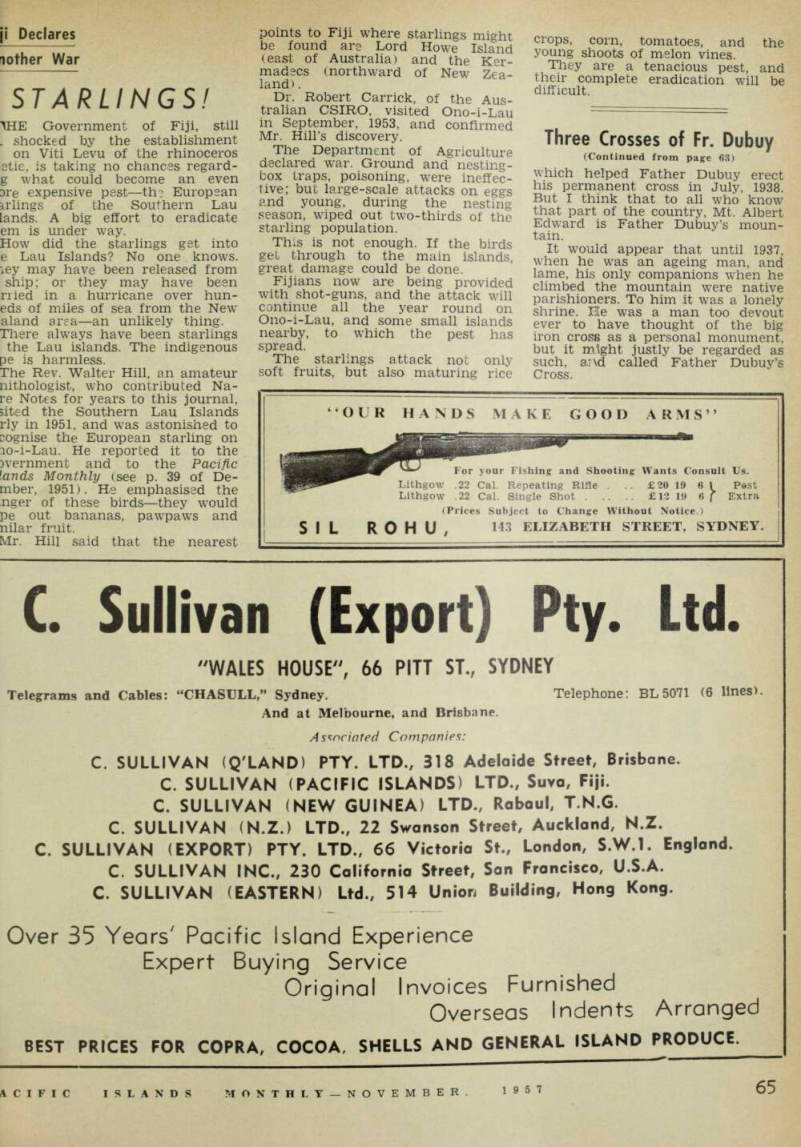
'IHE Government of Fiji, still . shocked by the establishment on Viti Levu of the rhinoceros etie, is taking no chances regard g what could become an even ere expensive pest—the European arlings of the Southern Lau lands. A big effort to eradicate em is under way.
How did the starlings get into e Lau Islands? No one knows. iey may have been released from ship; or they may have been riled in a hurricane over hun eds of miles of sea from the New aland area —an unlikely thing.
There always have been starlings the Lau islands. The indigenous pe is harmless.
The Rev. Walter Hill, an amateur nithologist, who contributed Na re Notes for years to this journal, sited the Southern Lau Islands rly in 1951, and was astonished to cognise the European starling on io-i-Lau. He reported it to the ivernment and to the Pacific lands Monthly (see p. 39 of De mber, 1951). He emphasised the nger of these birds—they would pe out bananas, pawpaws and nilar fruit.
Mr. Hill said that the nearest
points to Fiji where starlings might be found are Lord Howe Island (east of Australia) and the Ker madecs (northward of New Zea land) .
Dr. Robert Garrick, of the Aus tralian CSIRO, visited Ono-i-Lau in September, 1953, and confirmed Mr. Hill’s discovery.
The Department of Agriculture declared war. Ground and nesting box traps, poisoning, were ineffec tive; but large-scale attacks on eggs and young, during the nesting season, wiped out two-thirds of the starling population.
This is not enough. If the birds get through to the main islands, great damage could be done.
Fijians now are being provided with shot-guns, and the attack will continue all the year round on Ono-i-Lau, and some small islands nearby, to which the pest has spread.
The starlings attack not only soft fruits, but also maturing rice
crops, corn, tomatoes, and the young shoots of melon vines.
They are a tenacious pest, and their complete eradication will be difficult.