Mothered The Coastwatchers
pp. 52-53 · Read in the full issue
He Has Retired
The Man In The Panama Who Mothered The Coastwatchers
When the future looked pretty grim for Australia and for the American forces in the Pacific, back in September, 1942, US Marines slugging it out with the Japanese in the jungles and coconut groves of Guadalcanal had an unusual visitor.
HE was a short, blunt-featured, fresh-complexioned man with humorous and observant blue eyes who wore, of all things, an Immaculate palm beach suit and a snappy panama hat for his visits to the frontline fox-holes.
The Marines were no doubt secretly reassured. Things must be going better than they seemed when tourists of this kind were permitted to inspect the mayhem.
What the Marines didn’t know was that they were on Guadalcanal, delivering Uncle Sam’s first counter punch after Pearl Harbour, very largely by courtesy of the man in the Panama hat.
He was Walter Brooksbank, civil assistant to the Director of Naval Intelligence, RAN, who was largely responsible for the Coastwatchers.
Probably no other body of men
in any of the services made so de cisive a contribution to victory in the Pacific as that gallant, motley band of scouts who let the tide of Japanese conquest roll over them and stayed on in their lonely hide outs to spy on and report movements of the enemy’s ships, aircraft and troops.
Admiral “Bull” Halsey, looking back on the decisive days, said out light: “If it had not been for the Australian Coastwatchers we would not have been able either to mount the invasion of Guadalcanal or to hold the island after we had invaded it in the face of enemy air superiority.”
The idea of a Coastwatching ser vice for Australia’s northern approaches originated in the mind of a Royal Naval Officer looking over the Commonwealth’s defence
THIS story by Osmar White originally appeared in the "Melbourne Herald"—to which newspaper full acknowledgement is made —but was sent to us by Navy Public Relations Section shortly after the recent retire ment of Walter H. Brooksbank, who bore the vitaminised nickname of "B 1".
Navy thought that our readers would appreciate this tribute to a man who was the back-room operator with most to do with setting up the Coastwatchers organisation in the Islands of the S-W Pacific—one of Australia's most vital contributions to victory in the Pacific War.
B 1 has retired because he prefers Melbourne to Canberra—and although it is rather a frying-pan or fire choice, who can blame him? The implication is that he will spend his retirement writing. In Coastwatcher fact he should have the basis for a lifetime of fiction writing.
problems soon after the First Woi War. But the job of translating idea into something practical, som thing that really worked, fell to t lot of a young civilian who had ji been appointed to the brand nt Division of Naval Intelligence Melbourne.
The young man was Walt Brooksbank, not so long back frc France and Gallipoli with a Milita Medal and a commission in the 71 Battalion, AIF, won in the field.
The Coastwatching service idl appealed strongly to him. He w
imaginative man. He had read arts of the Japanese sampans ch roamed the north in search trepang and pearl-shell and :hus—filling in blanks on the 3 in their spare time, he organisation of a skeleton ming” service, an intelligence misation to keep track of the opers’ movements became some ig of an obsession and a hobby i “Bl” (as he was known to dis ;uish him from his brother, •m e r Lieut-Commander John oksbank, who was known to his nds as “B 2”).
Bl” canvassed plantation men in islands whose properties were in itegic locations; traders, miners, 1 missionaries. he Navy wasn’t spending money those halcyon days of a world j for democracy indulging in a sat Depression. “Bl” had noth to offer his embryo Coast ■chers but the satisfaction of ping an eye on the impudent e brown men —and the promise t if the balloon ever went up y could stake a claim on im rtality. ut when war did at last come, m years after the unheeded pre vious of Winston Churchill, the e bones of an organisation did >t, thanks to the stubbornness L patience of the slightly built, erful fellow who spent his life inly among the files of the most ;h-hush department in the x*Eicks n 1939, “Bl” recalls, they really cracking—roping into the service most motley collection of South i island characters ever linked ether outside a musical comedy.
Walter Brooksbank was the man whose prime responsibility it was to keep them supplied, encouraged, disciplined and protected as far as possible from the grim fate that awaited them if the enemy ever caught them.
To-day “Bl” retires from the Naval Intelligence Division after nearly 35 years of service—a little before his prescribed time, because he has grown to love Melbourne and doesn’t want to move to Canberra when his department officially transfers there.
His years as a hush-hush “backroom boy” have been filled by far more work, thinking and “fixing” for the Navy than was accounted
for in the great Coastwatcher ad venture. But it is for that adventure —an adventure which continues oven to-day in the Far North and our Islands outposts—that he will be remembered by every man who fought in the south-western Pacific.
He admits no retirement plans, but for years his hobby has been short-story writing and play-writ ing for radio. Those who know him declare there’s a spark in his eye —the spark of storytelling which has for years been subdued by the shadow of the massive “Most Secret” files, “Bl” is surely a writer with a big start in the job—something to say.
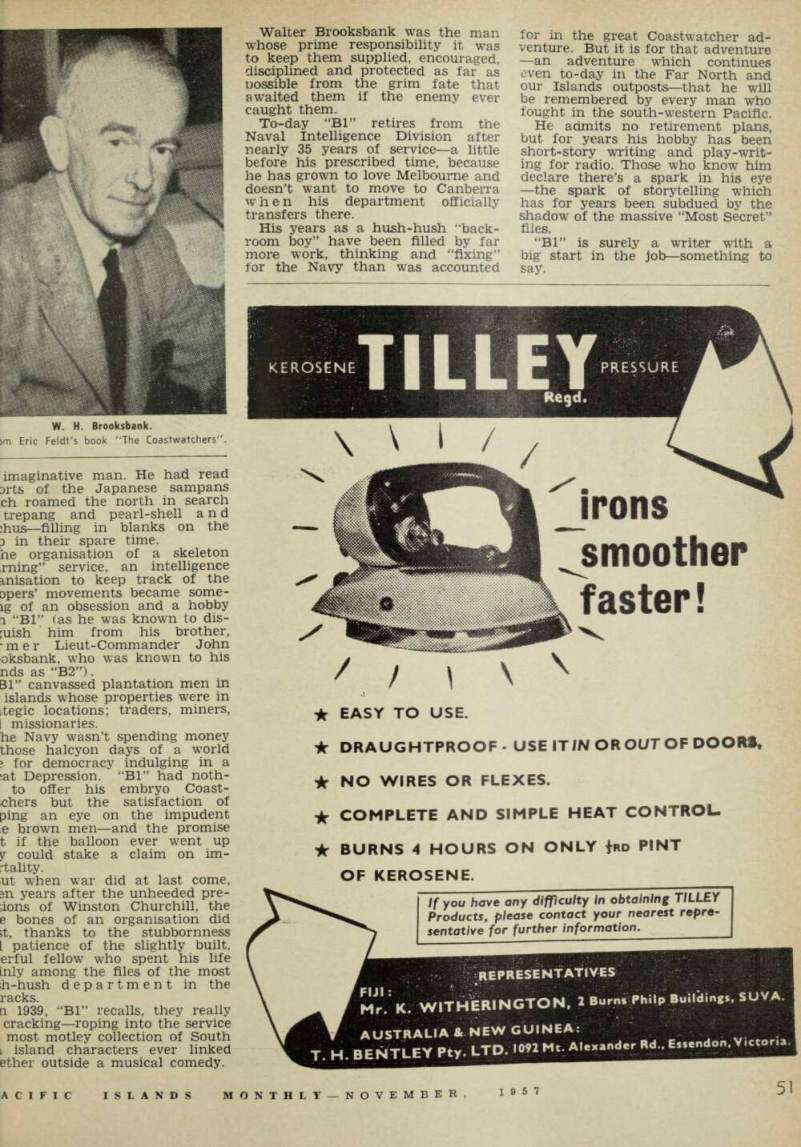
W. H. Brooksbank. [?]m Eric Feldt's book “The Coastwatchers".