Pacific Shipping And Cruising Yachts
pp. 43-129 · Read in the full issue

[?]is Month's News of—
Weather Broadcasts
hth another South Pacific hurri e season upon us we summarise known voice weather broadcasts the area:
Ort Moresby Radio : By Re
st only, on 6280 kc/s, coast lon replying on 6405 kc/s. From idcast station on 1250/6130 kc/s. iday-Friday, 0225, 0855, 1230, 2200 T; Saturday, 0225, 0855, 2155 T: Sunday, 0855 GMT.
Ila Radio: At 2115 Gmt On
I kc/s. Ships call on same fre ncy at other times.
Oniara Radio: On 5826 Kc/S.
rday-Friday, at 0400, 2300 GMT; arday, 2300 GMT. Nil Sunday, tn broadcast station on 1030/5960 5 at 0745 GMT; nil on Sundays.
Auru And Ocean Radios:
request only. Stations listen and ly 4413.8 kc/s 0430-0500 GMT
2145-2230 Gmt.
ARAWA RADIO: On request on
t. 4 kc/s, coast station replying
4413.8 kc/s 1745-0015 GMT and 0400 GMT till traffic cleared, days included. Broadcast station , 844/6050 kc/s for limited periods no information available re iing weather broadcasts.
Uva Post Office Radio:
4445 kc/s at 0230, 2130 GMT, also ■equest, ships on 4073.9 kc/s, dur daytime business hours.
UVA POINT RADIO (VRP ) : By lest on 4073.9 kc/s, Suva reply on 4379.3 kc/s at 0400 GMT; or >3OO GMT, ships on 8262.3 kc/s a at 8811.5 kc/s.
Ui Broadcasting Service
one or more of the following uencies: 840, 930, 3980 kc/s, at , 0707, 0907, 1907, 2007 GMT fol ng news, except Sunday: 2007,
’, 0907 Gmt.
ADI AERADIO: On 7530 kc/s at
I Gmt.
PI A RADIO: By request on 2182 ;, coast station replying on 2206 ;. Broadcast station on 1420 > gives weather during news at GMT, Monday, Wednesday, Fri , Saturday.
Ukualofa Radio: By Re
st on 2182 or 2080 kc/s, coast ion replying 2080 kc/s, between 1-0120 GMT and 0620-2220 GMT, ;pt Sunday.
Arotonga Radio: By Re
st on 2182 kc/s, coast station re ng on 2012 kc/s from 0000-1130 T and 1730-0000 GMT. Broad . station uses 4965 kc/s but no rmation on weather broadcasts. lUE RADIO: On request on 2182 > between 0625-0640 GMT and 1-2150 GMT, coast station re broadcasts of the latest in he above stations in some cases e broadcasts of the latest in
formation on every GMT hour or half-hour around the clock when a hurricane is located in their general area. All forecasts for the greater part of this hurricane region emanate from Nadi Weather Centre, Fiji. Nadi supplies regional forecasts to the Solomons, New Hebrides, Gilbert and Ellice, Fiji, Tonga, and Cook Islands areas.
Port Moresby and Noumea handle west of this area, but all Noumea broadcasts are in French as are those from Tahiti, which lies to the east of the main hurricane-infested area. Noumea and Papeete are available on 2182 kc/s for a good part of the day, if required, and their operators can manage Eng lish, if handled patiently.
Joy It A Compensation Paid
When a sum of £lB,OOO under the heading of “compensation” was queried in the NZ House of Repre sentatives in October, the Minister of Finance explained that this rep-
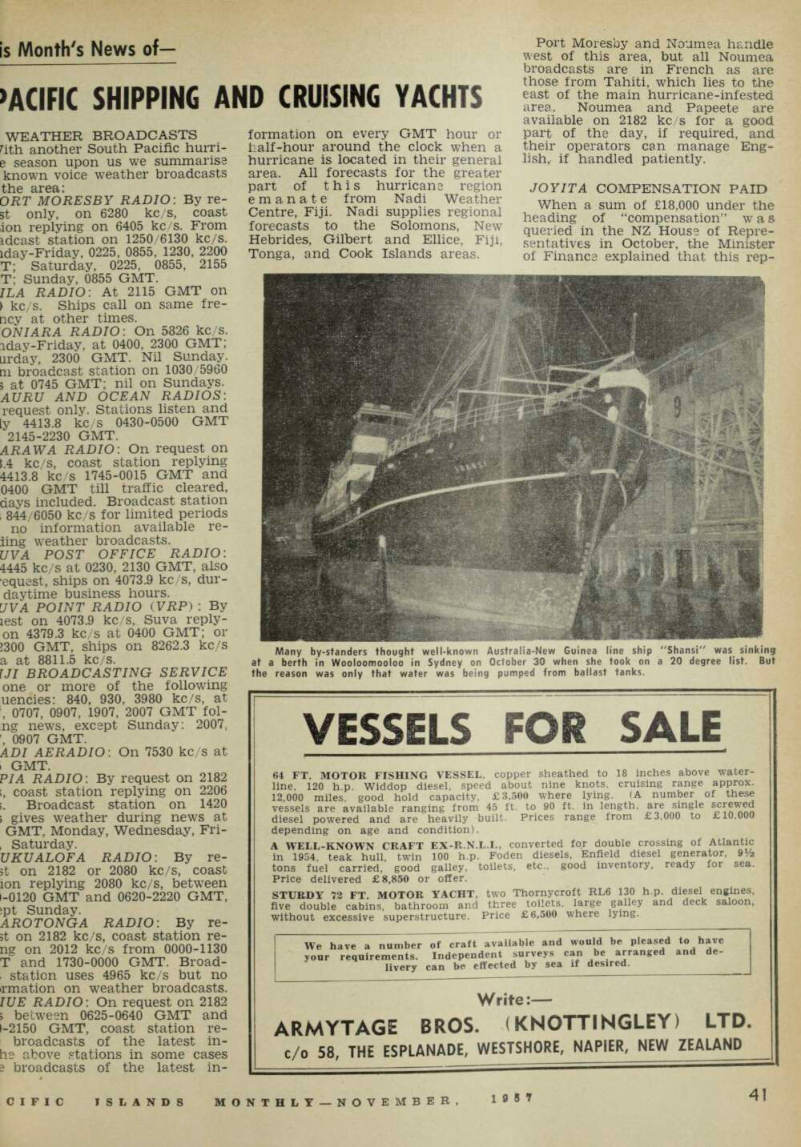
Many by-standers thought well-known Australia-New Guinea line ship "Shansi" was sinking at a berth in Wooloomooioo in Sydney on October 30 when she took on a 20 degree list. But the reason was only that water was being pumped from ballast tanks.
resented payments to the relatives of NZ citizens lost in the Joyita disaster of late 1955.
Mr. Watts said that so far as could be gathered, Joyita was not insured and did not comply with safety measures. Whether govern ment servants should have been aboard was a matter for argument.
The relatives had no legal claim on the Government, but there was a moral claim for assistance. It was doubtful even now whether any Court would grant probate or letters of administration to the dependants.
The salaries of the missing per sons had been paid to dependants for almost a year, up to the end of September, 1956.
The Minister did not give precise details of the allocation of compen sation and it was not made clear whether any was paid to the de pendants of the Tokelau and Samoan crew-members and passeng ers, but Mr. Watts said that the Government had tried to do what a just and generous employer would do in such circumstances.
One Found; One Missing
Discovered in an Auckland ship ping agency business recently was Captain Frank Baay, of Swedish birth, who will be well remembered in the Solomons as master of Fairy mead Sugar Co.’s Ruena, since sold
and now a hospital patrol craft in the Andamans under the name of Indaustral.
'Captain Baay commanded the vessel on her famous voyage of March, 1947, when she returned to Honiara as one of the first com
mercial post-war vessels, with crew of mainly pre-war plant and businessmen returning to th battered properties.
Since leaving the Ruena co mand in the Solomons, Caph Baay spent three years as Harbc
ter at Penang, a period on the la Coast trade, and a period a. shipping agency business at japore. His Auckland Shipping aces Ltd. was sub-agent for the ritzen Line vessel which re ly created great interest with largo of bunched bananas from ador. issing, at least as far as Cap- Baay is concerned, is an old mons friend, engineer H. skops, formerly of Ruena, who still be in the Solomons. If so, Iter to Captain Baay at GPO 3685, Auckland, would be wel e.
Same Lady, New Name
ne wooden 300-tonner formerly wn in New South Wales waters iahd, has been renamed Gaitcha Societe de Transports Maritimes )doniens of Noumea, who pur sed her in July last, resent owners are a syndicate smaller Noumea businessmen, they appear to have purchased :he right time. Import restric s caused by the recent French ency devaluation have restricted ;oes from Sydney—and Gaitcha ibout the right size to handle ,t offers. The vessel loaded in ney in October.
Vtman, Spare That Reef!
he coral polyps took a hammer in New Hebrides waters in re i weeks. Skipper Wilfred )hens, who officiated at the last
rites of Adi Gaetane some months ago, lately conducted another con test —Leroy workboat Wombat versus reef off Tisman, south-east Malekula. The reef won by a tech nical KO in the first round, but Wombat survived, bruised and shaken, to fight again. The vessel was under charter to a group of mining prospectors at the time.
They report no manganese sighted on the reef. (Stephens, in early No vember, was flown to hospital in Brisbane after being accidently shot).
Next to cut corners unsuccessfully was another workboat formerly owned by Mr. Oliver Stephens and lately purchased by a Tonkingese syndicate. She, too, was salvaged.
New Hebrides Potpourri
The converted Fairmile naval launch Wailana, taken to the New Hebrides “on spec” by an Auckland syndicate about 1949, and there sold to Mr. Naturel, of Santo, has lately been re-sold to trader Fu Kwan Ghee for a reported price of £AB,OOO. (Over)
[?] J. E. Broughton, who recently retired the sea, on bridge of MV "Matua". page 114).
le welded steel, five-year-old, 60freighter Paama, lovingly built Australian backyard, and an 1 craft for New Hebrides pur s, appears to be ending her t career on a Santo beach, svned by Mrs. McCoy, of Epi nd, the vessel was first some t neglected as to paint, and then lly given a coat of copper paint her bare iron bottom plates, i somewhat disastrous electro
lytic effects —rapid and severe cor rosion of the hull, which now shows holes in places.
Captain Fred Davis, late of Pacific Star and Tutuba, has lately been engaged in fitting out the steel Dutch-built yacht Anna Elizabeth for copra carrying duties. Owner Ernst Lamberty is now managing a plantation on Santo.
Despite rumours that Tutuba and Deutgan might soon leave the
Group for Singapore and new owner ship, Tutuba was reported still pre sent in mid-October, when a scheme to salvage or demolish El Retiro on the reef at Million Dollar Point was also static. Incidentally, the war-time wreck of President Coolidge still lies nearby. Salvage rights are believed now to be owned by Mr, Tom Hagen, of Noumea.
Gloom For The
Underwriters
Not all the October reef-pounding was done by Islands craft. The 5490 ton Eifuku Maru, owned by Shofuku line, of Tokyo, and commanded by Captain T. Abe, bound from Bris
The new landing-craft "Tamona" which was built in Brisbane for Papuan Apinaipi Of Prospecting Company. (See page 121).
bane for Japan with a half-a million pounds worth of wool and barley and 47 persons aboard, in cluding one passenger, went up on Wreck Reef, 300 miles east of Rock hampton in the early hours of October 11.
In response to distress signals, the BPC phosphate vessel Triadic, on the Nauru-Oceania-Australia trade, then 200 miles from the reef, stood by until the Brisbane salvage tug Fearless with gear and divers arrived on the scene.
There was then high hope of quickly refloating the four-year-old £1,000,000 vessel. However, with salvage gear aboard Eifuku Maru, a sudden change of wind caused the ship to suddenly heel over and the hasty evacuation of all aboard.
Some valuable salvage gear was reported lost.
Later in the month, however, a Japanese expert made a further ex amination of the wreck and reported that salvage might be possible, though probably at great cost.
At about the same time as the Eifuku Maru stranding, the US Navy announced from Pearl Harbour that a crew of 45 had “successfully abandoned” the naval tanker Mission San Miguel, which had plowed a 15-knot groove into Maro
Reef, 730 miles north-west of Hono lulu while bound for Guam from Seattle. The tanker and most of her cargo was expected to be a total loss. The crew were taken off by
Lst-664.
The Chicken Or The Egg?
It has been suggested by P/A from time to time that the marim insurance companies might favour ably influence safety of life at sej in Islands waters, and at the sam
me do themselves a good turn, by Bering more favourable rates in ie case of vessels carrying auto matic distress transmitters, radar Sectors, and such like devices hich migth aid the search for small ooden Island craft adrift at sea.
The matter was discussed with a -presentative of one large insur nce company this month, but he as less than enthusiastic. In effect, e said that hull insurance of small -aft in Pacific Islands waters was :arcely interesting and not sought fter. But for those owners who anted cover there were the well >sted rates.
If owners did not like those rates was up to them, and not the nderwriters, to do something about by improving general safety ;andards. , There are shipowners in the lands who do maintain their vessels ) accepted standards, and for them ie rates were not excessive.
The existing rates are based on icords of marine losses in specific reas over long periods, and looked b from that angle the shipowners re the only people to lose in the mg run. The underwriters, taking ie long view, are always in pocket, >me what may.
Back Home
Manu’a Tele, the converted YMS wned by the people of the Manu’a Iroup of Eastern Samoa, cleared .uckland for Pago Pago, October 0, following refit. Ready for sea, be returned to the slipway for everal days to locate and repair serious leak which had appeared.
Tiis necessitated stripping some letal sheathing. The cause was an Id cemented butt-joint in the hull lanking which had been started brough straining in the slipway radle.
It was quickly put right when jeated. The vessel was unable to
(Continued on page 113)
At Left: American yacht "Altaic"; Right: US [?]al Zone yacht, "Celeste 16", with owner [?]chard Cosmos and crewman Bill Poindexter.
Photos: J. O'Donnell.
id a cargo as she possessed no bernational Load Line or Safety rtlficates which would have in- Ived further special costly sur fs.
Dming —But More Slowly
rhose Leper’s Trust Board dical patrol ketches are in trouble fin. ’’auabu Twomey, first of the trio inched many months ago from Auckland shipyard, and since ig awaiting propeller shaft, was ind to have suffered serious elec lytic corrosion of rudder bolts and 11 sheathing aft, when she was lied out for installation of shaft October.
The cause of the electrolysis was ; clear as the usual precautions i been taken, and the Depart nt of Scientific and Industrial search was called in to investi e and advise. Whatever the ise, it now appears certain that r hope of delivering the first two sels before the coming hurricane son will be dashed, lie second vessel, Ozama omey, is nearing completion. It 3 intended that the delivery ?per, Mr. Mark Anthony, would Iver the first craft to the omons in October and immedi ly return for the second ketch.
The choice will now rest between risking the hurricane season by island-hopping north, or holding the vessels in Auckland until next April.
All aspects were being discussed by the interested parties at an Auckland meeting in October.
Reef Blasting Continued
En route to the Christmas Island H-bomb testing grounds for weather observing duties with her companion frigate, HMNZS Pukaki, HMNZS Rotoiti made calls at Mangaia and Rakahanga in the Cooks with consignments of explosives during October. These will be used, under the supervision of Director of Public Works, W. H. Ryan, for the deepening of reef passages at those islands.
Ut7Tn
Help From Micronesia
As the 7,930-ton Lamport & Holt Line British vessel Timaru Star headed north from Auckland to Japan with a cargo of meat in September, a New Zealand woman passenger developed peritonitis when the ship was on the equator.
A radio call was made to Guam
for urgently needed dextrose saline and as a result a US naval aircraft flew south to drop the package near the ship. It was quickly recovered by a lifeboat. All speed was then made for Truk, 360 miles awav Captain W. Pitcher taking the" vessel in through 11 miles of reefs without any detailed chart of the
area -
There an American doctor and nurse were waiting. The patient was lowered to a launch in a stretcher, and next day flown on to Guam for surgery, which was suc cessful.
Timaru Star was back in Auckland from Japan in mid-October,
More Beepers
Not all the IGY beeping is to come from outer space. Some of it may emanate from well beneath the surface of the Pacific, and some more from radio-equipped buoys drifting on the surface.
The Russian research ship Vityaz, which called at Rabaul in July- August (photo Aug. PIM, p. 58), on the first of five oceanographic re search voyages, was to anchor
[?]e only photograph that has come this [?] of Robert Tomarchin, who became world [?] us for a week, as the castaway on Hender [?]s. The photo was taken in Tahiti; name [?]ampanion not known. (See story else [?]e this issue).
Photo: Charles McPhee.
undersea buoys equipped with re cording instruments at various depths and at many points in the Pacific American, Japanese, and Canadi an research vessels will also take part in other Pacific Ocean research.
Free buoys, carefully ballasted to sink to pre-arranged density levels and not to the bottom, will be tracked from the surface as they emit sound signals, and the surface drifters, equipped with automatic radio transmitters, will be tracked by ship or shore direction-finders.
Anyone finding some strange looking gadget parked on his reef is advised to notify the nearest meteorological or other observatory, where they will know what action to take. Rough handling may de stroy recorded information.
Manuia For The Captain
After 41 years at sea, 25 years with the Union Steam Ship Co., and the last six years in command of the 4,250-ton Matua in the NZ-Fiji- Tonga-Samoa passenger and fruit service, Captain John E. Broughton went ashore at Auckland in October to tend his flower garden, do a little fishing, and to generally order his affairs according to his own whims. A „ , Born in London, he went to Mel bourne with his parents as a boy and first went to sea as an assist ant purser with Huddart Parker & Co.
His introduction to the Islands and interesting years of meeting many Island personalities came when he joined the former Tofua as third officer in 1935. Between then and 1951 he served in various ships, including the pre-war trans pacific “mail boats.”
Asked to pluck one memorable in cident from his years in command
of Matua, Captain Broughton r< marked that these, happily, wej mainly of a human rather tha nautical nature.
In this category he recalled! visit from a steward one mornii between Apia and Suva. A passeng particularly wished to see hii urgently. By all means, send hi up; and the passenger present
eared, to state his problem, aking the round trip from kland he’d met an old flame, ttle younger than himself—he just 78—and the two had ightway realised that the in ening years had been wasted, buld the Captain marry them tout delay, to-day? le Captain gently explained story books to the contrary, iad no power to perform that :tion, even had all the legal mlities been complied with. But yould be very happy to get onto radio telephone and have every g prepared at first port of call, ;h was only a matter of a day o away. it that would not do, it seemed. x>uld have to be to-day, and if was not possible, well! And old doy departed crestfallen, but an interesting gleam in his
Ater Taxis For Cruise
Ship
esumably because there are no table craft available at Port ssby and certain other anchor ports, Matson Line is currently ding $56,000 on two water taxis >e carried by Lurline on her h Pacific cruise this Summer. two diesel-powered, 10-knot, ; steel craft will be equipped with 0 telephone installations for act with Lurline. They will be ipen barge type of craft with >-seats and canvas hood, wording to our figuring, at least -a-dozen such craft could have supplied by Australian or New and shipyards for that kind of ey (£A.25,000).. But placing orders Down Under would very ably involve the company in a )r maritime strike.
Business Voyage
le 47-ft motor fishing vessel nt Swan was preparing to leave Thames River, England, port 7 November for Auckland via ima and Island ports and would or sale en route or at destina iling as navigator on the third 1 delivery voyage—the others Richard & John, delivered to orne, NZ, in 1955, and Pagan r ered to Auckland last year—is ime “Pathfinder” pilot Graham i, of Sydney. gan will be remembered as be adriftt for three weeks in the dty of the Kermadecs en route i Papeete to Auckland, with no 3 and with engine broken down. ;he vessel was not expected in Uand the drift might have ;d unhappily, had the motor not tually responded to treatment brought the vessel safely to with all hands in hungry con m. le present craft is somewhat Her than the other MFV’s. so aboard Solent Swan is Major
W. Ellery Anderson, described as an Antarctic explorer, and Messrs.
M. Fitzgerald and J. Dryer.
Delivery was expected to take three months. The shareholders are hoping to show a profit on the enterprise.
Pagan found a purchaser in an Auckland fishing company, was con verted to their purposes with a new motor, and later was badly damaged by fire but is again in service.
He Caught A Big One
With thoughts of the Flying Walrus hap still in mind, Captain A. C. Jones was not greatly sur prised when one of the officers on the bridge of his 15,682-ton liner Corinthic (which first sighted Tomarchin on Henderson), reported a very small boat in sight in the vicinity of Rapa Island while bound from Panama to New Zealand re cently. (Over>
>ure enough, as the liner drew irer, a lone figure was seen to waving frantically. Corinthic ;led, stopped and prepared to nch a boat. ’hen across the water came the from a Rapa fisherman about normal business though far m home, “You like good fish?” he displayed his wares, lb business was transacted.
Lose Pearl For Auction
lose Pearl, which was ordered to sold last month in Darwin (to isfy a claim of Dalgety and is) will be auctioned on Sheriff’s ers at 10,30 a.m. on November 23. his 700 tons vessel has been tied in Darwin for the last three aths. (PIM, October, p. 59). Cap i Peter Stein and his wife have r flown back to America, but the v of 10, Chinese and Filipinos >tly, are stranded and destitute Darwin and are being fed by Red Cross and other organisa is or helped out somewhat by the vs of other ships, hey have had no pay for months . the total amount now runs into te thousands of £’s. Under in lational maritime law, the crew have first claim to any amount t the vessel brings, he auction of Rose Pearl is caus a certain amount of interest in them Australian States. How •, the expense involved in get
ting to Darwin is likely to weed out all but the very keenest bidders at the outset.
Darwin is probably the worst port the former owner of Rose Pearl could have picked for his trouble, as another well-known Pacific shipowner, Cap tain Emile Savoie found so me months ago. When he purchased Damadora Del Mar in Western Australia, he made the journey to Sydney the long way, via Darwin with cargo. How
ever, as there is very little berth ing space in Darwin, he had to wait almost a month for a berth — during which time the pay of the full Australian crew, which local maritime unions had obliged him to carry, had to go on.
Japs Will Be Busy For
Years In P-Ng
The Japanese, who have proved themselves able to get things done in the matter of salvaging sunken ships in the islands, have announced
a new series of operations designed to clean up the New Guinea coast line.
The Matsukura Salvage Com pany, of Tokio, will start at the end of this year on salvaging 32 ships, mostly Japanese, spread from Aitape to Kavieng. Ships range from 1,000 to 8,000 tons, and should yield at least £1 million Australian worth of scrap, according to a director of the firm, Mr, T. Okawa.
It’s likely to be the biggest salvage operation undertaken near Aus
Mr. Norman Thomas, owner-skipper of yacht "Coongoola" (PIM Oct., p. 107) at present in Sydney, with crewmember Bill Poeti of Nukualofa, extreme right, and Nairana Ormsley of NZ, centre. The photograph was taken at the Polynesian Club. —Tele Photos, Cammeray.
tralia, with enough work to keep the Japanese busy for two or three years. To help with the job they are going to bring in echo-sounding devices, a floating crane and other elaborate equipment—using about 200 men in the operations.
Australian salvage expert, Captain John Johnstone, travelled with Mr.
Okawa when he made a survey of some of the sunken vessels in Oc tober-November.
Ships Without Flags
Ships registered in the Trust Territory of New Guinea should be allowed to fly the Australian Ensign New Guinea Mainland member for the P-NG Legislative Council, Mr.
Dudley Jones told a Council meet ing in Port Moresby in October.
He said at present Trust Terri tory ships had no right to fly any flag, and ship owners in the Terri tory “were considering registering their vessels in Panama”.
He added that one Territory ship, which he did not name, would soon be trading in Chinese waters, where there was a great danger to ships without a flag, and Australia should make some kind of regula tion to fix this matter of a flag.
Sister Ship For Southern X
If the Shaw Savill Line decides to build another all-passenger liner
for its round-the-world service— and this is a possibility—it will be of the same revolutionary design as the 20,204-ton, two-year-old Southern Cross, the first all passenger liner on a regular service to the Antipodes, and the first passenger liner to have her motors
right aft like an oil tanker.
The design has proved highly suc-j cessful. No cargo means no delay in port, and the engines aft means spacious accommodation midships —where it should be—for the passengers and freedom from smoke and smuts on the upper decks.
hen Southern Cross was launched e was looked on as a daring ex riment which might prove a lancial failure.
That this is not the case is seen the announced intention of an position company to build a ship similar design. rhe Secretary of Shaw Savill Line, J. A. Walsh, was visiting Aus ilia and New Zealand in October amining aspects associated with 3 building of a second vessel of is type.
Foiling The Beetle In
Tonga
Jnder an amendment to the linoceros Beetle Regulations in nga, provision is now made for a uation where a vessel, lying at wharf, is unable to move out into 3 harbour before nightfall due to ather conditions. The regulations luired. all vessels to move out to chorage not less than a mile from id. [f this is impossible, for example, rough a strong wind preventing 3 manoeuvering of the vessel ay from the wharf, all hatches ist be battened down an hour fore dark and the vessel fully hted with all deck lights on, until hour after sunrise.
During this period the vessel is der absolute quarantine, with no rson coming ashore. The lighting of course, intended to attract y beetles which may already be deck and discourage them from ing ashore. The regulations apply all vessels arriving from infested jas, e.g., Fiji.
Ap Vessel On Toka Reef
Dne good way of pinpointing a if and so enhancing the science cartography is to get stranded it. This was the method adopted October 14 by the Japanese fish ; vessel Taikomaru 16, on Toka ef, western extremity of Puka ia, outlier of the Cooks, rhe following day two other Jap ese vessels of similar type arrived assist in salvage attempts but i Taikomaru was still stuck fast hours later. )n the same day a Japanese fish : craft was reported at nearby ssau, the captain and some of ; crew going ashore.
Nassau is a fertile little isle fifty les southeast of Pukapuka. now ned by the people of Pukapuka 3 regularly worked by them for )ra.
Phis is the second contact that rent labour gangs at Nassau have de with Japanese crews in recent nths —events that will be re ded dramatically in song and ace when these people return to kapuka and foregather to per m their uapos at the LMS church, fhe island of Pukapuka now ns that name by official pro
clamation but is equally well known as Danger Island, so designated by Commodore Byron, HMS Dolphin, as of 1 1S reac^lons on June * n?'i „ Of Toka Reef, Byron wrote, “We saw innumerable rocks and shoals which stretched near two leagues into the sea, and were extremely dangerous.
Old Monterey Begins New
vv t’v.q locAn Tv/r +.
weTl h known o 'on f
well known on the trans-Pacific .v? th 6 nJ 6a + S prior t 0 the Pacific war, as Monterey, re-entered the company’s service on June 11 under the name Matsonia, operating with Lurline on the Pacific Coast-Honolulu run.
Just as the nost-war Mnnfprpu carried on the P old name so the completely rebuilt old takes over the name of a former vessel of the company.
Rejuvenated after years of idle ness following war service, Matsonia completed trials at Newport News early in May and was officially handed over to Matson Line at N6^X^^ OI \ May 17 * * Matsonia s former sister-ship on trans-Pacific, the pre-war Mariposa, now sails the Atlantic as homenc under the Panamanian fl ?g and the ownership of Home Lines Inc
Another Fiji Stranding
Tim Hurley’s 42.7 tons gross weight Melanesia, went on to a reef
r the island of Vatulele, south Vitu Levu, while carrying 25 day-makers returning home, a crew of six or eight, during Cession Day week-end. he passengers faced an ordeal some hours until they were ;n off by boats from a nearby an village. r. Hurley, immediately he heard he stranding, took another ship iss and placed empty drums on Melanesia to give her buoyancy, tie Melanesia floated off about 1 , on October 17, and after her ne had been repaired, returned suva.
Lucky Escape For N.
Hebrides Vessel
jcording to the New Hebrides eminent newsletter (Sept, issue received) the small local trad vessel Dillons Bay had a narrow pe from a sticky end late Sep ber. She was saved by the Con inium vessel Don Quixote, whose ter is Captain J. C. Barley, le engines of Dillons Bay had id off Devil’s Point and two ves swam ashore and walked for hours into Vila to report that was in danger of drifting onto rocks about half a mile inside 5 Bay. yn Quixote was the only vessel port with a speed capable of hing Dillons Bay before she was and within minutes of the
call for assistance Captain Barley had put to sea.
When he reached the spot where the natives had swum ashore, there was no sign of Dillons Bay. After inspecting the coast thoroughly, Captain Barley began to believe that the vessel must have struck a reef and sunk immediately and he was preparing to return to Vila. How ever, a sharp-eyed member of his native crew sighted the mast of a drifting vessel as it rose to the crest of a wave, 12 miles out to sea.
Don Quixote set off in pursuit but was unable to catch up for an hour —by which time the captain of Dillons Bay had thrown overboard some of his cargo to lighten the vessel, which was taking in water badly.
Don Quixote took Dillons Bay in tow and both vessels reached Vila safely.
The incident, which ended happily in this event, nevertheless had all the makings of another Joyita or Arakarimoa sensation.
Long Tow Ends For Dutch
Tug
The Australasian Petroleum Com pany’s new 120 tons barge (a more elaborate version of the war-time LST) arrived in Port Moresby on October 19 in tow to a Dutch tug, Witte Zee, of 328 tons.
The barge was built in the United Kingdom and will join two other
Similar craft already being used by APC for carrying stores and equip ment to field operation sites in Western Papua.
Barge Built In Brisbane
Just previously another oil prospecting company had taken de livery of a landing-craft—but this one had been built by a Brisbane shipyard.
Spick and span in green and white paint, gleaming chrome and polished brass, Tamona, the new landing craft owned by the Papuan Apinaipi Petroleum Company, left Brisbane for Port Moresby on Sep tember 25.
Tamona is of welded steel con struction with totally enclosed tunnel stern tubes to protect the shafts, and is said to be the first of her type to be built in Brisbane since the war.
Her measurements are 68 ft length, 18 ft breadth and as she draws only 3 ft is an ideal craft for nosing her way up and down rivers.
She is the Company’s first land ing craft and it is expected that she will be used for the transporta tion of men, drilling equipment and stores from Port Moresby as re quired. In addition, provision has been made below decks to carry bulk liquid fuel.
The designer-builder of the craft, Mr. Fred Ammerman, of the Power Manufacturing Marine Co., of Norman Park, Brisbane, said that
Tamona was designed, the keel laid) and she was built all in 8 months It is expected that the all-steel hull will be found to withstand many of the troubles and pests thaj beset wooden craft in tropical waters The permanent crew of five will be able to live in comfort with fresi water showers, electric light, kero sene-operated refrigerator and stove a galley finished in chrome steel and laminex plastics.
The cabins and wheel-house arl panelled in natural finish silky oaj and maple, and are mosquito proofed.
Tamona is powered by two Gardner 5-cylinder, marine diesels of 7: bhp each and operating at 1,2(M rpm through 2 to 1 reduction gear! to the Monel metal shafts and pro pellers.
The Company’s Marine Superim tendent, Capt. Gordon, and engineer Mr. Burton, were in charge of thi Tamona for the voyage to For Moresby, and, in addition, Captaii Robert Ledley, veteran seaman, am a Torres Strait pilot during Work War 11, was signed on as navigato) for the trip.
Te Vega Strikes Trouble!
Going Home
Te Vega, 242 tons passengei schooner, arrived Papeete fron Suva, Apia, and Pago Pago Sepi tember 29 after completing he; charter to the Dudley Film Cor poratibn which was shooting filn for Cinerama.
Between Pago Pago and Papeet: the mainsail ripped out and wai lost overboard. All that remains were the bolt ropes, mast hoops am ether gear securing the sail to thi mast, boom and gaff.
Prior to the accident, Te Vega hai encountered 5 or 6 hours of tor rential rain and the weight of thi water on the sail is believed to haw accentuated a weakness in thi canvas.
Captain Omer Darr, who owns T Vega, reported in Suva, in Sepc tember, that he will no longer maim tain a Honolulu-Papeete passenge connection.
In future, Te Vega, based a Papeete, will make each year thres voyages to Suva and five cruises to Bora Bora-Moorea-Raiatea-Raro tonga and back to Papeete, as we!: as some other inter-island cruisei; (See PIM, Oct.) The Darr family is shifting fron Honolulu to Papeete, where Etab lissements Donald are bookim agents for the vessel.
Ill-Luck Dogged Voyage!
Tiare Taporo was dogged by a ru:i of bad luck on her voyage fron Papeete to Tuamotus and Marquesas in August. This old schooner, we> known in Cook Is.-Tahiti ares: was built in Auckland manr years ago by the late Chari© Bailey, remembered as builder o many fine craft formerly, am
me like the Taire Taporo, still en iged in the Pacific Islands trade.
On board for this particular trip as Mr. G. V. Cornwell, retired anager of the Ford Motor Co. of iieensland. The Tiare’s first call as made at Takaroa, and then i to Fatu Hiva. Between Fatu Iva and Hiva Oa, the main boom oke and was almost carried away.
After leaving Hiva Oa, the mate, r. T. V. Nagle, took ill and, on riving at Nuka Hiva was in such •or condition that he was put hore for medical attention. How er, this was of no assistance and i died, presumably from a heart ndition, 12 hours later.
At the request of relatives, the dy was brought back to Papeete r burial.
The third and final incident curred while the vessel was en ute to Oa Huka when, in a spell extremely rough weather, when ie of the ship’s boats was carried r ay. The vessel returned to Papeete September 24.
News of Cruising Yachts
• TE MATANGI, 35-ft Honolulu tch, manned by Jack and Jacque rguson, was reported in September be preparing to clear that port r Auckland, NZ, via way ports. • NOVIA, 34-ft ketch, with Lee id Anne Gregg, of San Diego; TTLE BEAR, 36-ft, San Fran co ketch, with Buz and June lampion, FLYING WALRUS, 36ketch, from Westview, BC, with e now famous Wells couple oard, and WHITE HART, Tony eves’ 48-ft ketch-rigged, salmon herman from Victoria, BC, were at Rarotonga at the end of Sep
tember. LITTLE BEAR had arrived 45 days out of Sydney direct—a long jump for a small craft. The Champions were heading for Hono lulu and home. Rarotonga Customs Dept, reported this yacht as the 13th to call this year and this was the first occasion since 1921, when records commenced, that four over seas yachts had been in port to gether. FLYING WALRUS cleared for Auckland on October 10, and WHITE HART cleared for the same port with eight paying Cook Island ers aboard, on October 20. (See else where this issue). (See page 125). • MARCO POLO, of Auckland, unsold at Suva, and back in her home port after her world cruise, had a price ticket of £NZ 1,900 on her in October. (See also p. 125). • NINA, of Auckland, second in the Auckland-Suva Race last year, arrived home on October 25 after cruising eastward to Tonga, French Oceania, the Cooks and Samoa be fore returning to Suva. With owner J. Moody, on arrival at Auckland, were R. Spragg, B. Quirke, and E.
Vowles. The run south took 17 days with some bad weather. • AST RID, of Auckland, with Mr. and Mrs. L, Panther aboard, arrived at Whangarei, NZ, October 28, 23 days out of Suva. Some 10-ft was lost from a mast on the plug south.
The 24-footer had visited Tongan and Fiji islands since sailing mid- May. • KOCHAB, with Dr. John Franklen-Evans and Eric Pammet aboard, made Auckland on October 18 from Vavau. Built in England for Dr. Franklen-Evans, who formerly cruised the Pacific in Stortebecker 111, in 1952-54, Kochab
left England in time to enter last July’s Trans-Pacific Race (Los Angeles-Honolulu) but was un placed. Heading thence for Auck land, calls were made only at Apia and Vavau. The yacht will remain in Auckland waters indefinitely. « FITHEACH BAN, attractive 85ft schooner which Captain C.
Watchlin, of Auckland, brought from European waters through Panama and down through the Islands in 1952-53, has been sold in Sydney to Captain A. D. Tregida, of Nelson, NZ, and will return to that port.
The new owner is planning a world cruise so the yacht may again be seen in Islands waters. • JEN CO 11, previously reported as Jenko, reached Napier, NZ, from Norway, on October 17, 70 days out of Egersund and non-stop under sail and power from Panama. As earlier surmised, this fishing craft was delivered for Mr. Jens Jensen, who came out by the same route with his family in Jenco (number 1), in 1954-55. JENCO II was de livered by a Norwegian skipper— name not given in any press report sighted—assisted by two Napier boys, Jim Bothwell and David Dempsey.
The skipper caused some excite ment in the North Sea in the early stages of the voyage when he de cided to cruise in circles to the anxiety of the crew who called for assistance over the radio. When the cause of the circles was found, normal courses were made for the remainder of the voyage. The crew members were reluctant to discuss the circles and affirmed that Jenco II had since been a happy ship, when they arrived at Napier. • WANDERER, winner of Auck
id-Suva Race last year, removed m her moorings and beached in jtember, causing £330 damage and vage fees, brought a sentence three years probation to a young stralian in an Auckland Court in tober. There was no evidence that i offender really planned to “go ces” in the yacht. * AGNES, of England, trading ch of 100 tons deadweight, 70overall, and 135 years of age, tviy making her way towards ;kland from Appledore, which she ired last May 4, was in the West lies in October and may now be the Pacific. Owner-skipper stair Barr, a qualified merchant ry officer, aged 33, selected 18 sons from a large number of dicants as a result of an ad tisement offering passages at D per head with no refunds for nbers tiring en route, to as far Papeete, and then an additional per head for those who wished continue on to Auckland, mongst those selected were eight nen. Barr plans to operate the 3h in the Islands after deliver his human freight to Auckland, jre have been technical hitches route, with a few abandoning Ir fares and some others join and with Agnes’ gear causing iety at times, but there appears )e little doubt that skipper Barr make the distance.
WANDERER IPs wanderings ;he Pacific several years ago are .ted in “White Cliffs To Coral fs,” recently published in Eng -1 Australian dentist Bill Howell sed from Falmouth to Victoria, via French Oceania and Hawaii. * yacht was nearly lost in a blow Papeete. His excursion into litera j will be of interest to at least person there.
SCOLOPAX, of England, which reported as clearing for the ific a year ago with the Elver family aboard, seems to have i side-tracked. This 38-footer reported at Houston, Texas in r, with no mention of an Island JESSICA, of Honolulu, arrived k at that port from Papeete on tember 24.
NOV lA, 34-ft San Diego ketch, med by Lee and Anne Gregg, Drding to a later report, was to lock in Pago Pago to make x>m repairs, then head for Suva.
MARCO POLO, 12 days out of a, arrived at Russell, NZ, on Oc }r 4, thus completing a round ■world voyage which commenced July 18, 1954.
WHITE HART, Tony Reeve’s 't fishing ketch from Victoria, doubling back towards Auck -1 from Papeete, arrived at Raro ?a on September 22. Also aboard: s Pauline Scott, of Rarotonga, Mrs. Elizabeth McFee, of liti.
• NORDLYS, of San Francisco, owned by Walter Johnson (TIARE MAORI) departed Papeete on the afternoon of October 4, bound for Rarotonga. However, owing to her starboard main topmast spreader giving way she put back on the following morning. Repairs were effected and she departed again on the afternoon of October 7. On board for the trip where skipper Stan McDade, four Tahitian crewmen,
Daryl Shields, American business man, of Papeete, and Harrison Burke, Tahiti representative of Kendall Oil. • ALTAIR’s owner, E. C. (Slim) Lambert, returned to Honolulu from Papeete per TEAL and PAA in October, owing to business commit ments. (PIM, Oct., p. 107). Mr, Lambert operates the Voyager, a. forward cruise-boat operating in and around Honolulu harbour. Crew
"Rose Pearl", to be auctioned in Darwin. (See page 117).
member Len Leary departed on Oc tober 13 on the Mariposa for Auck land, thence Honolulu by PAA; Larry Garrett intends returning by the same route on the next Monterey, and A 1 Quintara is staying on in Tahiti for the time being. Present arrangements are for the boat to be sailed back by Jerry Ralston (ex Jessica), and a scratch crew some time in January • VARUA, with owner William A.
Robinson aboard, arrived Papeete on September 29. The boat has been slipped and re-coppered after her lengthy cruise on a private scientific expedition. (We have heard a re port that “the beautiful Ah You”, who was the heroine of Robinson’s recently published book, To the Great Southern Sea, died some time ago). • HARFRUEN 111, owned by Group-Captain (Ret’d) Carr and Mrs. Carr, arrived in Papeete on October 6. Also on board are S.
Cunningham-Brown, Mrs. Christine Eyre, Michael Bragg and George, a West Indian seaman, Papeete is the end of the cruise for both Mrs.
Eyre and Mr. Cunningham-Brown, the former is a veterinary surgeon and is returning to England; and the latter, a retired colonial servant, intends going to Malaya, where he was stationed for many years.
Harfruen 111 has made a very ex tensive cruise of the West Indies, and on leaving the Canal Zone planned to visit the Galapagos but
was forced to abandon this plan because of adverse weather. Accord ingly, sail was set for the Marquesas and, after 23 days under a steady SE breeze, Hira Oa was sighted.
Other stops in the group were at Tao Hauta and Nuka Hiva. The Carrs’ intended making a quick trip through the Society Group, then on to the Cooks and Tonga and Auck
land, NZ —all before Christmas.* • CELESTE 16, of Balboa, Can Zone, owned by Richard Cosmos ai accompanied by Bill Poindexter, i Texas, arrived in Papeete on O tober 10 via Galapagos and Tin motus. Cosmos and his companit have for the past 3 years be employed in the Canal Zone. T 1 vessel, 42 ft x 11 ft 6 in. x 6 ft 6 r
f unusual construction. She is iff-headed double-ender cutter pied by Murray & Watts and by Lytle Brothers, Hawthorn, iornia, or armour-plate nickel as is used in the construction S Navy vessels. This, the owner s. has special anti-corrosive [ties. The auxiliary is a 78-hp ules diesel fitted with a 11:1 re ion gear and gives a speed, r power, of 6 knots. Among v items of equipment are a i. ft electric refrigerator, 32lighting plant, pressurised r system and an electric wc.
Cosmos originally intended a lengthy cruise and the vessel fitted out accordingly. However, g to a change in plans, the t now intends to proceed to via the Cook Islands, dispose ie vessel there and return to Canal Zone by normal trans ition.
SOLQUEST (length 38 ft 9 in., l 11 ft, draft 5 ft 6 in., sail area q ft), cleared Papeete on Sep er 24 to continue her cruise to •ica via Moorea, Huahine, tea and Bora-Bora under the fie handling of Len and Joyce es. th their two children (aged 8 j), they planned emigration to ica. However, they reckoned ait the enchantment of Tahiti, it seems likely they will be re ng to Tahiti (according to .ong other things, he is a fie artist, and is a member and Executive Council member of Tasmanian Art Society. He an exhibition of water-colours is arrival in America.
VENTURER: Arrived Sydney November from Suva, Fiji, owners John and Peggy Bourke d. They married in Honolulu ily and this is a honeymoon They expected to spend six hs in Australia and return to JS by South Africa.