Territories Talk-Talk
pp. 27-31 · Read in the full issue
By Tolala
Whence Pato?
In September PIM, I sent out a SOS for the derivation of the Pidgin word for duck — Pato. The most reliable answer came from the old war-horse, Syd. Chance, now in Brisbane.
After quizzing the weekly gather ing of old-timers in the Bananaland capital without success, he writes; “It is a Spanish word, one of the few, I think, that got into pidgin. . . . I looked up a Spanish-English dictionary . . . and here it is: PATA (ornith.) female of the drake . . .”
That appears likely and could have been brought down from either China or the Philippines.
Or it might be connected with Portugese, for they gave us “savvy” and “piccaninny”. I rather favour the idea that pato was introduced by the Ambonese, who were brought into NG by the early German companies.
Any comment?
More Pidgin As
She Is Spoke
Latest addition to the pidgin dictionary library is the “Neo- Melanesian Grammer and Ortho graphy”, put out by RC priest, Father Mihalic, of Wewak.
A press report from Moresby states it “settles several disputed questions . . . one is the use of the letter ‘p’ instead of T in words such as “pella” (fellow). . . .
It will be accepted by the Territory Education Department and all missions”.
That is as maybe, I should say.
Pronunciation of Pidgin words varies as to the district in which it is spoken, and over such a wide
area as TNG values of consonants change, even as they do in Europe.
In New Ireland, for instance, the “f” is pronounced: and what of the Highlands country? The Bukas (Big and Little) are fond of the combination of “tsz”, which is difficult for other natives.
Invariably the Buka will mix his “d” and his “r”, as will the Blanche Bay mix his “s” and his “t”.
Presumably Pater Mihalic is not basing his work on the Wewak area alone; otherwise he would be looking for trouble.
As for the orthography of Pidgin, I would say the sooner it reaches an approach to the true English style in preference to the present slap-happy phonetic business, the better. The present phonetic style was introduced first following a Government-Mission conference in Rabaul some years ago (pre-war) when the study of pure English was given away altogether.
Turning Back
The Clock
Browsing through that very informative treatise, The Making of Modern New Guinea, by Sociologist Reed, of Yale University, and published back in ’43, I came upon “The relatively high prices paid for copra in 1937 led many natives in villages near the oldest European settlements to spend most of their working time producing this commodity”.
A footnote states the copra price then was £lB a ton, and it cost Europeans roughly £4 a ton to produce.
Interesting these comparisons, are they not? (Over)
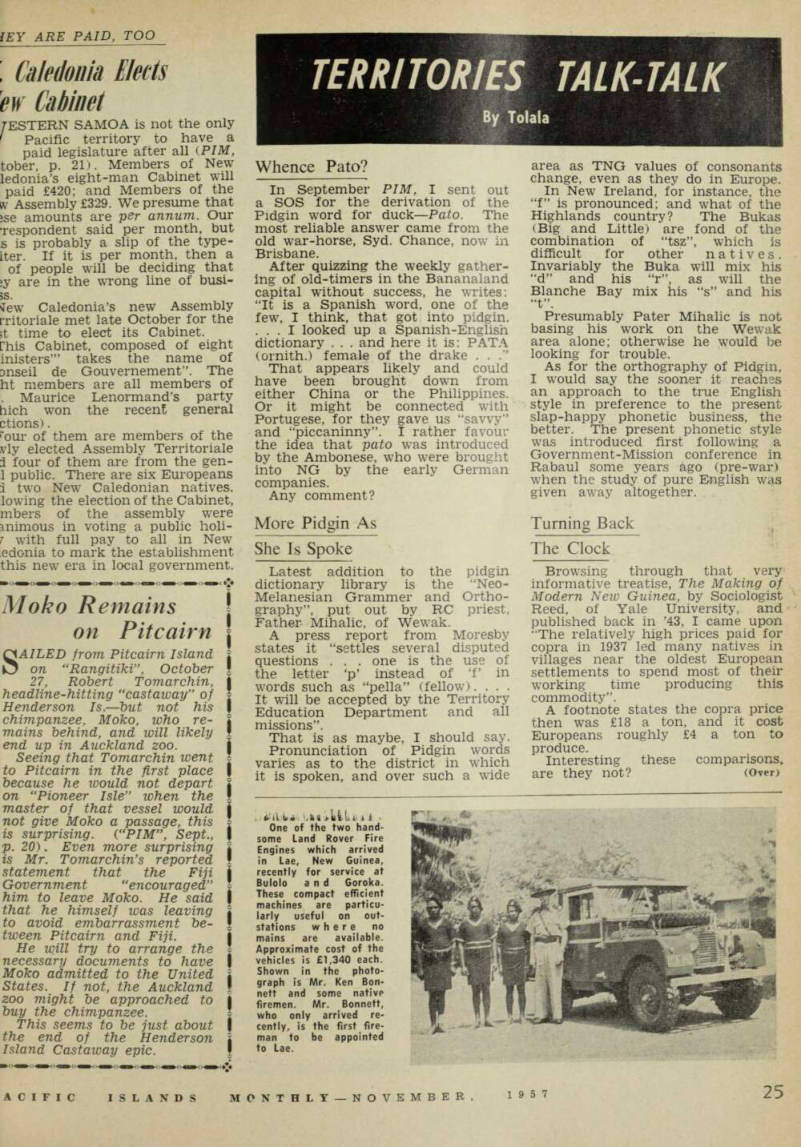
[?] One of the two hand some Land Rover Fire Engines which arrived in Lae, New Guinea, recently for service at Bulolo and Goroka.
These compact efficient machines are particu larly useful on out stations where no mains are available.
Approximate cost of the vehicles is £1,340 each.
Shown in the photo graph is Mr. Ken Bon nett and some native firemen. Mr. Bonnett, who only arrived re cently, is the first fire man to be appointed to Lae.
went on to say; “As a con lence, not a few families be ie dependent for food on rice
and tinned meat, which they pur chased out of their earnings. The number who thus completely
abandoned the tribal mode of subsistence was never large, and a drop in the price of copra sent most of them back to their gardens. The case is noteworthy, however, as the first complete breakaway from a tribal economy”.
The price of £lB was compared with the prices ruling in 1933 of £9/3/4; 1934 of £4/11/- and 1935 of £6/8/6.
Rabaul was at its zenith in the first part of 1937, and a festive town it was during the coronation celebrations. Then came the gods, Vulcan and Mars.
In those days the copra price peak was reached in 1920 with £27, dropping to £22 in 1926. But a quid was worth 20 - and the £ sterling was real money. Civil Servants had not grown into brow beating bureaucrats and the League of Nations did not consist of an anti-West bloc. I still think of them as the good old days; the days of gracious living.
The Old
“Herstein”
In the August PIM (p. 23) appeared a photo of the refloated Norwegian vessel which was loading copra for overseas ports in Rabaul when the Japs came down in January, 1942.
Its name was reported to be the “Herstine”, of some 10,000 tons.
The name of this vessel has been
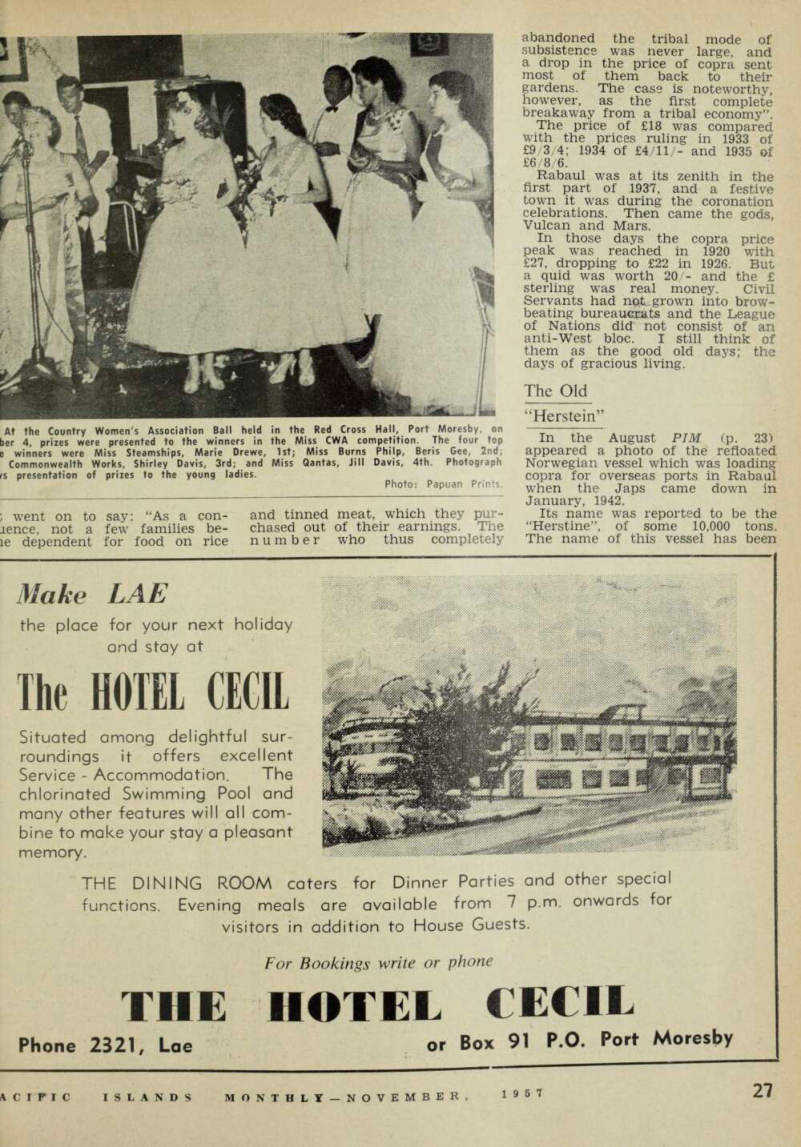
At the Country Women's Association Ball held in the Red Cross Hall, Port Moresby, on [?]ber 4, prizes were presented to the winners in the Miss CWA competition. The four top [?]e winners were Miss Steamships, Marie Drewe, 1st; Miss Burns Philp, Beris Gee 2nd; [?] Commonwealth Works, Shirley Davis, 3rd; and Miss Qantas, Jill Davis, 4th. Photograph is presentation of prizes to the young ladies.
Photo: Papuan Prints.
spelt in various ways at different times. I remember when I came out of Rabaul in 1945 I gave the spelling as “Hoersten”.
Desiring a clarification after all these years I asked a friend to consult Lloyd’s Register, and he informed me the record shows HERSTEIN, 5,100 gr. tons and 3,050 nett tonnage of 424 ft 7 in. x 56 ft 4 in. x 26 ft 3 in.
Identity Cards
Identification cards are to be introduced in connection with still another revision of P-NG’s Native Labour Regulations. (Ye gods!
How many times have these Regs been overhauled in an attempt to play ball with everybody?)
Simple means of identification speed up dealing with big labour lines. But cards? . . . Well, now that we have reached the cellophane age it mightn’t be so bad.
In the middle ’thirties Riding Permits for native cyclists were introduced and issued by the Police in Rabaul after the lad had been duly tutored in hand signals and general road courtesy.
The card contained a space for the rider’s photograph (it was not compulsory), but most of the cyclists spent a few bob with an Asiatic photographer who did pretty well out of the craze. But the cards became a bit worn and not so legible after being carried in leaf baskets amongst lime, betel nut, stick tobacco and other paraphernalia which repose in the average basket.
In the dark ages, circa 1914, on some plantations with big labour lines it was customary to issue each lad with a numbered brass identity disc, which they wore round their neck, wrist or suspended from an ear-lobe, and the system worked well.
Native names are not the easiest thing in the world for a new-chum overseer or manager to master, especially if a native tabu forbids uttering your own name as it used to be the custom with the Blanche Bay tribes.
This ban has, no doubt, gone into the discard now. But years ago it was the usual practice to ascertain a native’s name by asking another man. I remember carrying a boy on a nominal roll for some time with the name “Marauqu”, until I discovered that the word meant “my namesake” in the dialect. He had the same name as the boss-boy, and it was the boss-boy whom I had asked for the labourer’s name.
Calling
George Clarke
From Brisbane comes an SC from Harry Mowat, one-time dwt chaser on the Waria. He wants get in touch with his old cobbi George Clarke. Come in, Georg wherever you may be and rep to Syd. Chance, CTA Clu Brisbane, Queensland.
Soldier
Settlements
For several years now at tl annual Federal RSL Congress tl demand for a soldier settleme:
scheme in P-NG has been made the determined and very voo Territorial representative.
Neither George Whittaker u Bob Hunting have pulled the punches in describing the pa promises made by politicians meet their demands, which hai now been going on for over decade.
But each year the fight is grow ing more uphill as the emphau is laid on native independence ai needs of the European fade mcc and mors into the background.
Federal Treasurer, Artie Faddo did not make the going any easi; when he announced in Morestf at the same time the RSL wv meeting in Hobart, that eventual natives would take over t.i responsibilities now being carrii
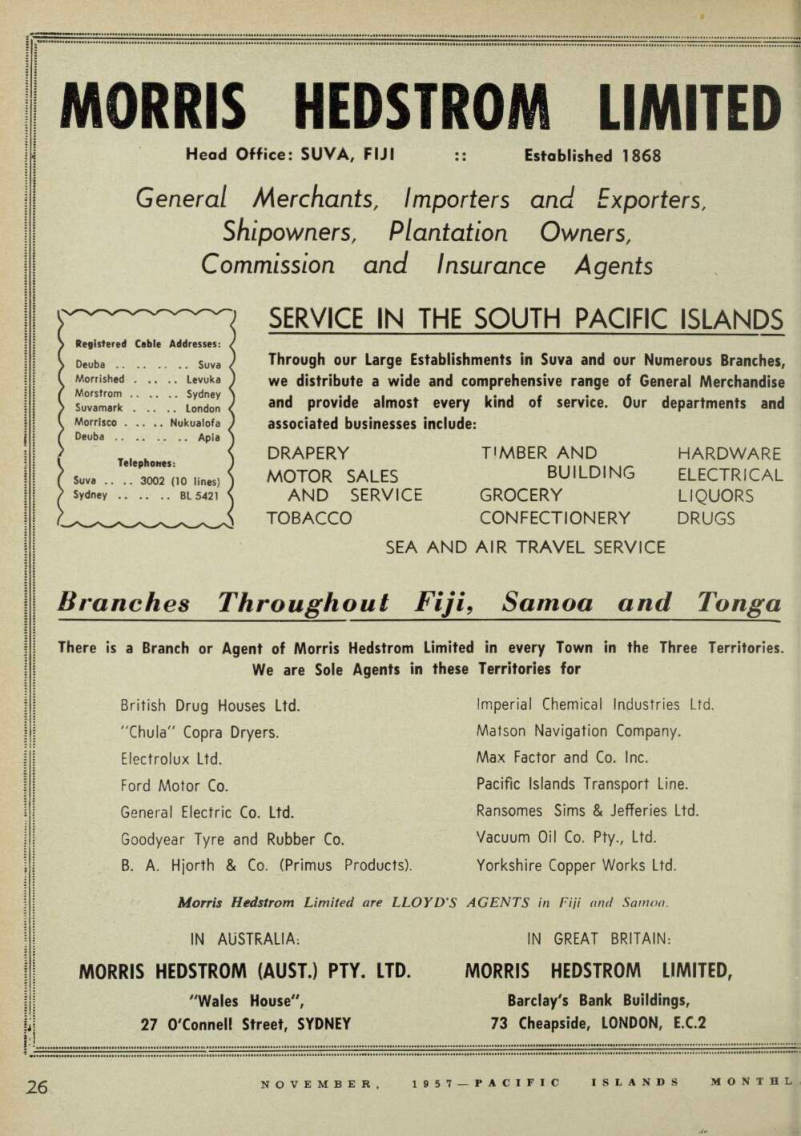
Mr. Pat Berg, well-known and popular Area Traffic Supervisor of Qantas, Lae, New Guinea, who left the Territory on November 10, on transfer back to Sydney, has been in the Territory seven years, and it is with regret that his many friends and business acquain tances see him go. He has always been ready to help and advise about flights and cargo, and every problem from the transport of cats to cattle could be speedily arranged.
Mr. Berg has been relieved by Mr. R. Weekes, who spent some time in Nadi, Fiji, before going to the Territory.
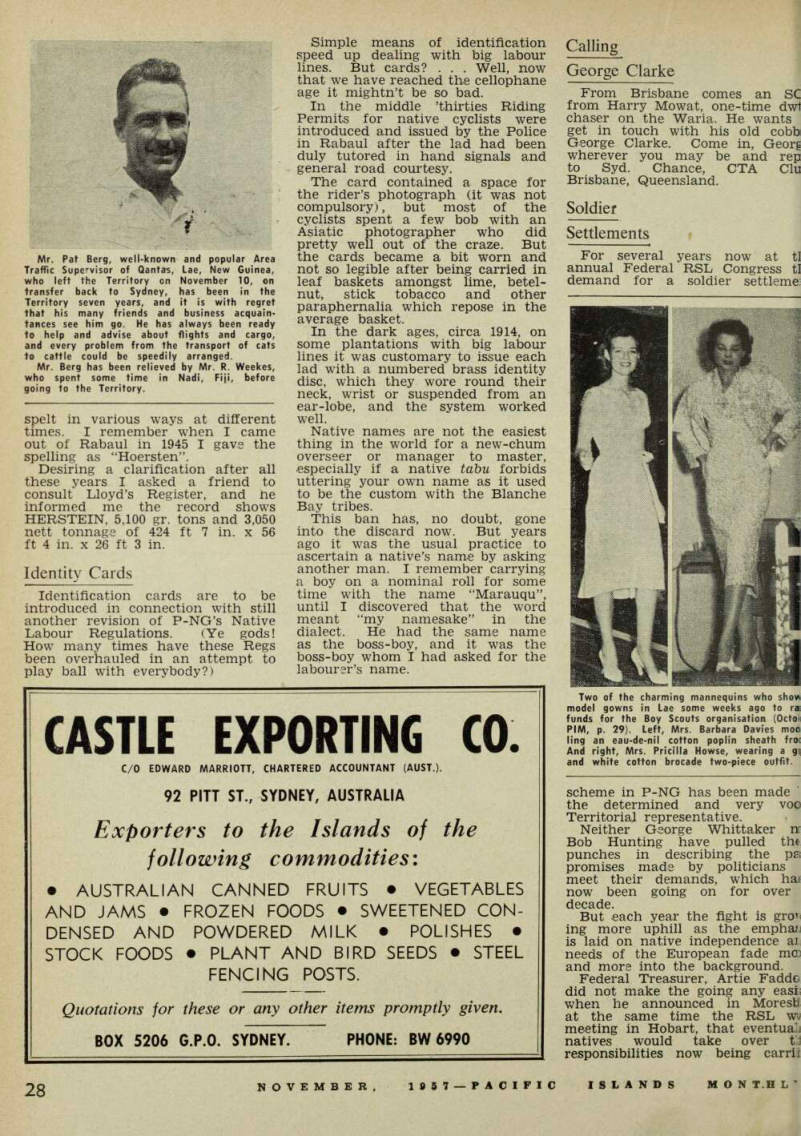
Two of the charming mannequins who show model gowns in Lae some weeks ago to ra[?] funds for the Boy Scouts organisation ( Octo[?] RIM, p. 29). Left, Mrs. Barbara Davies mo[?] ling an eau-de-nil cotton poplin sheath fro[?] And right, Mrs. Pricilla Howse, wearing a g[?] and white cotton brocade two-piece outfit.
Australia. “We will receive our rn in the gratitude of almost million natives in this tory”, said Sir Arthur. We hope, sistant Administrator Gunther the unenviable job of placating Returned men on the one hand, e keeping the Hasluck-Lambert i happy in their pandering to Afro-Asian dominated UNO. inning with the hares and hunt with the hounds has nothing he doctor’s job. But his state t about “encouraging sound ling whenever and wherever could be made available”, and native people had an inalien right to their land”, leaves the -hungry Diggers a bit cold after ears of waiting, fact, that coolness is being felt Tally amongst potential white ers following Fadden’s indica of the long-range policy, plus experience of other planters in r lands, where native independ has been achieved, le can be too optimistic where ire graditude is expected.
•et Ballot
r. lan Downs is reported to i suggested in the Legco re ly that official members do not ess themselves or vote accord to their beliefs. it comes to that, where is the ician who does? Certainly not either the State or Federal ses in Australia. The solution is :>us: Secret ballot at the meet on every major issue, then a iber’s true feeling can be ex sed.