Port Moresby
pp. 26-153 · Read in the full issue
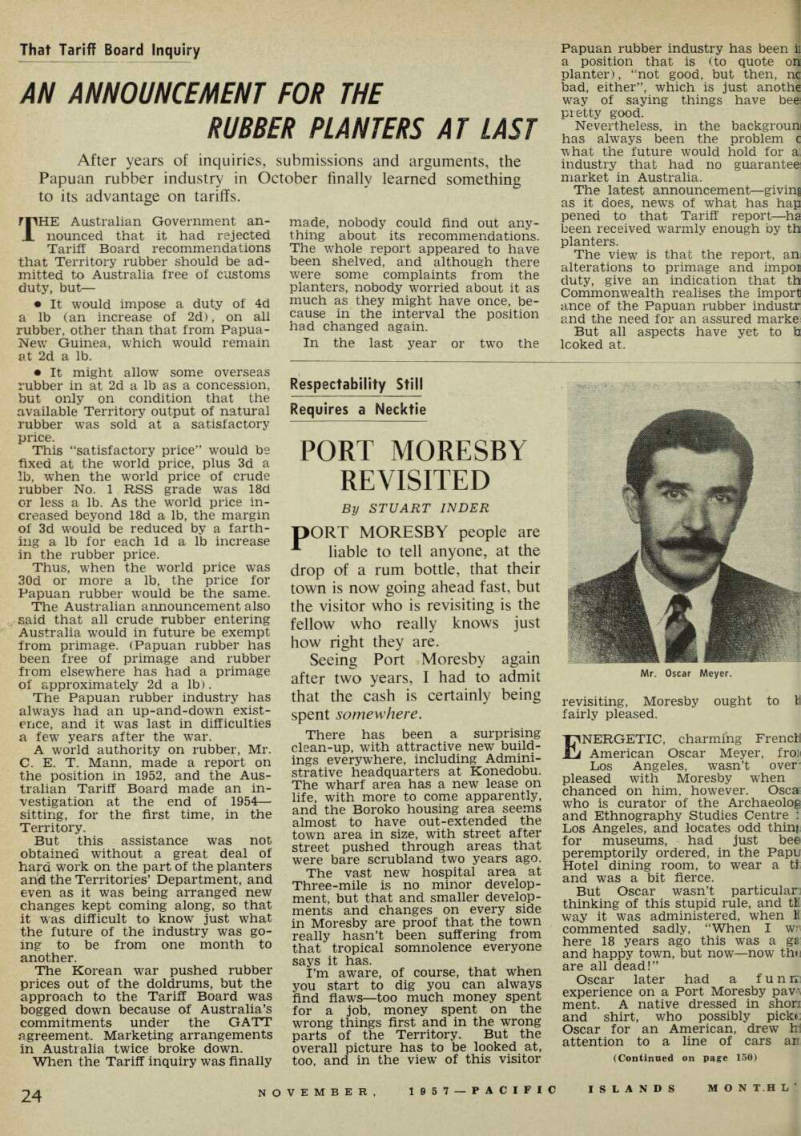
Respectability Still Requires a Necktie
Revisited
By Stuart Inder
pORT MORESBY people are
* liable to tell anyone, at the drop of a rum bottle, that their town is now going ahead fast, but the visitor who is revisiting is the fellow who really knows just
how right they are.
Seeing Port Moresby again
after two years, I had to admit that the cash is certainly being
spent somewhere.
There has been a surprising clean-up, with attractive new build ings everywhere, including Admini strative headquarters at Konedobu.
The wharf area has a new lease on life, with more to come apparently, and the Boroko housing area seems almost to have out-extended the town area in size, with street after street pushed through areas that were bare scrubland two years ago.
The vast new hospital area at Three-mile is no minor develop ment, but that and smaller develop ments and changes on every side in Moresby are proof that the town really hasn’t been suffering from that tropical somnolence everyone says it has.
I’m aware, of course, that when you start to dig you can always find flaws —too much money spent for a job, money spent on the wrong things first and in the wrong parts of the Territory. But the overall picture has to be looked at, too, and in the view of this visitor
revisiting, Moresby ought to b fairly pleased.
ENERGETIC, charming French
American Oscar Meyer, Iron Los Angeles, wasn’t over pleased with Moresby when chanced on him, however. Oscas who is curator of the Archaeolog and Ethnography Studies Centre i Los Angeles, and locates odd thinjj for museums, had just bee peremptorily ordered, in the Papu Hotel dining room, to wear a ti and was a bit fierce.
But Oscar wasn’t particular-] thinking of this stupid rule, and tE way it was administered, when H commented sadly, “When I wr here 18 years ago this was a gs: and happy town, but now—now th»j are all dead!”
Oscar later had a funm experience on a Port Moresby pav\ ment. A native dressed in shon and shirt, who possibly pick*; Oscar for an American, drew hi attention to a line of cars an
(Continued on page 150)
Mr. Oscar Meyer.
announced: “See, those cars a] American, all American”.
“No,” said Oscar. “They areii American. That one is Germ! this one is English, that one!
Australian.”
“Aw . . .”, said the indigeH walking off. “Australian no good!
ANYHOW, Oscar soon escajl
from Moresby and headed ff more civilised parts til Western Highlands in search I some mud or stone ruins. That what I thought he said, but he ma have got sidetracked, because somi body told me later they pass* him in Lae, headed for Bulolo I look for a big stone fish that hs been too heavy for him to caff away before the war. That’s whi I thought they said, I swear.
PLANTATION manager Nevil Ahern, from Paili, down tl coast, was in town but bustil to get out of it, too. “I can’t Stan the place—never could”, said Ne “Give me the civilised life in tl bush.” But Nev recalled anothi planter, a mutual friend, who hj recently given away plantation lii for something a bit more civilist in the towns. He explained tl decision to his mates this wa “Well, look, well ... I dunno, bn the fact is I want to be able to < to the 'pictures!”
MORESBY is one of the laE Pacific centres where tl native maidens can go abon the town wearing nothing above tl waist, but even there the custoc seems to be on the way out.
The Commonwealth Bank com used to be the meeting place f the girls, especially on Saturdi. mornings, but it doesn’t seem to 1 any more, and consequently the are not many girls to be seen.
And you can’t take your ow photograph of anyone you do se without being asked to pay out 2< or risk having a broad back turno at the camera. Only two years a|j the tourists could get a fn photograph, any payment for tl; mercenary ones was 1/-. Ever thing’s gone up.
However, it’s an ill wind. . ..
American tourists pay in dollar and the drinkers around the bar the Papua smartly trade the gii. real cash for the dollars.
ON this subject of clothe Europeans in Moresby seem be putting more on, too. Thea was a time when a man’s two-pie: suit, no matter how light in colon was the hallmark of the visito* The locals all wore whites.
Now you can’t always tell tl: local from the visitor, because thea is a fair number of two-piece suii in the new washable materia around town.
lEY told me Dr. John Gunther, the Assistant Administrator, had got so much fatter since hospital spell that I would ily recognise him. But he ned the same lean strip of :gy to me when I first saw in a pair of aged shorts, ng down his side path, nd he displayed the same old 'gy when presiding next day le Administration’s twice-weekly s conference, which he takes , instead of Administrator and. le conferences have certainly lien in size since Cleland igurated them and “Steph” »hens and I, as the only two ent, had to pit our wits against Old Man in an attempt to tse questions so he couldn't d around them. (But being a ;ician, he usually won). lere wasn’t r.ny wit-pitting led with John Gunther. All answers were fired back as fast he questions came; straight or Y, it didn’t matter. Some of answers were so much on the that I asked at one stage bher one statement was meant e on the record. It was.
TER, elsewhere, a top Admin, officer said he wondered if all the honesty at a press con ice helped anything while the news that ever seemed to get ished “is about natives being m behind horses with their
wrists tied and missionaries who encourage Cargo Cults”.
A good comment. Too much of that kind of thing probably does make depressing reading for those many efficient Admin, officers who believe in what they are doing.
But that stuff is not always happening, and a continuous policy of official honesty with the news will pay for itself in the end. After all, the Administration hasn’t been exactly openhanded with its secrets since the war, and the novelty of the new lay-it-on-the-table approach is probably still being enjoyed.
HAVING a quiet talk one night with a man whose name, if I could use it, would make this paragraph better, I was startled to have him say suddenly. “In five years time, and I mean five years, there will be natives holding down important posts in this territory.
In 10 years some of them will have a vital hand in Government. You don’t believe it now—but just remember it.”
It’s an interesting thought to close with.
t Mrs. Joan Chatfield returned to Port Moresby in October on MV Delos after a four months holiday, in which she visited Japan and Hongkong, She is president of the Associate Members of Port Moresby Bowling Club.