Liquor Drives Fijians Mad
pp. 22-139 · Read in the full issue
Government Gravely Embarrassed
By Drinking-Permit System
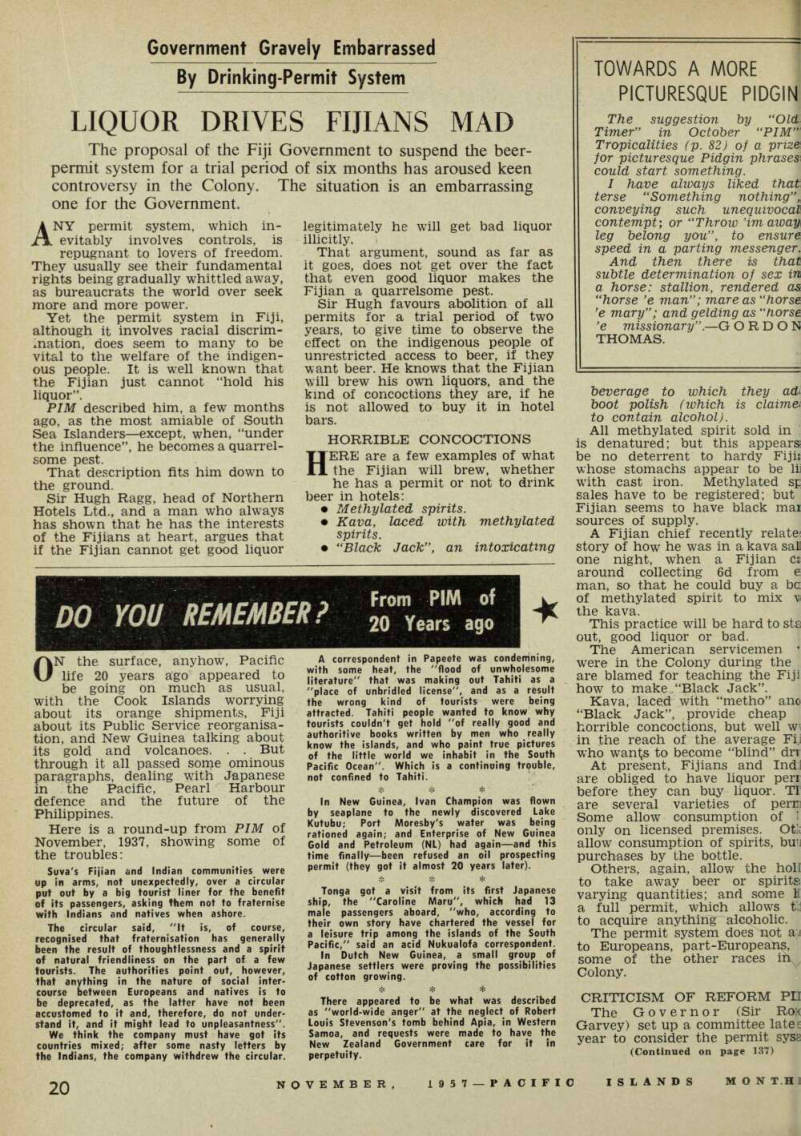
The proposal of the Fiji Government to suspend the beer permit system for a trial period of six months has aroused keen controversy in the Colony. The situation is an embarrassing one for the Government.
ANY permit system, which inevitably involves controls, is repugnant to lovers of freedom.
They usually see their fundamental rights being gradually whittled away, as bureaucrats the world over seek more and more power.
Yet the permit system in Fiji, although it involves racial discrimmation, does seem to many to be vital to the welfare of the indigenous people. It is well known that the Fijian just cannot “hold his liquor”.
PIM described him, a few months ago, as the most amiable of South Sea Islanders—except, when, under the influence”, he becomes a quarrelsome pest.
That description fits him down to the ground.
Sir Hugh Ragg, head of Northern Hotels Ltd., and a man who always has shown that he has the interests of the Fijians at heart, argues that if the Fijian cannot get good liquor
legitimately he will get bad liquor illicitly.
That argument, sound as far as it goes, does not get over the fact that even good liquor makes the Fijian a quarrelsome pest, Sir Hugh favours abolition of all permits for a trial period of two years, to give time to observe the effect on the indigenous people of unrestricted access to beer, if they want beer. He knows that the Fijian will brew his own liquors, and the kind of concoctions they are, if he is not allowed to buy it in hotel bars. ■htt'r'rt'rt it pnMPnrTTONC!
Horrible Concoctions
TT ERE are a few examples of what H. the Fijian will brew, whether he has a permit or not to drink beer in hotels: • Methylated spirits. • Kava, laced with methylated spirits. • “Black Jack”, an intoxicating
beverage to which they a& boot polish (which is claimet to contain alcohol).
All methylated spirit sold in ! is denatured; but this appears, be no deterrent to hardy Fijis whose stomachs appear to be lii with cast iron. Methylated sp sales have to be registered; but Fijian seems to have black mai sources of supply.
A Fijian chief recently relate; story of how he was in a kava sail one night, when a Fijian cs around collecting 6d from e man, so that he could buy a be of methylated spirit to mix v the kava.
This practice will be hard to sts out, good liquor or bad.
The American servicemen T were in the Colony during the are blamed for teaching the Fiji how to make “Black Jack”.
Kava, laced with “metho” ano “Black Jack”, provide cheap horrible concoctions, but well m in the reach of the average Fij who wanl;s to become “blind” dnr At present, Fijians and IndJ are obliged to have liquor pen before they can buy liquor. T 1 are several varieties of pem Some allow consumption of 1 only on licensed premises. Otk allow consumption of spirits, bwj purchases by the bottle.
Others, again, allow the holl to take away beer or spirits varying quantities; and some M a full permit, which allows t: to acquire anything'alOQholic.
The permit system does not ai to Europeans, part-Europeans, some of the other races ihy Colony.
Criticism Of Reform Pii
The Governor (Sir Rox Garvey) set up a committee late£ year to consider the permit sysa (Continued on page 137)
committee recommended re ion of liquor laws so that all be allowed to consume beer >ut the need to obtain a permit, that only those in possession Decial permits be allowed to ; liquor other than beer. ;el proprietors, of course, pre the obvious objection that at periods it would be difficult >revent permit-holders from ptitiously passing spirits back ends. ; committee has recommended if experience proves the hotel sees’ contention, the Liquor lance be amended to require ees to set aside a separate room, er parlour, in which beer only je served; and to make it an :e for any person who does not a spirit permit, to enter a 3 bar. s system, of course, will only ablish “discrimination”, which 5 very system the new Ordin is planned to avoid, suggestion that Fijians be ed to buy beer by the bottle, ;ake it away, could mean that ■ will get into the villages, inevitably would lead to women ming alcoholic liquor. m now, the morals and general cter of some Fijian women are undermined by the use of ■ and methylated spirit. In Fijian women have been d up by police patrols in a of hopeless drunkenness.
Stken Footballers In Nz
IE startling stories about the ehaviour of the Fijian rugby xffball team, during its recent of New Zealand, are creeping into the Colony—and all stem a improper consumption of ol by the Fijians.
Darently, the Fiji Rugby Union ed to make a decision re ng the consumption of : before the team left. The manager (Mr. J. W. Ackroyd) :ompletely against allowing the to have any beer. The tour iger (Ratu Penaia Ganilau), ;ed a somewhat different atti , Ackroyd (who is headmaster va Boys’ Grammar School), re d that the results of drinking he team were “catastrophic”, aid the tour was a “ghastly e”, and anything but the sport nd social success it was claimed story current in Suva is that resident of the NZ Rugby Union W. Birdsall) had threatened jommend that the tour be can l because of the misbehaviour e team.
The president of the Fiji Rugby Union (Mr. Maurice Scott) was asked if this was mentioned in the reports presented by the two managers. Mr, Scott said it was not. He did say, however, that it had been men tioned at a meeting of the manage ment committee.
The managers recommended according to Mr. Scott, that some players should not be sent on tour again. This recommendation no doubt stemmed from the trouble over drunkenness.
Another report is that Mr. Ackroyd “apprehended” two players who had left their hotel without permission, and that they assaulted him.
Temperamental Peculiarity
THIS all points to the claim that the Fijian just cannot “hold his liquor”—it is unnecessary to draw any comparisons with people of other races. The trouble lies in a temperamental peculiarity of the lovable Fijian people.
The Government, undoubtedly, is trying to (a) find a solution to a problem created by the impact of other races upon a people who, in less than 100 years, have come from a comparative Stone Age to Western civilisation, and (b) re move the resentment that the Indian people feel at the kind of racial discrimination which appears to exist in the liquor-permit system.
Experienced commentators say that, in setting up a Committee (which did not include experts— except for two Fijian chiefs, who should know their own people), the Government was only toying with the problem.
It seems certain that, if the Gov ernment’s present proposals are approved by the Legislative Coun
cil, the Commissioner of Police (Mr.
R. H. T. Beaumont), will have to ask for an increase in the number of police. Also, heavier penalties will have to be provided for drunk enness and disorderly conduct.
The bedlam that reigns now in areas near the Suva hotels, on pay nights, has to be heard to be be lieved.
No one envies the Government its task of trying to find a liquor control system that may be applied successfully in Fiji.