Editorial. ..
pp. 19-20 · Read in the full issue
[?]E SPC AND THE PROBLEMS OF THE SOUTH PACIFIC
THOUGH the six Governments vhich created and established he South Pacific Commission ; years ago (Australia, France, erlands, New Zealand, United dom and United States), met inberra last April, and produced hy directives for clearer think md the more efficient operation le Commission, there has been idication that the six propose se the Commission to advocate ;itutional reforms in the South ic Territories. report of the Commission’s 17th on appears elsewhere in this lal. The Session was attended ; least some men of wide vision, ble of constructive thinking, t neither there, nor anywhere has there been any suggestion the six nations realise that the ‘acific Islands Territories for i they are responsible are grow ap, and demanding something i more than the paternal and
volent Admin :ions which the irovide. e SPC is (as Mr. 3-. R. McKay ;ed out in his ?htful address) advisory body, and simple, concerned only h the social, nomic and :h condition of [slanders. That ►t enough, course, the has neither ority nor in ion to concern !1 f with ad strative powers policy. But does not blind more experi- I and long- I I e and Commis ;rs to the fact most of the [tones have ing-pains, and sooner or later will challenge administrative ority of some ill of the six ms.
ERE are 16 separate Ad ninistrations in Pacific Islands. l two or three ptions, none any self-gov lent. mga is under
the autocratic rule (completely benevolent) of a royal family, and subject to check by the British Colonial Office. New Caledonia and French Oceania elect govern ing Councils by popular vote, but in the last analysis their ad ministrations are dominated com pletely by the Government of Metropolitan France. New Zealand, at this moment, is planning a measure of self-government for Western Samoa, through a Council elected by popular vote. But in actual fact these concessions relate only to local government—they rep resent little more advance towards national government than do the so-called Legislative Councils of Fiji and New Guinea.
It is probable that none of these 36 Pacific Islands Territories now is socially competent, or big enough, to become an independent self-gov erning country. Plain commonsense says that for a long time, for their
own protection — and ours — they must remain under Western super vision. But that does not alter the lact that growing pressure from beneath, all the time, is being directed towards self-government and nationalism: and that the six nations are blandly ignoring it.
ALL the larger Territories have domestic problems which tend to grow acute, and which should be dealt with on a broader basis than is provided under present con ditions by the petty bureaucrats of the six national capitals.
We may see very deplorable things in the self-government of im mature countries like Burma and Indonesia and Cambodia; but that does not mean that the nationalist ferment in our South Pacific countries will be retarded or dis couraged.
In Papua and New Guinea, the indigenous people are not capable of exercising any degree of self-gov ernment; and so the Administration (Australian) necessarily remains as a complete autocracy.
But the non-indigenous com munities, who are quite capable of self-government, are increasingly
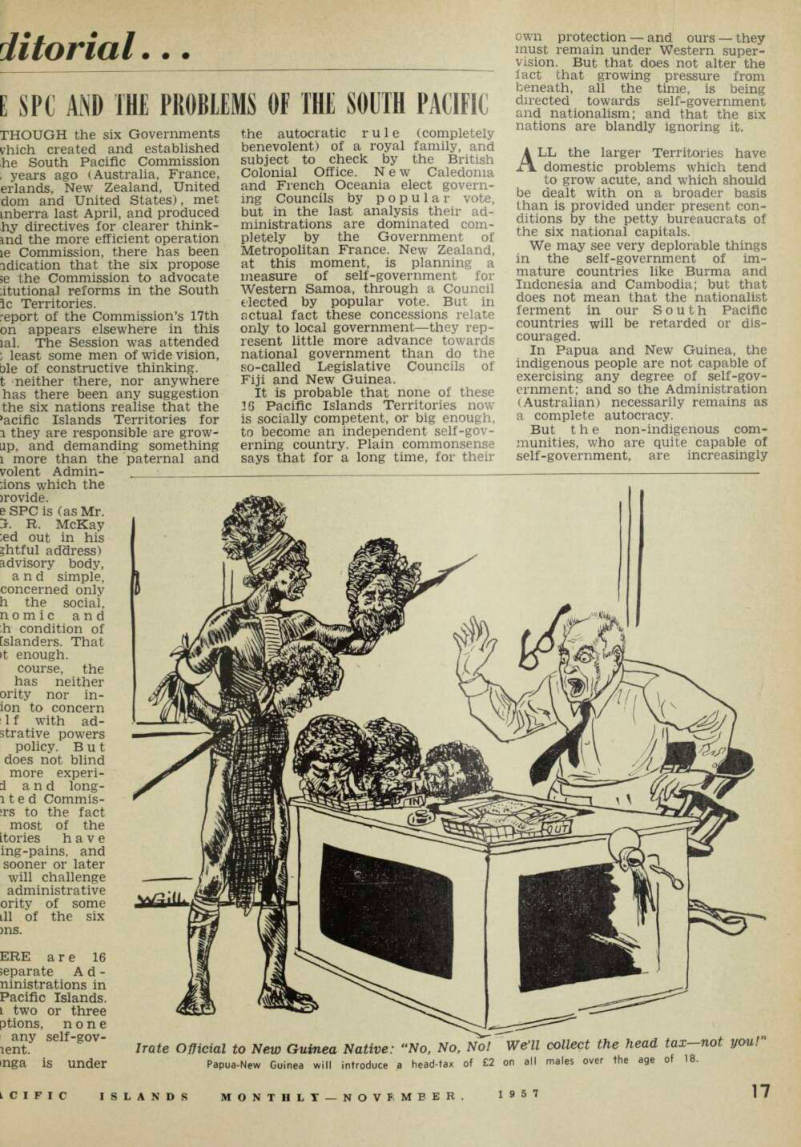
Irate Official to New Guinea Native: “No, No, No! We’ll collect the head tax-not you!"
Papua-New Guinea will introduce a head-tax of £2 on all males over the age of 18.
restive under a bureaucracy which makes all the decisions, and against which there is no appeal. The Legis lative Council is not “legislative” at all —it is only a machine which carries out bureaucracy’s instruc tions, and provides a valve through which the non-official classes can explode, without hurting anyone.
In Western Samoa, there is a different situation. The Samoans, generally literate and competent, probably could govern themselves after the manner of their fellow- Polynesians, the Tongans; but they have got neither the finance nor the top personnel required for an independent State.
Although France has admitted all classes in New Caledonia to a common roll, it is apparent that the Melanesian indigenes there are not capable of casting an effective vote.
In literacy, and in social conditions, they are little different from the natives of New Hebrides and Solomons. But, between the in digenes and the top European com munity, there is a somewhat mixed social stratum capable of giving an intelligent vote and, with the Euro peans, capable of exercising self government.
Although Fiji’s 175,000 Indians and 145,000 Fijians and 5,000 Chinese, and 20,000 Europeans and part- Europeans are generally literate, the communities are so different in their outlook and their social conditions that the governing authority (the British Colonial Office) so far never has introduced a common roll. British wisdom, in this respect, has been completely justified by events. But the poltical air, even in the quiet South Pacific, is pregnant with change; and, somehow or other, the chief communities of Fiji must be given a larger and larger share of governmental responsibility.
Most of the other Territories are bothered, in some form or other, with similar socio-political problems which have to be solved through action by one or other of the six nations. They are not within the sphere of the South Pacific Com mission.
All these problems have a certain basic similarity. Is it not possible to deal with them as a whole, and not separately by six different nations in perhaps 16 different ways?
THE answer seems to be provided by the South Pacific Commission itself, in that on three different occasions the Commission has brought delegations from the 16 Territories into a South Pacific Con ference , to discuss matters which affect their common lot.
Why should there not be a South Pacific Federation, with all these 16 Territories as units of that Fed eration? Why should each unit or Territory not be allowed to elect, on a suitable franchise basis, a certain number of representatives to
attend the central Parliament of that Federation?
Each unit would have some degree of local government, but, of course, the over-all authority would be exercised by the Government of what might be called the South Pacific Federation.
The Federal Government would be responsible for all the usual functions of administration, con trolling taxation customs, police, health, education, administration of justice, immigration, lands and agri culture, aviation, harbours and lighthouses, post and telegraphs, public works, and so forth.
Islands people would have a definite status as citizens of that Federation instead of—as is now so often the case—having no national status, or a very vague one.
SUCH a Federation, once estab lished, automatically would solve Territories problems which now appear insoluble.
New Guinea Europeans with a grievance, instead of battering their heads against an insensitive bureaucratic wall in their so-called Legislative Council, would carry their troubles, through their elected rep resentatives, to the South Pacific Federal Parliament and Govern ment.
Western Samoa or Tonga would enjoy self-government: but in the larger matters of finance, public works, development, justice admin istration, and health, where its small resources would tend to reduce efficiency, it would have the sup port of the whole Federation.
Within such a Federation could be found the answer to Fiji’s most acute problem—how to give each community an adequate voice in government, while preserving justice for all.
THE establishment of such a Fed eration, or Union, would not be easy. At first glance, it presents two major difficulties —how to in corporate the French Territories, and how to maintain a necessary association between an Islands’ Fed eration and Australia and New Zealand.
Although, since World War I and the rise of United States to world dominance, the English language has become virtually international, the French people still are jealous and sensitive in regard to the use of English rather than French; and they would resent the absorption of New Caledonia and French Oceania into a Federation that would be predominantly Eng 1 i s h-speaking.
However, it need not be an insuper able difficulty.
Australia, because of her interest in New Guinea as a defensive barrier against Asia, and her heavy investments in Fiji and other Terri tories, would have to be tied in closely with the Federation, in some
way. And, of course, there would the question of the New Gulit Trusteeship. Would UNO agree to k lease New Guinea from Unit!
Nations control, to allow it to ent a South Pacific Federation?
A South Pacific Federation Union would present a constitt tional task of much difficulty a j delicacy. But it should not be beyoc the capacity of available statesmas ship; and it certainly would provi a solution for a number of Pacii Territories problems that are groc ing in urgency and becoming uglir the longer they are ignored. tMr. Charles R. Turbet, BV' MRVCS (Lond.), formerly a go ernment veterinary officer in H and the Solomons, has b© appointed to the newly creatj position of Port Veterinary Offio Auckland.