Adjourned After
p. 171 · Read in the full issue
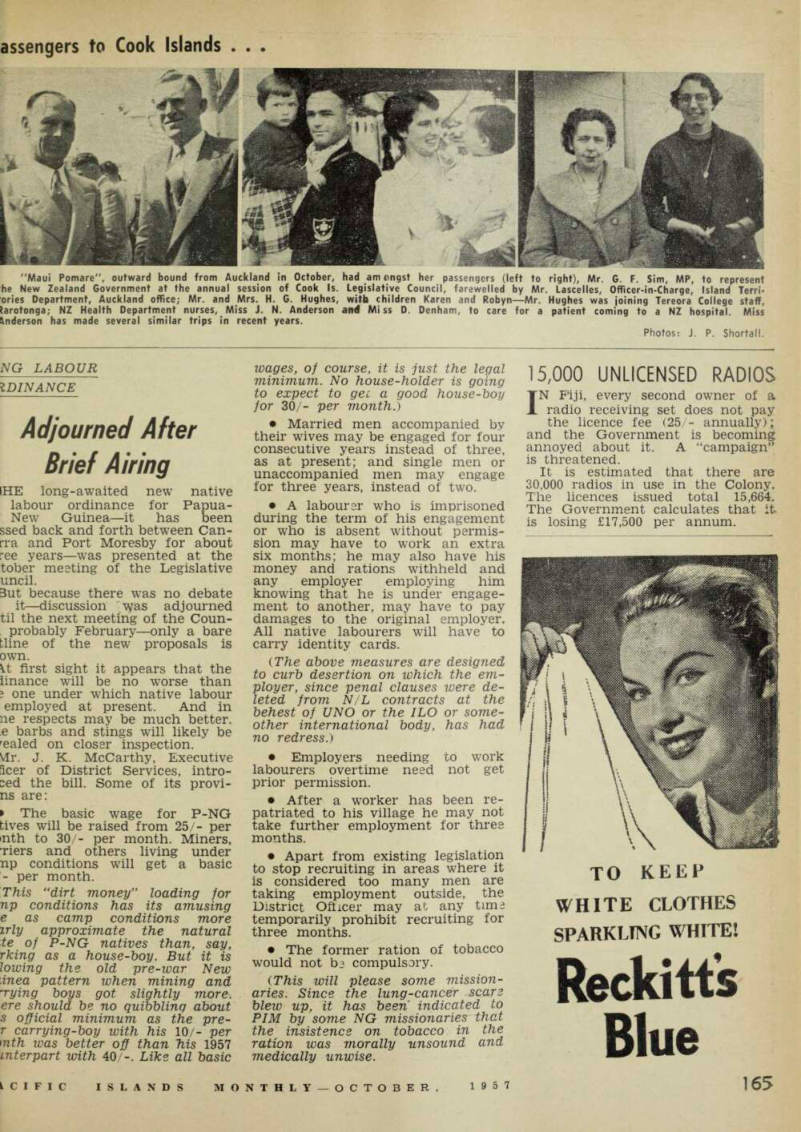
Ng Labour
Rdinance
Adjourned After Brief Airing
IHE long-awaited new native labour ordinance for Papua- New Guinea—it has been ssed back and forth between Can rra and Port Moresby for about ree years—was presented at the tober meeting of the Legislative uncil.
But because there was no debate it—discussion \yas adjourned til the next meeting of the Coun probably February—only a bare bline of the new proposals is own.
U first sight it appears that the finance will be no worse than J one under which native labour employed at present. And in ne respects may be much better, e barbs and stings will likely be r ealed on closer inspection.
Vlr. J. K. McCarthy, Executive scer of District Services, intro ced the bill. Some of its provi ns are: ► The basic wage for P-NG fives will be raised from 25/- per •nth to 30/- per month. Miners, Tiers and others living under np conditions will get a basic - per month.
This “dirt money” loading for np conditions has its amusing e as camp conditions more irly approximate the natural te of P-NG natives than, say, rking as a house-boy. But it is lowing the old pre-war New inea pattern when mining and 'rying boys got slightly more, ere should be no quibbling about s official minimum as the pre r carrying-boy with his 10/- per »nth was better off than his 1957 interpart with 40/-. Like all basic
wages, of course, it is just the legal minimum. No house-holder is going to expect to gee a good house-hoy for 30/- per month.) • Married men accompanied by their wives may be engaged for four consecutive years instead of three, as at present; and single men or unaccompanied men may engage for three years, instead of two. • A labourer who is imprisoned during the term of his engagement or who is absent without permis sion may have to work an extra six months; he may also have his money and rations withheld and any employer employing him knowing that he is under engage ment to another, may have to pay damages to the original employer.
All native labourers will have to carry identity cards. (The above measures are designed to curb desertion on which the em ployer, since penal clauses were de leted from N/L contracts at the behest of UNO or the ILO or some other international body, has had no redress.) • Employers needing to work labourers overtime need not get prior permission. • After a worker has been re patriated to his village he may not take further employment for three months. • Apart from existing legislation to stop recruiting in areas where it is considered too many men are taking employment outside, the District Officer may at any time temporarily prohibit recruiting for three months. • The former ration of tobacco would not be compulsory. (This will please some mission aries. Since the lung-cancer scars blew up, it has been indicated to PIM by some NG missionaries that the insistence on tobacco in the ration was morally unsound and medically unwise.
15,000 Unlicensed Radios
IN Fiji, every second owner of a radio receiving set does not pay the licence fee (25/- annually); and the Government is becoming annoyed about it. A “campaign” is threatened.
It is estimated that there are 30,000 radios in use in the Colony.
The licences issued total 15,664.
The Government calculates that it is losing £17,500 per annum.