Guinea Goldfields Ltd.
pp. 139-141 · Read in the full issue
ohn Hohnen Finds Geological Nightmare”
New Lease Of Life For New
Present indications are that New Guinea Goldfields Ltd. will soon be giving its patient shareholders a good return. In recent years, it has been paying a dividend equal to 14 per cent, on the market value (about 2/3) of its shares. If only half of its expectations are realised, it will do better than that.
RATHER remarkable change L has come over the prospects of the Company—which probably the oldest-established of the ?w Guinea goldmining companies.
NGG Ltd. has (a) found new serves of goldbearing country lar Wau, which apparently it n work profitably; (b) extended i activities profitably into pro iction of timber from the pine and dar forests surrounding the Bulolo illey; (c) planted up coffee in ther a big scale in the Bulolo illey; (d) launched into general iding from a new depot based in ie; and (e) based some consider le hope on an examination of rtain gold-bearing areas which it ,s acquired in the Kainantu area the Eastern Highlands.
TGG LTD. had an unhappy I history. In the flurry of gold prospecting and company pro- Dtion which followed the discovery the phenomenally rich deposits Edie Creek and Koranga, in the :e- ’Twenties, an enterprising man med Leslie Urquhart, was ominently in the picture; out of is came the Ellyu Syndicate llyu being the initials of ■quhart’s name), and the British ining Trust Ltd.; and these ramiding flotations ended up as iw Guinea Goldfields Limited, th an issued capital of about £5 llions.
NGG certainly had rich leases; t the Directors had most travagant ideas, and the high pes of a mass of little investors ire not realised. Mining was read over Edie Creek fossicking, ep mining and cyaniding at )lden Ridges; sluicing in the )ranga and Gorge areas.
By the time the enormous costs ire brought under control, and e capital written down from Five about One Million Pounds, the panese had invaded New Guinea, id the whole enterprise was andoned for about five years.
Despite War Damage compensa >n, rehabilitation was slow and ry painful. NGG Ltd., in the st-war as in the pre-war period, ffered in comparison with the tremely profitable Bulolo Gold •edging Ltd., operating a few miles /ay, below the Gorge.
IT was then that the quiet, hard-working and patient John Hohnen came into the picture, to attack the problem of making NGG pay, with capital not adequate for treating the Co.’s gold-bearing leases on a large scale—which was the only way they could be made payable, under post-war con ditions. Mr. Hohnen and his Board decided to re-establish the Golden Ridges mill, and tunnel deeply into the hillsides at the back of Anderson Creek—a big and ex pensive undertaking, the imple mentation of which occupied years.
During those years, inflation sucked the backbone out of capital, and costs rose steadily. By the time deep-mining and cyaniding started in earnest, the ore values could barely take care of costs. It looked as if NGG was nearing the end of the road.
One of its heaviest burdens was the gold royalty tax of 5 per cent., collected by the Administration.
But Hohnen fought on, stub bornly. If BGD could go over to timber-milling, to replace the worked-out dredges, why shouldn’t he? So, while still mining and
sluicing modestly, NGG established a timber-mill, and trucked lumber down the new road (made in war time) to Lae.
But it was not easy. When BGD wanted timber-rights, the Aus tralian Administration smiled kindly, and was co-operative. But, when NGG sought timber-rights, the Administration, in those early days, was sour. However, from the leases over which NGG already had rights, and from small areas made available (with apparent reluctance) a supply of logs came in, and John Hohnen kept his sawmills going, and so ensured useful income during a precarious period.
The annual 3d per 4/3 share continued to be paid (6d in 1956). r.EN, in 1956-57, the outlook changed. The Administration, suddenly realising that BGD’s gold production was ending, and that the 5 per cent, royalty impost could kill NGG and the smaller
gold producers, reduced the royal, to U per cent.
Canberra, hitherto indifferent NGG, began to smile upon tl Upper Bulolo enterprise; ar Forestry Czar, J. B. McAdai became co-operative, so that timbi areas became available on s official re-afforestation systei similar to that over in the BG (now Commonwealth New Guini Timbers Ltd.) section.
But, most remarkable of all, NG found that it had, immediate available, a far larger quantity profitable gold-bearing count than it had dreamed of for yea: IN the Anderson Creek-Nar Creek area, curling in a sort half-circle around the Gold.
Ridges mill, there is a vast he: of gravelly-looking stuff, a sort razorback ridge. Hundreds of goll seekers, during the past 30 yea: have scratched at it, and maj geological deductions from it —a: left it alone.
I do not know why John Hohm had it re-examined. Perhaps it w a gesture of despair, made when found that the ore from tho expensive deep tunnels, while ru ning true to the values anticipate simply could not pay on present-d costs.
Perhaps he got a clue from H McConnon’s strange experience.
After Tex Thomas d i e: McConnon purchased the Thom lease—not far from the NC leases, and in similar country from Mrs. Jean Thomas. It v, a good lease, and McConn planned to work it as Thom worked it—from the lower sii But, for some reason, he inves gated the top of the terrace —a was astounded by what he fou:.
So he formed Edie Alluvials L. and started sluicing the top; a the Co. paid 150 per cent, in first year of operation, and expected to pay 50 per cent, ti year.
Anyway, NGG’s head examin that semi-circle of ridge around * mill, and —in his own words— found a “geological nightmare’’.. 1 THINK this must be the oc formation of its kind in world”, Mr. Hohnen said to i “On top, we found about 50 ft of stuff suitable for sluicing—s it runs about 6 dwts, which is qu profitable for sluicing.
“Then—and this is most exti ordinary—we found a thick strati of manganese-breccia stuff —and . are running this black stuff straii into the mill, which is only a : hundred yards away.
“Under this again, there is so more queer strata—a mass volcanic cover, and we don’t kn what is under it—it could valuable.”
The most remarkable thing; that the mill, having become pn tically useless for the deep-mii
tuff, owing to increased costs, is ow being profitably employed on lis “black stuff”, brought over "om the sluiced-away ridge, almost longside.
Formerly, there were 18 miners nployed in those deep and remote mnels; now, there are only 3 lere. But NGG’s production of Did from the Golden Ridges area, bigger and better ... in the iree months ended in August, the reduction from Golden Ridges yeraged 1,100 ounces.
It is NGG’s intention to carry i with the sluicing of the top Tatum of that ridge—and this fentually will carry the sluicing Deration around to the farther end : the ridge, where “Blue” Allan id “Bill” Royal had profitable uicing establishments before r orld War 11. Mr. Hohnen thinks lere may be six years’ work ahead, lere.
The removal of one end of this dge has exposed the timbering of i old, forgotten tunnel, put in Dout 1929 to ascertain the ore dues in the hill, at the back.
What with this new supply of )ld, an established output of mber, coffee beginning to come from 20 acres (planting is anned for 200 acres), and ex msion into merchandising, there a new air of quiet confidence )out NGG Ltd. which should
encourage shareholders, and give some future to the pleasant little
R. W. Robson.
town of Wau.
t Julius Horder, aged 10, was accidentally shot by his brother Peter, 13, in Western Samoa, on September 19, when the boys were hunting birds. Both are the sons of Mr. Ben Horder, of Falemanga Plantation.
* New Caledonia’s “Miss New Cale donia” contest, held every second year, generally has as its most im portant prize a trip to Sydney. This year, however, “Miss New Cale donia” is forsaking Australia and, instead, goes to New Zealand. The winner, on September 24 (New Caledonias’ Foundation Day) re ceives a trousseau, and 4 days of entertainment in New Zealand.— Noumea Correspondent.
Artist in
Rabaul
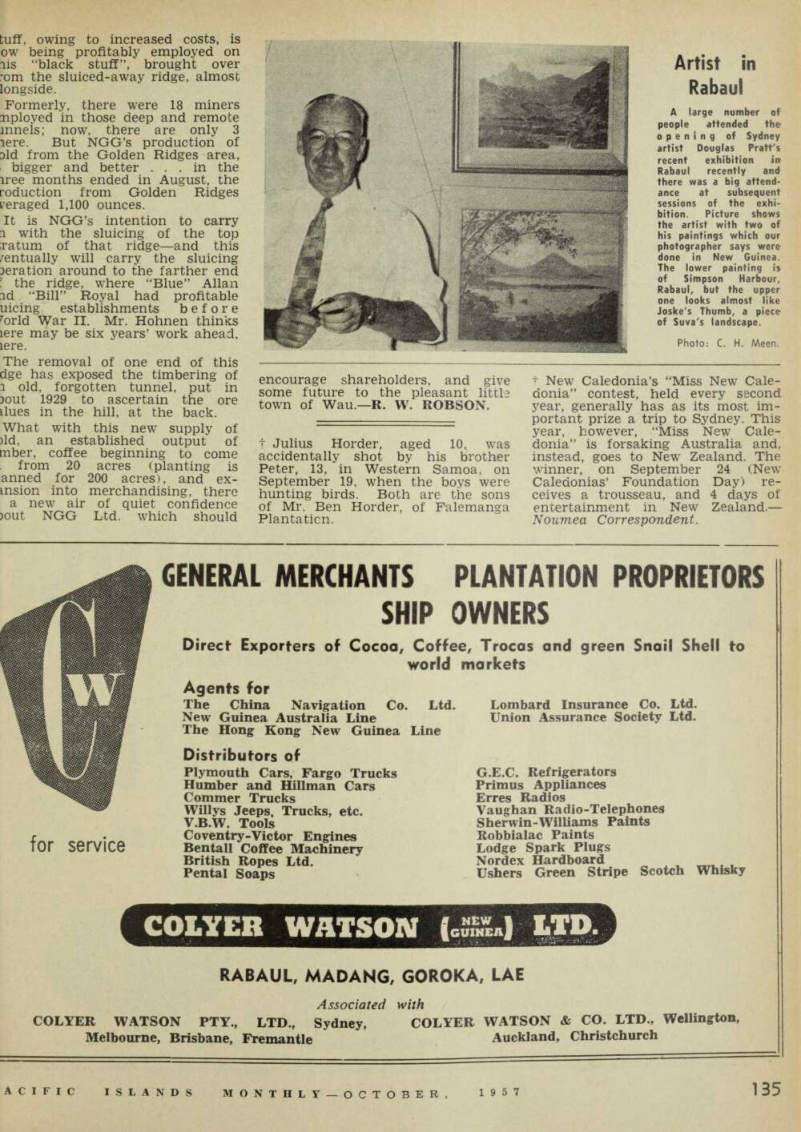
A large number of people attended the' opening of Sydney artist Douglas Pratt's recent exhibition in Rabaul recently and there was a big attend ance at subsequent sessions of the exhi bition. Picture shows the artist with two of his paintings which our photographer says were done in New Guinea.
The lower painting is of Simpson Harbour, Rabaul, but the upper one looks almost like Joske's Thumb, a piece of Suva's landscape.
Photo: C. H. Meen.