Banana Boat-With Bunches!
pp. 131-136 · Read in the full issue

Auckland
By J. P. Shortall
Undoubtedly the most publicised shipment of fruit to reach Auckland in years, and one studied with great interest by fruit importers, the Depart ment of Agriculture, and some Island exporters, was the shipment of 30,000 bunches of bananas from Ecuador in the smart Danish Lauritzen Line fruit ship Argentinean Reefer.
Iruit Distributors Ltd., The
importing organisation, which is formed of all the leading New jaland fruit importing firms, nphasised that this was an experi ental shipment, intended mainly check whether Ecuadorian inanas could be landed success- Jly, should refrigerated tonnage i offering from that direction at ues when sufficient fruit is not rthcoming from the usual Island urces.
Such shortages can be due to a triety of reasons—a regular fruit issel undergoing annual survey, duced crop through climatic con tions, etc. It is not likely that ;uador is going to offer any real reat to Island growers, in normal rcumstances. But this shipment as a demonstration to Island owers that there is a market in ?w Zealand for all they are likely produce.
From the point of view of the ;w Zealand banana-eater this ad tional source is, of course, wel me; for various reasons the lands are not providing all re tirements, all of the time.
Because New Zealand is foster g an increasing export trade in ozen meat to the East, to Hawaii, id to the United States West >a&L—a trade which at present 11s for small refrigerated vessels :e the Argentinean Reefer —it is :ely that tonnage will be offering r further shipments of bananas om Ecuador, if required, from ne to time, as the Lauritzen Line .11 in future be maintaining a re ilar service in the NZ meat trade id some of their vessels will come ►wn from Panama.
Perhaps the most striking fea re of this shipment was the wide fference of opinion as to the rtues of shipping by bunch as :ainst cases.
Many factors enter into this lestion, and it would require very j-eful analysis of costs, wastage, c., unlikely to be freely available the public.
The shipment was an eye-opener several respects. For example, the mplete cargo of 30,000 bunches— [uivalent to about 20,000 cases, as loaded in Ecuador without any ecial equipment from barges, as ie vessel lay in the stream —not a wharf—in just ten hours! arges lay on either side of the 100-ton vessel (about half the size
of Matua ), planks were rigged to doorways m the ship’s sides, and every bunch was lugged aboard on a man’s shoulder.
The holds consist of a large num ber of refrigerated compartments, and each campartment was sub divided with temporary dunnage into about 10 ft square pens like stock yards—not closely boarded.
At the plantations each bunch, on being cut down, was slipped into a transparent plastic sleeve, which was perforated with about one-inch holes six inches apart, to allow ven tilation, and was cut off at the re quired length and tied at each end.
The bunches were stowed on end, two high, with in some cases, one further bunch lying horizontally on top. The refrigerated compartments were shallower than the holds in Union Co. vessels. The bunches varied from 3 ft to 4 ft 6 inches long, but the average weight was about 65 lbs per bunch, according
to the Chief Officer. Though bunches averaged larger, individual bananas compared in size with the Island product.
The bananas were of the “Gros Michel” variety—and endless dis cussion took place in Auckland as to the relative merit in flavour, compared with the usual Island varieties to reach there.
On the 18-day voyage the fruit was held at 58.2 degrees Farenheit approximately, and at about 90 per cent, humidity. When the first com partments were opened up there was just an occasional yellow ba nana visible, but by the end of the three days taken in discharging the full cargo in Auckland, there were many ripe bunches.
Such fruit had by this time been held at least 22 days, and probably longer, since picking. The condition of the latter part of the cargo seemed to indicate that this was about the maximum time possible for successful delivery, even in a specially equipped ship.
The ship carried discharging trays about 6 ft square with 2 ft high sides on three sides, with wire slings attached to the four corners.
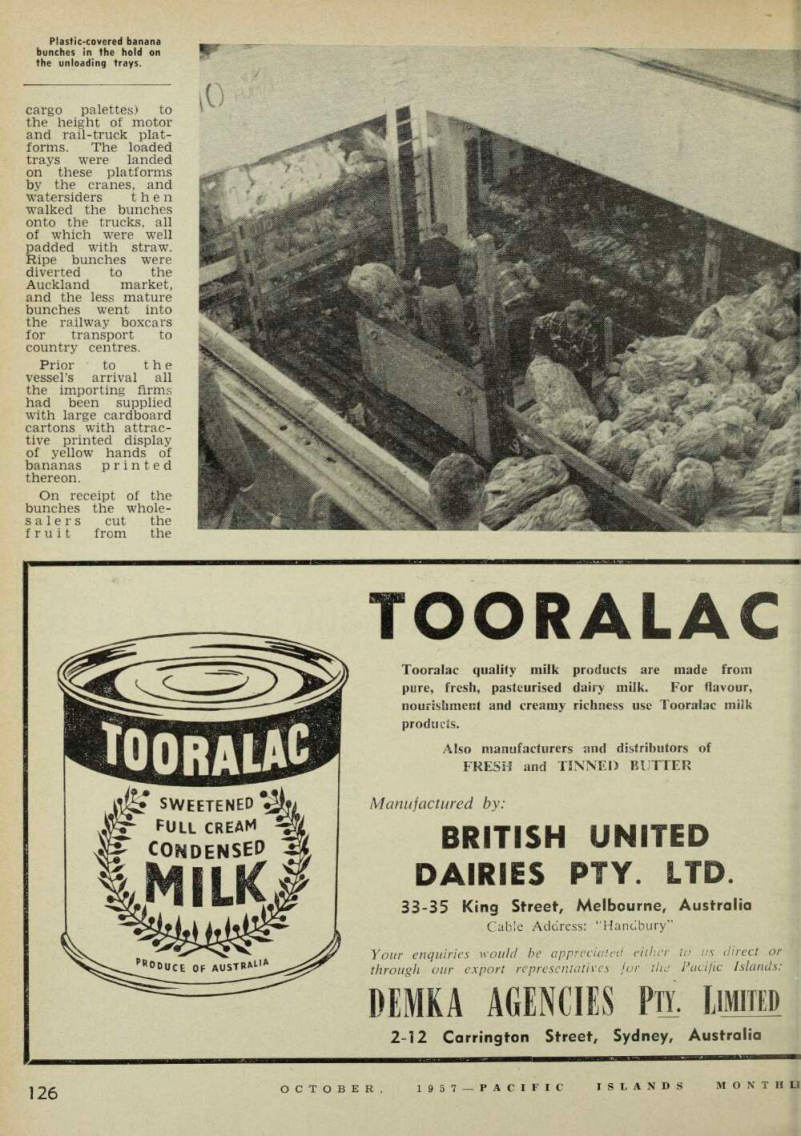
These trays were heavily padded inside to prevent bruising. They each took about 20 bunches, stowed cn end, and were handled by wharf cranes.
Alongside the ship at Auckland, platforms had been erected (stacked
cargo palettes) to the height of motor and rail-truck plat forms. The loaded trays were landed on these platforms by the cranes, and watersiders then walked the bunches onto the trucks, all of which were well padded with straw.
Ripe bunches were diverted to the Auckland market, and the less mature bunches went into the railway boxcars for transport to country centres.
Prior to the vessel’s arrival all the importing firms had been supplied with large cardboard cartons with attrac tive printed display of yellow hands of bananas printed thereon.
On receipt of the bunches the whole s a 1 e r s cut the fruit from the
Plastic-covered banana bunches in the hold on the unloading trays.
ns and packed them in hands the cartons, which were sold to lilers in that form, at a fixed 2e and retailed at the fixed :e of 11 Ed per pound. (In Sydney, rent banana price is 2 - per and the bananas average about \ches long and taste like potatoes. , for an Ecuador —and a banana scious government! — Ed. PIM ). n Auckland, and possibly at er centres, the retailers could ) purchase the riper bunches mt for display purposes in their •es—for it must be remembered t many a New Zealander has er seen a bunch of bananas, ome retailers tried to force the sumer to purchase by the nd”, but most housewives would r e none of it. They were not ig to be told how many they’d e! If they wanted six bananas y’d have six—or none at all, ler than be forced to take a id of, say, a dozen, t was noted after a few days t the hands were being plucked suit individual requirements. 3E importing firms had been put to much trouble to handle this shipment, as they were set up to deal with bunches ch had to be hung in their 1 holding-cellars and not stacked s cases. Here immediately was objection: the bunches occupied more stowage space than cases.
Thousands of steel hooks were de by one firm to hang the iches, each of which also had to r e a rope lanyard attached to i end for suspension purposes )m the thin end of the stem). ,t the ship the trucks were led with bunches reclining, thin l-of-stem outwards, so that when y arrived at the cool stores at Auckland markets men could dily attach these lanyards to correct end of the bunch. On side of the truck men attached g lanyards, on the other side rt lanyards. Bunches were ckly surveyed. The green ones e carried into the cool chambers De held and gradually fed out to retailers as called for.
'he riper bunches were diverted the packing department for ini tiate sale. Many of these riper iches, despite all care, had suf ?d bruising and many individual lanas had to be rejected. Such iches were packed as loose lanas after grading, pecial pipe-frame hanging trol -5 had been built by one firm for transport of the ripe bunches m truck to packing table, so t they would not be damaged, t was noticeable with this ship nt that very few loose bananas in the vessel’s holds, in contrast the situation with cased fruit ere invariably many cases are >ken. Importers claim however it most of this loose fruit is
gathered up and sold, whereas the bruised mature bunch fruit cannot be sold.
A careful check of comparitive losses would be interesting. Only the later, ripening bunches, dis charged especially on the third day, suffered any bruising of conse quence.
The green fruit was delivered in far more attractive condition than most Island cased-fruit. It was completely free from the usual scratches, blights, and blemishes which make Island bananas so un attractive as sold in New Zealand.
One importing firm pointed out a feature of the bunches-versus cases case-book which is often over looked. All Island banana cases
reaching Auckland are used in the vegetable distribution trade. In the unlikely event of a change-over to shipment by bunch, the price of vegetables would inevitably rise in New Zealand, as the merchants would have to pay full price for their own, new cases. The vege table market is at present very closely tied to this second-hand banana case supply.
The Union Go’s present banana ships— Tofua, Matua, and Navua— would have to undergo modification for the successful handling of bunches. The hold-depths are ex cessive for stowage like that in Argentinean Reefer. Stowage in ex cess of two bunches high would place too much weight on the lower
nches, causing mage to fruit, another ’tween ck would have be built in— d space might t be great ough for this, m if other ;tors permitted, ie-ports would ve to be cut to rmit quick iding. rhen again 33 r cent. less lit could be ided in each ssel. 3o why are nanas shipped bunches to rope from laador largest nana producing antry in the rid? There was > convincing swer available this question Auckland.
Ml who have ;n bananas for e in Europe i confirm that
;y are clean, yellow, attractive it —vastly more attractive than i bananas which arrive in Auck id in, what the importers main n, is a much superior and less naging pack. Time taken in dis irge was comparable with that a similar shipment of cased ianas. This shipment cost more handle and sell in all probability, :ause the special equipment was ; already available. The specially ide cartons, each taking about lbs of “hands” must have been a >tly item alone, but they were jessary in the absence of rail and id trucks equipped to transport nging bunches to the retailers.
Che initial cost of a changeover bunches would be high, distri tion costs even then would appear sly to be higher than with cases, d, in short, whatever the merits the bunch shipment method m the consumers point of view, is fairly safe to say that the idesalers and retailers would vote jrwhelmingly in favour of cases, would the case-makers who lose b, despite the counterbalancing '1 for new cases for the vegetable ide.
Various reasons are given foi ling shipment by bunch which i once exist. One importer said is was occasioned by shortage of Ipping space at the time. A vessel aid carry many more individual nanas in the same cubic space casing. [n the markets too, there was
Close-up of the bunches.
constant quibbling over bunches.
No retailer wanted to pay the same price for a thick-stemmed bunch as a thin-stemmed bunch which weighed the same but might have several pounds more bananas on it.
Under today’s methods the in dividual bananas lose all identity, poor and good fruit being merged in the general shipment—and all growers receiving the same price to long as their produce resembles a banana.
It is believed to be close to 40 years since any quantity of bunched bananas arrived in New Zealand,, so what-ever its merits, the Sep tember shipment was an event.