Mixed-Race Community
pp. 57-62 · Read in the full issue
[?]w Status for Chinese — [?]thing for the Euronesians
Canberra's Treatment Of N. Guinea's
By
R. W. Robson
DHEN I was in Papua in July, f the official announcement had just been made that New ninea-born Chinese were to be yen a new status —which meant Ptually that in future, if they ught Australian citizenship, they uld move in Australia and in the istralian Territory of Papua as sely as any other Australian.
Papuan residents discussed the atter with liveliest interest. Did is mean that Chinese traders in ture would have the right to lerate as freely in Papua as in iw Guinea?
Papuans are not anti-Chinese; it they do point out that the rival in Papua of Chinese traders id artisans would be a factor of ajor economic importance.
They now are waiting to see what e the next developments in this ;w aspect of Hasluck policy.
M’EANWHILE, the official action 'X in granting new status to New Guinea Chinese, while com etely ignoring the claims of the
many hundreds of mixed-race people to special consideration, has aroused indignant comment in both Tern tories.
“The roots of these people are deeper in the soil of New Guinea than those of the Chinese, was one statement. “If Chinese residents are entitled to Australian citizenship why not the mixed-race residents?
It seemed to me that the Aus tralian Territories Department in contradiction of all its fine talk about the rights of the indigenes, had committed a manifest social m justice; and I decided to see for myself. I spent one evening with mixed-race men in their club in Lae, and another in their club in Rabaul.
For convenience, I shall refer to them as Euronesians (a mixture of European with Polynesian, or Mel anesian or Micronesian), although in a number of cases the mixture is of Asian and Islands races—and an excellent mixture it is.
In both places, I met some fine men—competent and qualified to stand beside Europeans and Chinese
in carrying on the more important work of the Territories; yet they are accorded no status above that of the Islanders, and the Adminis tration will not pay them at Euro pean rates for the work they do.
Mr. Johnny Comboy, for example, is an Education Department clerk, and apparently does his job quite competently. The Department pays
him £7BO per annum. If he were a full European, he would get £9OO per annum.
Ken Ahnon also is an officer of the Education Department, in Lae.
I do not know his rate of pay; but I do know that, although he is educated and better-poised than scores of Europeans and Chinese, he has no status in citizenship.
Sam Moessner talked to me of the Jap invasion. “I was in Rabaul when they came,” he added. "I tried to join the New Guinea Volunteer Rifles. But they would not have me.”
“Why?” I asked.
“Because of my mixed race,” he answered, simply. “Three or four of us were rejected, like that. So we just sat down and did nothing dur ing the invasion, except to look after ourselves,”
I WAS particularly impressed with the good types I met in the Kombiu Club in Rabaul, to which I was introduced by Mr.
George Kassi.
I heard a long record of the struggle made by this Kombiu com munity against injustices; yet there was little bitterness expressed, and no disloyalty.
They blazed now and again, as they told their stories; but for the most part they philosophically accepted the fact that a certain blind
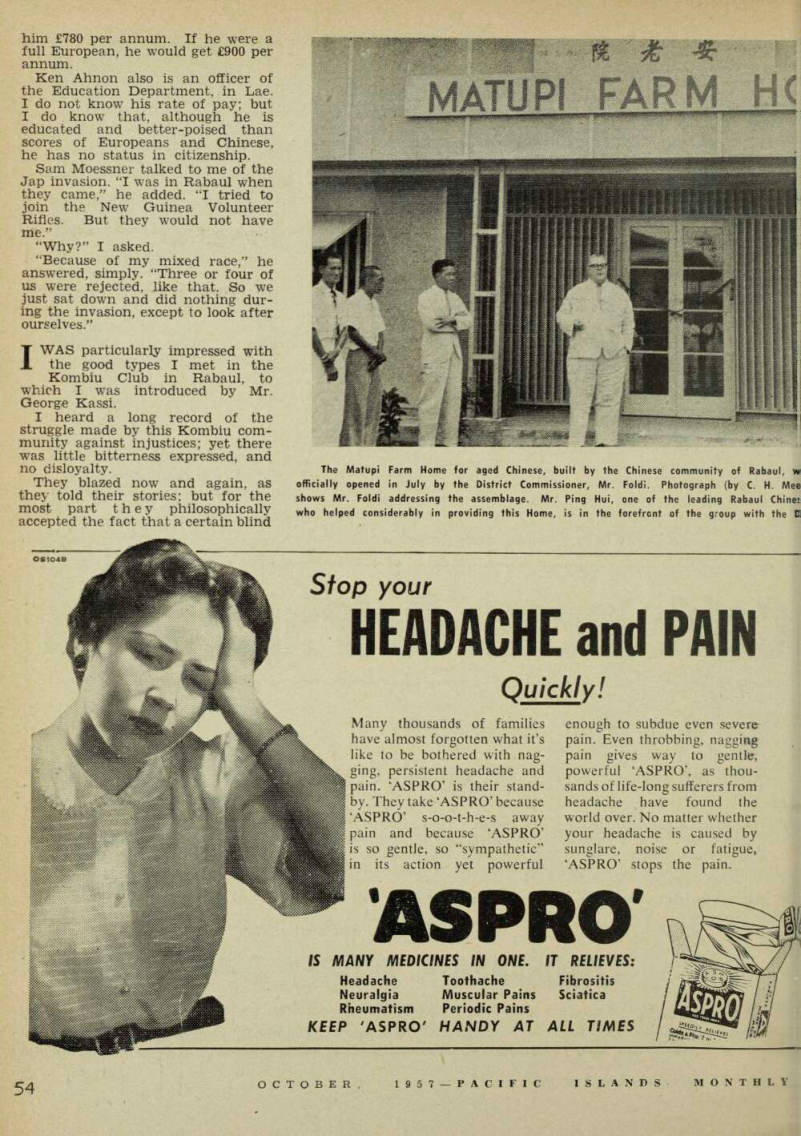
The Matupi Farm Home for aged Chinese, built by the Chinese community of Rabaul, w officially opened in July by the District Commissioner, Mr. Foldi. Photograph (by C. H. Mee shows Mr. Foldi addressing the assemblage. Mr. Ping Hui, one of the leading Rabaul Chines who helped considerably in providing this Home, is in the forefront of the group with the E
and rather stupid class of European tends always to punish them for the unhappy accident of their birth.
They make no apology for their nixed blood. While I was there, they bad a lively and somewhat humor ms debate on the question of whether—for the purpose of their aending demand upon the Adminis tration for at least equal status with the Chinese —they should be called Anstral-Asians or Euronesians. rHESE Kombiu people first intro duced the idea of Government loans, repayable out of wages, to mable them to improve their hous ng conditions (which are deplor able) . But, to their surprise, the Chinese came into the picture, and jot Government aid in housing, while ;he Euronesians got none at all.
After that, they made to the Ad ninistration a united demand for laturalisation, believing that thus ;hey would be helped in getting lousing aid.
The Administration, responded to ;hat by informing them that they :ould not obtain Australian natural sation unless they could prove that iheir fathers and mothers had been egally married. Which, to anyone vho knows the history of this com nunity, shows the utter lack of •ealism of certain higher officials.
“Where is our future?” said the Dlub’s chairman, to me. “This is our lome —and we are happy to regard t that way. But, while we are ienied any status, what is going to lappen to our children?
“We want better houses—but we cannot get them unless we have nore money. We have nothing but )ur wages—and the wage rate is cept down by local conditions. Hav ng no status, we get no considera ;ion when we ask for better wage ■ates.”
“I went for a loan,” said one man. ‘The official side-stepped. ‘How did mu know about this loan arrange nent?’ he asked me. T read the lewspapers’ I answered. ‘Well, it is lot for you,’ he answered. ‘lt is for jeople who can put up a deposit in noney or in land.’ ”
There was a chorus from others, n which bitterness was shown. “It iidn’t happen to him alone —many )thers of the working class tried, md were knocked back,” they said. ‘lt is not for the poor—only for ;hose with property.”
“None of us have any land.”
“We are poor, and -we are lesperate—and you can tell them ;hat.” rHEY reminded me that, before the war, the NG Administration planned a settlement at Talasea ’or suitable people of mixed race; md this plan included provision for assisting them to acquire land.
But the post-war Administration ipparently is trying to ignore this ndiscretion of the pre-war Ramsay
McNicoll-Harold Page planners.
Nothing has been done about Talasea. •'There is plenty of surveyed land there—l saw the pegs myself not long ago,” said one man. “But the Administration will do nothing to help us get there.”
There are between 500 and 700 Euronesians in the Rabaul and Kokopo areas—decent, hardworking people whose one aim is to get possession of some land, maintain themselves in comfort and educate their children. But, because they have inherited all the disabilities of social carelessness and mixed race, the Administration treats them as if they were natives.
Why (they very properly ask)
should the Euronesian community be ignored in this way, while the Chinese community is given social and monetary help, directly and in directly? They point out that many of the original Chinese immigrants took native wives; and the off spring of those unions (at least 20 per cent, of the younger genera tion) are exactly the same as the Euronesians. Yet, be cau s e the Chinese-Melanesian people have been reared as Chinese, they get the privileges of the Chinese community; while the Euronesians get nothing, For years, the Kombiu community asked for a service of electric light and power, and were ignored. The Administration, however, gave ser vice to the Basketball Club and the
xolf Club, nearby, and to the Jhinese.
So then Mr. George Kassi broke loisily through the sound barrier, yhy, he demanded, should “Malay own” be treated in this way, just
because the people did not play golf and had dark skins. “Then we got it,” he said, pointing complacently at the lights in the club-house.
“But why should we have to put on an act, and howl, to get things
that should be ours by right of citizenship?”
THE Administration, in failing to do anything for the Euronesians, is cruel and stupid and out of step with modern trends. It also is exceedingly unwise. (Over)
There has been remarkable development in lie last three years in the Matupi Farm area f Rabaul —between the town proper, and the irfield. This is part of new Chinatown, and at east £400,000 has been spent in the con [?]uction of residences and trade-stores (mostly ombined), which cover many acres.
Old Chinatown is represented by numerous uildings erected on the site of the Chinese uarter of pre-war Rabaul (which was com letely obliterated). Between 1945 and 1948, [?]hile Old Chinatown was being rebuilt, a
"street” of dilapidated shacks was also erected southwards of the town. New Chinatown now has engulfed and swept away most of thoso shacks.
An old resident says: "The Chinese some times get a residential block from the Ad ministration because they want a family home, clear away from the trade store. Then they put up a nice house —and often rent it to a European, and continue to reside behind the trade store!"
The natives, for a long time, generally will be incapable of de veloping a subversive movement, no matter how cunningly they may be worked upon. But these Euronesians, reacting to a sense of bitter injustice, could become dangerously sub versive overnight.
Having talked to them, and seen something of their ability, I am astonished that, long since, they have not formed an anti-govern mental “cell”.