"Back-To-Bread And Water" Budget
pp. 22-155 · Read in the full issue
Treasurer Reeve's
From STUART INDER, in Port Moresby
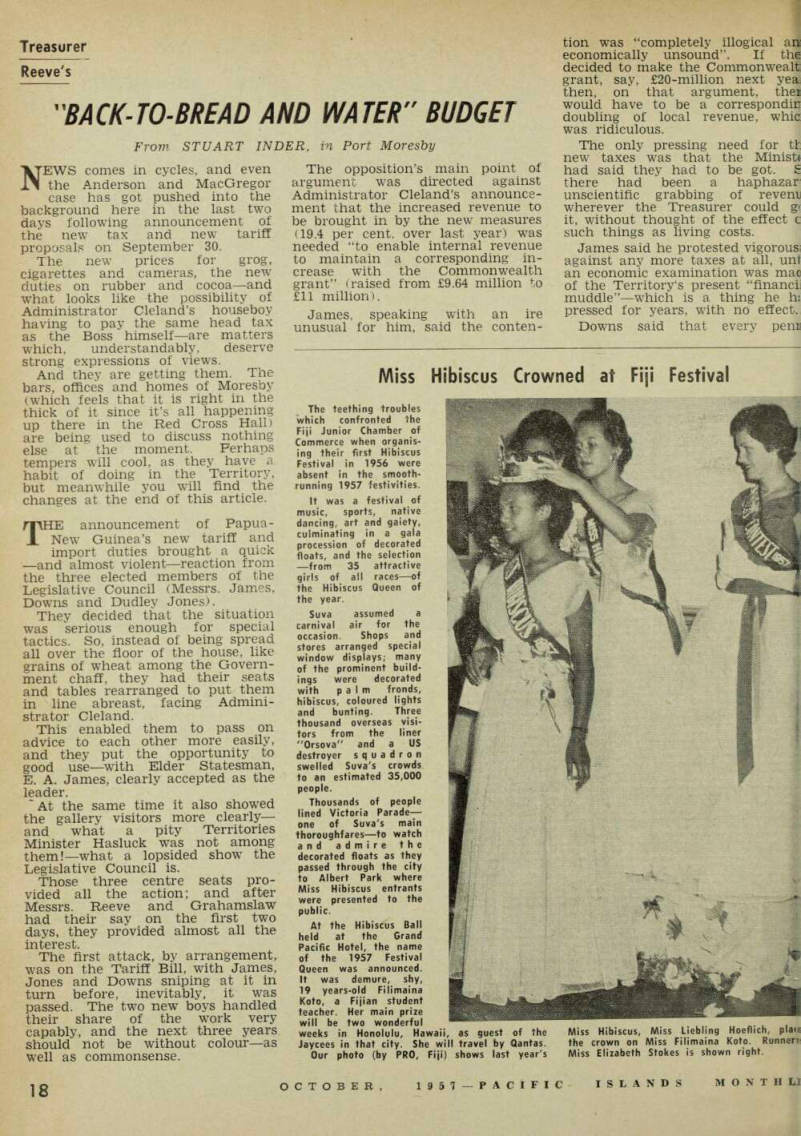
NEWS comes in cycles, and even the Anderson and MacGregor case has got pushed into the background here in the last two days following announcement of the new tax and new tariff proposals on September 30.
The new prices for grog, cigarettes and cameras, the new duties on rubber and cocoa —and what looks like the possibility of Administrator Cleland’s houseboy having to pay the same head tax as the Boss himself —are matters which, understandably, deserve strong expressions of views.
And they are getting them. The bars, offices and homes of Moresby (which feels that it is right in the thick of it since it’s all happening up there in the Red Cross Hall) are being used to discuss nothing else at the moment. Perhaps tempers will cool, as they have a habit of doing in the Territory, but meanwhile you will find the changes at the end of this article. r[E announcement of Papua- New Guinea’s new tariff and import duties brought a quick —and almost violent —reaction from the three elected members of the Legislative Council (Messrs. James, Downs and Dudley Jones).
They decided that the situation was serious enough for special tactics. So, instead of being spread all over the floor of the house, like grains of wheat among the Govern ment chaff, they had their seats and tables rearranged to put them in line abreast, facing Admini strator Cleland.
This enabled them to pass on advice to each other more easily, and they put the opportunity to good use —with Elder Statesman, E, A, James, clearly accepted as the leader.
“At the same time it also showed the gallery visitors more clearly— and what a pity Territories Minister Hasluck was not among them! —what a lopsided show the Legislative Council is.
Those three centre seats pro vided all the action; and after Messrs. Reeve and Grahamslaw had their say on the first two days, they provided almost all the interest.
The first attack, by arrangement, was on the Tariff Bill, with James, Jones and Downs sniping at it in turn before, inevitably, it was passed. The two new boys handled their share of the work very capably, and the next three years should not be without colour —as well as commonsense.
The opposition’s main point of argument was directed against Administrator Cleland’s announce ment that the increased revenue to be brought in by the new measures (19.4 per cent, over last year) was needed “to enable internal revenue to maintain a corresponding in crease with the Commonwealth grant” (raised from £9.64 million to £ll million).
James, speaking with an ire unusual for him, said the conten
tion was “completely illogical am economically unsound”. If the decided to make the Commonwealt grant, say, £2O-million next yeaj then, on that argument, then would have to be a corresponds doubling of local revenue, whic was ridiculous.
The only pressing need for tb new taxes was that the Minist* had said they had to be got. £ there had been a haphazar unscientific grabbing of revenu wherever the Treasurer could gi it, without thought of the effect c such things as living costs.
James said he protested vigorous, against any more taxes at all, unt an economic examination was mao of the Territory's present “financii muddle” —which is a thing he hi pressed for years, with no effect., Downs said that every penii
ned on the ‘‘foolish increases” aid be lost by the effect of reased prices. ones said the Government fht be hoist on its own petard y quickly, if it tried to continue h this illogical system. If the ritory became an unattractive ce to live, work and invest in, n the Commonwealth could pour £IOO-million a year and still not gress. There was likely to be iistressing and vicious circle of ng living costs and rising wages keep pace with them, as in Aus iia. ones made a point that was not ; when he said that many of the iff increases which were claimed be only 5 per cent., were not ter cent, at all. “Some things t were 5 per cent, have been ;ed 5 per cent, to 10 per cent., [ that to my mind is a 100 per t increase!” he exclaimed.
Iven one of the nominated native nbers, John Vuia, complained t the Bill would be a hardship lis people because of the increase living costs it would bring. he gallery decided that the ate on the Tariff Bill was one the most vigorous held in the mcil. One man expressed surprise t the Government members In’t taken more notice of it—
(Continued on page 149)
>ut he, of course, had only been n the Territory a week!
Duty Increases
Duty is up by the following amounts (with ew duty in parenthesis): 10 per cent, on aerated waters (25 per cent.). 1/3 per gallon on beer (6/3). 9/- per gallon on alcoholic liquors (63/-). 5/- per gallon on sparkling wine (35/-). 2/6 per gallon on still wine (15/-). 4/- per lb on cigarettes and cigars (30/-). 2/6 per lb on manufactured tobacco (17/6).
Id per gallon on petrol, kerosene and fuel ils (6d). 10 per cent, on cameras, projectors, cine atographs, parts and accessories (25 per cent.). 5 per cent, on chronometers, clocks and atches (25 per cent.). 5 per cent, on fancy goods (30 per cent.). 5 per cent, on games and all classes of sport ig requisites (20 per cent.). 5 per cent, on jewels, jewellery and precious tones (30 per cent.). 5 per cent, of musical instruments, parts id accessories (20 per cent.). 10 per cent, on photographic materials, lemicals, apparatus and accessories (25 per snt.). 5 per cent, on radio receiving sets, parts id accessories (20 per cent.). 5 per cent, on apparel, including footwear, its, caps and umbrellas (10 per cent.). 5 per cent, on bedding, including mattresses, ankets and pillows (10 per cent.). 5 per cent, on carpets and floor coverings 0 per cent.). 5 per cent, on fibres, yarns, textiles and sub itutes therefor, n.e.i. (10 per cent.). 5 per cent, on confectionery (20 per cent.). 5 per cent, on motor cars, cycles, and com ercial vehicles with a manufacturer's payload ting of 15 cwt and under (25 per cent.).
The present duty rate of 15 per cent, on lilding board, cement, sheet glass, galvanised in and prefabricated metal buildings will ! reduced to 5 per cent.
Some other mixed items have also been re iced or the duty removed, such as distress jnals for use on vessels, fire-fighting equip ;nt, fencing posts, some printing equipment.
Ustoms (Rubber Export)
Tariff
here the assessed The rate of duty per value of the rubber lb of the rubber is is 2/6 Id 2/7 1 .166d 2/8 1.333d 2/9 1 . 5d 2/10 1 . 75d 2/11 2d 3/- 2.3d ceeds 3/- but does not ex ceed 4/8 2.3d plus 0.3d for every penny by which the assessed value exceeds 3/-. ceeds 4/8 15 per centum of the assessed value.
Customs (Shell Export)
Ordinance
Sessed Value Duty Per Ton
is than £200 Nil )0 £6/13/4 :eeds £200 but not £250 . . As above plus 3/4 for each , extra £. :eeds £250 but not £370 . . As above plus 6/8 for each extra £ by whicl, it ex ceeds <i250.
Exceeds £370 15 per cent. of the as - value.
Customs (Cocoa Export)
Tariff
Assessed Value Rate Of Duty
Per Ton
Not more than £l6O Nil £l6O £ 5 Exceeds £l6O but not £240 £5 plus 3/4 for every £ over £l6O.
Exceeds £240 but not £3lO £25 plus 6/8 for every £ by which value exceeds £240.
Exceeds £3lO 15 per cent. of the as - value.