KAINANTU: Gold in the Creeks and Coffee
pp. 139-141 · Read in the full issue
New Guinea's New Boom Town
KAINANTU: Gold in the Creeks and Coffee on the Hillsides
A Despatch From R. W. Robson.
NEW GUINEA’S newest and most promising town is Kainantu, lying at a cool 5,500 ft. on the Ramu-Markham Divide, in a lovely setting of green hills.
When the Lae-Goroka Road is completed next year (which means he construction of two small bridges jver Isoap and Manguan, and two Dig bridges over Leron and Umi —
he road itself is in), Kainantu will )e the first important Highlands own on the upwards road, some 40 Giles east of Goroka.
Kainantu is being built on gold md coffee. There are 120 Europeans here now and their numbers grow iach month. The attractive little ownship lies on a slope, parallel nth the indispensable air-strip. A [nejob is being done by Mick Foley, The Kainantu goldfield is unique, >ecause it is being developed by latives. European fossickers found
gold around there 25-30 years ago (Ned Rowlands was there) but not enough to create excitement.
Ernie Übank has been there for years. But in re cent years natives,
working for themselves, began to bring in interesting quantities of alluvial gold.
WHEN, on July 19, I walked into the office of James Gallin, Mines Department official, I found a line of natives with little packages waiting on the verandah; one native facing Gallin across a
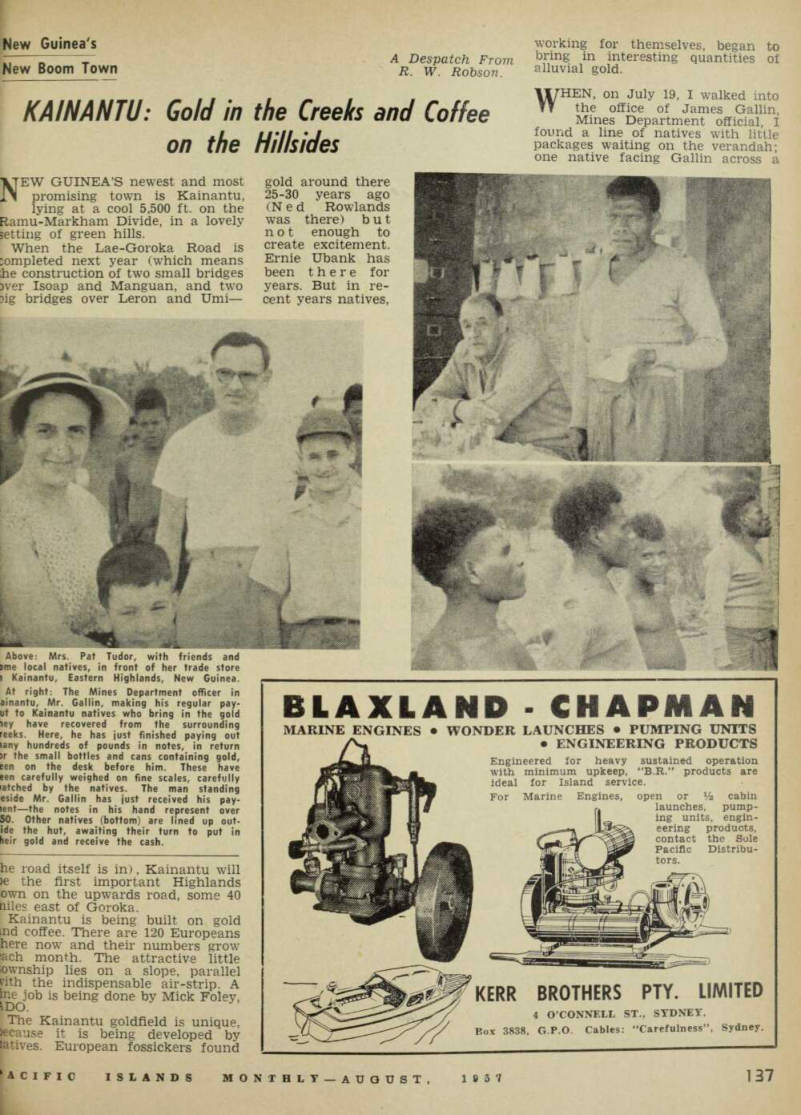
Above: Mrs. Pat Tudor, with friends and [?]me local natives, in front of her trade store [?] Kainantu, Eastern Highlands, New Guinea.
At right: The Mines Department officer in ainantu, Mr. Gallin, making his regular pay [?] ut to Kainantu natives who bring in the gold [?]ley have recovered from the surrounding reeks. Here, he has just finished paying out [?]lany hundreds of pounds in notes, in return [?]or the small bottles and cans containing gold, [?]een on the desk before him. These have een carefully weighed on fine scales, carefully atched by the natives. The man standing eside Mr. Gallin has just received his pay ent—the notes in his hand represent over 50. Other natives (bottom) are lined up out side the hut, awaiting their turn to put in heir gold and receive the cash.
table on which were many hundreds of pounds in Australian notes, and very numerous tins and bottles con taining almost pure alluvial goldi It was pay-day for the native fossickers. (See photos.) From July 1, 1956, to June 30, 1957 this Mines office paid out £23,00C to native gold-miners. The average pay-out per month now is betweer £1,200 and £2,000.
The natives get £l5/10/-per ounce 1 plus £llO/- subsidy; and they pas no royalty charge or miner’s rigfr fee.
This is part of the Hasluck policj of encouraging the native miner; as against Europeans, who pay all the fees and usual charges, plus s royalty (recently reduced from 5 te li per cent.) Comparatively recent pay-outs b: Mr. Gallin for gold brought in in elude amounts for £3lB, £558, £432 £291, and a whopper of £2,464/12/11 to a native named Kubak, who hac been saving nuggets and good golc for some time. I was allowed t< handle nuggets of pure, water washed gold of up to 13 dwts.
Between 40 and 60 natives ar gathering this gold. What do the;i do with the proceeds? Many hoar —but the Administration slowly ii inducing them to bank it.
It is the old problem of creatin; new needs for primitive people whj acquire wealth. In this case the;; are going for watches, bicycles am jewellery, such as rings. Kubak haf ordered a motor-bike, and Kainant: is waiting rather anxiously to sei how he gets along with it. mHE gold is in the valleys withi:.
JL 40 miles radius of Kainantu, am a considerable number of Euroc peans now are out after the metaj But the going is tough and ex pensive. There seems to be a grea deal of gold in the valleys aj around—but the seekers have no yet found it spread thickly enoug.; to make fortunes.
Messrs. Noel Stagg, E. Übanl Victor and Clark. Norgran, McGowar Frank Romanoff, S. B. Barker, Jin Wright (a Wau veteran, jus arrived) are among the men whr are “giving it a go.”
If parent lodes can be discovered this could become an import an goldfield. Meanwhile, enough gold : coming out to keep people interested Messrs. Buchanan and BlomfielT have been working a 5-stamr battery, west of Kainantu, for considerable time.
The big companies are “takim a look.” A team under Mr. Jin.
Herridge is testing two exclusiv nrospecting licenses taken up fci New Guinea Goldfields Ltd. There a strong rumour that Emperor GoL Minas, of Fiji, are making inquiries NGG’s production manager to!( me in Wan; “This is a big fielil with possibilities—but there’s a wio
area to cover. An official geological survey is needed, to show what is reallv there. There are indications of many metals besides gold.”
THERE is a considerable native population in this attractive country and so there is little agricultural land available. But here and' there coffee plantations have been established, and are pro ducing a high-grade article.
Mr. Len Tudor and his wife came into Kainantu, goldseeking and trading, some ten years ago; but he died, at an early age. Mrs. Pat Tudor carried on alone, with her two children; has established the leading trade store in Kainantu; and now is taking two tons of coffee per annum from her plantation.
Mr. K. Simons, of Port Moresby, now is in Kainantu, getting the foundations and timber ready f®r svhat should be a very handy hotel.
Everything is in favour of growth here. The gold prospects encourage the Europeans; but even if they don't find the gold rich enough for exploitation, the natives will. The natives now are turning to sluicing the terraces and getting better re turns.
Native gold and incoming coffee should be enough to keep Kainantu growing.
Anyway, Kainantu is organising a race meeting (24 horses are coming from Arena, on the other side of the big valley) and district ball for September 1. Proceeds go to the dependants of Jack Grey and Jim Smith, who were killed here recently n an aircraft accident.
Rice at Kaiapit JUST over in the next valley, at Kaiapit, I found a different kind of enterprise—rice-growing.
Pastor Holzknecht, Luther am missionary, said the natives there were selling land surplus to require ments; with the proceeds they were buying tractors and other equip ment: and thus they were cultivat ing rice, for which there is a great market in New Guinea. They are expecting 500 bags of rice from their first tractored crop; and they have ordered a rice-huller.
Pastor Holzknecht has been 35 years in this country—lo of them in Kaiapit. But his wife was even more interesting. She is a German woman who was born in Finsch haven before Lae even was heard of.
“My father knew the area around the mouth of the Markham,” she said, “and he called the tribe that lived there the Lahe (pronounced La-hay). But he spelled it Lae— and then the Emropeans came in afterwards and pronounced it Lay.”
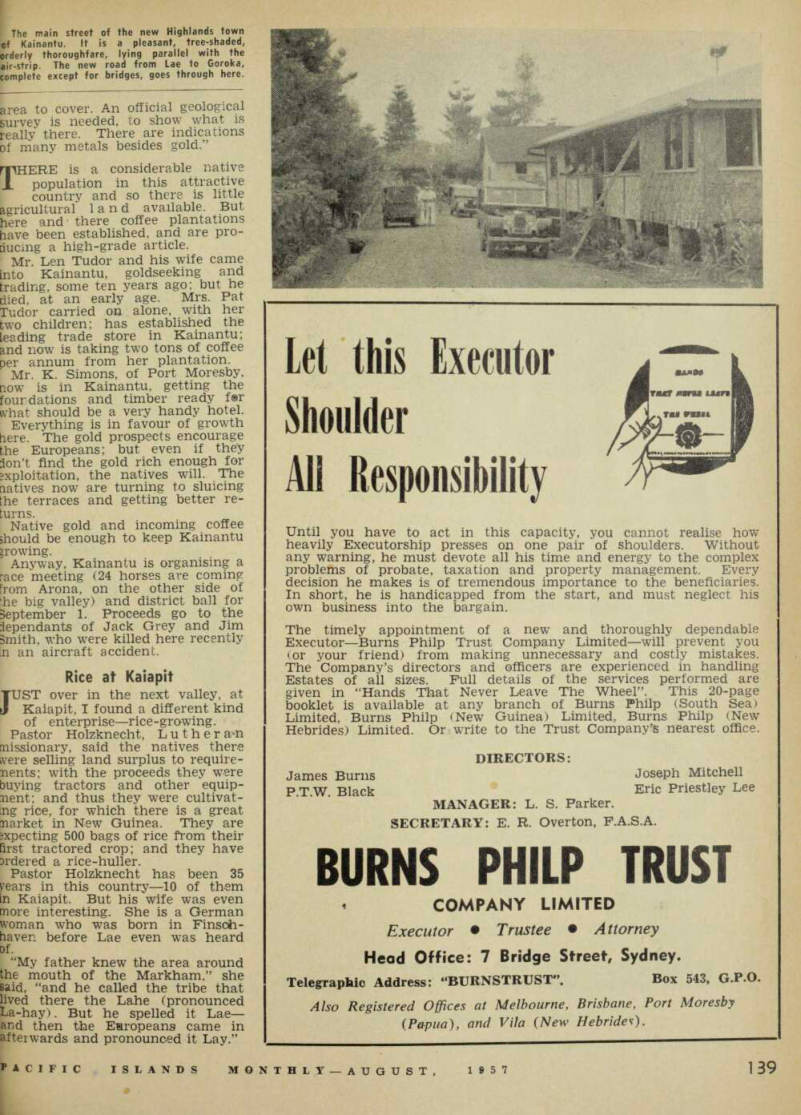
The main street of the new Highlands town of Kainantu. It is a pleasant, tree-shaded, orderly thoroughfare, lying parallel with the air-strip. The new road from Lae to Goroka, complete except for bridges, goes through here.