Peculiar Disease Among
p. 131 · Read in the full issue
Mew to Science Peculiar Disease Among Primitive Tribe
A DISTINGUISHED scientist from USA, Dr. Gaidusek, is at present out in the jungle, near Cainantu, in the Eastern Highlands if New Guinea, investigating a iisease that is believed to be new o science.
The experts still have to decide whether this thing, kuru, is caused y local conditions, or whether its
igm in genetic. Indications are at it is something peculiar to this eed of people.
There are three groups of High ids natives in the area southwards Kainantu—Kimi, Kaiagana and rei. In racial type they seem to something between the Kuku ku pygmies and the Wahgi tribes.
Most of them have one rather
rrible practice—they eat their
lers. Available animals and birds ig since were killed out, and the ffein -hungry people developed the bit of eating their dead—both )se who died naturally of old age, d those who were old and seemed need some help in crossing the :der. [ t was among the Forei tribe, mbering about 15,000, that Patrol .icers John McArthur and J. G.
Iman first noticed this peculiar
“shaking disease,” which the natives attributed to sorcery.
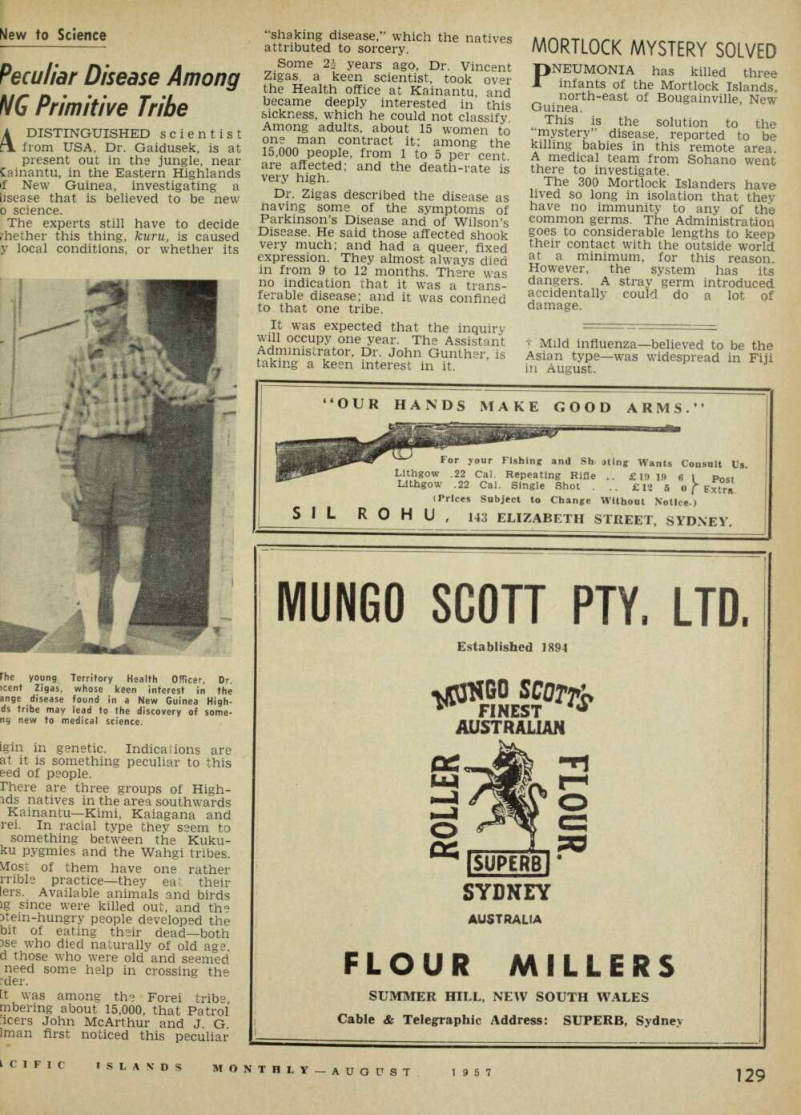
Some 21 years ago, Dr. Vincent Zigas, a keen scientist, took over the Health office at Kainantu, and became deeply interested in this sickness, which he could not classify Among adults, about 15 women to one man contract it; among the 15,000 people, from 1 to 5 per cent are affected; and the death-rate is very high.
Dr. Zigas described the disease as navmg some of the symptoms of Parkinson’s Disease and of Wilson’s Disease. He said those affected shook very much; and had a queer, fixed expression. They almost always died in from 9 to 12 months. There was no indication that it was a trans ferable disease; and it was confined to that one tribe.
It was expected that the inquiry will occupy one year. The Assistant Administrator. Dr. John Gunther, is taking a keen interest in it.
the young Territory Health Officer, Dr. [?]acent Zigas, whose keen interest in the [?]ange disease found in a New Guinea High d[?]s tribe may lead to the discovery of some [?]ng new to medical science.