Future Marketing
pp. 125-127 · Read in the full issue
South Pacific Copra
Some Possibilities of Future Marketing
3y Our New Guinea Correspondent [T may be pertinent to look at the operations of Papua-New Guinea Copra Marketing Board in this ast year of the Ministry of Agri ulture, Food and Fisheries contract, ’he Board consists of: Messrs. D. Barrett and H. Quinton, epresenting the planters of New ruinea.
B. Fairfax-Ross, representing the lanters of Papua.
H. H, Reeve and R. E. P. Dwyer, fficial representatives.
I. McDonald, Chairman.
Under the chairmanship of Mr. in McDonald, and with Mr. R. K.
Whittle, B. Com., AJA. AAS A, as hief Accountant, the Board buys ad sells some 80,000 tons of )pra annually. Payments for copra slivered, made twice monthly, pproximate £500,000 per month.
The handling of copra at Port bresby, Samarai, Madang, Kavieng, abaul, Kabakaul and the Admin tration and financial section at ort Moresby, is carried out with i efficient minimum staff of 28 Liropeans (out of which 2 or 3 are merally on leave).
Costs are cut to the minimum; id the Board was able last year return £2/16/6 to growers from vings in estimated costs. Further stributions from previous savings costs are anticipated.
The Board’s finances are in good ndition. The Balance Sheet for 56 shows total assets of £1,128,963. f this total, £806,920 represents >cks of copra and other stores at luation. Fixed assets are con watively valued at £156,992 and re rves (prior to the distribution of /16/6 per ton on 1956 deliveries), tal £614,544.
Phe Board is the major weigh idge-owner in the Territory, and mechanical handling equipment in good order and is sought after local firms. Hire of this equip mt netted over £6,000 in 1956. It iploys over 300 natives regularly me in clerical positions), and, de te constant heavy work involved, :le if any native labour trouble is jountered. Some half-dozen Asians i also employed.
With the same management in •8. planters generally can expect iximurn returns for their copra d to the Board. ’he Board has gained considerable lerience in co-ordinating shipping angements; for, apart from the 25 30,000 tons shipped to Australia ih year, 50 to 60,000 tons are PPed in bulk to the UK. In this ard the Board also arranges for ik space to be made available for :onut Products Ltd.’s coconut oil
shipments, and also brings forward ships to pick up copra from BSIP completing the tonnage at Papua and New Guinea ports.
With this experience, and a repu tation for quiet efficiency, perhaps the major criticism that can b Q levelled at the Board is its failure to take the lead in creating or co ordinating a South Pacific Pool for copra sales from 1958 onwards.
It is, of course, a cliche to say that “united we stand divided we fall’; and in the world of oils and fats one must be indeed large to stand against one of the world’s biggest, if not the biggest, buyer of oils and fats—namely Unilevers ‘Raw Materials) Ltd.
However, it is felt that this firm would not have sent its chief buyer
-^ r ./• £•. A - Faure, to the South PaoifiG this year if it did not warn Hence, if a united front, repre senting producers of 250,000 tons annually of British preferential h ad been presented, itTs feh that Undeyers might be more helpful m the negotiation of prices. As it is, they might now, as they did pre war call the tune at the price the weakest seller is prepared to take.
SOUTH Pacific copra is now almost the only copra available to UK under the preferential tariff. No sales of Straits-Malaya copra have been made to UK for 18 months.
Ceylon copra is marketed almost exclusively at home and in the East. (Over)
■ence crushers must look for copra om S. Pacific Territories to fill UK uotas, or import non-British copra nd pay duty.
Of course, it is not too late now )r producing Territories to co- Derate in the interests of maximum rices.
In fact, items for discussion on a )-operative level could well include cal crushing, the increased use of >conut oil and copra in local co jerative ventures, such as soap, >ap-powders and cleansing pro lets, hair and body oils, Far East arkets, sale of inferior conra and ist with high FFA (tannic) acid r plastic manufacture, etc. In her words, put as much thought id action co-operative selling Unilevers have put into the task dominating the purchase of oils id fats.
The Pacific producers will have no 3uble in selling their product. The aximum effort should now be made see that they get full value for : and, in this regard, to speak th one voice is imperative. P-NG, the largest single producer, with efficient basic organisation, is the peal leader.
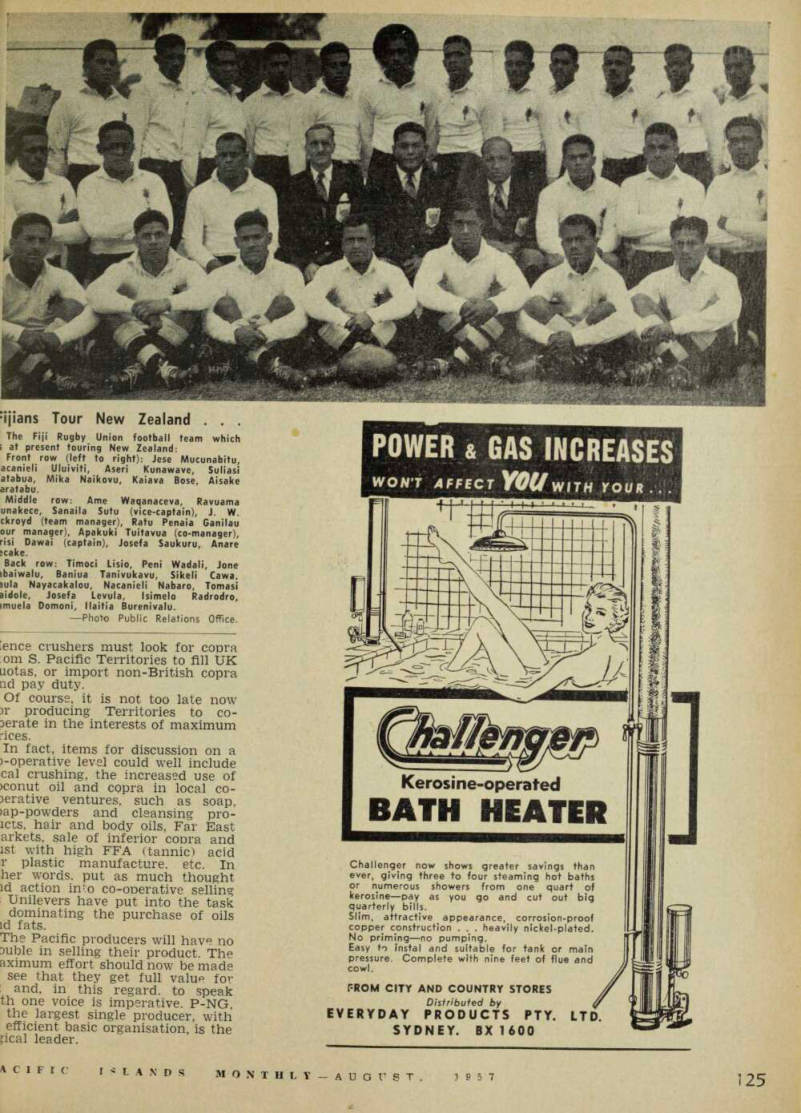
Fijians Tour New Zealand...
The Fiji Rugby Union football team which s at present touring New Zealand: Front row (left to right): Jese Mucunabitu, acanieli Uluiviti, Aseri Kunawave, Suliasi atabua, Mika Naikovu, Kaiava Bose, Aisake aratabu.
Middle row: Ame Waqanaceva, Ravuama unakece, Sanaila Sutu (vice-captain), J. W. ckroyd (team manager), Ratu Penaia Ganilau our manager), Apakuki Tuitavua (co-manager), risi Dawai (captain), Josefa Saukuru, Anare ecake.
Back row: Timoci Lisio, Peni Wadali, Jone abaiwalu, Baniua Tanivukavu, Sikeli Cawa, aula Nayacakalou, Nacanieli Nabaro, Tomasi aidole, Josefa Levula, Isimelo Radrodro, imuela Domoni, llaitia Burenivalu.
Photo Public Relations Office.