Keeping the Planes
pp. 119-120 · Read in the full issue
Behind The Scenes
Keeping the Planes Flying in P-NG
THERE is still a place for fabric workers in the aircraft in dustry, in spite of the fact that most modern planes are now metal.
Recently fabric workers were taken to Lae, New Guinea, to work
on Qantas Catalinas, etc., there.
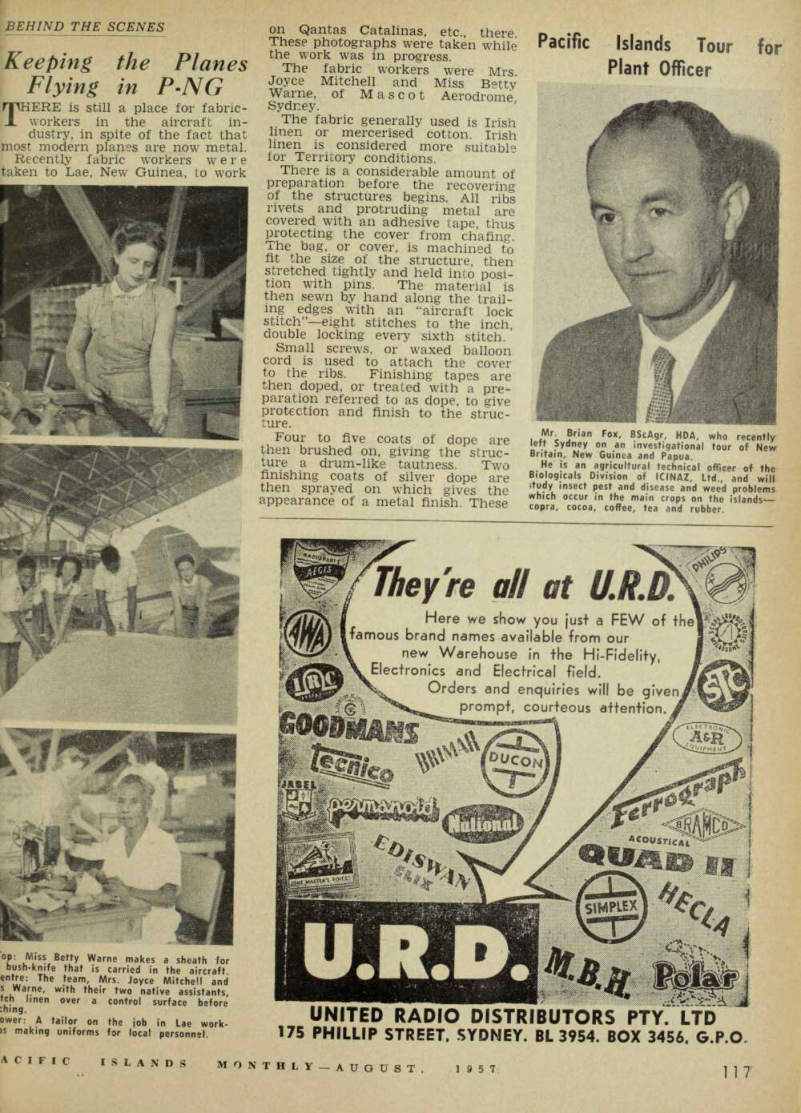
These photographs were taken while the work was in progress.
The fabric workers were Mrs Joyce Mitchell and Miss Betty Warne, of Mascot Aerodrome Sydney.
The fabric generally used is Irish linen or mercerised cotton. Irish linen is considered more suitabl Q for Territory conditions.
There is a considerable amount of preparation before the recovering of the structures begins. All ribs rivets and protruding metal are covered with an adhesive tape, thus protecting the cover from chafing.
The bag, or cover, is machined to fit the size of the structure, then stretched tightly and held into posi tion with pins. The material is then sewn by hand along the trail ing edges with an “aircraft lock stitch”—eight stitches to the inch, double locking every sixth stitch.
Small screws, or waxed balloon cord is used to attach the cover to the ribs. Finishing tapes are then doped, or treated with a pre paration referred to as dope, to give protection and finish to the struc ture.
Four to five coats of dope are then brushed on, giving the struc ture a drum-like tautness. Two finishing coats of silver dope are then sprayed on which gives the appearance of a metal finish. These
op: Miss Betty warne makes a sheath for bush-knife that is carried in the aircraft. entre: The team, Mrs. Joyce Mitchell and s Warne, with their two native assistants, [?] tch linen over a control surface before ching. ower: A tailor on the job in Lae work [?] is making uniforms for local personnel.
protective coverings enable the fabric to stand up to severe climatic conditions.
The two women say that they find the work interesting, although it requires a great deal of time and patience. They learnt their trade during the war-time manpower shortage, and have continued in the job.
Native boys assisted them at Lae.
They were surprised and pleased with the co-operation and nimble fingers of the natives.