Prominent Part Taken in Development
pp. 88-90 · Read in the full issue
Death of Hugh Kerr Recalls —
Prominent Part Taken in Development Of New Hebrides By The Kerr Brothers
By Lew Friday
WITH the death this year in re tirement at Hornsby, on Syd ney’s North Shore line, of Mr.
Hugh Kerr, the New Hebrides loses one of its older settlers, and a link with pre-Condominium days. To the end Mr. Kerr maintained old friendships with those he had known in the islands in his really strenuous years. To him and to the widow he leaves I am indebted for kindnesses that will never be for gotten, and for information about the past that few others could have imparted with the same human de tail and enlivening comment.
The family story is well worth telling. A portrait of Hugh’s uncle, the great Captain Donald MacLeod, first of New T Hebridean pioneers, and pictures of ships that plied the group for Kerr Brothers in the early 1900’s, hanging on the walls of his dining room, brought memories of days gone by.
The MacLeod family arrived in New Zealand on the Bredalhane, from Nova Scotia, in 1858, and settled at Whangarei Heads. Here, in the early 1860’s, Donald’s sister Flora MacLeod married James Walter Kerr, who had arrived from Scotland. Mrs. Kerr died on a visit to that country in 1904, and Mr.
Kerr in Zealand, where he was school teacher, farmer, storekeeper,
and member of many local bodies, in 1912, long after their sons and daughters had gone away to form the company which has played a prominent part in the development of the group.
ON Captain MacLeod’s death in 1894—he had pioneered the Hebrides since the 1860’s—Hugh’s brother Mr. Graham Kerr, now liv ing at an advanced age in Noumea, was sent from New Zealand to Efate to take charge, and was later joined by his elder brother James. James had already been at Havannah Harbour with his uncle in the 1880’s, but had been stricken with malaria.
When sufficiently recovered, James returned to New Zealand, and he was able to join Graham at Vila, where Kerr Brothers built a new store alongside MacLeod’s old one, in 1895. Their sister Flora joined them in 1899, and Hugh a year later. They carried on business for a while as MacLeod and Com pany, but later formed Kerr Brothers Ltd., registered in Syd ney, where they set up their first office in 1902. Two other sis ters, Mary and Agnes joined them in Australia, Agnes, whom I met on one of the last of her trips to the group, and again in Svdney after
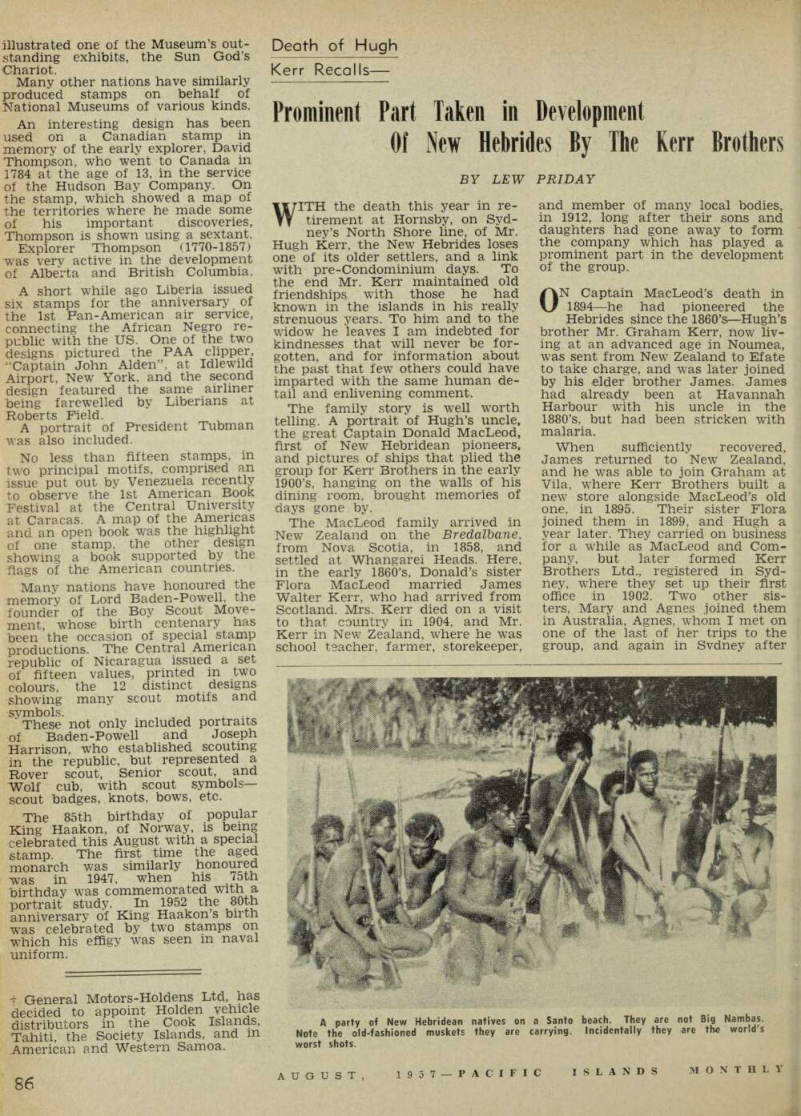
A party of New Hebridean natives on a Santo beach. They are not Big Nambas.
Note the old-fashioned muskets they are carrying. Incidentally they are the world's worst shots.
the war, was a most capable ac countant.
In the late 1890’s and early 1900’s settlement was shifting from Efate and Epi to Malekula, Santo, and other northerly islands. It was French settlement mostly, though trading was carried on by people of other nationalities, and Austra lians for a while showed an unusual burst of interest.
In these circumstances the Kerr Brothers became well known for developments at Santo, where they established a big plantation at Turtle Bay. Here among the early settlers were the brothers Matt and Willie Wells, from Tamora, New South Wales, who had bought the Trumble plantation Trumble, brother of the Australian Test cricketer had been murdered by the natives. Next came the Kerr’s place at Matewula (“Smooth Water”) a beautiful small harbour, but with out a deep entry, so that you had to get in and out at high tide.
Another important activity of the nrm in those days was their own shipping service round the group “SJ, is, north of Vila. From the 1890 s on, Messageries Maritimes ran an excellent overseas shipping ser vice, arriving in Noumea from France, via Suez and Australia, every 28 days, and it was on one of these mail vessels that Mr. Gra made his first voyage Sydney-Noumea, in about 66 hours, or faster than to-day. cpnHni l, i n +u he a 1?? 0 ’ 8, the Australian tn rcfu °f in AU SN Company used to call at Vila and Noumea, on its ixm to and from Suva; and later ? urn p hilp service from Sydney to Lord Howe, Norfolk Island, and the New Hebrides was established. But for hnktag up thl » la s d °V tp ? sts f rotn Vila north wards, planters, traders and mis
sions were very dependent on the Kerr Brothers’ services, mHE vessels the X Kerr Brothers had in thnse
earlv davi in se?
Jfrps rmmd fhl
vices round the
ft aTi
mente were the “ , Anderson nf nnn * “““ V
Toa^Ro'sabTl
France Luna and Heather. Mostly these vessels they owned ’ but a few e / e under charter.
Then wa f P? out the time of , outbreak of World War One— 2“?® tragedy. The was lost in a hurricane in the region of northern Ambrym.
There were many French passeng ers on board, and
\ZS£j' toW i people lost their lives, including two nuns.
Mr. Graham Kerr was twelve hours in the water, and in that tim~ he and a native drifted fifteen miles °n a spar. They were washed up on the fringing reef of two-mile-long Sakau largest of the tiny Maske lyne Islands forming the south-east Malekula. The native was killed in the wash, but Mr. Kerr though cut to ribbons by the coraf managed to scramble ashore, where the French planter Gautier looked after him.
Mrs. James Nicol (Flora Kerr) was on board, but was picked up Her husband had come out from Britain as engineer on the yacht Euphrosyne (she was too small to be termed a gunboat), sent out for the British New Hebrides adminis tration. This brother-in-law of the Kerrs became resident commis sioner, at Tanna, for the southern islands.
The master of the Tathra, Captain Halliday, last to leave, broke his chin getting into one of the boats. An inquiry into the ves sel’s loss was held in Sydney, and
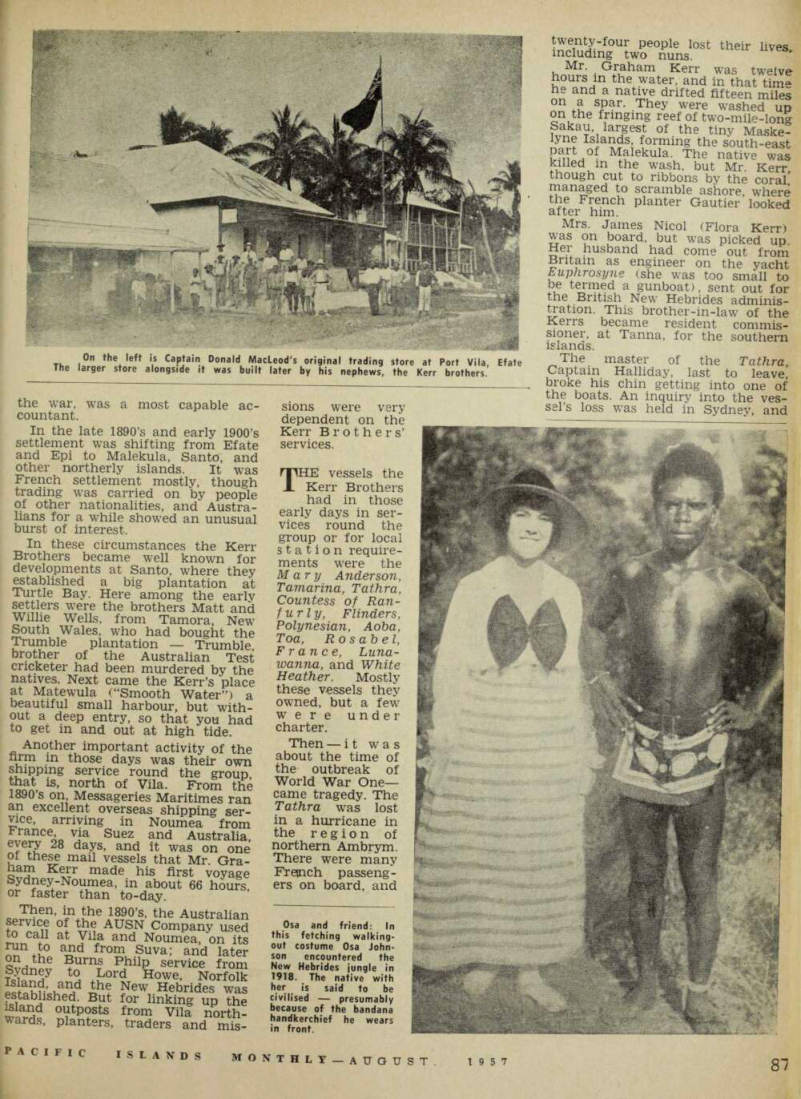
On the left is Captain Donald MacLeod's original trading store at Port Vila Efate The larger store alongside it was built later by his nephews, the Kerr brothers.’
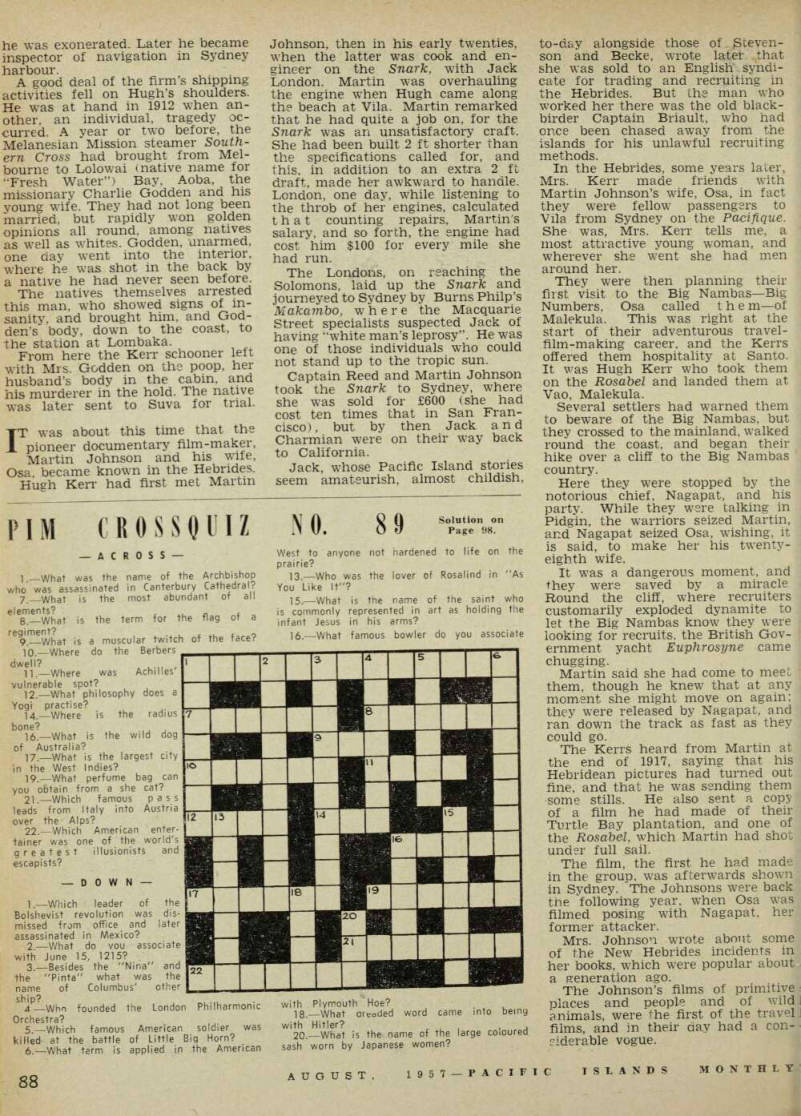
Osa and friend: In this fetching walking out costume Osa John son encountered the New Hebrides jungle in 1918. The native with her is said to be civilised presumably because of the bandana handkerchief he wears in front.
he was exonerated. Later he became inspector of navigation in Sydney harbour.
A good deal of the firm’s shipping activities fell on Hugh’s shoulders.
He was at hand in 1912 when another, an individual, tragedy occurred. A year or two before, the Melanesian Mission steamer Southern Cross had brought from Melbourne to Lolowai (native name for “Fresh Water”) Bay, Aoba, the missionary Charlie Godden and his young wife. They had not long been married, but rapidly won golden opinions all round, among natives as well as whites. Godden, unarmed, one day went into the interior, where he was shot in by a native he seen The natives themselves airest this man, who showed signs of in-
rSSSHr coast ' to
ss htemu n rdlre b r°?n y the ”ter sent to Suva tor trial. 1T was about this time that the T pionee a documentary film-maker, Martin Johnson and his wife, Osa, became known in the Hebrides.
Hugh Kerr had first met Martin
Johnson, then in his early twenties, when the latter was cook and en gineer on the Snark, with Jack London. Martin was overhauling the engine when Hugh came along the beach at Vila. Martin remarked that he had quite a job on, for the Snark was an unsatisfactory craft. she had been built 2 ft shorter than the specifications called for, and this, in addition to an extra 2 ft draft, made her awkward to handle, London, one day, while listening to t he throb of her engines, calculated that counting repairs, Martin's salary, and so forth, the engine had cos 1: h im $lOO for every mile she h ad run.
The Londons, on reaching the Solomons, laid up the Snark and iourneved to Svdnev bv Burns Philp’s Mak ' ambo where the Macquarie
not slsz
STo
she was sold for £6OO (she had cost ten times that in San Fian cisco), but by then Jack and were on them way back to California. , . .
Jack, whose Pacific Island stories seem amateurish, almost childish,
to-day alongside those of Steven son and Becke, wrote latel* that she was sold to an English syndi cate for trading and recruiting in the Hebrides. But the man who worked her there was the old black birder Captain Briault, who had once been chased away from the islands for his unlawful recruiting methods.
In the Hebrides, some years later, Mrs. Kerr made friends with Martin Johnson’s wife, Osa, in fact they were fellow passengers to Vila from Sydney on the Pacifique.
She was, Mrs. Kerr tells me, a most attractive young woman, and wherever she went she had men around her.
They were then planning their first visit to the Big Nambas —Big Numbers, Osa called the m—of Malekula. This was right at the start of their adventurous travel film-making career, and the Kerrs offered them hospitality at Santo.
It was Hugh Kerr who took them on the Rosabel and landed them at Vao, Malekula.
Several settlers had warned them to beware of the Big Nambas, but they crossed to the mainland, walked round the coast, and began their hike over a cliff to the Big Nambas country.
Here they were stopped by the notorious chief, Nagapat, and his party. While they were talking in Pidgin, the warriors seized Martin, and Nagapat seized Osa, wishing, it is said, to make her his twenty eighth wife.
It was a dangerous moment, and they were saved by a miracle Round the cliff, where recruiters customarily exploded dynamite to let the Big Nambas know they were looking for recruits, the British Gov ernment yacht Euphrosyne came chugging.
Martin said she had come to meet them, though he knew that at any moment she might move on again; they were released by Nagapat, and ran down the track as fast as they could go.
The Kerrs heard from Martin at the end of 1917, saying that his Hebridean pictures had turned out fine, and that he was sending them some stills. He also sent a copy of a film he had made of their Turtle Bay plantation, and one of the Rosabel, which Martin had shot under full sail.
The film, the first he had made in the group, was afterwards shown in Sydney. The Johnsons were back the following year, when Osa was filmed posing with Nagapat, her former attacker.
Mrs. Johnson wrote about some of the New Hebrides incidents in her books, which were popular about a generation ago.
The Johnson’s films of primitive places and people and of wild animals, were the first of the travel films, and in their day had a con siderable vogue.