With Two Hog Biscuits And A Bible
pp. 86-87 · Read in the full issue
Wife Trouble Set Him Adrift...
By R. J. Parker
At Ocean Island, Central Pacific, a young Ellice Islander’s attraction to another man’s wife recently led to a sea voyage of over 160 miles in an open galvanised boat barely 10-ft long.
Taulamati, of Funafuti, Ellice Islands group, had been working in the messroom of the British Phos phate Commission, Ocean Island, for a period of 8 months, during which time he became attracted towards an Ellice woman, the wife of one of the Ellice labourers.
Finally he decided to approach this woman and crept into her house at midnight on May 24.
However, he was unfortunate to. find the husband at home and did' not escape before being recognised.
Next day, gossip spread among the native labourers of Taulamati’s visit and his friends became angry with him.
Realising that public feeling was rising against him, and fearing the action that would be taken, he de cided to hide the following night.
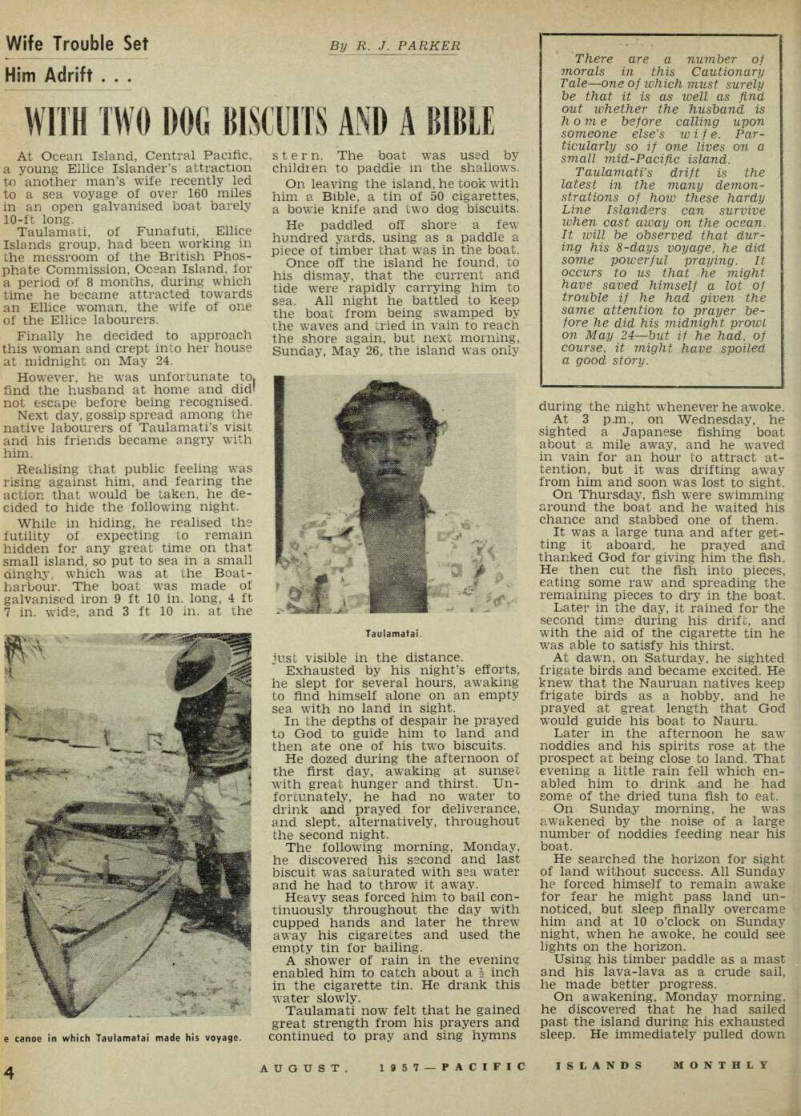
While in hiding, he realised the futility of expecting to remain hidden for any great time on that small island, so put to sea in a small dinghy, which was at the Boat harbour. The boat was made of galvanised iron 9 ft 10 in. long, 4 ft 7 in. wide, and 3 ft 10 in. at the
stern. The boat was used by children to paddle in the shallows, On leaving the island, he took with him a B ible, a tin of 50 cigarettes, a b o wie knife and two dog biscuits.
He paddled off shore a few hundred yards, using as a paddle a P ie “ c ° f “ e his disma y> that the current and gf "«e him to ‘he - boat bein ® swam P ed b ? the waves and tried in vain to reach shore again, but next morning, Sunday, May 26, the island was only
just visible in the distance.
Exhausted by his night’s efforts, he slept for several hours, awaking to find himself alone on an empty sea with no land in sight.
In the depths of despair he prayed to God to guide him to land and then ate one of his two biscuits.
He dozed during the afternoon of the first day, awaking at sunset with great hunger and thirst. Un fortunately, he had no water to drink and prayed for deliverance, and slept, alternatively, throughout the second night.
The following morning, Monday, he discovered his second and last biscuit was saturated with sea water and he had to throw it away.
Heavy seas forced him to bail con tinuously throughout the day with cupped hands and later he threw away his cigarettes and used the empty tin for bailing.
A shower of rain in the evening enabled him to catch about a 3 inch in the cigarette tin. He drank this water slowly.
Taulamati now felt that he gained great strength from his prayers and continued to pray and sing hymns
There are a number of morals in this Cautionary Tale—one of which must surely be that it is as well as find out whether the husband is home before calling upon someone else’s wife. Par ticularly so if one lives on a small mid-Pacific island.
Taulamati’s drift is the latest in the many demon strations of how these hardy Line Islanders can survive when cast away on the ocean.
It will be observed that dur ing his 8-days voyage, he did some powerful praying. It occurs to us that he might have saved himself a lot of trouble if he had given the same attention to prayer be fore he did his midnight prowl on May 24—but if he had, of course, it might have spoiled a good story.
during the night whenever he awoke.
At 3 p.m., on Wednesday, he sighted a Japanese fishing boat about a mile away, and he waved in vain for an hour to attract at tention, but it was drifting away from him and soon was lost to sight.
On Thursday, fish were swimming around the boat and he waited his chance and stabbed one of them.
It was a large tuna and after get ting it aboard, he prayed and thanked God for giving him the fish.
He then cut the fish into pieces, eating some raw and spreading the remaining pieces to dry in the boat.
Later in the day, it rained for the second time during his drift, and with the aid of the cigarette tin he was able to satisfy his thirst.
At dawn, on Saturday, he sighted frigate birds and became excited. He knew that the Nauruan natives keep frigate birds as a hobby, and he prayed at great length that God would guide his boat to Nauru.
Later in the afternoon he saw noddies and his spirits rose at the prospect at being close to land. That evening a little rain fell which en abled him to drink and he had some of the dried tuna fish to eat.
On Sunday morning, he was awakened by the noise of a large number of noddies feeding near his boat.
He searched the horizon for sight of land without success. All Sunday he forced himself to remain awake for fear he might pass land un noticed, but sleep finally overcame him and at 10 o’clock on Sunday night, when he awoke, he could see lights on the horizon.
Using his timber paddle as a mast and his lava-lava as a crude sail, he made better progress.
On awakening, Monday morning, he discovered that he had sailed past the island during his exhausted sleep. He immediately pulled down
e canoe in which Taulamatai made his voyage.
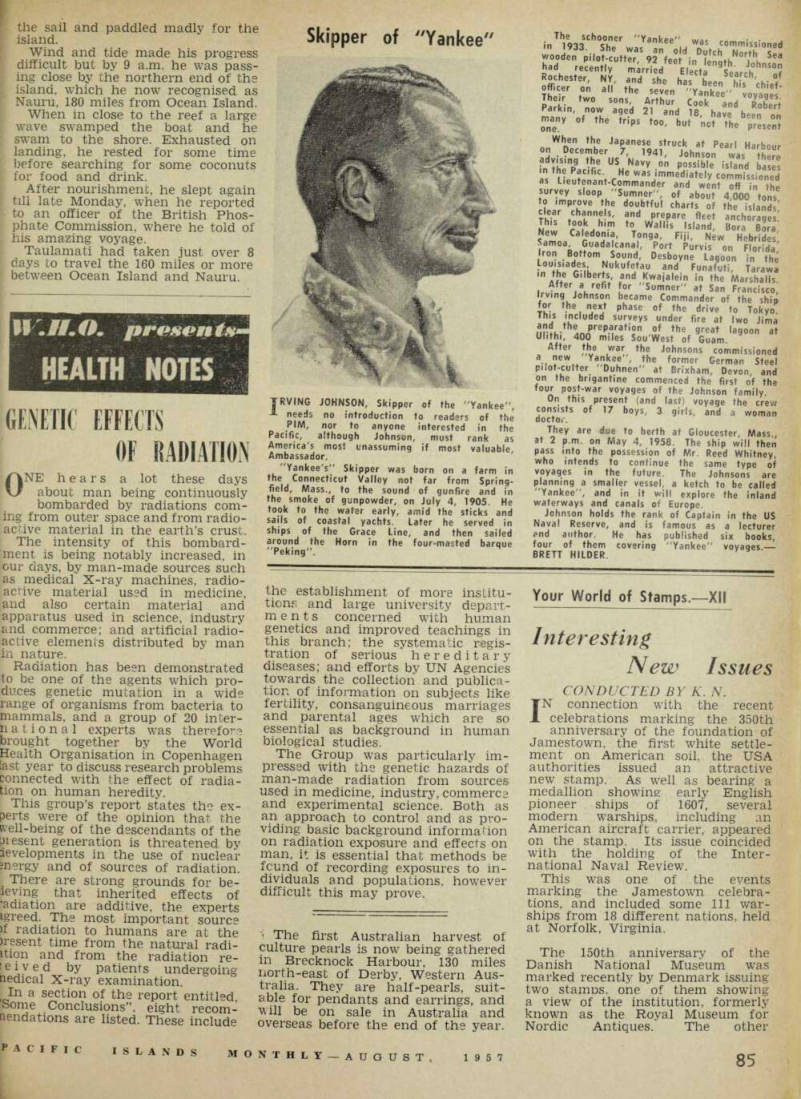
Taulamatai.
the sail and paddled madly for the island.
Wind and tide made his progress difficult but by 9 a.m. he was pass ing close by the northern end of the island, which he now recognised as Nauru, 180 miles from Ocean Island.
When in close to the reef a large wave swamped the boat and he swam to the shore. Exhausted on landing, he rested for some time before searching for some coconuts for food and drink.
After nourishment, he slept again till late Monday, when he reported to an officer of the British Phos phate Commission, where he told of his amazing voyage.
Taulamati had taken just over 8 days to travel the 160 miles or more between Ocean Island and Nauru.