Pacific Shipping And Cruising Yachts
pp. 59-109 · Read in the full issue
This Month's News of—
Again In The News
Over the past year an organisa tion allegedly headed by a Mr.
Bruce Aitchison, of New York, with subsidiaries known as the Crescent Corporation of Monrovia, and the Victor International Corporation of Panama, has caused a good deal of interest in South Pacific maritime circles through its flag-of-conveni ence operations. The organisation first appeared in the area with its vessel, Sea Pearl, a converted US Navy net-layer, which had a little earlier appeared in New Zealand waters under other ownership as Maria Ines, with a cargo of potatoes from California. [ Southbound from the States as Sea Pearl, the vessel broke down near Tahiti. Later she uplifted oranges at Rarotonga for Welling ton. There for a long time she lay seeking a refrigerated cargo. Dur ing this period an attractive young lady from New York arrived on the scene as representative of the prin cipals and transacted the purchase of four New Zealand coasters —two serviceable, though old, and two as hulks past useful life.
One of the serviceable vessels Storvi, was renamed Rose Pearl. The other, Holmdale, became Pacific Pearl. With Sea Pearl, all vessels then proceeded to load scrap metal for Japan.
Some time later, when ready to sail, Pacific Pearl found a writ on her mast, which was cleared in due course.
The hulks —Matangi and Arahura —loaded with scrap, departed under tow of a tug, the others at inter vals under their own power.
Apart from the sight of their un usual flags, the vessels caused no further stir until Sea Pearl, best of the flotilla, met her fate off the north-east coast of New Guinea by explosion, fire, and stranding in June. She then carried a crew of mainly men from Fiji and Tonga.
On July 23, the organisation again made headlines when Rose Pearl was held up at Darwin by two writs. The first, for £12,000, was reported cleared, when a second for £lB,OOO was affixed on behalf of Dalgety & Co. of NZ. Owner Aitchi son, of New York, was reported to have lodged a counter claim with
the court for £5OO per day covering wrongful detention. The vessel was ‘° ° lear lor Cairns and more claims . others, too, were making claims i? f U Ju’ but the Probabilities were that the daily press had the story well confused. The cabled story from Pokio said that the Japanese Gov ernment was preparing a claim on behalf of some Japanese shipping operators for damages due to the necessity of having to divert their ships on the phosphate trade dur ing the British Pacific H-bomb tests.
Some papers said that the ships concerned had been trading to Angaur—which was very far from the Christmas-Maiden bomb tests and in any case, phosphate pro duction is believed to have ceased there some time ago.
Far more likely was the Tokio Radio report that the affected ships were on the Makatea service, Maka tea being located between Tahiti and the Tuamotus and a major source of phosphate imports for Japan.
It is conceivable that these ships were diverted to the south or even avoided calling at Makatea over the test period. Much more likely to suffer diversion were vessels on the
Tahiti-Honolulu or Tah i t i-West Coast of the US run, such as Mat son Line and Pacific Transport Line vessels.
New Liaison Officer
Lieut. K. C. H. Cadman, RNZN, lately first lieutenant of the
mine - sweeper Stawell, was to take up a new
appointment in
July as Naval Liaison Officer, Fiji, in succes sion to Lieut.- Commander E.
H. P. Bryan,
Rnzn.
One of the functions of the Fiji naval liaison officer is to act as business agent
for the naval tankers which call from time to time to discharge gasoline for the RNZAF, and for other naval craft which occasion ally call.
Kon-Tiki Finds Final Home
Kon-Tiki, the balsa-wood raft
which carried the Norwegian flag from Peru to Polynesia in 1947 under the command of Thor Heyerdahl, was shifted into a new permanent building in Oslo in July and took her nlace near the famous Nor wegian polar exploration vessel,
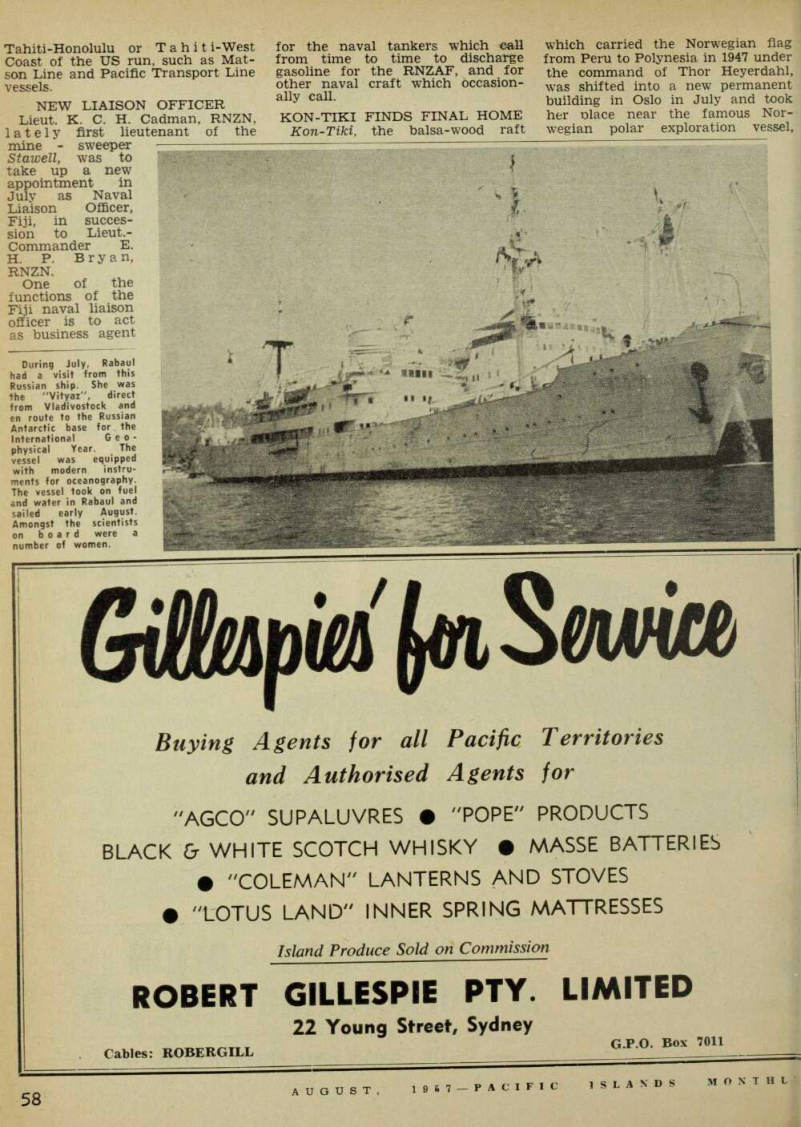
During July, Rabaul had a visit from this Russian ship. She was the "Vityaz", direct from Vladivostock and en route to the Russian Antarctic base for the International Geo physical Year. The vessel was equipped with modern instru ments for oceanography.
The vessel took on fuel and water in Rabaul and sailed early August.
Amongst the scientists on board were a number of women.
Fram, once skippered by Roald Amundsen,
To The Rescue
NZGS Maui Pomare interrupted cargo operations off Rarotonga in mid-July to go to the aid of a local launch with seven men aboard. The launch, with engine broken down, was reported drifting out of sight of land south-west of the island, in rough weather conditions.
It was reported that had Maui Pomare not been available the launch and all hands might well have been lost, as the small craft was partly swamped when located.
Pleasing Visitor
The once rarely seen Liberian flag, now worn by many of the world’s largest tankers, was to appear in South-West Pacific waters in July when the handsome Hono lulu-based schooner Te Vega de parting from her usual Honolulu- Papeete passenger run, was to make a charter voyage to Samoa, Fiji, and other islands with an American cinerama film unit.
Te Vega, spoilt in appearance as she has been by having her mast
heights and sail area greatly reduced prior to entering commercial ser -52 s “v ? al years ago, is still easily the most attractive craft regularly trading south of the Line to-day.
There are still a very few attractive sailing craft in Poly nesian waters—a hot contender for me title is the American-owned .Nassau (Bahamas)-registered Tiare Maori, but she is much smaller and of less flowing lines than Te Vega.
Final Refit?
Refitting in Auckland, perhaps for the last time under present ownership, Tonga Copra Board’s 80ton ketch A’oniu arrived there July 16. Like the other Tonga Govern ment-owned ketch, Hifofua, which
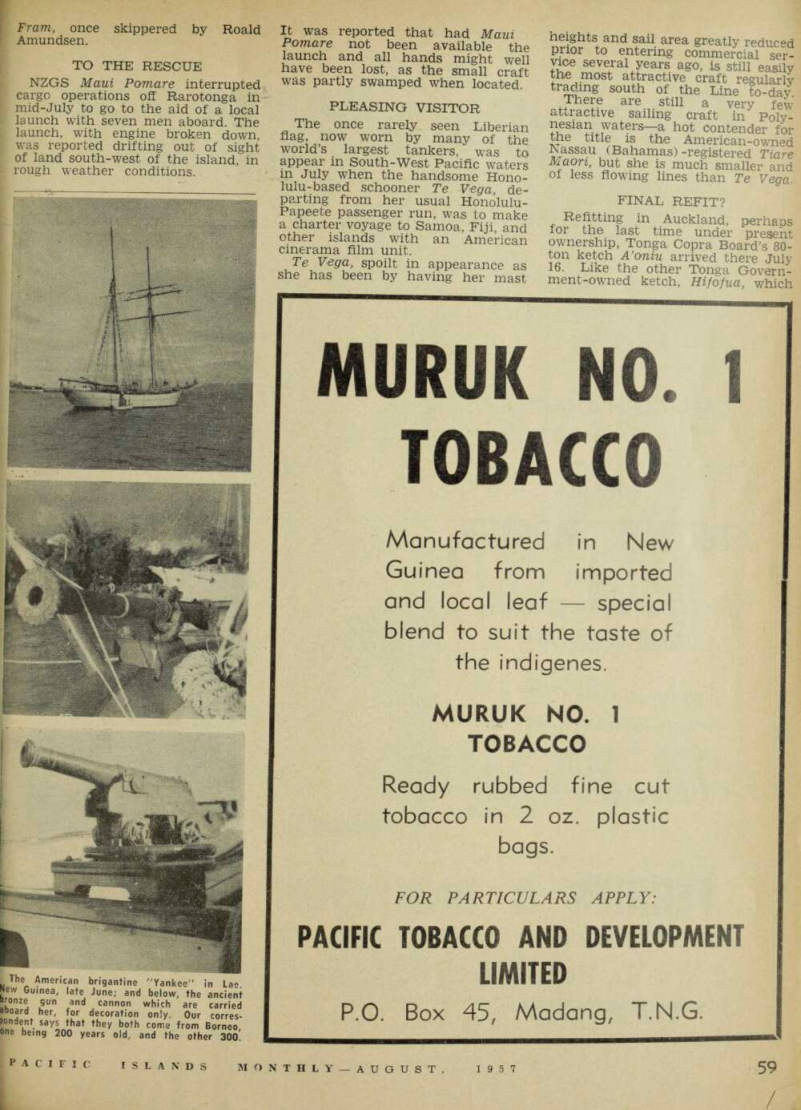
The American brigantine "Yankee" in Lao New Guinea, late June; and below, the ancient Bronze gun and cannon which are carried board her, for decoration only. Our corres pondent says that they both come from Borneo, one being 200 years old, and the other 300.
cleared Auckland May 27, following refit, A’oniu should be replaced within the next six months by a modern, new, Dutch-built 500-tonner of the same name.
Inflatable Rafts Accepted
There is good news for South Pacific seamen in acceptance by the New Zealand iVlarine Department of inflatable rafts and dinghies in coastal vessels there. New Zealand’s standards of marine survey in all departments are generally known to be severe, so the fact that the De partment’s 1956 annual report, in noting that inflatable life-saving gear has been accepted there, says “the efficiency and suitability of suitably designed and constructed rubber dinghies under adverse con ditions of abandoning ship have been convincingly demonstrated,” is bound to influence surveyors and survey-standards in certain Island areas where such equipment might replace the standard rigid lifeboat with great profit to everyone con cerned.
Only disadvantage of the inflat able equipment is that it cannot be loaded prior to launching, but this factor makes no difference in the average low-freeboard Island trader.
W. Samoa Has Marine
Committee
No doubt as a direct result of the
Joyita disaster of 1955, Western Samoa Government established a Marine Committee during 1956 according to the latest Annual Re port of the Territory just published in NZ.
The function of this Committee is to maintain certain safety margins in the operation of locally registered small-craft, of which there were 25 at the end of 1956. As a result of the Committee’s investigations and recommendations, the licensed passenger loads of some of these craft were reduced.
Shipping safety was also advanced during the year with the establish ment of an organised R/T watch on new smallships frequencies by the Apia coast station, and the instal lation of modern R/T equipment in most of the vessels of the local fleet.
Apia’S 1956 Cargo Flow
The 1956 Western Samoa Report shows that 38,861 tons of cargo were loaded for export and 35,085 tons unloaded at Apia during the year. There are no berths for deep-water vessels, all the above cargo being handled by lighterage.
Unfortunately, no figures of cargo handled by the local coastal fleet are available, though they would be interesting. Of the 223 deep-water vessels which entered and cleared the port, 107 were British, and most
of these were represented by regularly scheduled visits of the Union Co. s Tofua and Matua. The Norwegian-registered Thorshall and Thorsisle on the trans -Pacific freight and passenger service for most of the foreign
Vagabond Arrives After
Rough Passage
a T er £ ro \* gh Passage, the J6-ft vessel Vagabond arrived in Noumea on June 15, 15 days out of Maryborough, Q’ld., where she was bunt for M. Jean Boyer.
On board were Captain George
Wyeth, skipper for the delivery voyage; the owner; Captain Helme, well-known Tahiti skipper; and two New Caledonians. They encountered two storms and spent some days hove-to. Vagabond is equipped with a 6-cylinder Gardner engine and is fitted with two-way radio and a depth sounder. M. Boyer hopes to use the vessel for tuna fishing off New Caledonia.
Ben Does It Again
As Ben Carlin’s amphibious jeep, Half-Safe, can scarcely come into the section dealing with “cruising yachts” it will have to go in here.
Carlin now seems set fair to make hazardous, or foolhardly, ocean cross ings in this most unsuitable of vessels —or vehicles —his life’s work.
So he will have to be regarded as a professional.
The jeep, and Carlin, plus another crew member, reached Aleutians in July, from Japan. They were over due —but this is, of course, usual.
Carlin is an Australian, and his companion on this part of the voyage was an American, Boyde Menthe.
We have not heard of wife Elinore, who accompanied him on the first part of the trip, for a long time.
Half-Safe started its round-the world amphibious cruise in mid -1950, from Halifax. Now, nearly back once more on the North American continent, the saga should surely be drawing to its conclusion.
Turtle A La Helicopter
Bound from Panama on nuclear business some months back, 800-odd souls aboard, HM aircraft-carrier Warrior witnessed a spectacle that has yet to be seen by anyone else.
A large turtle was sighted taking it easy on the surface, and up rose the Warrior's helicopter in chase.
Hovering overhead, the pilot lowered
the grab-net rescue device used for such helicopter assignments, scooped up the turtle, and there was an extra dish in the officers’ mess that night.
Radio To The Rescue
Adequate charts were not avail able to the skipper of a New Guinea Government trawler recently when
he was called on to make an emerg ency trip from Sohano to the Mort lock Islands, but he was guided in by radio from a ship anchord off the latter.
Sickness had broken out among the natives and Captain Bert Wick ham, of the Nereus, sent out a call for help, then stood by to guide the trawler in by radio.
The trawler finally accomplished its mission, landing a doctor and a pathologist. The disease was later diagnosed as pneumonia, and has now been checked.
Bastille Day Tours
Not only pleasure yachts make the yearly pilgrimage to Papeete for the Bastille Day celebrations —it is be coming a regular excursion for trad ing vessels from the Cook Group.
This year MV Melva and Tiare Maori were both there.
Melva, owned and skippered by Capt. Hugh Williams, carried 26 excursionists, some of whom com peted in the dancing at the fete.
The voyage took four days, arriving Papeete on July 12.
Tiare Maori (Capt. Walter S. John son) also carrying 26 passengers, arrived in Papeete from Rarotonga on July 12, too, clearing that port again on July 26 for home. This vessel is registered in Nassau but trades for the South Pacific Trading Co., whose headquarters are at Penrhyn, Northern Cooks,
More Work For The
Slipways
Madang Slipways Ltd., of Madang, New Guinea, is proving very popular with Territory small-ships.
In mid-July, MV Kilinailau was there for survey and overhaul. Main work done was the fitting of a new tail-shaft.
Kilinailau is still better known as the Southern Cross Vll —after being tied up in Sydney Harbour for a couple of years—she was sold by the Melanesian Mission to the Bourgain ville Company at the end of last year and for the past six months has been operating out of Rabaul.
Away At Last
The Japanese tanker Naruta, a visible—or partly visible—feature of Rabaul Harbour since the War, has finally been raised and patched up for towing to Japan as scrap. Offered for sale several times in recent years, the hulk is the first of the vessels in the harbour to be salvaged by the Japanese contractors en gaged to recover many war wrecks.
Naruta was being towed north by the Hongkong tug Golden Cave, 525 tons.
Resurgent Returned To
Owners
The 8,000-ton Resurgent has been withdrawn from the Messageries Maritimes Line’s service operating from Sydney to Marseilles, via
Noumea, Vila and Papeete, to be re turned to her owners, the British Ministry of Trans port.
Previously the Chang Chow, the Resurgent went on to the run in May, 1956.
MM has operated her under charter from the British Ministry of Trans port.
Resurgent left Sydney on her last voyage in May and reached Marseilles on July 9.
Rona’S Maiden
Voyage
The Colonial Sugar Refining Co.’s new Rona arrived at Suva on July 23 on her maiden voyage
The 65-ton trawler, "Tagula", which was handed over to the Fishe ries D epa rtm en t on July24. "Tagula" is a marine research ve ssel and has bean built for work at Port Moresby. She was built at the Mill Kraft Boat Yards, Bulimba, Brisbane.
The tra wle r is 60 ft. long, and is equipped with the latest electronic "fish-finding" gear. Her echo-sounding equipment will de tect marine life at great depths. She is powered by a 160 h.p. diesel.
She has a fish refrigeration room with a capacity of 13 tons.
The accommodation caters for officers, a native crew and a biologist. Before she leaves Brisbane she will undergo sea trials.
from Aberdeen. From Suva she went to Lautoka, Penang and Labasa to work those ports, before leaving for Sydney, where she was due between August 6 and August 9.
The 6,600-tons d.w. vessel is replac ing the previous Rona, which was sold last year to John Manners and Cos. The old Rona is now operating out of Hongkong as Suva Breeze.
Matson Ships Step-Up
Service
The Matson liners, Mariposa and Monterey, will now make 16 round trips a year, instead of 14. The new schedule began when the Mariposa left San Francisco on June 29.
Southbound, the liners now call at Los Angeles, Tahiti, Auckland and Sydney, and on the return trip at Auckland, Suva, Pago Pago and Honolulu. Wellington and Mel bourne have been eliminated.
The liners will spend 44 hours in Tahiti and 32 hours in Honolulu.
They stay in Sydney for three days, Auckland nine to 21 hours, Suva
"Utopia" under full sail (see page 106).
nine hours and Pago Pago five hours.
Fares for the round voyage range from £558 to £1,696. (See also elsewhere).
Personal
Captain M. J. Greggor, of the well-known New Guinea ship Busama, left his home port, Lae, for leave in Australia at the end of July. Busama will be laid up during his absence.
During the month we received a note from Captain G. W. Ostenfeld, late of the Union Steamship Cos., and well-known in the Pacific. He is now retired and living at Noosa Heads, Queensland —alone, since the death of his wife last February. Captain Ostenfeld says that there is still much to interest him and that he is in demand locally as a lecturer on things Pacific; however, he does frequently have twinges of nostalgia for the South Seas.
Cook Islands’ Reef Problem
Being Tackled
The Cook Islands’ problems of widening and deepening existing reef passages, and providing pass ages where none exist, has been raised at every meeting of the Legislative Council since its inception; but lack of time and
money have prevented a full scale attempt by Public Works, and the many attempts made by other people have resulted in failure.
Mr. W. H. Ryan, Superintendent of Works, has studied the problem
for the last decade, and now feels that he has found the answer. The success of his work at Manihiki last June confirms this opinion.
Last February, Mr. Ryan com pleted a short frogman and under
water demolition course at the RNZN base at Auckland, and re turned to Rarotonga in March aboard RNZN Rotoiti, which also carried 36 redundant Air Force depth charges.
Most of these depth charges were used in May to effect small improve ments on the reef channels at Palmerston, Manihiki and Puka f puka, and to effect a major improvement at Tukao landing, Manihiki.
Mr. Ryan, a much decorated officer of World War 11, has had I extensive experience of explosives, and personally carried out the priming of the depth charges. At Tukao landing the depth charges were fired in series of 5 to 7 simultaneously, and coral debris rose to over 1,000 ft. All beached boats and canoes were previously moved out of the danger area, a radius of half a mile from the explosion’s centre.
Tukao landing was only a narrow fissure in solid coral, barely 4 ft at the broadest, but when blasting was completed the passage exceed ing 30 ft in depth, and an entrance of 40 ft had been formed.
A cleared area 60 ft by 30 ft, with a minimum depth of 15 ft had also been made behind the passage entrance. The channel from the cleared area to the stilling pond ; was 80 ft long, 20 ft wide, and of 10 ft minimum depth. The stilling pond, necessary to cancel the effect of waves, is 40 ft by 30 ft with a : minimum depth of 10 ft. Since the initial work was carried out the passage has been widened to 30 ft.
Mr. Ryan is enthusiastic over the effect of the depth charges, which completely pulverised the coral at Tukao, and he is convinced that “playing about with gelignite is jpst a waste of time”. However, in such places as Avarua harbour, where buildings and property lie close to the proposed demolition area, charges less powerful than the depth charges will have to be used.
At Mangaia it is planned to blast a reef passage with a minimum depth of 30 ft, and a 90 ft wide entrance. The passage will have high, solid reef edges on both sides. Behind the entrance will be a cleared area 170 ft wide, 60 ft long, and with a minimum depth of 40 ft. A channel 30 ft wide, 150 ft long, minimum depth 20 ft, will run from this area to a stilling pond 100 ft by 60 ft. The stilling pond, which will be located in front of the landing of 12 ft 111 haV6 a minimum depth The proposed passage will be at Vairoronga, 900 yds. north of the existing passage at Oneroa, and its large dimensions will be made easily possible by the existence of a large fresh water stream which Bows under the reef.
The estimated cost of the work is £2,500 in cash, ana aoouD 60 flepth charges will be needed. The Mangaia Island Council will raise
both money and free labour, and the project is being enthusiastically supported by the people.
The success of the Mangaian reef passage project will, to a large extent, depend upon the availability of old Service explosives—and it is hard to visualise a better use to which they could be put.
Mien A For Sale
Elsewhere in this issue, the well known auxiliary ketch Miena (owned by the equally well-known Capt.
Jimmy Richmond) is offered for sale.
This 140-ton vessel has been trad ing for many years around the Solomons and the Bougainville area of New Guinea.
Captain Richmond says that he hopes to retire from deep-sea work and that a much smaller vessel than Ml^} a will now suit his needs.
The captain’s headquarters are at Sivilou, Shortland Islands, but his postal adress is “via Buin, Bougain ville, TNG”—interesting in its own way, because it shows what geo graphical troubles are laid in store for us when politicians draw arbitrary lines on maps. The Short land group, although it shelters under the southern end of Bougain politically belongs to the British Solomon islands Protectorate Practical measures have been taken u) get over the difficulties of mail deliveries—but it is a little like
(Continued on Page 101)
• addressing a letter to the Channel Islands via Cherbourg.
Another 300-Tonner For
New Caledonia
A 300-tonner previously owned by an Adelaide company has been pur chased by the Societe Transports Maritime of New Caledonia through F. H. Stephens Pty. Ltd., of Sydney.
She is the Hiadh.
She left for her new duties — coastal trading in New Caledonia on August 9, in charge of Captain Emile Savoie, who had temporarily deserted his own “del Mar” ships for the job.
Hiadh was built in Tasmania and is of the well-known war-time type, but she was not commissioned until 1952, and then for the South Aus tralian trade. On her new job she will carry cargo only—no passengers.
Theresa May Lost—And
Found
The P-NG Administration trawler Theresa May, which became “lost” on a voyage between Rabaul and Bougainville on August 7, was located on August 10.
The engine of the trawler broke down, and because of bad visibility the Master could not give his posi tion. Planes and local shipping were
diverted to the search. The vessel was In no danger.
News of Cruising Yachts
• The Slocum Society And
the Seven Seas Cruising Associa tion are again brought to the at tention of those yachtsmen who may not yet have heard of them. If you are interested in the history of small-craft cruising and in current news of cruising yachts in other parts of the world, the Slocum Society and its little periodical, The Spray, will probably be of more in terest to you than any other yacht ing publication we know in that par ticular sphere. Write to The Secre tary, Slocum Society, c/o USIS, American Embassy, Lima, Peru.
Seven Seas Cruising Association is a more exclusive organisation in that membership is restricted to yachtsmen actually living aboard their yachts and at least intending , to do off-shore cruising; if not currently so engaged. Nomination by another member is essential.
There is no more interesting monthly bulletin than theirs avail able to the cruising yachtsman.
Each month members relate their current experiences—members are scattered around the world and many of the yachts mentioned in PIM belong to this “disorganisa tion.”
For details of how to join, write
PO S Rnv n 7fl^ e w i Crilising Association, PO Box 784, Wilmington, Cal., USA (Over)
t»ut don’t write unless you are a genuine “live-aboarder” and can prove it, because you will be in vestigated by a “Commodore” for verification of claims before you are Member yachts at present number about 90 and much of the informa tion provided in letters to the Bulletin should prove of consider able value to other world-cruisers first-hand up-to-date information on off-the-track ports which is obtainable in no other assembled form. PIM and the two above mentioned organisations exchange news items where applicable. • CALIFORNIA , 63-ft barquen tine. believed to be the same craft that cruised the Pacific and round the world several years ago, was stolen from her Honolulu moorings early June by five boys—sons of TJSAF personnel, and stranded on the reef off Waikiki Beach, Salvage appeared doubtful according to owner T. S. Applegate. • SWEVENS II was in trouble again in July. After spending some weeks in Lae, New Guinea, under going engine repairs, she left with anew crew on June 20 for the south (PIM, July, p. 106), but ran into difficulties not long afterwards.
Near the Trobriands she ran on to a nigger-head and sat on the reef for an hour until rescued by Mr. Col. Wilson, manager of Muwo Plantation.
Mr. Wilson entertained the crew for a week while they waited for a supply of oil and attended to the engine trouble.
Starting off again, the engine cut out off Goodenough and they drifted all night until they were towed in by Mr. G. Hancock, to a safe anchor age. They were given technical
advice over the air, got the engine going and headed off to Fergusson Island, where they again ran out of oil. They stopped with Mrs. Grant, of the Methodist Mission on East Cape. Twenty gallons of oil arrived and they later made Samarai, where the skipper, Mr. “Blue” Douglas, of Lae, entered hospital with a broken
toe. Meanwhile, the owner, Mr.
Laing-Peach was in Cairns awaiting the arrival of the vessel. • JOPED A: When the American Rudder magazine made available the plans of Seagoer, a 34-ft hard chine ketch that could be backyard built by any group of patient, in dustrious, handy young men, they contributed quite a lot to helping people who desire to go down to the sea in small ships.
In such a craft, Englishmen John Walmsley, his brother Peter, and David Field, a Canadian, set out from San Francisco Bay in July, 1956, destined for lotus parts and, ultimately, New Zealand.
All three had been well estab lished in key engineering billets but felt that they must make this gesture to romance and adventure before being engulfed for ever in the System. They called their dream ship Jopeda , a piece of word building based on their three names.
For almost a year plans went nicely to schedule. After four months in the Marquesas and six months in Tahiti and the Societies, they sighted Rarotonga’s lofty peaks late on June 14, 1957, in a flat calm.
The island was a long way off so they all turned in. However, an in sidious current (see Admiralty charts: trade wind drift) carried the Jopeda stealthily towards the jagged coral reefs off the east coast of Rarotonga.
At 4.30 a.m., June 15, Jopeda struck. The voyage was over, and at auction a few days later vessel and effects were disposed of “as is”.
Bids were pathetically low but enough was secured to pay their fares to New Zealand.
And off they went, JO-hn, PE-ter and DA-vid, to Auckland in the July Maui Pomare; poor in pocket, rich in experience. • MARCO POLO, almost home to Auckland, New Zealand, after three years afloat (around Australia, Indo nesia, S. Africa, USA, Canada and South Pacific) slipped into Raro tonga, Cook Islands, in July for a couple of weeks stay before tackling the final stretch to Auckland. Tony Armit, owner-skipper and his ship mate, Brian Loe, reported looking very well on it. Many answer the call but few make the complete circuit. • TAIHOE —A note from Ameri can reader, Phillip L. Schroder, says be made contact with Robert Fenton and Gunars Dambe after they arrived m San Francisco (last mentioned in PIM, June issue, p. 101). They had a tough 36 days crossing from Honolulu to San Francisco, accompanied by an American and a Canadian. They have sold the 30-ft ketch and planned to see something of America before heading back to NZ.
• NINA , ketch-rigged 33-footer of 9i tons, registered in Auckland NZ arrived in Papeete, Tahiti, on July 21. Owner-skipper is Jack Moody; with him are Bob Vale and Edwin Vowles. Nina was placed second in the Auckland-Suva yacht race of 1956. Moody plans to stay only briefly in Papeete and return to Auckland by mid-October via the Cook Islands. • SOLQUEST, owned by the
migrating Australians, Len and Joyce Staples (June PIM, p. 101), arrived m Papeete on July 22, 42 days out from Auckland, NZ. They expert— “every kin <i of bad weather.”
With them are Len, Jr., seven, and Wayne, four. The Staples have waited 10 years for their American quota number to come up. In order that they should arrive in the Land of Uncle Sam, with adequate dollar capital, Solquest was designed with a view to sale in the US.. (Over)
• WHITE HART, the 48-ft ketch, registered in Victoria, Canada, and skippered by Tony Reeves, returned to Papeete on July 25 after having abandoned a voyage to Canada.
While Hart lost most of her canvas
in severe storms after she left Papeete on June 22.
Reeves’ intention now is to sail to Rarotonga in late August, accom panied by Miss Pauline Scott. Mrs.
Reeves, part-owner of White Hart, who has been in Tahiti painting pictures for an exhibition, will not accompany them but will sail to NZ on Waitemata, in August. • NOVIA, the floating home of
Anne and Lee Gregg for the last eight years, made Tahiti landfall early July after a long trip from Honolulu. They left Honolulu in May and had a hard job getting their Easting. On the voyage they were carried about 40 miles inside the Christmas Island H-bomb "pro hibited” area and were still there during the second bomb explosion.
In March, while anchored in the Ala Moana yacht base at Honolulu, Novia was damaged by the tidal wave that resulted from the Aleutian disturbance. The yachts in the basin had had only 10 minutes warning
This stur dy-look ing Japanese motor-ship (left), is the 8,000-ton "Tibi Maru". Commissioned only in June she arrived in Noumea on her maiden voyage in July carrying 24 large wooden barges and two diesel tugs for local use (above).
and another vessel, the Albatross, crashed into Novia. • DIANA, 24-ton yawl, of Fal mouth, UK, arrived Papeete July 7, after a very slow passage from New Zealand, where she had been laid up for six months. Owner-skipper M. E. Young had three new crew members on the voyage to Tahiti— Fred Unstead, an Englishman; Davis Morgan, an Australian; and Half Sprague, of NZ.
• UTOPIA, an attractive 65 ft x 18 ft staysail schooner yacht, cleared Balboa. June 30, for Galapagos, Pit cairn, Marquesas, Papeete, Suva and Auckland. A centre-board craft of 6h ft draft with board up, Utopia was designed and built by Mr. Fred
Peterson at his own ship-yard at Sturgeon Bay, Wisconsin, USA. Now aged 63. Mr. Peterson is realising a life’s ambition. His wife will join him at Papeete. Also aboard now are Mr. and Mrs. William Fitzgerald, Hubert Kansy, and Howard Mil
End of "Jopeda" on the reef near Rarotonga —see page 103.
brandt. This sturdy craft with her twin motors and excellent electrical Installation, with deepfreeze refrig eration and electric stove, and an ample spread of canvas, should create a good deal of interest at way ports. Present plans are for a three or four year world cruise. <See photo p. 65). • COLORADO : This 48-ft luxury motor-cruiser was recently pur chased in Australia by Dr. Edward Mangrin, of Noumea (through Cap tain Kennedy, Sydney shipbroker).
The vessel arrived in Noumea on August 1, skippered by Michel Simon, who is Ist mate on Dama dora del Mar. It will be used as a pleasure craft. • RESTMORE, Danish 33-ft yawl, manned by Peter Dohm, his wife, three-year-old son, Largs, and one year-old daughter, Anne, was re ported at Plymouth, England, late April, and about to clear for the Pacific via ports. The 24-year-old English-built yacht, flying the burgee of the Copenhagen Yacht Club, cleared that port a year earlier, and has cruised Norway, Sweden, Holland and Belgium since then’.
The Dohms had earlier hiked across Europe and Africa.