The Editors' Mailbag
pp. 22-151 · Read in the full issue
COL—Both
Sides of the Border
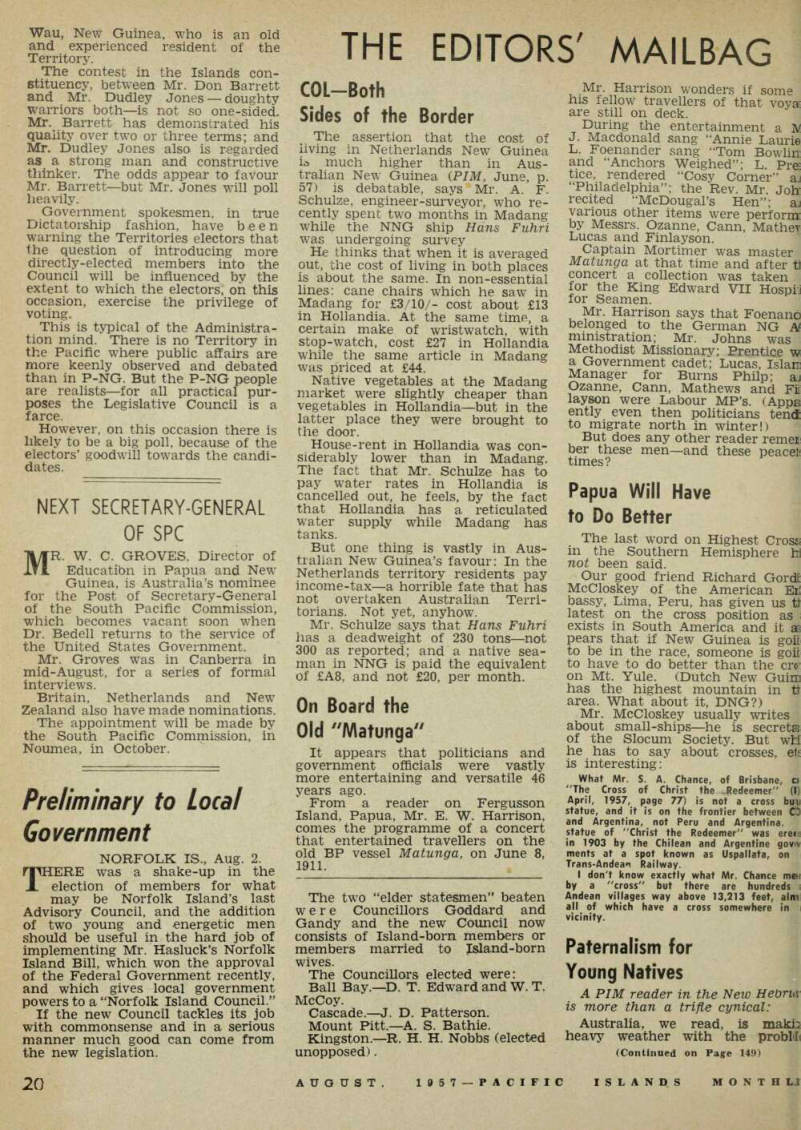
The assertion that the cost of living in Netherlands New Guinea ia much higher than in Aus tralian New Guinea (PIM, June, p. 57) is debatable, says Mr. A. F.
Schulze, engineer-surveyor, who re cently spent two months in Madang while the NNG ship Hans Fuhri was undergoing survey He thinks that when it is averaged out, the cost of living in both places is about the same. In non-essential lines: cane chairs which he saw in Madang for £3/10/- cost about £l3 in Hollandia. At the same time, a certain make of wristwatch, with stop-watch, cost £27 in Hollandia while the same article in Madang was priced at £44.
Native vegetables at the Madang market were slightly cheaper than vegetables in Hollandia—but in the latter place they were brought to the door.
House-rent in Hollandia was con siderably lower than in Madang.
The fact that Mr. Schulze has to pay water rates in Hollandia is cancelled out, he feels, by the fact that Hollandia has a reticulated water supply while Madang has tanks.
But one thing is vastly in Aus tralian New Guinea’s favour: In the Netherlands territory residents pay income-tax—a horrible fate that has not overtaken Australian Terri torians. Not yet, anyhow.
Mr. Schulze says that Hans Fuhri has a deadweight of 230 tons —not 300 as reported; and a native sea man in NNG is paid the equivalent of £AB, and not £2O, per month.
On Board the
Old "Matunga"
It appears that politicians and government officials were vastly more entertaining and versatile 46 years ago.
From a reader on Fergusson Island, Papua, Mr. E. W. Harrison, comes the programme of a concert that entertained travellers on the old BP vessel Matunga, on June 8, 1911.
Mr. Harrison wonders if some his fellow travellers of that voyaE are still on deck.
During the entertainment a IV J. Macdonald sang “Annie Laurie L. Foenander sang “Tom Bowlin and “Anchors Weighed”; L. Pre tice, rendered “Cosy Corner”
“Philadelphia”; the Rev. Mr. Joh recited “McDougal’s Hen”; aj various other items were perform by Messrs. Ozanne, Cann, Mathey Lucas and Finlayson.
Captain Mortimer was master Matunga at that time and after t! concert a collection was taken for the King Edward VII Hospij for Seamen.
Mr. Harrison says that Foenand belonged to the German NG At ministration; Mr. Johns was Methodist Missionary; Prentice w a Government cadet; Lucas, Islarr Manager for Burns Philp; aj Ozanne, Cann, Mathews and Fit layson were Labour MP’s. (Appa ently even then politicians tend to migrate north in winter!) But does any other reader remei ber these men—and these peaceli times?
Papua Will Have
to Do Better
The last word on Highest Cross; in the Southern Hemisphere hi not been said.
Our good friend Richard Gordt McCloskey of the American Er: bassy, Lima, Peru, has given us ti latest on the cross position as exists in South America and it as pears that if New Guinea is goii to be in the race, someone is goii to have to do better than the cro on Mt. Yule. (Dutch New Guim has the highest mountain in tt area. What about it, DNG?) Mr. McCloskey usually writes about small-ships—he is secrets of the Slocum Society. But wtl he has to say about crosses, etj
is interesting:
What Mr. S. A. Chance, of Brisbane, a “The Cross of Christ the Redeemer" (I) April, 1957, page 77) is not a cross buu statue, and it is on the frontier between C and Argentina, not Peru and Argentina, statue of “Christ the Redeemer" was erets in 1903 by the Chilean and Argentine goviv ments at a spot known as Uspallata, on Railway.
I don't know exactly what Mr. Chance met! by a "cross" but there are hundreds Andean villages way above 13,213 feet, aim all of which have a cross somewhere in vicinity.
Paternalism for
Young Natives
A PIM reader in the New Hebruv is more than a trifle cynical: Australia, we read, is maki: heavy weather with the probM
(Continued on Page 149)
of how to “civilise” New Guinea, to the point of self-government, within the limited time set by the nagging Trusteeship Council. Perhaps Canberra would like to know what we are doing here to lift our Melanesian types out of then accustomed state of lethargy, in two easy lessons.
In the first instance, buses supplied by the Government run six Dr more miles out from Vila, and pick-up native youths, and carry them to school; and then carry them home again.
In the second step, the Govern ment provides a canteen at the school. The youths, for something like 2/- per month, are supplied pith lunches, consisting of food that is very good, on European standards.
The system is producing a class )f young natives who are quite sure that they need neither toil nor s p i n—the rich Condominium j-overnment always will take care )f them. No more exertion in the ram and taro patch—we now have roung men whose chief ambition is i town job, with a pencil behind me ear. t The paternal Condomium in New Hebrides recommends the system to me fretful United Nations Trustee ship in New Guinea!