When New Guinea Gets Independence . . .
pp. 19-20 · Read in the full issue
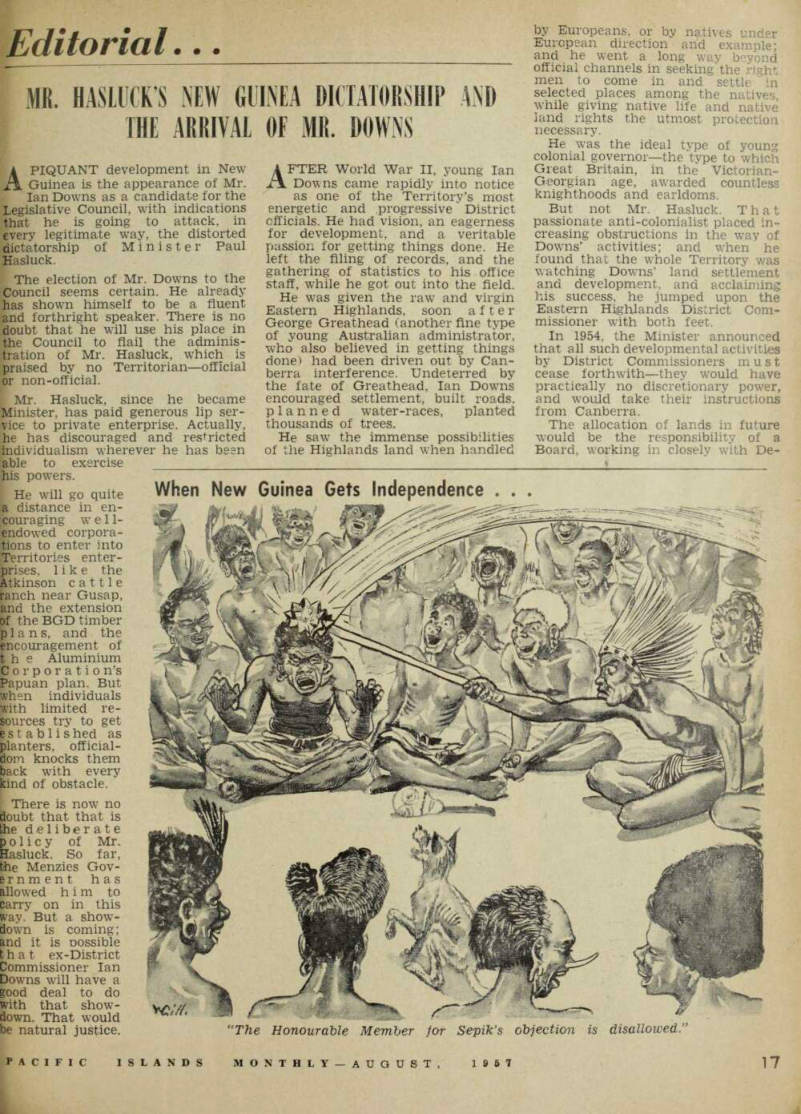
"The Honourable Member for Sepik’s objection is disallowed.”
partmental heads. These “balanced teams of experts” would decide what lands might be made available in the various Districts; would screen the applicants for land; and would allocate the lands to the applicants.
THE District Commissioners, as a vital, active and personal factor in land settlement and develop ment, were “wiped”. They had been raised from the status of District Officers: but they now were left with virtually nothing to do.
All the “local governor” functions which they might have performed with great advantage to the Dis tricts were taken from them and centralised in Canberra under Min ister Hasluck and Departmental Secretary Lambert.
This sweeping change in the delegation of Ministerial authority affected also the status and powers of the Administrator.
Under the Hasluck set-up, brought into being so cunningly in 1954-5 that not even the Commonwealth Cabinet could see its significance.
Brigadier D. M. Cleland was left in the Administratorship as a mere cipher. The authority which he came in so confidently to exercise at the end of 1952, for the develop ment of a great Australian Territory, was grabbed by Canberra; and has been exercised with increasing arrogance by Canberra ever since.
Under the Hasluck - Lambert Dictatorship, the Administratorship and most of the 15 District Com missionerships (now maintained at a very heavy cost) could be removed entirely, and their duties transferred to the working officials next in line, without causing even a ripple in administrative efficiency.
TIE leading men of the non official European population (and the majority of officials) sense that there is something wrong with the Administration; but they are unable to name the trouble.
Club lounges and airport waiting rooms and town market-places— wherever the people get together— echo to the clamour of argument and criticism (almost wholly anti- Administration); but none seems to understand what is the cause of it all.
Few can see that the Admin istrator and the District Com missioners (who should be exercising the authority and taking the re sponsibilities of governor and sub governors) have been deprived of all real authority; and that the latter, being thus hamstrung, have lost all major interest in their jobs.
Generally, the administrative ser vices supplied by these young Aus tralians are first-class; while the funds made available by Australia for the purposes of government are almost staggering in their abund ance. But there is no soul in the Administration.
There is nothing but Hasluck and Lambert, and rule-of thumb regula tions—more and more being brought in to cover every conceivable situa tion. Competent men who should be out in the field, planning and directing, spend their working days struggling with masses of paper forms designed in Canberra. Private enterprise, in the shape of countless young Australians, circles angrily around the Territory, seeking vainly for encouragement and protection.
A dictatorship could, if it would, do a magnificent job for the assist ance of private enterprise in the development of Papua and New Guinea. But not the Canberra Dictatorship of Messrs. Hasluck and Lambert.
It seems much more concerned with the prevention of “colonialism”, the discouragement of capitalism and the build-up of a native society which will displace the last vestige of Western European culture in the Southwest Pacific. (For further de tails, see one or two books and numerous articles by Paul Hasluck).
AND, now, back to 1954 and Dis . trict Commissioner lan Downs.
That young man had given everything he had to the sound development of the Eastern High lands. One can imagine his reaction to the “Hasluck Policy”.
Within a few months, his resigna tion was in—and the Australian Department of Territories had lost one of its most promising sub- Administrators. Mr. Downs did not leave the Eastern Highlands. He left the Residency in Goroka, and moved onto a leased area in the valley, not far away, to plant and produce coffee. Fellow planters nearby are J. L. Taylor and George Greathead, also former District Officers.
Judging by extracts from his speeches which have been published, Mr. Downs in the Legislative Council will be a merciless critic of the Hasluck regime, and all it stands for. He saw it brought into operation, appreciates the curious quirks of the mind which conceived and operates it, stood by helplessly while the self made dictator swept away every trace of individualism in District administration.
Mr. Downs knows the facts; and— what is more important—can put what he knows into effective language. It is time that the Aus tralian politicians and press, in credibly ignorant on the subject of what actually is at stake in New Guinea, should learn something of the truth.
The Hasluck Dictatorship will not long survive an exposure of its true character. Dictatorship and bureaucracy flourish only where there is public indifference and ignorance.
Mr. Hasluck may rue the day when he drove Mr. Downs out of the P-NG public service.