Ansett Airways
p. 159 · Read in the full issue
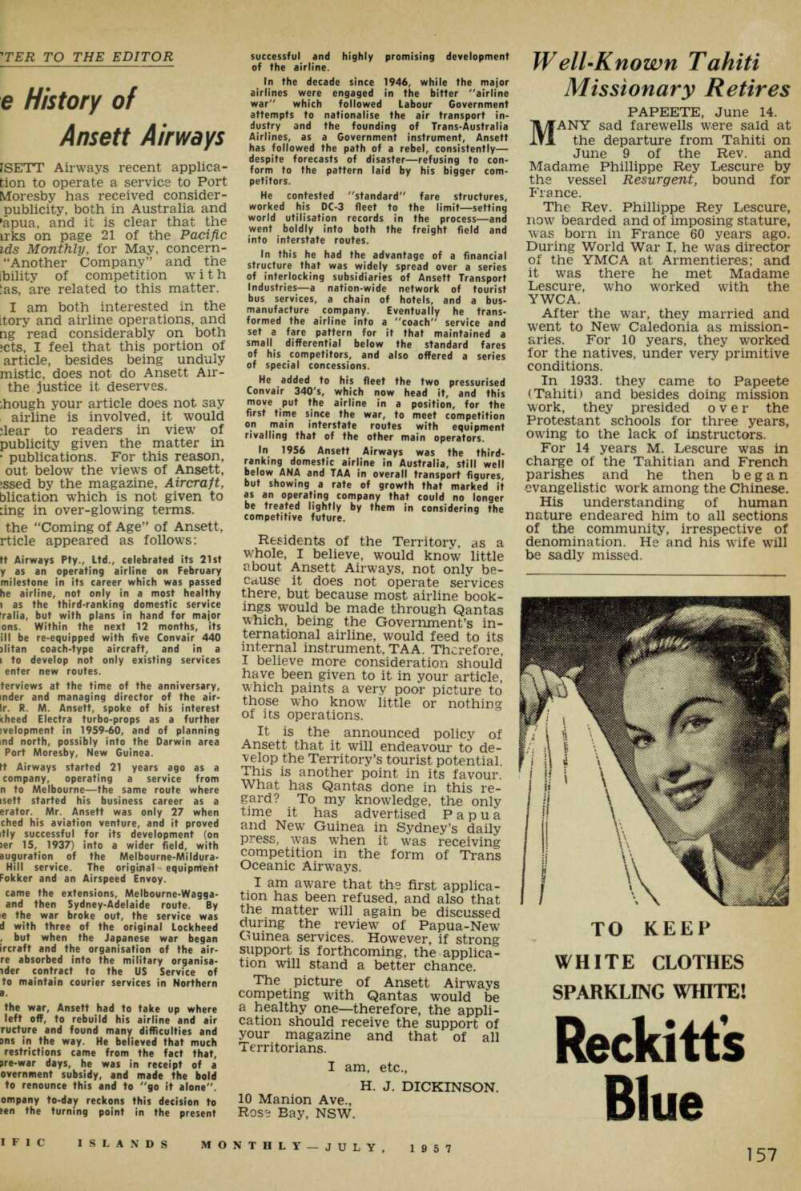
Let Ter To The Editor
[?]e History of Ansett Airways
ISETT Airways recent applica
tion to operate a service to Port Moresby has received consider publicity, both in Australia and >apua, and it is clear that the irks on page 21 of the Pacific ids Monthly, for May, concern “ Another Company” and the
ibility of competition with
tas, are related to this matter, I am both interested in the itory and airline operations, and ng read considerably on both ;cts, I feel that this portion of article, besides being unduly mistic, does not do Ansett Air the justice it deserves, though your article does not say airline is involved, it would jlear to readers in view of publicity given the matter in ■ publications. For this reason, out below the views of Ansett,
;ssed by the magazine, Aircraft,
blication which is not given to
:ing in over-glowing terms,
the “Coming of Age” of Ansett,
rticle appeared as follows:
ft Airways Pty., Ltd., celebrated its 21st y as an operating airline on February milestone in its career which was passed he airline, not only in a most healthy i as the third-ranking domestic service hralia, but with plans in hand for major ons. Within the next 12 months, its ill be re-equipped with five Convair 440 ilitan coach-type aircraft, and in a i to develop not only existing services enter new routes. terviews at the time of the anniversary, mder and managing director of the air- Ir. R. M. Ansett, spoke of his interest cheed Electra turbo-props as a further ivelopment in 1959-60, and of planning md north, possibly into the Darwin area Port Moresby, New Guinea.
It Airways started 21 years ago as a company, operating a service from n to Melbourne—the same route where isett started his business career as a erator. Mr. Ansett was only 27 when ched his aviation venture, and it proved itly successful for its development (on »er 15, 1937) into a wider field, with auguration of the Melbourne-Mildura- Hill service. The original equipment Fokker and an Airspeed Envoy, came the extensions, Melbourne-Wagga and then Sydney-Adelaide route. By e the war broke out, the service was d with three of the original Lockheed , but when the Japanese war began ircraft and the organisation of the air re absorbed into the military organise ider contract to the US Service of to maintain courier services in Northern a. the war, Ansett had to take up where left off, to rebuild his airline and air ructure and found many difficulties and ons in the way. He believed that much restrictions came from the fact that, »re-war days, he was in receipt of a overnment subsidy, and made the bold to renounce this and to "go it alone", ompany to-day reckons this decision to ten the turning point in the present
successful and highly promising development of the airline.
In the decade since 1946, while the major airlines were engaged in the bitter "airline war" which followed Labour Government attempts to nationalise the air transport in dustry and the founding of Trans-Australia Airlines, as a Government instrument, Ansett has followed the path of a rebel, consistently— despite forecasts of disaster—refusing to con form to the pattern laid by his bigger com petitors.
He contested "standard" fare structures, worked his DC-3 fleet to the limit—setting world utilisation records in the process—and went boldly into both the freight field and into interstate routes.
In this he had the advantage of a financial structure that was widely spread over a series of interlocking subsidiaries of Ansett Transport Industries—a nation-wide network of tourist bus services, a chain of hotels, and a bus manufacture company. Eventually he trans formed the airline into a "coach" service and set a fare pattern for it that maintained a small differential below the standard fares of his competitors, and also offered a series of special concessions.
He added to his fleet the two pressurised Convair 340's, which now head it, and this move put the airline in a position, for the first time since the war, to meet competition on main interstate routes with equipment rivalling that of the other main operators.
In 1956 Ansett Airways was the third ranking domestic airline in Australia, still well below ANA and TAA in overall transport figures, but showing a rate of growth that marked it as an operating company that could no longer be treated lightly by them in considering the competitive future.
Residents of the Territory, as a whole, I believe, would know little about Ansett Airways, not only be cause it does not operate services there, but because most airline book ings would be made through Qantas which, being the Government's in ternational airline, would feed to its internal instrument, TAA. Therefore, I believe more consideration should have been given to it in your article, which paints a very poor picture to those who know little or nothing of its operations.
It is the announced policy of Ansett that it will endeavour to de velop the Territory’s tourist potential.
This is another point in its favour.
What has Qantas done in this re gard? To my knowledge, the only time it has advertised Papua and New Guinea in Sydney’s daily press, was when it was receiving competition in the form of Trans Oceanic Airways.
I am aware that the first applica tion has been refused, and also that the matter will again be discussed during the review of Papua-New Guinea services. However, if strong support is forthcoming, the applica tion will stand a better chance.
The picture of Ansett Airways competing with Qantas would be a healthy one—therefore, the appli cation should receive the support of your magazine and that of all Territorians.
I am, etc.,
H. J. Dickinson.
10 Manion Ave., Rose Bay, NSW.