[?]Ereap
pp. 131-132 · Read in the full issue

[?]er a Flood [?]a Famine
[?]Ng Ship Schedules
IPPING services, as well as air line services, have come in for a lot of criticism in Papua-New lea recently. me territory ports do not see a for weeks and then five or six r e in together. This, of course, as that the others have to loiter nd waiting for the ship already le wharf, to unload, id if a ship is not one of the en, with a “priority”, it may or-out for three or four days, e question of priority is a very point with some shipping com 3s. As one company official “It’s absolutely unheard of in other part of the world. Can imagine what would happen e Port of London if ships had ity?” :ly in June, in Lae, an Aus ,-West Pacific Line ship, Aros, d at anchorage while two other , which came in after her, un d ahead of her. Then she was to take aboard a record ship of timber and plywood for i. 1 a week later, the Bulolo stood rtiile another vessel unloaded, was unusual. In almost every ice, if a ship beats the Bulolo port, she has to give way to o’s priority.
I Bulolo carries freezer goods, other ships carry necessary , also. ely a better time-table than iresent overlapping one could ranged —Lae Correspondent. pokesman for Burns Philp & itd. in Sydney said that his my could make a time-table keep to it (except for bad er) if Australian-owned vessels ?iven priorities at P-NG posts, t would be the only way to i regularity of service, said that often Australian had to wait while ships from ast loaded and unloaded, one occasion, the Malaita was [p at Rabaul for five days wait er a ship from the East to said that BP’s had applied priority for its new cargo ship, ontoro, but this had been re by the Administration, m told that Territorians had ained about shipping services d: “So have we, and we have ained bitterly.” )okesman for Swire and Yuill, ; for the New Guinea Aus- Line, said that there were factors which interfered with
schedules, but the chief of these was the weather.
A ship might be delayed at any Pa. pua-New Guinea port for two or three days because of the weather. It might arrive back in Sydney a week behind schedule,
ite next sailing from Sydney could not be arranged to avoid a
clash with a BP vessel, or even another vessel from the New Guinea
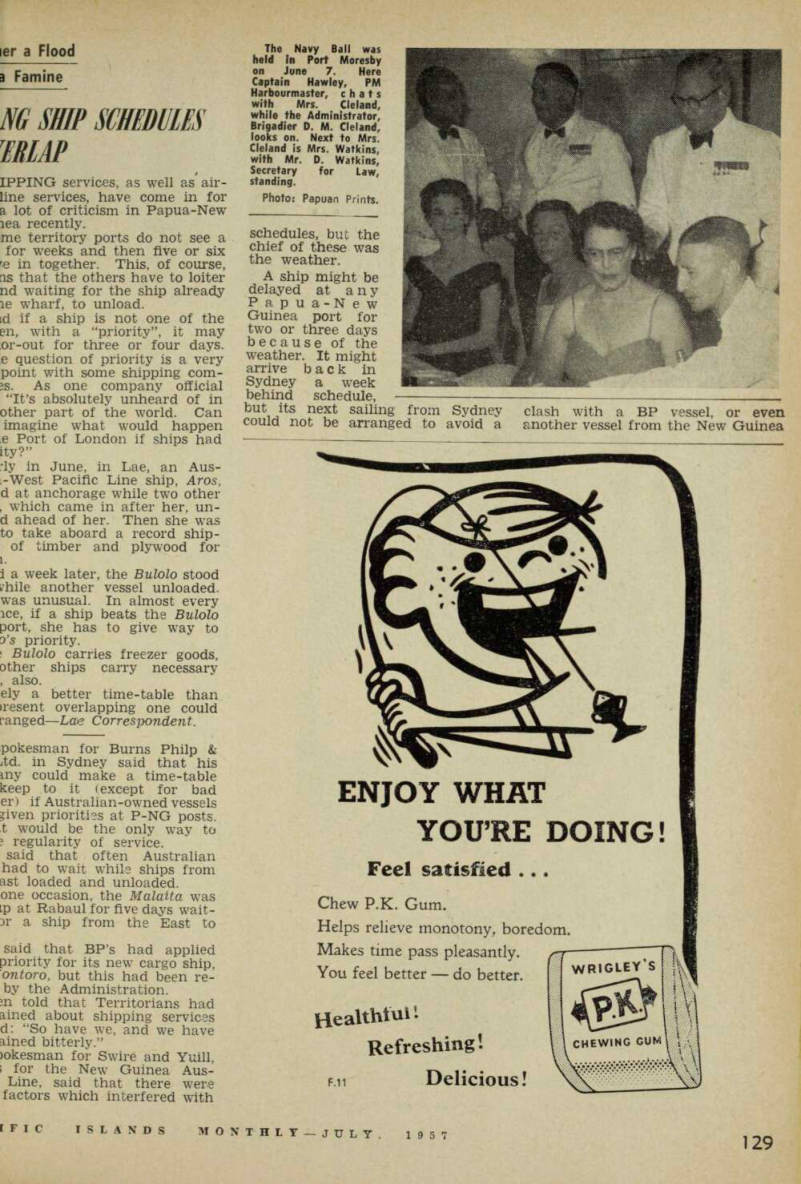
The Navy Ball was held in Port Moresby on June 7. Here Captain Hawley, PM Harbourmaster, chats with Mrs. Cleland, while the Administrator, Brigadier D. M. Cleland, looks on. Next to Mrs.
Cleland is Mrs. Watkins, with Mr. D. Watkins, Secretary for Law, standing.
Photo: Papuan Prints.
Australia Line, because it was unn economical to hold a ship in port,] Waterfront troubles at ports could also cause serious upsets to schedules.
EDITORIAL NOTE: Like a lot oj New Guinea problems, this appear! to have turned into the vicious circle, with everyone giving perfectly reasonable answers, yei everyone continuing to be frustrated.
The only solution seems to be foi the Administration to build wharvei at each Territory port capable o: accommodating five ships at a And we cannot see that happening this side of the millennium.
In recent months, the seven ship! servicing Papua-New Guinea fron Sydney have piled up in fantastii fashion. Perhaps it is just the lucl of the game, but we cannot recal similar congestion before the wa: although there were fewer wharve then, and the weather was no dif ferent.
In July, by luck if not desigl these ships were scheduled to leav Sydney well-spaced: BP ships o: July 2,9, 16, and 29; and NG-A ship on July 26 and 31 respectively.
However, in the previous “nil around,” no less than six of ther sailed from Sydney within a wee! of one another, late May-early Jun( That has been typical of the pro gramme in recent months.
Sinkiang For Charter
The Australia New Guinea Line 1 passenger and cargo liner, Sinkiam has gone to the Far East on charte: She will resume the Guinea run on completion of th charter.
She proceeded to Hongkong fror Rabaul (terminal port for her Jun voyage to P-NG) on July 12.