"Yankee" In The Southwest Pacific
pp. 85-86 · Read in the full issue
[?]loating “Paradise”
Under Topsails
By R. W. Robson
IfHEN I arrived in Suva on T April 26, I noticed a handsome ship lying in the harbour, just I the Custom House, with a yellow ag at her peak.
There was something different 3out her, and I inquired.
“Brigantine Yankee, from some here eastwards,” they said. “In aarantine. Put a polio case ashore, ot a cable-telephone connection.”
Within five minutes I was talk- Lg to the Irving Johnsons, whom had never met, although we had sen “pen friends” for 20 years, ommander Irving Johnson, with is handsome sailing ship, and his ever wife, and his changing crew ’ a score of selected students —a sw company every 18 months —has ;en cruising in the North and DUth Pacific, Atlantic and Indian ceans since the early ’Thirties, hey have visited nearly every larted island in the Pacific —and :> m e not charted. Mrs. Electa )hnson’s articles have appeared in r M many times.
Three days later, they were fished with quarantine. Next to eeting the Johnsons, I got a mighty ck out of the Yankee, and out the endless stories of places and ents with which the skipper ridges his quarter-century of lands cruising.
Yankee 300 Feet Above
Sea-Level
He told me that he had had the mkee more than 300 feet above
sea-level. While I was still looking for the leg-pull, he grinned and said: “We were up the Sepik River.
When we reached the point of turn ing back, we were over 300 feet up in the interior of New Guinea.”
Incidentally, the Yankee —having travelled from Fiji via New Hebrides and Solomons —is due in Madang about July 1; but I do not think the voyagers will tackle the Sepik again.
Descending that great stream in 1955, they ran high up on a cross channel obstruction. They thought it was a rock, and that that was the end of the Yankee; but then discovered it was a bank of clay, or something like that. They got out their special warping ge a r—the Yankee seems to be ballasted with equipment like that —and attached it to trees on the distant shore; and then they made the ship turn and twist, until she broke up the narrow bank on which she roosted, and floated clear.
Factor That Beat The Japs
Commander Johnson has charted many islands and reefs, and checked on hundreds of charts already pub lished; and as he discussed this hobby of his, I learned how we won the Battle of Milne Bay.
Pacific War students will remember that the Japanese, in thrusting stubbornly southwards from Rabaul towards Port Moresby, sent a well equipped expedition into Milne Bay, at the eastern tip of New Guinea, late in August, 1942.
There was a force of Australians there —poorly equipped, and in experienced in battle. Yet they in flicted a stinging defeat upon the Japs: and that started a series of events which spelled disaster for Nippon in the Southwest Pacific.
There was an element of luck in it.
The Japs, working to a careful, well-coordinated plan, swept into Milne Bay at a fixed hour; and their plan provided that they seize and occupy a particular area which would have given them a command ing position in Milne Bay. Every thing went exactly to plan.
But for once the Jap General Staff blundered. They used British Admiralty charts of Milne Bay—and Admiralty charts are nearly always accurate.
But in this particular case—as Commander Johnson demonstrated to me with glee—the chart of Milne Bay which the Japs were using had an error of three miles.
The place where the Japanese went ashore was not the place they had selected. Instead, the expedi tion was most efficiently dis embarked into the middle of a tangle of swamps.
Before they could go into reverse and disentangle themselves from the mud and the crippling jungle, the Australians (effectively directed by a staff which had cleverly appraised the situation) fell upon them, and smashed the expedition to pieces.
Meanwhile, a Japanese expedition had been sent in from the Buna area, over the Kokoda Trail and the Owen Stanley Range, to attack Port Moresby in the rear, while the Milne Bay expedition crept around New Guinea’s South-Eastern flank.
The Japs got to within 40 miles of Port Moresby before they met the Australians: but their collapse at Milne Bay had left them “out on the end of a limb” and they re treated back along the Kokoda Trail.
Milne Bay was Japan’s “Farthest So u t h.” Thenceforward, as the American forces came pouring into the Southwest Pacific, there was nothing but disaster for the in vaders.
Reptiles, Genetics, Etc
This Johnson company studies everything—snakes (the stuffed skin of a monstrous reptile is stretched across their cabin ceiling—they told me it was a python they picked up on the banks of the Sepik River); marine life (they spent a couple of days at Kandavu Island, near Suva, on unde r-w at e r photography); genetics (they had just come from Palmerston Island, in the Cook group).
It is generally known that William Marsters settled on Palmerston a hundred years ago, with three or four Polynesian women, and thej all presented him with lusty babies In due course, the families grew up; and in the first generation or
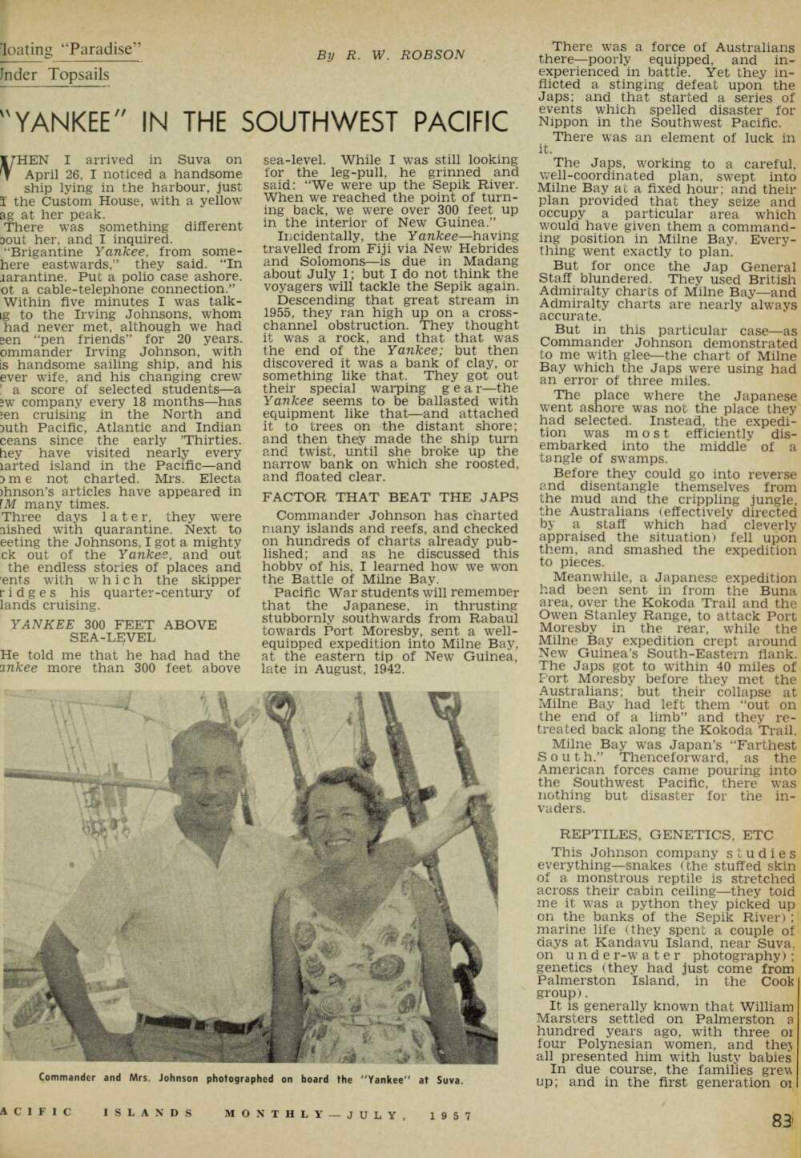
Commander and Mrs. Johnson photographed on board the “Yankee'' at Suva.
two, owing to their isolation, they inter-married.
Those who knew of the circum stances expected that thereby old Marsters’ grandchildren and great grandchildren would be abnormal in various ways; but, in fact, they were normal and healthy.
The Johnsons met various of the older Marsters (the younger brigade now have generally married outside the family group) and liked them, and made many friends among them.
They agreed that the Marsters history provides an interesting con tribution to the study of genetics.
Apparently, such things can happen, without disaster, if the parent stock is completely healthy and free from abnormalities—an unusual and unlikely thing.
Aboard The Yankee
Immediately beneath Yankee’s long, low deck there is abundant living space, running from stem to stern, the whole length and width of the brigantine.
The stern section is partitioned off. to form the living quarters of the Commander and Mrs. Johnson.
The bow is similarly cut off to pro vide quarters for a handful of girls—for the Yankee’s crew of students includes both sexes. The whole midships section accommo dates the “crew”—some 14 male students who handle the ship and man the yardarms with efficiency and dexterity. Two tiers of bunks run along each side of the big cabin.
There is a room for a powerful little motor (used only when sails are not practicable), and a dynamo for electric light and power. There is an emergency cold-store; but, as Yankee goes where and how she likes, her wanderings are planned to connect with supplies of fresh food. The galley is small, but efficient —the company, like most Americans, had a singularly well fed appearance.
I ran a sophisticated eye over the ship. Goodlooking boys, pretty girls, a well-found ship equipped like a pleasure-yacht; a care-free exist ence—wasn’t it a bit too much like he imaginative American’s “South Seas paradise”?
But there was discipline in the ?et of Commander Johnson’s chin, ind calm understanding in the mile with which Mrs. Johnson in troduced me to the ship’s doctor, a ■harming American lady who has harge of the girls, and sees that hey go to bed at a proper hour in the cabin which she occupies r/ith them. Reinforcing the wooden partition which separates the girls’ rom the boys’ quarters, there is t n inconspicuous mesh, made of steel jalculated to hold back elephants, ’hey thought of everything, when hey designed Yankee.
Somewhere about the end of this Yankee will make her way ccross the Indian Ocean to East Africa; around South Africa; and oien away northwards through the r.tiantic to her home port in the
United States, which she is due to enter at noon on May B—as she has done every second year for a long period.
Next time Yankee sails she will have a new owner. It is understood that he will join the ship shortly for part of the present cruise, and that he will carry on along the lines suc cessfully established by the John sons.
But the Johnsons still will wander across the oceans—in a new vessel much smaller than the present ship, and cleverly designed. I saw the plans in Suva. Maybe, some day, we shall see the unique craft itself in Suva, complete with the Irving Johnsons. Thousands of people in the South Pacific hope so, anyway.