Pacific Shipping And Cruising Yachts
pp. 63-115 · Read in the full issue
[?]is Month's News of—
Another Fiji Stranding
3trandings of ships on reefs in ian waters this year now total e. Latest victim was the cutter, i Levuka, 27 tons, owned by Mi', ssan Raza, of Suva. >he went aground on a reef off ro Island in the early hours of ae 13. Early reports were that ire was little damage.
Earlier strandings were the Joyita, xuata, Matua and Cakauhalavu.
Cakauhalavu sank on Vatu-i-cake ef, near Levuka, late May. She ild not be refloated, and was mtually towed submerged, to sova, near Levuka. )utcome of the sinking was a irp rap over the knuckles for the ster, Jeremaia Sovea, 54, of Lau. ?he Fiji Marine Board, after a iliminary inquiry, decided that a mal investigation was neither re site nor expedient. ?he president of the board, Cap-' ti E. L. James, in issuing a warn to Jeremaia, said: “On future asions take more care of the viga t i o n of vessels in bad ither.”
Ividence was given that the seas :e rough at the time of the inding.
Ince Tungi And His Fleet
‘rince Tungi of Tonga, in Fiji ently before leaving for London attend the copra conference; and Hand to inspect his new fleet, i a few new details to give >ut the latter. lometime next year, Tonga will e delivery of its new small ships, ich have been specially designed suit Tongan requirements. ’rince Tungi has had a great deal do with the design of the new sels. ’robably the first to arrive will a landing barge, built for the igan Copra Board by Thames inch Works Ltd., of Eel-Pie Island, ickenham, England. The barge ; already undergone trials on the unes and would have been pped out as deck cargo on the stralind but the ship was un e to accommodate the barge’s rail length of 60 ft. ’he barge will be named Kao and i service the Ha’apai group, •mally she will carry copra, but may be hired to convey heavy ipment, such as Public Works chinery. She is powered by two ivin diesels, each of 88 hp.
Tie same firm is building a gen -1 service launch for the Tongan )ra Board, to serve the Vava’u up. This will also go out as deck go.
Prince Tungi has also placed orders for 3 “dumb” barges (no motive power), of steel construction, from the Fairmile Company, in Cob ham, Surrey.
But the pride of the Fleet will be two vessels being built by Niestern Brothers, of Delszil, Groningen, Holland.
Of greatest interest to Prince Tungi is the ocean-going tug, built largely to his own design, for the work he knows she will have to do.
She has a specially streamlined hull, which fits her for cruising as well as towing. Her speed will be about 11 knots. She will carry about 8 saloon passengers in comfort and deck passengers as well. Powered by a German 500-hp MWM Benz diesel engine, she is to be painted gleaming white overall.
She has a small but complete machine shop aboard, with oxy welding equipment, etc. The idea is that she will do “on the spot” servicing of Public Works Depart ment machinery.
Then there is the new freighter Aoniu, which will replace the pre sent ship of the same name. Of 500 ton d.w., 177 ft long, with a 27 ft beam and a draught of 11 ft, she also is powered by a MWM Benz.
All engine parts are therefore in terchangeable with the tug.
The freighter will carry about 200 deck passengers and 12 saloon passengers, two to a cabin, equipped with hot and cold water and forced draught blowers. (Over)
Tuna And Tilapia
The American Fish and Wildlife Service vessels, operating out of Pearl Harbour, have recently been : oerimenting with tilapia—the so called wonder pond-fish—for tuna chumming purposes.
However, results with tilapia were lot very satisfactory. Unlike the ore usually used anchovy, which :tays on the surface, the tilapia
sounded as soon as it was thrown out from the live-bait tanks and hit the water.
Apparently tuna like to eat tilapia but as they can do this only at a depth that is out of the reach of the tuna pole-fishermen, it appears that tilapia will not be an easy solu tion to the live-bait problem.
Norbryn Away
The 9,000 ions Norwegian w Norbryn resumed her interru voyage from Suva in mid-Jum Norbryn was in tlie news in * when, after a series of nautical ventures, she was towed into I by a brace of Fiji’s smallships. (.' May, p. 78).
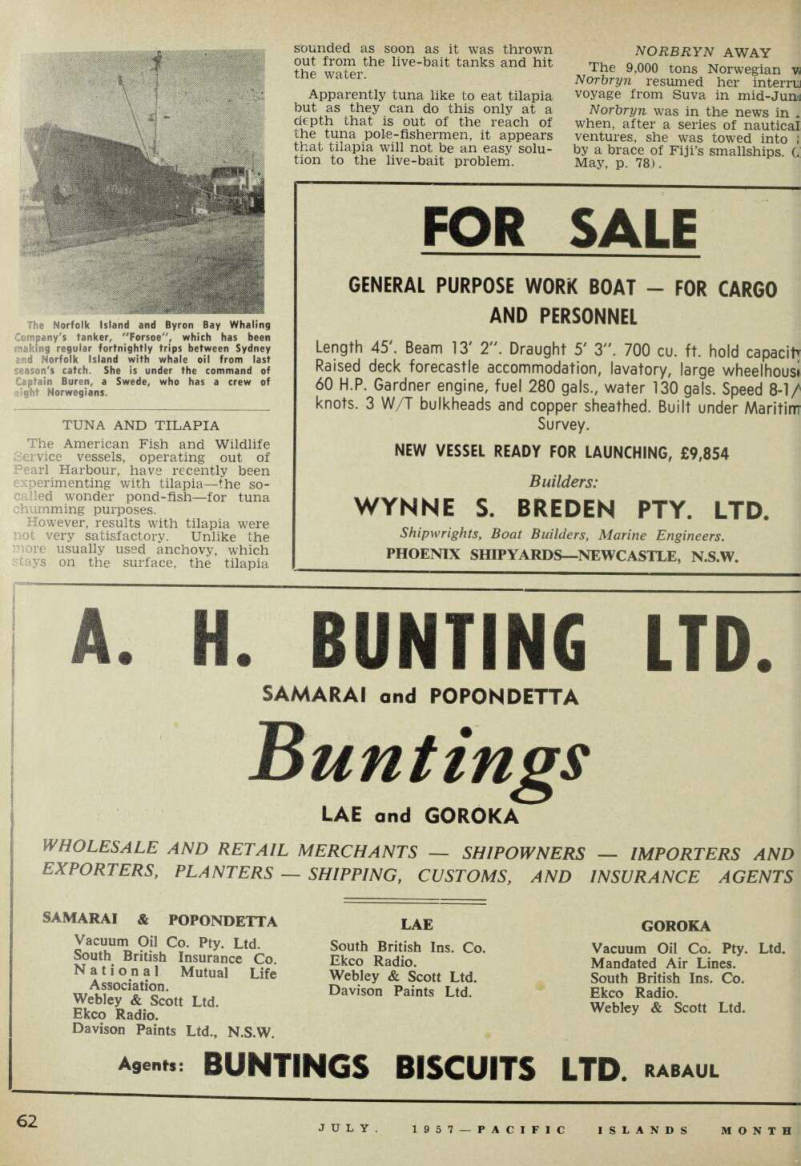
The Norfolk Island and Byron Bay Whaling Company's tanker, "Forsoe", which has been making regular fortnightly trips between Sydney end Norfolk Island with whale oil from last season's catch. She is under the command of Captain Buren, a Swede, who has a crew of eight Norwegians.
The vessel has been undergoing »airs in Suva and left there iney-bound. She reached there June 18, and left there June 27 Melbourne.
Suva’S New Slipways
’he Fiji Government has placed order for the special equipment be used in a new Suva slipway, Lch will be part of the Suva dock erne. This equipment, which will t nearly £Stg.9o,ooo, f.o.b. London, iuld be ready to ship from Eng d in 1959. ’here will be two parallel slips, vessels of 1,000 and 500 tons, re ctively, with one set of haulage chinery common to both slips. ’he slipways themselves will be It by the main contractor jointed to build the Suva and itoka dock schemes, but the nufacture of the winch with its shanical and electrical equipment, cradles which carry the vessels and down the slips, and the rails 1 pawl racks, will be undertaken a specialist firm and will take to two years to complete ready shipment.
Yankee At Lae
he coterie of small ships which ally shelter at Voco Point, Lae, v Guinea, shivered their timbers I fluttered their sails late in June ;n that aristocrat of the sea, the jantine Yankee, visited the port the third time. he crew of young American boys i girls made friends very quickly I there was a constant stream of tors to the Yankee. b be included in Captain John ’s crew for one of these 18ith cruises is a rare honour, and ever to be forgotten experience.
J lass said she had been dream of the trip for 10 years and then day she met someone on a rail -7 station who told her she was the next trip. She could hardly eve it. Most crew members students who have either shed their studies or who have en leave of absence for the trip, laustive inquiries are carried out Captain Johnson and his wife ut the background, suitability I capabilities of applicants before ecision is made. Eighteen months long time for a bunch of people be thrown together on a ship I ability to live with one’s fellows accessary.
Tie Yankee left Lae at the end Tune and sailed to Madang. From re she is going to Borneo, and mately across the Indian Ocean Africa.
Exit Sea Pearl
n late June, six of the crew of ■ Sea Pearl ( PIM, June, page 105), *e still in Wewak, New Guinea, aiting repatriation. Three others,
Joe McComber, Larry Shinnick and Jack Sinclair, had been repatriated to Sydney by the Australian Goveminent and hoped from there to be sent home to Fiji.
Sea Pearl’s Master, Captain R. L.
ManUa to Panamanian Consul there in the hope of getting some reimbursement for the crew.
On June 3, while 14 miles north of Wewak, New Guinea, Sea Pearl caught fire and drifted onto the reef of Valif Island—usually known as Wallis 15.— 25 miles NW of Wewak.
She had been bound from Auckland to Manila with 270 tons of frozen beef. The fire was caused by an explosion in the crankcase of
the port engine. The crew was blinded by heavy smoke but escaped out of the engine room which they battened down. The port engine was put out of action by the explosion but the starboard engine kept run- SSMtafc and as a consequence {sf r pfn™ er f^n 1 ed n the be b?aze Ped therefoie fanned the blaze.
The CO2 “smothering” system was turned on, but failed; foam ex tinguishers and water likewise had no effect on the fire. The captain said afterwards that the two 750gallon oil tanks must have caught 111 e> In three hours the whole ship was ablaze and the crew took to
the boats over the bows. The Chief Officer’s boat drifted and was rowed for two days and two nights; the Cap tain’s boat for three days and two nights. Both finally came ashore at Suam, near Aitape. The crew included Hongkong Chinese, Fijians and Filipinos.
At an enquiry held before local Magistrate Ralph Ormsby and Cap tain J. H. Evans, Harbour Master, Madang, the master spoke very highly of his crew.
The vessel, it is understood, was American-o w n ed but was registered in Panama and controlled from
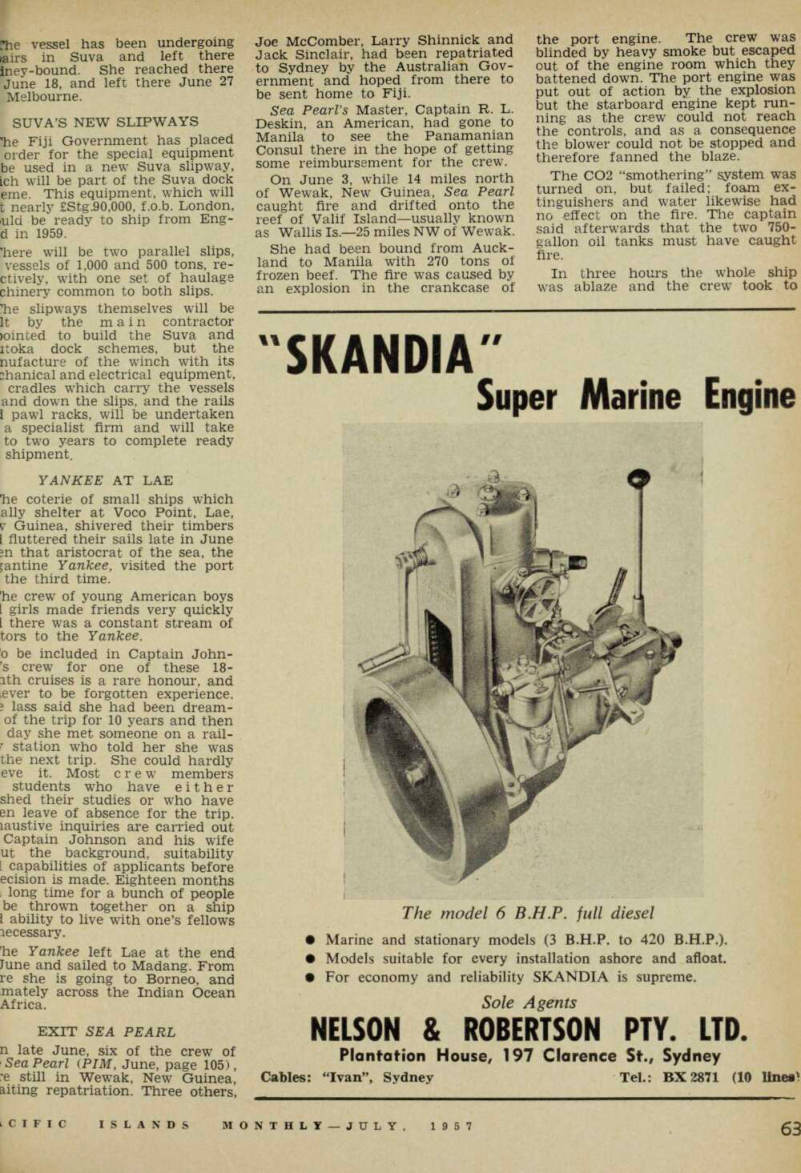
Upper: Stern view of the doomed "Sea Pearl".
Lower: Mid-ships section of the vessel after the fire.
an office in Monrovia, in Liberia.
The above information was re c. ed from New Guinea. Previously nformation has been that Sea ; rl is owned by Victor Inter [ional Corporation, which has its . dquarters in New York, and owns ■ o an airline, other cargo ships and v nkers. On May 3 the Sea Pearl t as in Suva on what was to be her :ond-last voyage (Tokio to Well ington'* . The vessel was short of nine crew members and these were replaced in Suva by local men. Cap lin Deskin told the Fiji Times on that occasion that when he had rrived in Tokio with a load of r ■ rap, he had allowed nine Chinese members of his crew leave in Hong kong. When they returned, the Japanese authorities refused to let them join the ship, insisting that a Japanese crew be recruited. Cap tain Deskin refused and when sail ing day came and they would not give him a clearance because of crew shortage, he got the engines going and pulled the i panese officials to jump for it e carried on to NZ. On his way h he called at Fiji to recruit : ne crew replacements).
T Other Cl Sea Drama Ends
Happily
‘ arly May, the 45-ft steel-hulled ■'ting cutter Manu was very close .leadline news when she went ssing between the Lower Cook
Islands of Mauke and Atiu and stayed that way for some 56 hours.
Not unfamiliar with SAR rescue procedure as a result of the stolen Inspire incident of October last, the local authorities prepared for alert conditions at an early stage and the SAR co-ordinating centre at Nadi, Fiji, was soon conversant with
all pertinent facts on Manu’s pc sonnel, safety equipment, like movements and also the availabij of other inter-island craft them the vicinity.
After forty hours with no port of the missing vessel from s source, the Resident Commission Rarotonga, authorised a request
lR action by one of the RNZAF nderlands based at Laucala Bay : just that worthy purpose. \s it happened no flying-boat was ailable for dispatch at that rnient but Nadi quickly organised • a Sunderland then on Grapple tomi c) business at Christmas and to be diverted south to search e troubled waters for little Manu.
Greatest handicap to the sue ssful outcome of painstaking SAR orts in recent Pacific marine sasters has been the unresponsive ss of wooden hulls to radar pulses msmitted from the searching air ift. From this point of view mu’s steel hull would likely have en a sitting shot, but the RNZAF re to be denied the satisfaction demonstrating this fact, for mu chugged into Rarotonga ?/57w none the worse for having en the cause of considerable local xiety for three days.
Dnly 40 miles separates Atiu from
Mauke but both islets are soon lost to sight when haze develops. Caught in heavy weather on departing Mauke, Manu had been hove-to for a long period and after three at tempts to locate Atiu, owner-skipper John Harrington had made for Rarotonga. A dead transmitter had prevented him from allaying grow ing fears —as gathered from a live receiver—for their safety.
John Williams In Suva
The LMS ship John Williams VI is currently in Suva for overhaul.
At the end of July or beginning of August, she will sail for the Gilberts, to play her part in the centenary of the LMS in those islands.
While John Williams was being overhauled, her first officer Captain Sydney Gaskin, had a short holiday at heme in NZ. Capt. Gaskin was with the Union Steamship Company lor 30 years—ls as master of one df their ships. However, since his re tirement from the company he has spent four years with John Williams VI. He says that the Gilbert and Ellice Islanders who man her are the “best sailors in the world.”
Pago Pago Visitor
Also for slipping in Suva in June was a visitor from American Samoa, the 83 tons ex US Army supply ship Isobelle Rose. Isobelle Rose is owned
(Contfnued on Page 102)
The BSIP Catholic mission ship "Salve [?]ina" which was blessed by Cardinal Gilroy, Sydney, on June 1 (PIM, June, p. 103). The sel left Sydney on June 11, and after calls Newcastle and Brisbane, arrived in Honiara June 29.
Left to right: Joe McComber, Larry Shinnick Jack Sinclair, crew members of "Sea Pearl" [?]e p. 63) in Lae, en route to Sydney and Fiji.
vi V Mr. Bill Steffany, of Pago Pago, ;nd used for trading around the group.
There are no slipways at Pago Pago although one is expected to hp built before the end of this year.
Most small ships, including the Japanese fishing vessels which operate for the Van Camp cannery, are pulled up on the beach for
minor repairs.
For Armchair Sailors
(And Others)
Three offerings are in this month ■om publishers Rupert Hart-Davis Ltd., Numbers 33, 34 and 35 in the Mariners’ Library series. All three are good reading for those with any kind of interest in a seafaring life.
No. 33, The Southseaman, by Weston Martyr is a reprint of a story that was first published in 1926" but like the sea itself, books rout boats do not date, and this is written in an amusing and light hearted fashion. It describes the r dventures of two young men who ai.it their bank and stockbrokers’ office respectively to build a 43-ft schooner in Canada, sail it to New York —and sell it at a profit. That is what they hoped, anyway, and although things did not turn out as
expected, following the history of Southseaman from drawing board to voyages in the Atlantic provides a lot of information as well as a lot of amusement.
No. 34, Wylo Sails Again, is the second book by Frank A. Wightman about his yacht. In the first, The
Wind Is Free, he tells how at end he has to sell Wylo in Trim*, and return home to South Afr: This second book describes how 1 returned to the West Indies fn SA and bought back the yacht s went sailing again.
No. 35, Heaven, Hell and S.
ter, by Bill and Phyllis Crowe, 5 published in 1955 and is now üblished in Mariners Library, is young American couple eared in the Pacific about 1948 h their 39-ft Lang Syne and ntually made a complete circum igation via East Indies, Ceylon, izibar, Africa to the West Indies, ustralian price of all three books 3/3 each.
Methodists Afloat
he Australian passenger liner itroon left Sydney on June 19 ■ying 350 Methodists for a three ks round tour of mission stations Fiji, Tonga and Western Samoa, he cruise was designed to show hodists what happens to the ley they donate for foreign sions. milar cruises were organised by Methodist Church on the old oomba before the war.
►Dern Whalechaser For
Norfolk Is. Co.
le new 125-ft wooden whale ser Norfolk Whaler completed trials on the NSW North Coast y June and at the end of the ith had departed for the Norfolk nd whaling station to begin season’s operations, le craft, the first of its kind t in Australia, was constructed by Ballina Slipway and Engineer- Co., at Ballina, NSW. imour on the local beach was she cost in the vicinity of ,000. She is equipped with the t modern instruments, including r and echo depth-sounder and first-class accommodation and nities for her crew of nine.
Personal
r. Bjarne Halvorsen, Sydney builder well known in the ids, will fly to Port Moresby on 23 to visit clients and prospec clients. Mr. Halvorsen’s com r builds (amongst other vessels) K-class copra scows that have so popular in the Territory. has been reported that Captain
Eric de Bischop, leader of the Tahiti Nui drift expedition that came to a disappointing end abodt 400 miles from its goal in May, was suffering from pneumonia at Val paraiso.
New Hebrides Gets Nz
Veteran From Fiji
The elderly 250-odd tons Nikau, purchsed by Burns Philp (SS) Co. from the Northern Shipping Co,, of
New Zealand, about a year ago for the Fiji trade, has now been trans fer r e d to Burns Philp (New Hebrides) Ltd., and arrived in Vila in June to go into service in that group.
She replaced Moala, which goes to Suva for overhaul.
Nikau was bought last year after Vasu was sunk on a voyage between Suva and Apia. In November of the same year, BP (SS) Co. bought
[?]ept. Aksel Evensen (right), who was in [?]mand of "Salve Regina" on her delivery [?]ge (see also page 67). [?]other Paul (left), who will take charge [?]er when she is in the Solomons.
atanui, also from the Northern lipping Co., and probably Nikau now surplus to requirements in Ji- For her delivery voyage to Vila, iptain J. L. Lumsdale, normally aster of BP’s Yanawai, was in mmand. Captain A. Pickering, lean’s master, acted as Chief Ficer for the voyage. The Fijian }w was replaced by local crew in la.
Vikau was built in Glasgow and inched in 1909 but is now diesel wered.
[Ose Costly Air Searchers
Concern at the high number of tly air searches which have 3 to be made for missing small ,ft, especially in the Fiji area, is >ressed in the latest New Zealand rine Department annual report, ['he report notes that in some es the vessels involved are not distress, but because they have ; been equipped with radio trans fers they have not been able to ort and thus prevent the cost of ;arch-and-rescue operation which i been set in motion when the sel has become overdue.
Tie solution, of course, is to re re all vessels on deep-water sages to be equipped with hand nked automatic distress trans fers operating on the continu sly monitored 500 kes mari e distress morse frequency.
The necessary equipment is available and standards for its capabilities have already been agreed upon by maritime nations.
A vessel using such a set can be speedily located by aircraft or ships using direction-finding equipment which is part of their normal navigational equipment—so what are we waiting for?
Someone will have to make the first move and we believe that it rests mainly with the marine insurance underwriters offering incentive rates for vessels carrying automatic distress transmitters, and secondly, by compulsion through the necessary .
The SARAH -type of midget very
high-frequency R/T distress equip ment used in aircraft is not the equipment best suited to present Pacific Islands waters conditions.
The 500 kcs equipment has greater range and the frequency better monitored. All big ships are equipped to receive on 500 kcs but few can monitor the “SARAH” VHF channel, and fewer still can take radio bear ln£S on this frequency. The equip ment needed for Islands small-craft is the Marconi Salvita-type and its English and American equivalents,
Scott Not Sold
Mr. J. B. Turner’s scow, Scott, was offered for sale at public auction in Suva on June 15, but bidding failed
te reach the reserve. Many F shipping people attended the sas which was conducted by A.
McGowan and Company.
The Scott is now in the dry da for overhaul.
She is well-known as a tradii vessel in the Fiji Group.
She last appeared in the news December (Dec. PIM, p. 105) wh allegations were made that Japanese vessel had tried to for her onto a reef.
News of Cruising Yachts
• SWEVENS I the yacht wh: has been moored at Voco Point, K for nearly two months, await! auxiliary engine parts from Austra’ left there on June 20 for Cair where her owner, Mr. J. Lain Peach, expects to join her. H Laing-Peach, who has been cooli his heels in Lae all this time, ss the “delay and miscarriage of cai between Australia and the Ten tory was the worst he had e* known.” • FITHEACH BAN, luxury 5 ft schooner, arrived in Sydney Ju. 21 after crossing the Tasman fn Picton, in the Marlborough Sount NZ.
Her owner, retired Royal Ns captain, Captain A. F. Watch! has been sailing round the wot in Fitheach Ban for the last years, stopping where he pleased as long as he wished.
The Marlborough Sounds were pleasure for three years.
From Southampton he went the Mediterranean area, where spent three years. Then he set across the Atlantic for the W Indies, after which he pass through the Panama Canal fort cruise through the Pacific, called in at the Marquesas, Tah American Samoa and Fiji bef<; arriving at Russell, in the Bay Islands, New Zealand.
This meandering voyage t o four years. On his arrival at Piet he met an old friend, a retired coastal captain, Captain A.
Baggett, who was later to becot one of his crew for the Tasm crossing. After three years in I Captain Watchlin had the sail again, so after engaging a err set out for Australia, where he I many friends.
Apart from Captain Baggett i other members of his crew m Commander W. Tidy (RN, retire and Mr. D. Maney, a Welling" garage proprietor and a yacht; enthusiast.
Soon after passing Cape Farew at the top of the South Islai Fitheach Ban ran into squs weather and hove to. She was h'j to for 6h days, during which tit she drifted as far north as northern tip of NZ’s North Islai The actual journey across
isman took 7S days, remarkably od time.
Captain Watchlin’s crew returned New Zealand a few days after rival in Sydney. The Australian ast may see a lot of Fitheach Ban d her wandering captain in the xt few years, for Captain Watchlin ,s no immediate plans to move . He does plan, however, to tear
himself away from his schooner long enough for a visit to the out back of New South Wales and Queensland.
Fitheach Ban was built in 1928 by White’s, of Southampton. She is powered with two 80-hp Glenagger motors. Her tonnages are: gross, 65; net, 52. She is equipped with an automatic pilot (George) which
"Fitheach Ban" at Barraclough's moorings, [?]hcutters Bay, Sydney.
Captain A. F. Watchlin, of "Fitheach Ban".
ayed its part admirably when the ptain and crew wanted to rest.
Fitheach Ban is Scottish-Gaelic r White Lady. 9 VIXEN, of Miami, Florida, USA, gaff-rigged cutter of 34 ft, with am of 10 ft, left Papeete (Tahiti), June 4, to continue a world lise. Owners: James and Jean ark. rhey arrived in Tahiti about one iv ago, via the Galapagos and irquesas Islands. The compass led among the latter Islands, and vigation thence to Tahiti was by vrist-watch compass, rhey contemplate travelling to the eat Barrier Reef, Australia, via moa and Fiji, and will spend over pear there. ► JOPEDA, a gaff-rigged yawl, 34 by 11 ft, of Vancouver register, der the command of John ilmsley, cleared Papeete on June :or New Zealand, via Rarotonga, nga, etc. [*he other crew members are ter Walmsley and David Field, are part-owners.
Sported June 18, yawl wrecked near Raro ia; crew safe.)
* The Flying Walrus, A 37-
ketch, built and registered in
Vancouver under the joint owner ship of John and Diane Wells, made the port of Papeete on June 1.
They left Vancouver last October; were on the Pacific coast of USA until February; left Santiago on February 28; arrived at Nukuhiva, in the Marquesas, on April 2. At Takaroa, the radio broke down. A Morman missionary was seriously ill, so they transported him to Kangiroa. Here they experienced a south-east gale; but conditions im proved as they neared Tahiti.
John and Diane intend staying in Tahiti until late in July. They were in Tahiti in 1948 on the yacht Escapee. (PIM has had worried in quiries from friends about these sailors). • WHITE HART, a 48-ft ketch, with a beam of 14 ft 7 in., Victoria registry (British Columbia) cleared Papeete on June 22. Owner-skipper Tony Reeves is widely known among the South Pacific Islands. Although soon returning home to British Columbia, via the Tuamotus, Mar quesas and Hawaii, so that he may be in time to join in the salmon fishing, he contemplates returning —probably to Rarotonga, to settle down there. • NANI, flying US flag, a ketch of 38 ft, under Owner-skipper Dr.
Jack Randall, cleared Papeete on
June 22. Of the crew, Jeremy Hewett and Jean Marsh both joined Nani in Papeete.
Dr. Randall is an ichthylogist, associated with the University of Hawaii and has spent nearly 18 months in French Oceania, conduct ing researches in marine lift, especi ally fish.
It was during his wanderings in Los Angeles that he chanced upon the hull of the Nani, purchased it, and built it into a compact and modern yacht. He probably will be soon returning home—an addition to the family is expected in early August. • MARCO POLO, a ketch of only 28 ft, under New Zealand registry, owned and skippered by Tony Armit, who is accompanied by
Tr Hoe, arrived in Papeete on June Yi ' After clearing the Panama and r Galapagos, they sailed for 32 c south-east to the Marquesas; remained there two weeks; then finally made Tahiti via the Tua motus.
Tony Armit says they soon will set sail again—Tahiti is not primitive enough, any more! • ASTRID, the 24-ft, New Zea- Dnd double-ender, was swinging at anchor in Nukualofa early June. Her skipper, Mr. Len Panther, and his only crew member, Miss Joan Foster King, sailed her from Mangonui, in Mew Zealand. This is Mr. Panther’s first ocean trip. They had a spell of bad weather south-west of the Kermadecs, then were almost be calmed.
Miss King was admitted to hos pital on arrival in Tonga, with an ulcer at the base of her spine, be -ieved to have been caused by sitting on hard decking while on watch.
They will cruise through the Vavau Group, then cross for a look Fiji before turning home to New Zealand. » MIRANDA, 34 ft x 111 ft gaff lunch, cleared Auckland for Papeete 22. With owner-skipper John Donnell, of Australia, is Peter : .Ison, who sailed in the yacht Pulmosa from Suva to Queensland ;v e years ago; Don Cameron, who reached Auckland recently in the
yacht Solquest, and who crewed in Celebes in the last Los Angeles- Papeete Race; and John Smith.
Mr. O’Donnell, who was formerly employed at Pago Pago hospital, has been fitting out Miranda in his spare lime since last September, while employed as a radiographer at an Auckland hospital. A call at Raro
tonga was likely if winds did n permit a direct passage to Papees ® TZU HANG, which called Island ports last year, was reportl in a Chilean port in April, havii been dismantled in a storm whi bound from Melbourne to Rio Janeiro via the Horn. The yac made port with 4 ft of water belc
ccording to a report received in .uckland. • RAIREVA, 36-ft sloop, which [eared Auckland in 1955 under the ame of Renegade, returned to that ort June 23 under new ownership, he had changed hands at Port [oresby after cruising Western acific waters.
Her present company, D. Robin m, of Canada; K. Teppo, of Fin ,nd; M. Fromager, of the Channel (lands; and R. Duyne, of Holland, ►ok over and cleared Moresby last ovember, bound Sydney, coastwise.
Raireva is expected to clear Auck nd for Papeete via Rapa late July, 'r. Teppo featured in a yaching saster off Sydney Heads two years jo. • PAGAN, motor fishing vessel hich, under Australian ownership, as adrift for several weeks between speete and Auckland en route from igland last year, has now joined ie Auckland fishing fleet under the jw name of San Cristobal, follow g extensive refit and alterations, le craft changed hands last inuary. • MAKORA, 48-ft English yawl, ,th New Zealander H. E. Goodwin, tughters Anthea and Alison and iss Stella Copsey aboard, entered ickland June 25 from Papeete and ikualofa.
At Papeete, Alison, who formerly aised the Islands in Arthur Rogers, placed Mr. Jeremy Hewett, who parted for Hawaii and the US. • ZONDA 111, sold by owner .lary Chiswell, at Auckland, will obably remain in those waters :e Chiswell, who has now pur ased a 21-ft craft for local cruis- Mr. Chiswell and Mr. Palmer, Diana, have both been employed an Auckland dinghy building m. • SOLACE, of England, cleared Imerston Island for Nukualofa on ne 3, west-bound for England via rts. • PETULA’S drift across the ►pical Atlantic several years ago an ocean-sounding and meteor ►gical expedition, will be recalled Fiji because Mr. Claude Dick 1, formerly of Nadi Met. Staff, s one of the three-man party, rhe full story has now been told “Voyage of the Petula”, by ink Evans, recently published in gland by the Robert Hale Cos. The ton yawl was accompanied by a t built at Dakar, from where the ft commenced. 9 DIANA, after a lengthy spell Auckland, resumed cruising early i.e when Norman Young headed yacht back towards Papeete, I h a possible en route call at rotonga. Also aboard: Ralph :ague, Dave Morgan, formerly of unty, and Fred Unsted. > SEA CHANTY, of Vancouver, s clearing there in July for an md cruise. Roy Kempel is owner the 36-ft ketch.
• TAHOE, 36-ft schooner, owned by Reg. Blake, was clearing the same port for Australia via the Islands. • NOVIA, in which Lee and Ann Gregg cruised Polynesia several years ago, is on the move south again after three years in Honolulu, and should have been at Papeete in time for the July celebrations. An en route call at the Line Islands was planned. The yacht suffered damage in Honolulu on March 9, when a seismic wave swept the moorings. From Papeete, Novia will head for Borabora, Samoa, Fiji and Queensland. o DANA RESCUER, the 19-ft
2 in., all-metal auxiliary life-boat, which Danish skipper Walter Vest borg is navigating round the world on a demonstration voyage, was at Canal Zone in May. As earlier re ported, Danish fishing skipper Claus Sorensen, 70, designed the craft as the ideal ship’s lifeboat for 30 per sons, totally protected from the weather, and with a 20-day motor cruising range. He hopes to interest the world’s maritime authories in the vessel’s capabilities. The boat will head north for Los Angeles and cross the North Pacific via Hawaii, Wake and Guam to the Philippines, Singapore and Colombo, thence home via Suez. • HAVFRUEN 111, 60-year-old,
)-ft gaff-ketch, owned by Terence ad Anne Carr, of England, was in le West Indies In April and plans ere for a July arrival at Papeete ith the probability of a more west ard Pacific penetration later. The arr’s have lived abroad for all their [ years of married life and are embers of Royal Cruising Club, cean Cruising Club, and Mr. Carr currently also Commodore of the oyal Air Force Yacht Club. The icht is of the well known Colin rcher type. • WIND SONG’S former owners, bom it will be recalled sold that icht in Suva in 1952, now own the i-ft double-ender Ocean Bird at Ilings Bay, BC. Allen and Sharie irrell and 14-year-old son, Keray, r e aboard —and dream of another ilynesian cruise. • WHITE SEAL will soon start oving from Chicago down the ississippi River to the sea on com sncement of a Pacific cruise via mama. Gerry Trobridge is owner other details lacking. • GEMINI, of Portland, Ore., in ilch radio ham Jack Wheeler id wife, Leah, cruised to Tahiti /eral years ago, should now be at Jmyra, Line Islands. Jack had en engaged by International ;ophysical Year research author -3s to tend scientific instruments
at that American atoll and was to clear Honolulu in May. Martin Vitousek is maintaining supply communications with Palmyra, Fanning and Jarvis with his 72-ft schooner
Fiesta for the same o -ganisation, Fiesta is well known in French Oceania and Cook Island waters.
The yacht ran cargo under charter in the latter group last year.
The Norfolk Island and Byron Bay Whaling Company's new 125-ft. whale chaser, "Norfolk Whaler", which went into service on June 9.
She was built in seven months, from the hull up, by the Ballina Slipway and Engineering Co. (see page 103).
The chaser has a beam of 22 ft. 6 in. and a 9 ft. draft. She has a displacement of 232 tons, and a maximum speed of 12 knots.
She is powered with 2 GM 220 hp diesel
motors, and has English hydraulic steering gear and propellors.
"Norfolk Whaler" is built of hardwood and is copper-fastened. She has accommodation for a crew of nine.
The master is Captain H. Hannell and the gunner is Captain L. C. Mills. When "Norfolk Whaler" has filled her quota of 120 whales at Norfolk Island she will go to Byron Bay to take up the quota allocated there.