Rarotonga Greets A Very
pp. 39-43 · Read in the full issue

[?]ween H-Bombs
Important Boffin
By Gordon Russell
7 2 p.m. on June 7, a very spruce and uncontaminated RAF Shackleton bomber roared out clear atomic void, circled Raro ;a’s beautiful airport, landed l little room to spare, and taxied to disgorge some important ors. l the ensuing 67 hours many >tonga residents (a) got to v, and like, Mr. W. R. Cook, itific director of the recent ;s of British nuclear tests at istmas Island; (b) entertained ring Commanders, 2 Squadron iers and several Flight Lieuten , all at once; (c) learned enough ease local minds on current ear affairs, and (d) did their best telp 17 escapologists forget the ms and strain of recent months Christmas Island, and there its. r. Cook, and the visiting RAF Wing Cdr. Alexander, were omed on arrival by Mr. Leon
Pitt, deputy Resident Commissioner, in the temporary absence of Mr.
Nevill, who was then at Penrhyn. a fortuitous social occasion of the moment was the close-of-season prize-giving party of the Rarotonga Yacht Club, and, in the palm clad moonlit grounds of Pue, the Union Company residence of Mr. and Mrs.
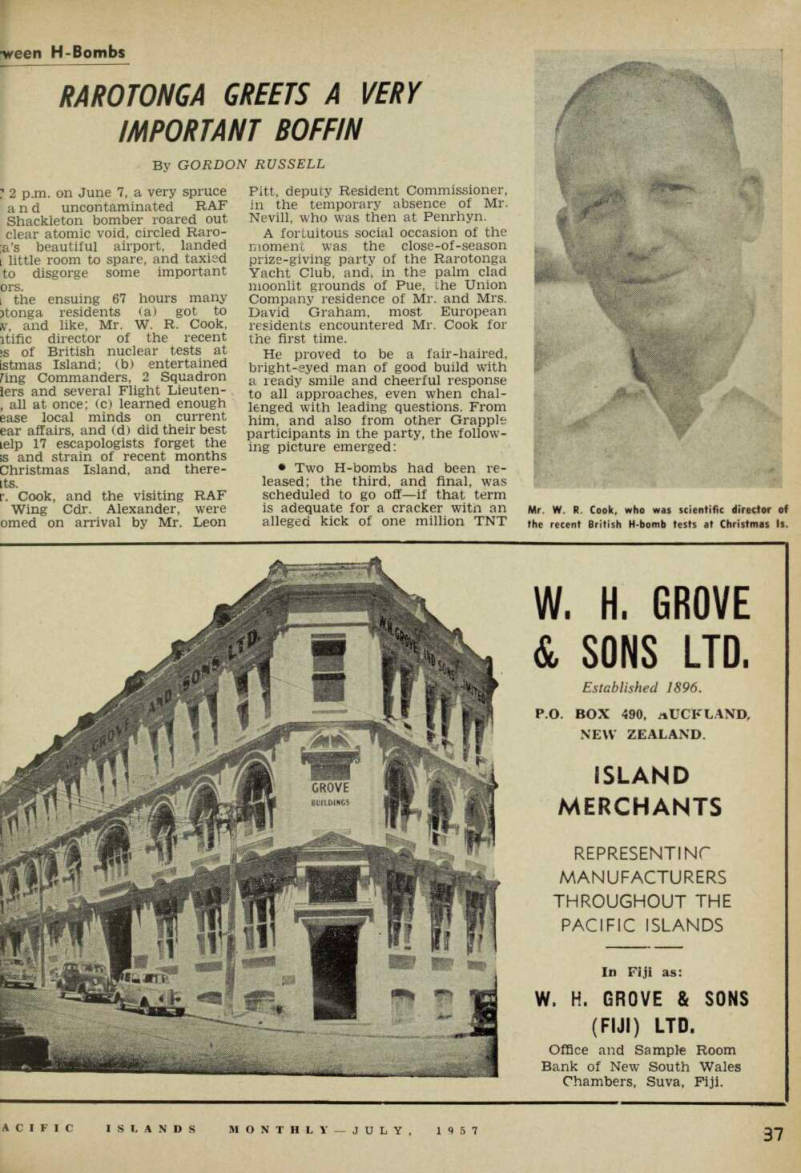
David Graham, most European residents encountered Mr. Cook for the first time.
He proved to be a fair-haired, bright-eyed man of good build with a iea dy smile and cheerful response to all approaches, even when chal lenged with leading questions. From bi m , anc j f ro m other Grapple participants in the party, the follow ing picture emerged; • Two H-bombs had been re leased; the third, and final, was scheduled to go off—if that term is adequate for a cracker with an alleged kick of one million TNT
Mr. W. R. Cook, who was scientific director of the recent British H-bomb tests at Christmas Is.
is—in about two wrecks time m then. (It was actually ex »ded on June 20, without in ent—Ed.) ► Both releases (to June £P had in made from a Valiant bomber 55,000 feet, with the explosion led to occur on descent of the nb to some 8,000 to 10,000 feet, nber nipping off smartly mean le.
Explosion at this level was the ence of the British tests and most critical factor of all, as organisation and recording ipment was strategically placed 1 attuned thereto. • The releases took place in the nity of the forward base, Iden Island, and the main re ding instruments were located Malden and on key ships and :raft situated thereabouts. 1 The control ship, HM air ft-carrier Narvik, lay 25 miles n the spot marked X, and on ,rd was Mr. Cook, able at a ment’s notice to press a button I negative the whole proceed 5. 1 Mr. Cook did not witness ler of the two explosions; nor any one else. In the interests eyesight all had to count ten ore looking. Four hours after release, Mr. Cook was 500 es away in an aircraft and the atomic cloud therefrom, lis suggests that it had already 2hed a height of some 30 es.) It was claimed that there was local fall-out of radio-active tides; that all radio-activity upward, with dispersal at high
levels in an initial direction pre determined by aerial meteorology.
One hour after release an aircraft passed, under the point of ex plosion without contamination. It was claimed also that there was no radio-active contamination of fish in the vicinity. Thorough tests were made to establish this fact. • The nucleus of one H-bomb release was tracked and lost somewhere over South America.
QUESTIONS on such matters as size of bombs and method of re lease were clearly out of order, but Mr. Cook was quick to appreci ate the local uneasiness, particularly on the score of fish contamination, and agreed to a radio talk from which some of the above statements have been extracted. This was a scoop for Rarotonga’s young ZKIZA broadcasting station, even if no one outside the Cooks heard it!
Interviewer was Mr. Arnold Stan bury, a New 7 Zealand DSIR scientist at present in Rarotonga installing modern ionospheric equipment for the IGY programme. Mr. Cook made it clear that, in speaking, he was anticipating official news releases soon to appear in the NZ press, but was anxious to say what he could to help allay local fears.
Great consumers of tuna, flying fish and other marine foods. Cook Islanders have had good cause to be genuinely concerned about nuclear tests in their part of the Pacific.
It has been established beyond doubt that tuna and other ocean roaming predatory fish were con taminated as a result of the Ameri can series of atomic tests in the
I v', 1952-1954, and recent nese statements and actions rnake it clear that they are prepared the same outcome from the pre c British series. There have also disturbing reports from more ii one source of fish-dependent , cific Islanders suffering from iarently incurable skin diseases, attributed to radio-activity.
How, then, was Mr. Cook able to assure his local radio audience that he was personally confident that no contamination of fish had occurred In his sphere, and to offer, later, to send a man and equipment to Rarotonga to demonstrate this fact upon locally caught tuna?
The immediate result of an H fcomb explosion is a giant fire-ball, from which the familiar smoke plume develops, said Mr. Cook. If the explosion occurs on the surface, or if the fireball is in contact with the surface, up to millions of tons of surface matter, solid or liquid, can be seriously contaminated and, because of its weight, remain there to effect all life in its vicinity. h would appear that the Ameri can tests in the Pacific were sur face tests and that at the time of lose tests no method of exploding a safe distance above the surface had been evolved.
The special feature of the present ish series was that the resultant
fire-ball was well clear of he sur face.
Hence the official British an nouncements claiming negligible fall-out—though they were scepti cally received in the Cooks until the advent of our escapologists.
An interesting feature of this brief
invasion was the fact that s* of Mr. Cook’s fellow-travellers \) also getting to know him for first time. To most of the 2,000souls on Chrismas Island, vict of the disciplined segregation net; sary on such a project, Mr. C has just been a symbol of actio:i
'here is no doubt that the ntaneous hospitality offered to ■ visitors was the right kind medicine and a final gathering the home of Mr. and Mrs.
Icolm McQuarrie, with the com nents of Wing Cdr. Alexander, i well regarded locally as a ctical gesture of appreciation, rominent in the liquid refresh it provided were cans of Ten ts beer “Specially brewed for Megaton Trials”. One megaton, case you don’t know, equals a \e of one million tons of TNT — ard word to swallow in any beer. ; is likely that the fragrant ’eis frangipani that festooned the >rs on departure, June 10, were irded by them as eloquent bols of a way of life far removed n man’s machinations at istmas Island. ut this is not the place to der upon how many frangipani soms equal one megaton. Suf snt that Mr. Cook has helped ry to reconcile the one with the ;r.