Editorial ...
pp. 19-21 · Read in the full issue
Australia Should Lead Move Towards
S. Pacific Federation
IE following recent events may not seem to be connected, or very significant: but they all fit the background of a picture is of great importance to the re of the South Pacific countries whole: One of Australia’s leading firms stockbrokers has underwritten s new development loans.
Some insignificant politician at ed Nations headquarters has i screeching again at Australia Dugh the Trusteeship Council) use Australia is not quickly iing over a measure of self rnment to the New Guinea ices.
The Prime Ministers of India Ceylon did not attend the on of the Commonwealth Prime sters’ Conference in London •e the Commonwealth’s defence the chief item on the agenda.
There is increasing anti-British ssure upon the new, self rning machinery which Great iln has given to Singapore and ,ya—with a growing probability anti-British, pro-Communist ents will get possession of the irnments in both States.
Another powerful Australian icial institution has entered into i n d u s t r y—namely, Carlton id Breweries Ltd., in association W. R. Carpenter & Co. Ltd.
Drganised government, based an elected Parliament, now has iletely collapsed in Indonesia, a governing council —dominated he moment by the Moslems — aken over. But Communist in ce grows steadily—a popular in June gave the Communists :ch larger share of the council i controls Djakarta city.
Australia’s Prime Minister, R. G. lies, and Foreign Minister, R. G. 7, in public statements respec r in London and in Canberra, ated Australia’s lack of con ce in the United Nations, and alia’s growing belief that her e security lies in a closer hment to some sections of the (h Commonwealth and to the ■d States. Even as these ons were being published, it announced that henceforth ican warships would enter and Australian ports without lonies and salutes—in other », these are bases now open for ree use of the United States. ’ us now bring these apparently isconnected events into focus, s part of our South Pacific re. They disclose these things,
which no man who knows the Pacific can deny: RHtish nowpr in Asin bp* p-nnp or is going* 3 Much of Asia is either
antf-lritish nr Sro Communis Z
both Asia Extends from the Arctic r “ om J: ne Arc "
Circle to Indonesia (on the northwest coast of Australia), thus providing a vast, hostile barrier between Western Europe, and the line of European nations which Britain and France have -established in the South Pacific, and of which Australia is the natural leader.
Political and strategic developments which have followed World
War II and the “communisation” of Asia have made the United States the protector of the non- Communist European countries established in the South Pacific.
There is no physical or political barrier between North America and the South Pacific Islands.
The great island of New Guinea, and the Melanesian archipelagoes (especially New Britain, New Ireland, the Solomon Islands and the New Hebrides) represent the South Pacific’s natural defence line against Asia. They should be —and must he —under the direct control of Aus tralia, and her fellow-nations of the South Pacific.
The sooner the useless and irritat ing connection between the UNO Trusteeship Council, on the one hand, and New Guinea and Western Samoa, on the other, is challenged and ended, the sooner may we ex pect to see the nations concerned (Great Britain, United States, The Netherlands, France, Australia and
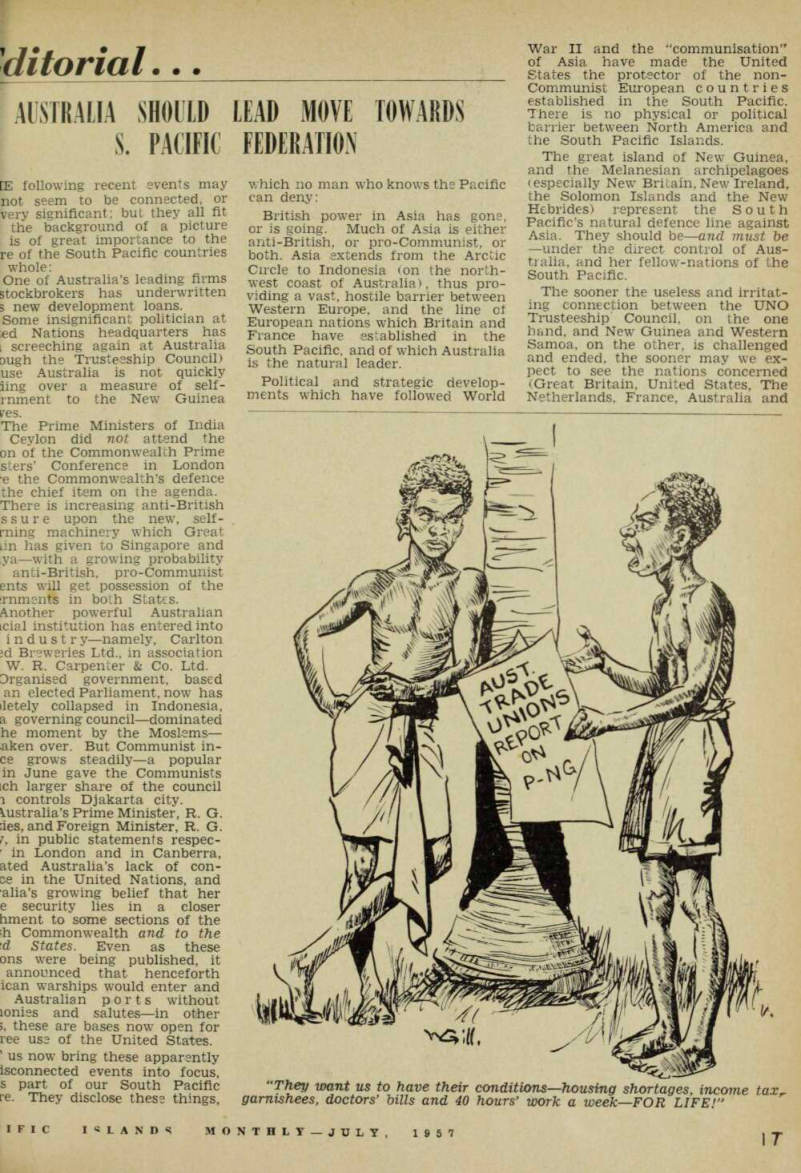
“They want us to have their conditions—housing shortages, income tax garnishees, doctors’ bills and 40 hours’ work a week —FOR LIFE!”
XTew Zealand) making a more re stic approach to the growing oblem involved in the future urity of the European commun es in the South Pacific, ff no clear-cut over-all plan is t opted at an early date for the pro tection of the South Pacific-Euro van countries against aggression, :d the education and training of the indigenous peoples in self-gov ernment, these South Pacific-Euro ean countries (including Australia 'nd New Zealand) will be over whelmed by Asia.
AT present, the Islands of the South Pacific are administered or supervised by the six nations named, as 16 separate Territories; BRITAIN —Fiji (Crown Colony), Solomon Islands (Protectorate), Gilbert and Ellice Islands (Crown Colony).
FRANCE —New Caledonia and Dependencies (Colony), French Oceania (Colony).
AUSTRALIA —Papua (Territory), Norfolk Island (Territory).
NEW ZEALAND —Cook Islands (Territory).
UNITED STATES —Eastern Samoa (Territory).
NETHERLANDS —Western New Guinea (Territory).
United Nations Trusteeships—New Guinea
(Australia), Western Samoa (New Zealand), Micronesia (United States), Nauru (Britain, Australia and New Zealand, jointly).
INDEPENDENT KINGDOM, under British Pro tection —Tonga.
CONDOMINIUM —New Hebrides (Britain and France, jointly); Canton Island (United States and Britain, jointly).
The problem is the protection of those 16 Territories, and of Aus ;alia and New Zealand, against aggression—especially from Asia; and the development, socially and economically, of the 16 Territories.
The shape and character of the problem seem to indicate the roblem’s answer—namely, that in stead of the 16 Territories being separately and often very clumsily administered or supervised from : ondon, Paris, Canberra, Washing ton, The Hague and Wellington, (hey should become the special care of a South Pacific Federation.
It would be a simple matter to form a Federation of the British South Pacific Territories, like the New West Indies Federation. Given goodwill and understanding, and a tolerant approach, it should not be oo difficult to form the French and Dutch and American Territories into a Federation, along with the British, even although the 16 repre sent a veritable hotchpotch of administrative forms. It would rep resent a tremendous forward step in the status and security and de velopment of the South Pacific Islands.
TMMEDIATELY, for example, the 1 indigenous people of the dif ferent groups, and the Fiji-born Indians, the New Guinea-b or n Chinese, the “local-born” of Samoa, the mixed-race folk of all the Islands, would become full citizens of an im portant country (the South Pacific Federation), carrying their own passports, instead of being the semi apologetic residents of small islands
Territories, pushed around by arrogant Customs and Immigration officials in half the ports of the world.
The sixteen Territories might re main as administrative divisions, re sponsible to one government, located in a selected capital city. There should be complete freedom of trade and communication between all the Territories of the South Pacific Federation. The Federation would have its own judicial and education and health systems, instead of the unhappy patchwork by which these systems now are so often represented.
With the menace of Asia loom ing in the north-west, some such plan must be made, and put into operation soon, if the Western Euro pean culture and freedoms are to survive in the South Pacific.
The time is ripe for this forward move—only leadership and direction are needed. Already, by their achievements through the South Pacific Commission, and by the con structive quality of their thinking in relation to South Pacific Islands affairs, the six nations which formed and now sustain the South Pacific Commission have indicated their readiness to consider a South Pacific Federation plan.
THERE is a duty upon Australia to take a leading part in this movement. Australia, with her 10 million population, and her wealth and energy and enterprise, and through the ease with which she can co-operate with her smaller sister, New Zealand, is the South Pacific’s natural leader.
Already, she has done a credit able job in Papua and New Guinea; and, had it not been for her un willingness to engage in anything like “imperialist” expansion, she would by now be doing a similar job in the nearby Solomon Islands (starving under remote Whitehall control) and New Hebrides (similarly stifled under the bumbling Con dominium) .
Incidentally, how many people know that the Australian Govern ment owns a very large area of good land in New Hebrides?
It is worth nothing that, while the Australian politicians literally run away from any extended respon sibilities in the adjoining Pacific Islands, Australian merchants and investors simply cannot be kept out.
Much of the economic set-up in Solomons and New Hebrides is Aus tralian—the Solomons currency is Australian,
I ECONOMICALLY, the British
U Colony of Fiji is almost wholly Australian. Remove the busi ness organisations and investments of Colonial Sugar Refining Co. Ltd., Burns Philp & Co. Ltd., W. R.
Carpenter & Co. Ltd., Emperor Mines Ltd. (and associated con cerns), Bank of NSW, Australian and NZ Bank, and some smaller
Australian organisations, and would be very little left oc Take away the Union SteamsH of NZ, the Bank of New Zl and Tasman Empire Airways there would be nothing left - Britain’s main contribution Solomons, Gilbert and Ellice an Hebrides, over many decade: been skilled administrative perr plus some generous develops loans. But little else.
In so many words, Britai been governing her South : Islands for a long time—and! it faithfully and efficiently—fl benefit of Australia and Nev land. Sentiment has some but on cold economic bs Britain is the loser. This is a to be remembered, when a Pacific Federation is discuss?
THERE could be compromis adjustment and an am settlement between H Australia, New Zealand and I States, in relation to their g interests. The Dutch and the tralians easily could get clos? gether in the future administi and care of Western and E[ New Guinea.
But the French, super-sei in such things by habit and teni ment, almost certainly would any suggestion that they shouU render any sovereignty or any' mercial privileges in New Gale; New Hebrides and French Oo in order to open the way for g; security against Asia, smoothe ministration and greater advar of citizenship for the people ac born in the Islands.
On the other hand, the F have displayed qualities in nection with the South Pacific mission which suggest they no \i be ready to make sacrifices in to promote a bigger and a and a more authoritative , Pacific Commission—n ame II South Pacific Federation.
TIIHE chief obstacle probably JL be a certain class of Aust:; “public man”—the pin-hi Trades Hall type, which mes ali-national considerations in of “working-class” conditions.: Australia would have to tak leadership in breaking away the UNO Trusteeship CounciL in forming a South Pacific Fe tion; but, at the first mov' those directions, we should hes clamour of the little bad; politician, who would see in itr ploitation of the natives”, a " towards Australian imperiai “creation of new markets for monopolistic capitalists”, am forth; so that even leaders of y like Mr. R. G. Menzies, frightened away from such a But the changes in Asia d: the last ten years, the growinr mands in the Islands for a I
ntinued from previous page)
re of self-government, and rming increase of Asian com es in practically every Islands »ry, all add up to this: Un le six Western nations with Pacific interests take united soon to consolidate their hold ;he South Pacific, the South ’s European communities (in > Australia) will be engulfed Asian flood, before the end 20th century.