Revolutionary Changes Planned In South
pp. 155-157 · Read in the full issue

[?]Ete May Become
Ssriads
Revolutionary Changes Planned In South Pacific Air Communications
When M. Walter Grand, President of the Tahiti Assembly, returned i Paris at the end of May, he announced that arrangements had i completed under which the Government of France would assist iti in the construction of an airport which will take the largest iners.
> is a triumph for local liti enterprise, and may mately result in Papeete be l the focal point of trans : air services. cost of Papeete’s airport, mg to M. Grand, will be £2,500,000 Australian. France irovide some of this; and r substantial part will come he grant which France, each makes Tahiti for develop purposes. proposed that the run-way le 10,000 feet long, and that f the necessary area will be ;d by the islet of Motu Tahiri ff Papeete, to the westward) >y reclaiming the shallow over the coral reef which Btween Motu Tahiri and the nd. r this plan, Papeete (the chief and administrative head s of Tahiti and French i) will have a modern air ght on its doorstep. It is that this development will stimulate the tourist traffic, plan to provide Tahiti with >ort, in this way, has been :onsideration for some years; very heavy cost has been a it. However, the growing lity that, before long, there airways communication be- South America, on the one md Asia and Australia, on er, with the airlines looking nain staging airport in the 'acific, has stirred the French - people to lively interest. ’ present conditions, Tahiti ;ed in the Southwest Pacific mly regular airline (TEAL, ;w Zealand and Fi.ii) is kept 7 subsidy. Otherwise, Tahiti ' upon widely-spaced ship aedules for communications, development of a trans airways connection with the nations of South America •eatly increase the economic nee of Tahiti, and the big ractive archipelagoes there ’and said that he expected i construction of the Tahiti would commence in October
Id Circle Route Via
Mexico
Australian aviation pioneer, lon Taylor, recently gave de a proposed route from Aus to Western Europe, via America.
Sir Gordon Taylor says that a new route from Australia to, say, London could be opened up, via Mexico, without coming into direct competition with an established air line.
Recently, with his wife, he went to Mexico at the invitation of the Director of Civil Aeronautics there.
The director wanted Sir Gordon’s assist ance in creating interest in Mexico, and to discuss financial aspects in opening up an air service from Australia.
In an ABC in terview on his re turn, Sir Gordon
said that the idea of developing this route was his own. He had made his first survey of it while he was flying with the RAF during the war.
He suggested the following route: Sydney, Auckland, Fiji, Tahiti, Clipperton Island, Mexico City, Ber muda, the Azores, and a Western European port, preferably London.
According to Sir Gordon, this route has some advantages over
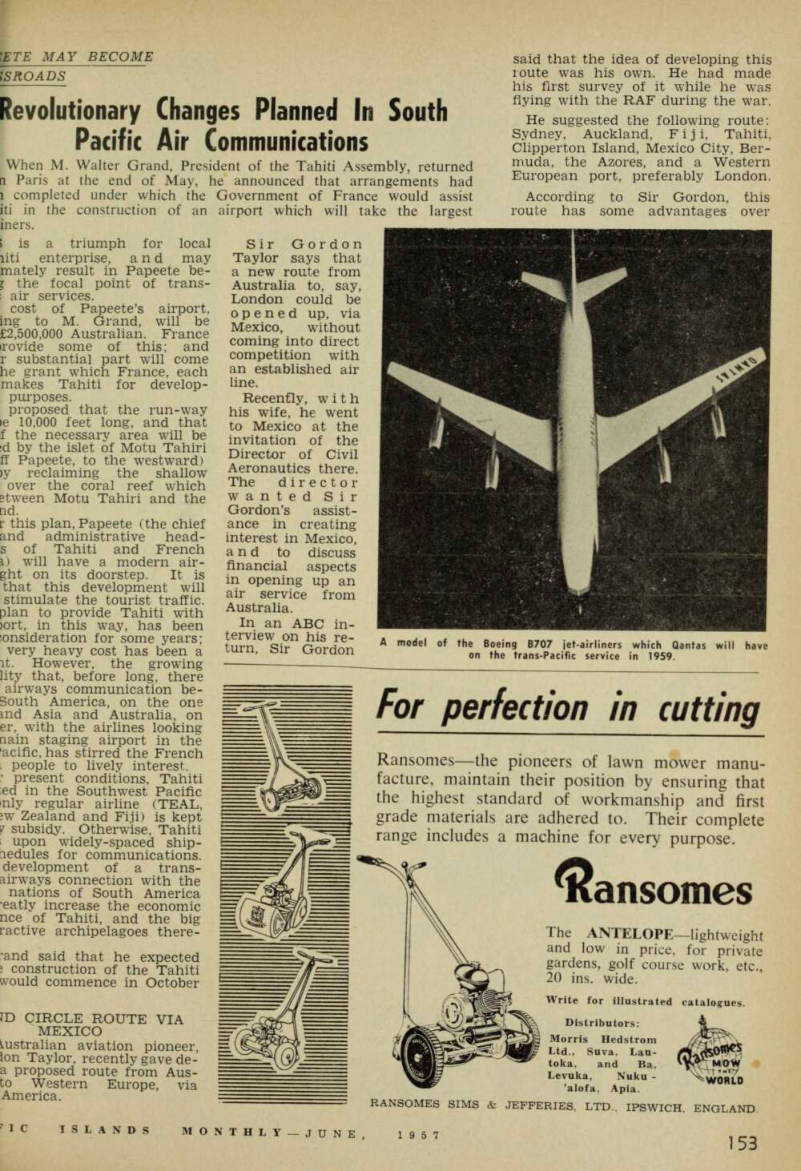
A model of the Boeing 8707 jet-airliners which Qantas will have on the trans-Pacific service in 1959.
existing routes. That from Aui to London via South-East As; the Mediterranean was subjj uncertain political conditions, route via North America in the domestic air lines.
“This line (via Mexico) is pj ally a great circle, and goes from Sydney to London withoi domestic air line situation beii volved, and through latitude; consistently good winds and weather,” he said.
Sir Gordon said his chief ii in the route was to give a I.
Australia and other parts » world on its possibility—he w interested in running air-lines self.
South and Central America fascinating areas and had possibilities for Austr a 1 ii thought; but there was little ii at present because there w trade or communications.
Santiago-Papeete Ro<
CHILEAN engineers have i
work on a 10,000-ft runv Easter Island which will vital stepping-stone on the prc Santiago-Australia route.
LAN (Line Air National), by the Chilean Governmen been planning for some ye operate this service. The fao there will be an internationj port at Papeete by 1960, brin connection much closer.
Chile, in the initial stages at would prefer to run a shuttle from Santiago to Papeete transfer passengers to othr
Sir Gordon Taylor.
The Chilean Air Attache in •alia, Colonel Robert Parrague, ;old PIM that he believes that icration is better than com on when there might not be jh passengers offering, shuttle service from Santiago ipeete, with jets (LAN plan to lets eventually) would enable aircraft to do the return trip e day. This would represent saving in costs, as all main ce would be done at the home
)Uth Pacific-Papeete
MAN Empire Airways flying >at service from Laucala Bay. iva, to Papeete, via Apia and iki, is likely to end in 1959, f TEAL have plans for the t of this “prestige” route they not announced them. It may it TEAL plans to operate the ivith land planes, when Papeete t is finished. the flying-boat service does i 1959, and it is believed that olent at present in use will mtlived its usefulness by then, could be a break of a year st before Tahiti gets another twice —when the landing field structed. :ourse, TEAL could do what een done in the past, and r a flying-boat from Ansett.
J the Papeete airport in built, is certain to have competi n the South Pacific-Papeete from the enterprising French , Transports Aeriens Inter mtaux. TAI has already run from Noumea to Bora Bora is an intermittant service to Island. No doubt the NZ iment took all this into con ion when it recently allowed 0 extend its Paris-Noumea service to Auckland.
'Iow Via Brisbane
sports Aeriens Interconti x has received one concession the Australian Government, pes to receive another by the next year. ight out of Paris on July 1 ;kland will now call at Bris )efore leaving for Noumea, isly the last stop before 1 was Darwin. The aircraft dw operate from Paris to id via Athens, Karachi, Darwin, Brisbane and i. le end of this year TAI hopes ; permission to call at Syd- Jtead of Brisbane. Should ve be successful, the question ying passengers across the l in competition with TEAL d to arise, even though TAI operating via Noumea.
Jet Age In Pacific
imerican Airways will operate 707 jets in the Pacific at d of next year—only 18 away. is plans to operate 8707 120er jets on its North Ameri vices by -the middle of 1959,
via Nadi and Honolulu to San Francisco.
Qantas may then be able to fly direct to the UK, via the Pacific. It has applied for a licence to fly across the United States—but this request has had a stormy reception in the USA from some quarters.
It has been stated that this would not be in the best interests of American domestic airlines, and that Australia has no reciprocal privileges to offer.
Permission has recently been given KLM and BOAC to fly across the United States.
Introduction of the jets will cut flying time between Sydney and the west coast of America by about 50 per cent, from about 30 hours to between 16 and 17 hours.
Canadian Pacific Air Lines will introduce 100-passenger Britannias (“Whispering Giants”) in April, 1958. Flying time from Sydney to Honolulu will be 14 hours, and to Vancouver, 22 hours.
CPA has six Britannias on order, with the option on another five. It also has eight Super DC6B’s on order.
Nadi airport will be ready for jets according to the latest information available in Sydney. All runways from which jets operate will have to be strengthened and widened, but not necessarily lengthened.
Wide runways which are easy to Keep clean are necessary because jet aircraft act like vacuum cleaners and will quickly suck up dust and debris Other airport modifications are also necessary for jets. * Mary Guise, the first Port Moresby girl to complete her training at the Colonial War Memorial Hospital,
Suva, Fiji, returned to Port Moresby in May and will join the staff of the native hospital there. There are eight other Papua and New Guinea girls training in Suva.