No Pots Now But Condensed Milk
pp. 111-113 · Read in the full issue
’Hen And
W Story
E village of Busama is situated an the upper part of the west coast of the Huon Gulf, on the th-eastern cost of New lea.
ie Huon Gulf some of the is t tropical Jry in the 3. On the i side is the i Peninsula, ed by the wli n -
son Mountains, an extension of the great Finisterre block, which rises to a height of over 10,000 feet within eleven miles of the sea.
To the south of the range, run ning Inland from the base of the Gulf, Is a broad, rift valley, which forms the natural gateway to the interior. The Markham River winds through the south-eastern end to empty itself into the Gulf, but be yond the headwaters, about 100 miles inland, is the Ramu River flowing in the opposite direction towards the Sepik swamps of v/estern New Guinea.
Traders were the first Europeans to visit the area, probably between 1895 and 1900; and the Busama people’s old way of life has been interrupted by many masters since then.
C<pntact with German Adminis tration officers and with labour re
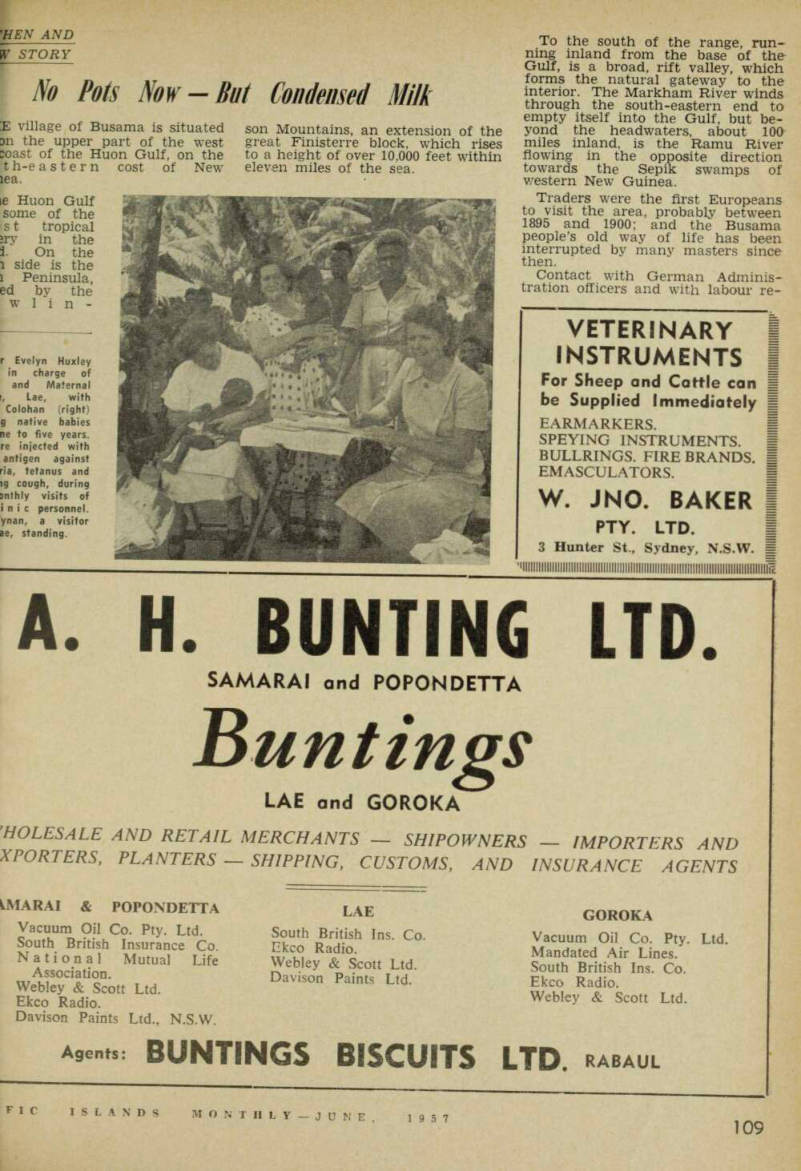
r Evelyn Huxley in charge of and Maternal e, Lae, with Colohan (right) g native babies ne to five years, re injected with antigen against ria, tetanus and ng cough, during [?]nthly visits of inic personnel, ynan, a visitor ae, standing.
waiters began soon after the Mteslonaries ra foUowed in, 1906 setting up church schools in tne Busama’s population, before the Japanese invasion in 1942 600. This was large for a New Guinea village. The houses were all stout structures, and the people had many European possessions—tools, bicycles, sewing machines and la A P few days after the Japanese h nded a force at Salamaua, in 1942, a small detachment of Japanese ■ \ilitary police, including an mter reter who spoke Pidgin-English, went around the countryside with orders that the village officials should attend at the headquarters to receive instructions.
The Busama people had another Master.
The Japanese bought food and pigs from the villagers, and sought the services of the men for unload ing ships, promising payment in in vasion money which could be spent in shops to be set up when the war was over. Lack of medical at tention was the biggest disability suffered by them during the period.
By 1943, when the Allied forces - ere meeting with success, air raids increased in intensity and bombs were dropped on the villages.
Busama, along with several others, was obliterated and many persons killed. Later, the Busama village site served as a convalescent camp,
but by then nothing of the village remained. Every building had been destroyed, the villagers were living in crude huts in a bush clearing nearly half a mile from the sea, and most of their belongings and all domestic animals were gone.
From then until the end of the war, little time was left to the villagers for their own concerns. A
large number were conscript© act as carriers in the Mark: Ramu campaign and later for in Lae and elsewhere, and in the village were ordered to s: a quota of 1,600 sheets of t.: weekly for Lae, However, step by step rehali tion took place. By 1948, the ; lation has increased to 617
e had 85 new dwellings; 27 canoes and 17 large ones, and ;s. day, with a population of over he village is clean and neat, lildren healthy, and the village erous—but the old arts are y no longer make their pots lets. They buy them. The men prefer to work as ores on the ships at Lae. The en are cared for by the Gov nt. Once a month they are I by Infant and Maternal re Sisters who examine and inis t e r injections against leria, tetanus, and whooping etc. The under-nourished iven cod liver oil and con l milk; and the motherless ven Sunshine milk. And they ntent. villagers are an example of i native group with simple and simple material apparatus apted itself to the values and lues of industrial civilisation.
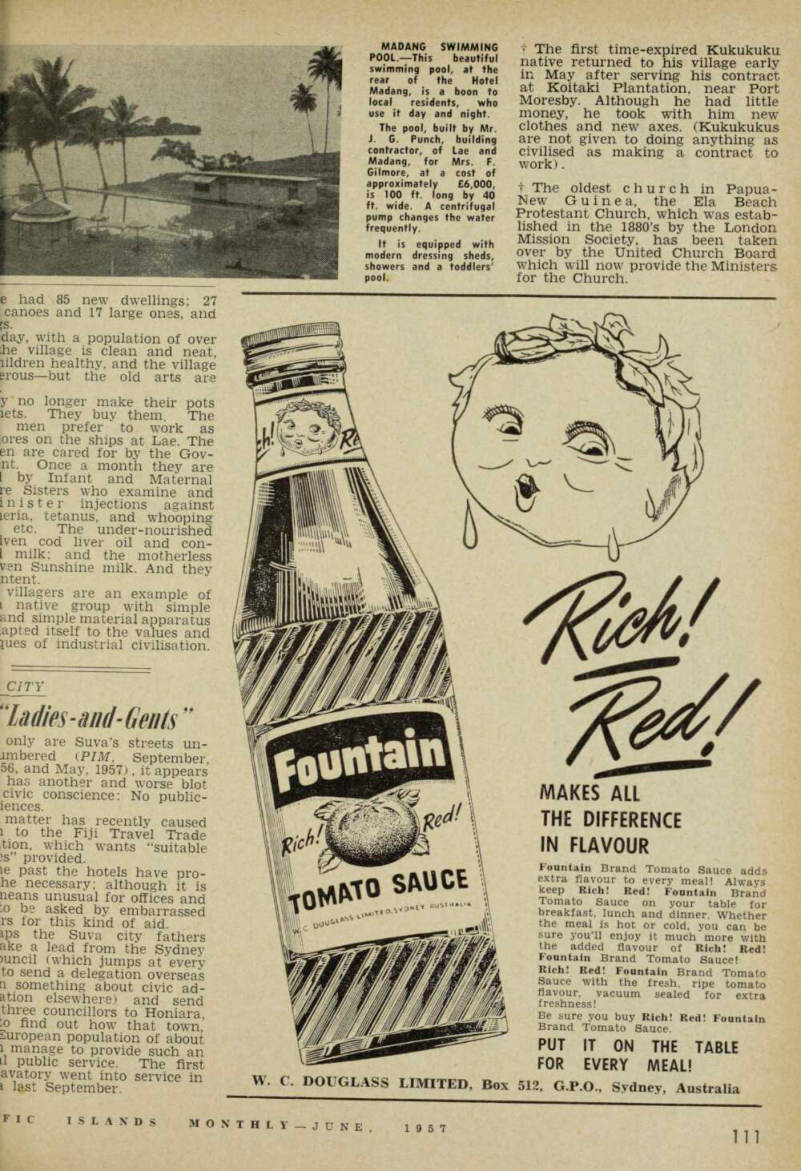
Madang Swimming
POOL.—This beautiful swimming pool, at the rear of the Hotel Madang, is a boon to local residents, who use it day and night.
The pool, built by Mr.
J. G. Punch, building contractor, of Lae and Madang, for Mrs. F.
Gilmore, at a cost of approximately £6,000, is 100 ft. long by 40 ft. wide. A centrifugal pump changes the water frequently.
It is equipped with modern dressing sheds, showers and a toddlers' pool.