gen?al° Medical
pp. 85-86 · Read in the full issue
tragedy that ght have been averted
Little Flares Of Death
By Alice Allen Innes
was some time in 1928 that I lad good reason to regret I vas not able to read Morse !e, as I may have been able to ; a number of lives. fter dinner one night I took five men guests out on to the mdah facing Salamaua Bay. gramophone was playing softly ve sipped our coffee and chatted roldfields news. It was a still,
gen?al° Medical
whn shnfiilw £
th?r eu??t biff Whn insert
S fn B ? Wfli te d SL? o nSwf ? : f *. • “H 16 1 lr ] and idly followed °L? 1 £ ri ? llg > h .ts on *• a tnougnt shattered Sl^ 0 t !]iVn j. !“,• snarply to my to someone
niS? iv/r Dot ’
dash can t anyone read Morse !7*v-iof Trnil 4. 4.V, ’ lau S hed !ny •and. Fancy a woman who nat^e? O n S^ o Ln^inJr fe th^» n fr»
STfllres” 1 TrS tr,
g flares. Trying to kid she s
“Master, master, you come quick along house sick. All boy he like die long salt water. Master, too, him close up die along salt water.”
Hastily we all fled to the admin istrative section of the isthmus. As far as I remember now, there was an Assistant District Officer from Madang, almost drowned. He had been injured by a floating spear, and his native police boy had swum with him from the reef to the beach a good mile or more. Those little flickers of light that stabbed the dark night had indeed been calls for help, sent out by a desperate little band of twenty-six souls from the Chinese-owned launch that now lay in the depths of Samoa Bay.
The boat had been chartered by the Government to bring the Assist ant District Officer and recruited mountain natives, from the back of Madang, to the goldfields, where the natives were to work as carriers on the new road. They had left Madang and struck days of bad weather almost at once. Although the District Officer had been very ill, he was trying to push through to Salamaua, for he knew that native carriers were badly needed to carry medical supplies to the many dysentery cases then on the gold fields track and in road camps.
As the little boat came to the reef entrance at Salamaua, she was blown off her course, the engines having failed in the narrow entrance.
She struck the reef edge, and was nearly ripped in two.
In panic, the mountain natives threw themselves into the boiling surf, in the deceiving light think
a tourist, I suppose.”
“Of course, they’re fishing flares”, said the young administrative cadet.
I felt squashed, but far from satisfied. We sat on from 8 p.m. until after 11 p.m., and for an hour those lights tantalised me so that I couldn’t take my eyes off them.
Somehow I seemed to sense they were calling for help. I made k „• . , L<Bt s ta . ke , a canoe or dinghy fu d g °f out J?,. th ® reef to watch the natives fishing. nobody wanted to make the effort, though the wharf was within a few yards of where we sat.
Again I persisted: “ If those lights are fishing flares we should be seeing sparks drop from bundles of burning coconut leaves. Look they’ve gone out — just this minute”.
“Woman!” said Himself. “Will you stop mooning about the lights and us some supper?” (We never kept . s^a ® on night).
I gave in and got the required re fieshments. Our little party was jUSt breaking up for the night when ? n . atll r« boy came running breath lessly to the door, calling:
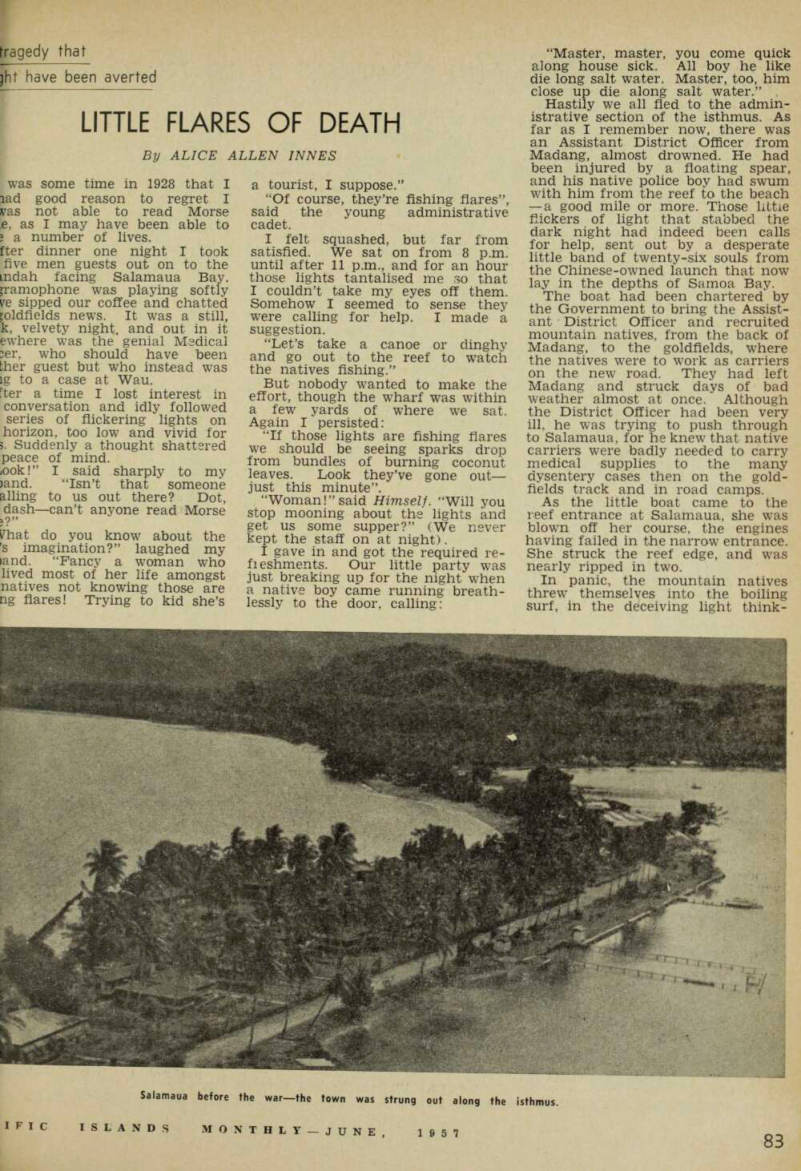
Salamaua before the war—the town was strung out along the isthmus.
r g ihe coast was much nearer than <■ Actually was. “The Masta, with -eat presence of mind, managed . rescue his “shoot-lamp (torch) nd so signalled the shore two miles away for help. But, of course, the call was in vain.
Then Kong, the skipper, had quickly made for the little dinghy "led to the stern of the launch, and was able to get clear of the wreckage and make for the beach.
The officer lost consciousness when he was injured in the water, but some of the police boys were fine swimmers and rescued him, together with many of the inland natives who could not swim.
Immediately the news reached the shore, our local district officer and boat’s crew went to the rescue, succeeding in bringing safely to land a number of those still in the water, but despite their heroic efforts, eleven were drowned.
This tragedy was responsible for a dramatic incident that happened after the whole story leaked out.
There were a number of miners on the beach at the time of the tragedy.
These men, angry at finding that the Chinese captain had made no effort to rescue his companions be fore making off with the only dinghy, and perhaps even more angry that the wreck had not been reported immediately he reached the shore so that help could have gone to the rescue, decided to take the law ito their own hands. It was found that Captain Kong had gone straight to his kinsfolk, and had been either too hysterical or too terrified to report that he had left a wrecked launch.
Chris Hollaris led the miners up to the Chinese store, and there they meted out to the terrified China man the punishment they con sidered he deserved for his in humane conduct.
Kong took the punishment badly, screaming out curses and imploring his ancestors to come to his aid; but he had to take his medicine.
When the miners, considering he had had sufficient, desisted, Kong turned to Chris, and, in a calm, passionless voice ,told him he would be dead in two days. Naturally, the tough bunch of miners did not lose any sleep over that statement, but, whether the Chinaman actually did “make medicine” against him or whether it was just coincidence, poor Chris Hollaris did die two days later —from blackwater fever.